
In a world increasingly driven by data and numbers, the ability to understand and calculate percentages isn’t just a mathematical convenience—it’s a critical life skill, especially within the realm of personal and business finance. From evaluating investment returns and understanding loan interest rates to calculating discounts, taxes, or profit margins, percentages are the universal language of financial comparison and growth. For anyone aiming to master their money, make informed decisions, or grow their wealth, grasping the mechanics of “how to find a percent” is not merely beneficial; it’s absolutely essential.
This article delves into the core concepts, practical methods, and real-world applications of percentages, all viewed through a financial lens. We will demystify these powerful figures, empowering you to confidently navigate your financial landscape, whether you’re a budding investor, a shrewd shopper, or a business owner optimizing revenue.
The Core Concept of Percentages in Finance
Before we dive into calculations, it’s crucial to establish a solid understanding of what a percentage truly represents and why its role in finance is so pivotal. Percentages provide a standardized way to express proportions, changes, and relationships, making complex financial data more accessible and comparable.
What Exactly is a Percent?
At its heart, “percent” means “per hundred” or “out of one hundred.” The symbol “%” is a shorthand for expressing a fraction where the denominator is 100. So, 50% literally means 50 out of 100, or the fraction 50/100, which simplifies to 1/2 or the decimal 0.50. This standardized “out of 100” framework is incredibly powerful because it allows for direct comparison between different quantities, even if their original total amounts (their “bases”) are wildly different.
For instance, if one investment returned $500 on a $10,000 initial capital, and another returned $50 on a $500 initial capital, simply comparing the dollar amounts ($500 vs. $50) would be misleading. By converting them to percentages (5% vs. 10%), we immediately see that the second investment actually yielded a proportionally higher return. This ability to normalize comparisons is why percentages are ubiquitous in financial reporting, analysis, and decision-making.
Why Percentages Matter for Your Money
The impact of percentages permeates every aspect of financial life. They are the bedrock upon which many financial calculations and insights are built:
- Understanding Costs and Savings: From sales discounts (e.g., 20% off) to interest rates on credit cards or mortgages (e.g., 6% APR), percentages dictate how much you pay or save.
- Evaluating Investments: Investment returns (ROI), dividend yields, and portfolio allocations are almost exclusively expressed in percentages, allowing you to gauge performance and risk.
- Budgeting and Financial Planning: Allocating a percentage of your income to savings, housing, or discretionary spending is a common and effective budgeting strategy.
- Taxes and Contributions: Income tax brackets, sales tax, and retirement contributions are all percentage-based, directly affecting your disposable income and future wealth.
- Business Metrics: Profit margins, sales growth, market share, and operational efficiency are all measured and tracked using percentages, crucial for business health and strategy.
Without a firm grasp of how to find and interpret percentages, individuals and businesses are left to make blind financial decisions, often missing opportunities or falling prey to unfavorable terms.
Essential Methods for Calculating Percentages
While the core concept is straightforward, there are several distinct ways percentages are calculated and applied depending on the financial question you’re trying to answer. Mastering these fundamental methods will equip you with the tools to tackle almost any percentage-related financial scenario.
Finding a Percentage of a Number (Discounts, Taxes, Commissions)
This is perhaps the most common percentage calculation. It involves determining a part of a whole based on a given percentage.
Formula: Part = Whole × (Percentage / 100) or Part = Whole × Decimal Equivalent
Example: You want to buy a new appliance priced at $800, and there’s a 25% discount.
- Convert 25% to a decimal: 25 / 100 = 0.25
- Calculate the discount amount: $800 × 0.25 = $200
- The final price would be $800 – $200 = $600.
This method is critical for calculating sales tax, tips, commissions for sales agents, or the interest portion of a loan payment for a specific period.
Calculating Percentage Increase or Decrease (Investment Growth, Inflation)
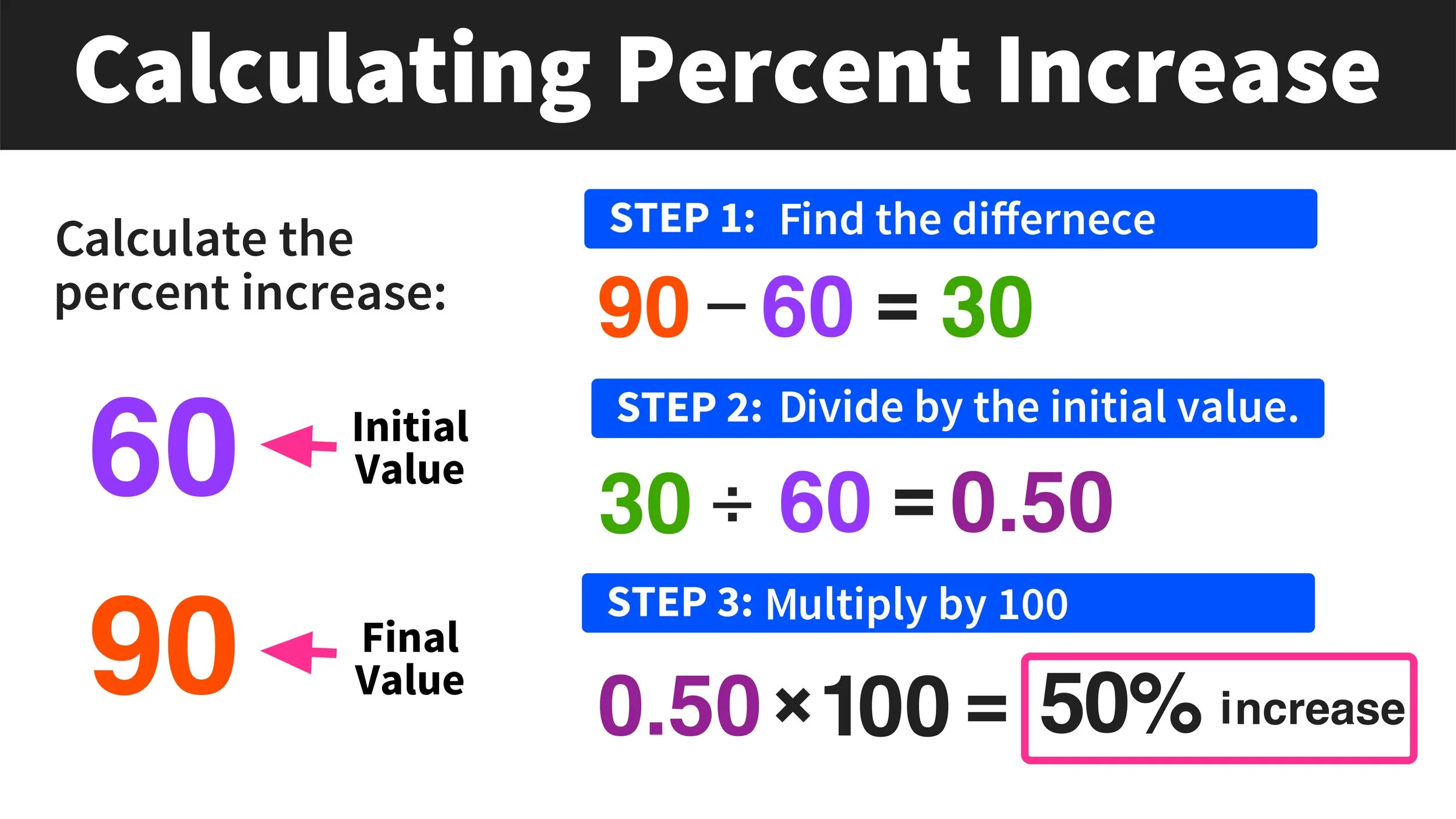
When you need to understand how much a value has grown or shrunk relative to its original amount, percentage increase or decrease is the metric. This is vital for assessing investment performance, inflation rates, or changes in expenses.
Formula: Percentage Change = ((New Value - Original Value) / Original Value) × 100
Example 1 (Increase): Your investment portfolio grew from $10,000 to $12,500.
- Change = $12,500 – $10,000 = $2,500
- Percentage Increase = ($2,500 / $10,000) × 100 = 0.25 × 100 = 25%
Example 2 (Decrease): The value of a stock you own dropped from $50 per share to $40 per share.
- Change = $40 – $50 = -$10 (a decrease)
- Percentage Decrease = (-$10 / $50) × 100 = -0.20 × 100 = -20% (indicating a 20% drop)
This calculation is fundamental for tracking personal net worth fluctuations, evaluating the effectiveness of a marketing campaign by sales growth, or understanding the real erosion of purchasing power due to inflation.
Determining What Percentage One Number is of Another (Budgeting, Debt Ratios)
Often, you’ll need to express one quantity as a proportion of another, as a percentage. This is invaluable for budgeting (what percentage of your income goes to housing?), analyzing debt (what percentage is your debt-to-income ratio?), or understanding portfolio allocation (what percentage of your portfolio is in stocks vs. bonds?).
Formula: Percentage = (Part / Whole) × 100
Example: Your monthly income is $4,000, and your rent is $1,200.
- Percentage of income spent on rent = ($1,200 / $4,000) × 100 = 0.30 × 100 = 30%
This calculation helps you benchmark your spending against financial guidelines (e.g., the 50/30/20 rule for budgeting) or assess financial health by comparing various financial metrics against total assets or income.
The Power of Percentage Change Over Time (CAGR, ROI)
For long-term financial planning and investment analysis, understanding average annual growth rates or overall returns is crucial. Concepts like Compound Annual Growth Rate (CAGR) and Return on Investment (ROI) rely heavily on percentage calculations extended over multiple periods.
-
Return on Investment (ROI): Measures the profitability of an investment relative to its cost.
ROI = ((Current Value of Investment - Cost of Investment) / Cost of Investment) × 100
Example: You invest $1,000 and it grows to $1,300. ROI = (($1300 – $1000) / $1000) * 100 = 30%. -
Compound Annual Growth Rate (CAGR): Provides a smoothed annual rate of return over a specified period, assuming profits are reinvested. This is especially useful for comparing different investments over various time horizons.
CAGR = (((Ending Value / Beginning Value)^(1 / Number of Years)) - 1) × 100
Example: An investment grew from $10,000 to $18,000 over 5 years.
CAGR = (((18000 / 10000)^(1/5)) - 1) × 100 = ((1.8^0.2) - 1) × 100 ≈ (1.1247 - 1) × 100 ≈ 12.47%
This means the investment grew by an average of 12.47% annually over those 5 years, even if the actual year-to-year returns fluctuated.
These advanced percentage applications provide deeper insights into the performance and potential of financial assets, essential for strategic financial planning.
Real-World Financial Applications of Percentages
The theoretical understanding of percentages comes alive when applied to everyday financial situations. Their versatility makes them indispensable across all facets of money management.
Personal Finance: Budgeting, Savings, and Loans
- Budgeting: Many budgeting frameworks advocate allocating specific percentages of your net income. For example, the 50/30/20 rule suggests 50% for needs, 30% for wants, and 20% for savings and debt repayment. Calculating these percentages correctly helps maintain financial discipline.
- Savings Goals: If you aim to save $10,000 and can put away $500 per month, you can easily determine what percentage of your goal you’ve achieved or what percentage of your income that $500 represents.
- Loan Interest: Understanding the Annual Percentage Rate (APR) on loans or credit cards is crucial. A small percentage difference can mean hundreds or thousands of dollars over the loan’s lifetime. Calculating the interest portion of a payment involves finding a percentage of the principal balance.
Investing: Understanding Returns, Risk, and Diversification
- Return on Investment (ROI) and Annualized Returns: As discussed, these percentages are paramount for assessing how well your investments are performing.
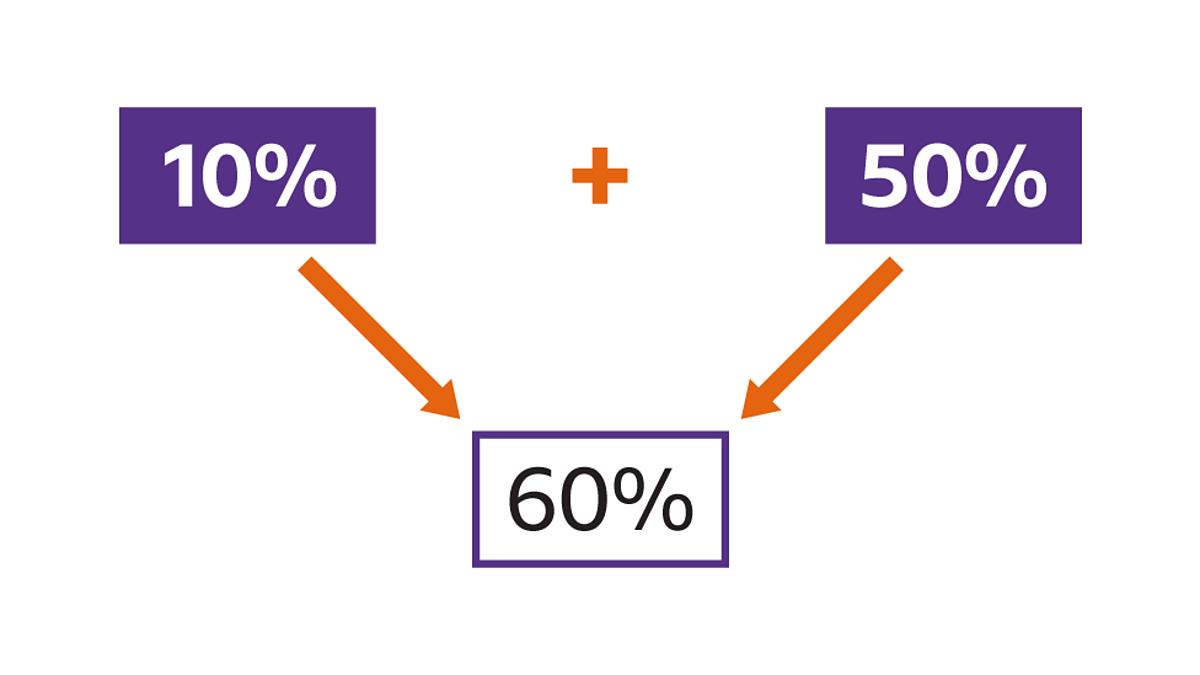
- Portfolio Allocation: Financial advisors often recommend diversifying your investments by allocating specific percentages to different asset classes (e.g., 60% stocks, 30% bonds, 10% real estate) based on your risk tolerance and financial goals.
- Dividend Yield: For income-generating investments like stocks or mutual funds, the dividend yield (annual dividends per share as a percentage of the share price) helps investors compare income potential.
Business and Online Income: Profit Margins, Sales Growth, and Commissions
- Profit Margins: Businesses live and die by their profit margins. Gross profit margin (gross profit as a percentage of revenue) and net profit margin (net income as a percentage of revenue) are critical indicators of operational efficiency and profitability.
- Sales Growth: Tracking sales growth as a percentage year-over-year or quarter-over-quarter provides essential insights into market performance and the effectiveness of business strategies.
- Commissions: Many sales roles, freelancers, or online entrepreneurs earn income based on a percentage of sales or services rendered. Accurately calculating these percentages ensures correct compensation.
- Market Share: Businesses use percentages to understand their share of the total market, a key metric for competitive analysis and strategic planning.
Leveraging Tools and Technology for Percentage Calculations
While manual calculation is fundamental, modern financial life often benefits from the efficiency and accuracy of digital tools. Integrating technology can streamline complex percentage calculations and minimize errors.
Digital Calculators and Spreadsheet Functions
- Basic Calculators: Any standard calculator can perform percentage calculations. Simply enter the number, then the multiplication or division operator, and then the percentage. For instance,
800 * 25%will yield 200. - Spreadsheets (Excel, Google Sheets): These are powerful tools for financial analysis.
- To find a percentage of a number:
=A1*B1%(where A1 is the whole number and B1 contains the percentage, e.g., 25). - To calculate percentage change:
=(B1-A1)/A1(where A1 is original, B1 is new). Remember to format the cell as a percentage. - For more complex scenarios like CAGR, spreadsheets have built-in functions like
RATEor can be calculated step-by-step using the formula.
- To find a percentage of a number:
Learning basic spreadsheet functions for percentages is an invaluable skill for anyone managing budgets, tracking investments, or running a business.
Online Financial Calculators and Apps
The internet abounds with specialized calculators designed for specific financial percentage-based scenarios:
- Loan Calculators: Many websites offer mortgage, auto loan, or personal loan calculators that factor in interest rates (percentages) to determine monthly payments, total interest paid, and amortization schedules.
- Investment Return Calculators: These tools can project future investment values based on expected annual percentage returns and regular contributions.
- Budgeting Apps: Modern budgeting apps often provide visual breakdowns of spending as percentages of income, making it easier to track and adjust financial habits.
- Tax Calculators: Online tools help estimate tax liabilities by applying various percentage-based tax rates and deductions.
These resources simplify complex calculations, allowing you to focus on interpreting the results and making informed financial decisions, rather than getting bogged down in arithmetic.
Common Pitfalls and How to Avoid Them
Even with a solid understanding, misinterpreting or miscalculating percentages is a common source of financial error. Awareness of these pitfalls can save you significant trouble.
Understanding the “Base”
The most frequent mistake is confusion over what the “whole” or “base” number is for a percentage calculation. A 10% increase from X is different from a 10% increase from Y.
Example: A stock drops 20% from $100 to $80. Then it increases by 20%.
- If you mistakenly calculate the increase as 20% of the original $100, you’d think it goes back to $100.
- However, the 20% increase is on the new base of $80. So, 20% of $80 is $16.
- The stock would rise to $80 + $16 = $96, not $100.
Always double-check what value the percentage is being applied to. This is crucial for understanding cumulative changes in investments or pricing.

The Difference Between Percentage Point and Percentage Change
These two terms are often confused but have distinct meanings with significant financial implications.
- Percentage Point Change: Refers to the absolute difference between two percentage values.
Example: If an interest rate increases from 5% to 7%, that’s a 2 percentage point increase. - Percentage Change: Refers to the relative change between two values, expressed as a percentage of the original value.
Example: If an interest rate increases from 5% to 7%, the percentage change is ((7-5)/5) * 100 = 40%. The rate itself increased by 40%.
Understanding this distinction is critical in financial reporting, especially when discussing shifts in interest rates, market share, or policy changes. A “2 percentage point” increase sounds less dramatic than a “40% increase,” but both accurately describe the same scenario, just from different perspectives.
By being meticulous about the base number and distinguishing between percentage points and percentage change, you can avoid common errors that lead to flawed financial analysis and poor decision-making.
In conclusion, the ability to “find a percent” is far more than a simple arithmetic exercise; it is a gateway to financial empowerment. From personal budgeting and investment analysis to business strategy and economic understanding, percentages provide the indispensable framework for measuring, comparing, and projecting financial outcomes. By mastering these fundamental calculations and understanding their diverse applications, you equip yourself with an essential skill for navigating the complexities of the financial world with confidence and precision.
aViewFromTheCave is a participant in the Amazon Services LLC Associates Program, an affiliate advertising program designed to provide a means for sites to earn advertising fees by advertising and linking to Amazon.com. Amazon, the Amazon logo, AmazonSupply, and the AmazonSupply logo are trademarks of Amazon.com, Inc. or its affiliates. As an Amazon Associate we earn affiliate commissions from qualifying purchases.