
In the vast landscape of personal finance, investing, and business operations, the ability to quantify change is paramount. Whether you’re tracking the growth of your investment portfolio, analyzing a company’s revenue surge, or simply monitoring the inflation of your monthly expenses, understanding how much something has grown—and more importantly, by what percentage—is a fundamental skill. Simple numerical differences only tell part of the story; percentage increase provides context, allowing for meaningful comparisons and informed decision-making.
This article delves deep into the essential mathematical concept of percentage increase, positioning it squarely within the domain of financial literacy. We’ll break down the formula, walk through practical examples, and explore its indispensable applications across various facets of the money world, from personal budgeting to sophisticated investment analysis. By the end, you’ll not only know how to calculate percentage increase but also appreciate its power as a financial diagnostic tool.
The Indispensable Role of Percentage Increase in Financial Understanding
Numbers alone can be misleading. A $100 increase might seem substantial for a $50 item but insignificant for a $10,000 asset. Percentage increase, however, normalizes this change, presenting it as a proportion of the original value. This perspective is critical for anyone managing finances, making it a cornerstone of sound financial judgment.
Beyond Simple Growth: Why Percentages Matter
Imagine your salary increased by $500 last year. Is that good? It depends. If your previous salary was $2,000, that’s a substantial 25% raise. If it was $50,000, it’s a more modest 1% raise. The absolute dollar amount offers a limited view; the percentage increase reveals the true magnitude and impact relative to the starting point. This relative measure allows for objective comparisons across different time periods, different assets, or even different companies, regardless of their absolute sizes. It transforms raw data into actionable insights, enabling you to gauge performance, assess value, and project future trends with greater accuracy.
Real-World Applications Across Personal and Business Finance
From the micro-level of individual spending habits to the macro-level of global economic indicators, percentage increase is omnipresent. In personal finance, it helps you track investment returns, evaluate savings growth, and understand the real impact of inflation on your purchasing power. For businesses, it’s a vital metric for assessing revenue growth, profit margin expansion, market share shifts, and operational efficiency improvements. Investors rely on it to compare the performance of different stocks, bonds, or mutual funds over various periods, allowing them to allocate capital strategically. Without this crucial metric, financial analysis would be largely superficial and prone to misinterpretation.
Deconstructing the Formula: Your Guide to Calculation
At its core, calculating percentage increase is a straightforward process involving just two numbers: an original value and a new value. Mastering this simple formula unlocks a powerful analytical capability.
The Core Equation: Step-by-Step Breakdown
The formula for percentage increase is as follows:
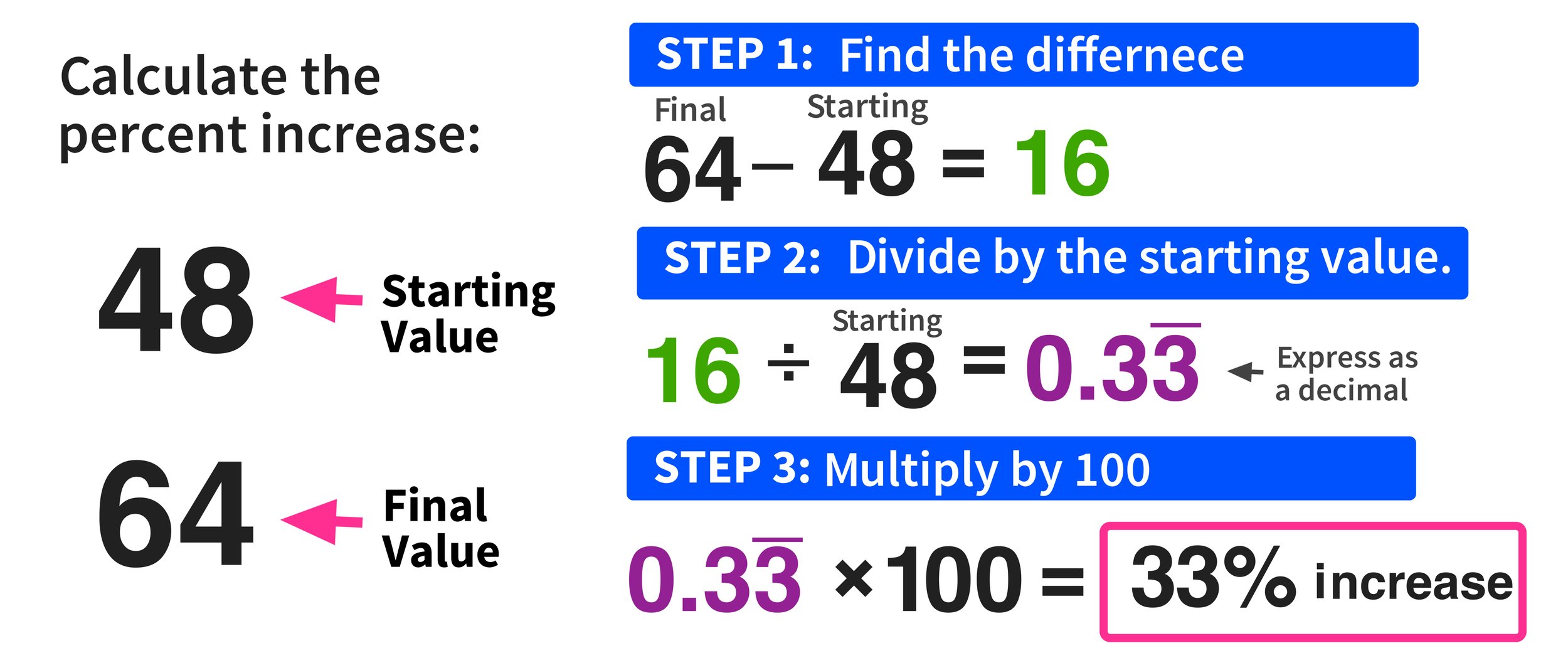
Percentage Increase = ((New Value – Original Value) / Original Value) * 100
Let’s break down the steps:
- Find the Difference: Subtract the Original Value from the New Value. This gives you the absolute increase.
- Example: New Value = 120, Original Value = 100. Difference = 120 – 100 = 20.
- Divide by the Original Value: Take the difference you calculated in step 1 and divide it by the Original Value. This converts the absolute increase into a decimal representation of the growth relative to the start.
- Example: 20 / 100 = 0.20.
- Multiply by 100: To express this decimal as a percentage, multiply the result from step 2 by 100.
- *Example: 0.20 * 100 = 20%.*
Thus, an increase from 100 to 120 represents a 20% increase.
Practical Example: Illustrating Investment Growth
Let’s apply this to a common financial scenario: tracking an investment.
Suppose you invested $5,000 in a particular stock at the beginning of the year. By the end of the year, its value has grown to $5,750. What is the percentage increase in your investment?
- Original Value: $5,000
- New Value: $5,750
Let’s plug these into the formula:
- Step 1: Find the Difference
- $5,750 – $5,000 = $750 (This is the absolute gain on your investment)
- Step 2: Divide by the Original Value
- $750 / $5,000 = 0.15
- Step 3: Multiply by 100
- 0.15 * 100 = 15%
Your investment saw a 15% increase over the year. This 15% figure is far more informative than simply knowing you gained $750, especially if you’re comparing it to other investment opportunities that might have different initial capital requirements.
Common Pitfalls to Avoid in Calculation
While the formula is simple, a few common errors can lead to incorrect results:

- Mixing Up Original and New Values: Always ensure you subtract the original value from the new value, and then divide by the original value. Reversing these will either give you a negative percentage (if the new value is smaller) or an incorrect positive one.
- Forgetting to Multiply by 100: The result of the division is a decimal. To express it as a percentage, the final multiplication by 100 is crucial.
- Dealing with Zero or Negative Original Values: The formula is designed for positive original values. If your original value is zero, percentage increase is undefined. If it’s negative, the interpretation becomes more complex and often requires a different analytical approach. For financial contexts, original values are typically positive.
Applying Percentage Increase in Personal Finance
For individuals, understanding percentage increase is a superpower for managing and growing wealth. It clarifies how quickly your money is working for you, or against you.
Tracking Your Investments: From Stocks to Retirement Accounts
One of the most frequent uses of percentage increase in personal finance is assessing investment performance. Whether it’s individual stocks, mutual funds, exchange-traded funds (ETFs), or your 401(k) and IRA accounts, tracking their growth in percentage terms provides a standardized metric. If your stock portfolio grew by 12% this year, you can easily compare that to the S&P 500’s performance or to a bond fund’s return to gauge how well your investments are doing relative to benchmarks and alternatives. This helps in making informed decisions about rebalancing your portfolio or switching investment vehicles.
Analyzing Income and Expense Trends
Percentage increase also serves as an excellent tool for budgeting and financial planning. By calculating the percentage increase in your income year-over-year, you can understand your financial progress. Similarly, tracking the percentage increase in specific expense categories (e.g., groceries, utilities, transportation) can highlight areas where spending is rising disproportionately. If your food budget increased by 15% last month while your income only grew by 3%, it’s a clear signal to investigate and adjust spending habits. This granular analysis empowers you to identify inflationary pressures on your personal finances and take proactive measures.
Evaluating Debt Reduction Progress
For those working to eliminate debt, percentage increase (or decrease) offers a motivating way to visualize progress. While the absolute dollar amount of debt paid down is satisfying, seeing a 10% or 20% reduction in your outstanding loan balance can be a significant psychological boost. It helps you understand the momentum of your debt repayment strategy and allows you to compare the efficiency of different repayment approaches, such as the snowball or avalanche methods, over time.
Percentage Increase in Business and Investment Analysis
Beyond personal finance, percentage increase is an indispensable metric in the world of business and professional investing, guiding strategic decisions and evaluating corporate health.
Measuring Revenue and Profit Growth
For businesses, the growth in revenue and profit is a primary indicator of success and sustainability. Investors scrutinize these figures closely, often looking for consistent, high percentage increases quarter-over-quarter or year-over-year. A company reporting a 20% increase in revenue signifies expanding market reach or product demand, while a 15% increase in net profit suggests improved operational efficiency or pricing power. These percentage changes are often more impactful than raw dollar figures, especially when comparing companies of different sizes within an industry. Analysts use these growth rates to project future earnings, value companies, and make buy/sell recommendations.
Understanding Market Share Dynamics
In competitive industries, companies constantly vie for a larger slice of the market. Percentage increase helps in quantifying shifts in market share. If Company A’s market share increased from 10% to 12%, that’s a 20% percentage increase in its market share (not an increase of 2 percentage points, which is a different concept). Understanding these proportional shifts is crucial for assessing competitive advantages, identifying emerging threats, and formulating growth strategies. It speaks to a company’s ability to win over customers and expand its presence.
Assessing Portfolio Performance and Asset Appreciation
Professional investors and fund managers constantly evaluate the percentage appreciation of their portfolios and individual assets. This could be the year-to-date return of a hedge fund, the historical growth rate of a real estate investment trust (REIT), or the compound annual growth rate (CAGR) of a private equity fund. Percentage increase provides the common denominator for comparing diverse asset classes and investment strategies. It allows investors to set realistic expectations, measure risk-adjusted returns, and ultimately determine if their capital is being deployed effectively to generate wealth.
Leveraging Financial Tools for Seamless Analysis
While the manual calculation of percentage increase is straightforward, modern financial tools can automate this process, allowing for quicker analysis and visualization of trends.
Spreadsheets (Excel/Google Sheets) for Automated Calculations
Spreadsheet software like Microsoft Excel or Google Sheets are indispensable for financial analysis. You can easily set up formulas to calculate percentage increase for large datasets. For instance, if you have a column for “Original Value” (A) and “New Value” (B), you can use the formula =(B1-A1)/A1 in a third column (C) and then format column C as a percentage. This allows for instant calculation across hundreds or thousands of rows of data, making trend analysis significantly more efficient.
Online Calculators and Financial Software
For quick, one-off calculations or specific financial scenarios, numerous online percentage increase calculators are available. Many financial planning apps and investment platforms also incorporate built-in tools to show percentage changes in account balances, portfolio values, or individual asset prices over selected periods. These tools often present the data graphically, making it easier to visualize growth trends without manual calculation.

Interpreting the Data: What Your Numbers Truly Mean
Beyond simply crunching the numbers, the real value of percentage increase lies in its interpretation. A 10% increase might be excellent in a low-growth economy but underwhelming in a booming market. Understanding the context—industry trends, economic conditions, specific company performance, or personal financial goals—is crucial. Always ask:
- Is this percentage increase sustainable?
- How does it compare to benchmarks or historical averages?
- What factors contributed to this change?
- What implications does this have for future decisions?
By asking these questions, you move beyond mere calculation to derive genuine financial insights, turning raw data into a powerful narrative that guides your financial journey. Mastering percentage increase is not just about math; it’s about mastering a fundamental language of money.
aViewFromTheCave is a participant in the Amazon Services LLC Associates Program, an affiliate advertising program designed to provide a means for sites to earn advertising fees by advertising and linking to Amazon.com. Amazon, the Amazon logo, AmazonSupply, and the AmazonSupply logo are trademarks of Amazon.com, Inc. or its affiliates. As an Amazon Associate we earn affiliate commissions from qualifying purchases.