
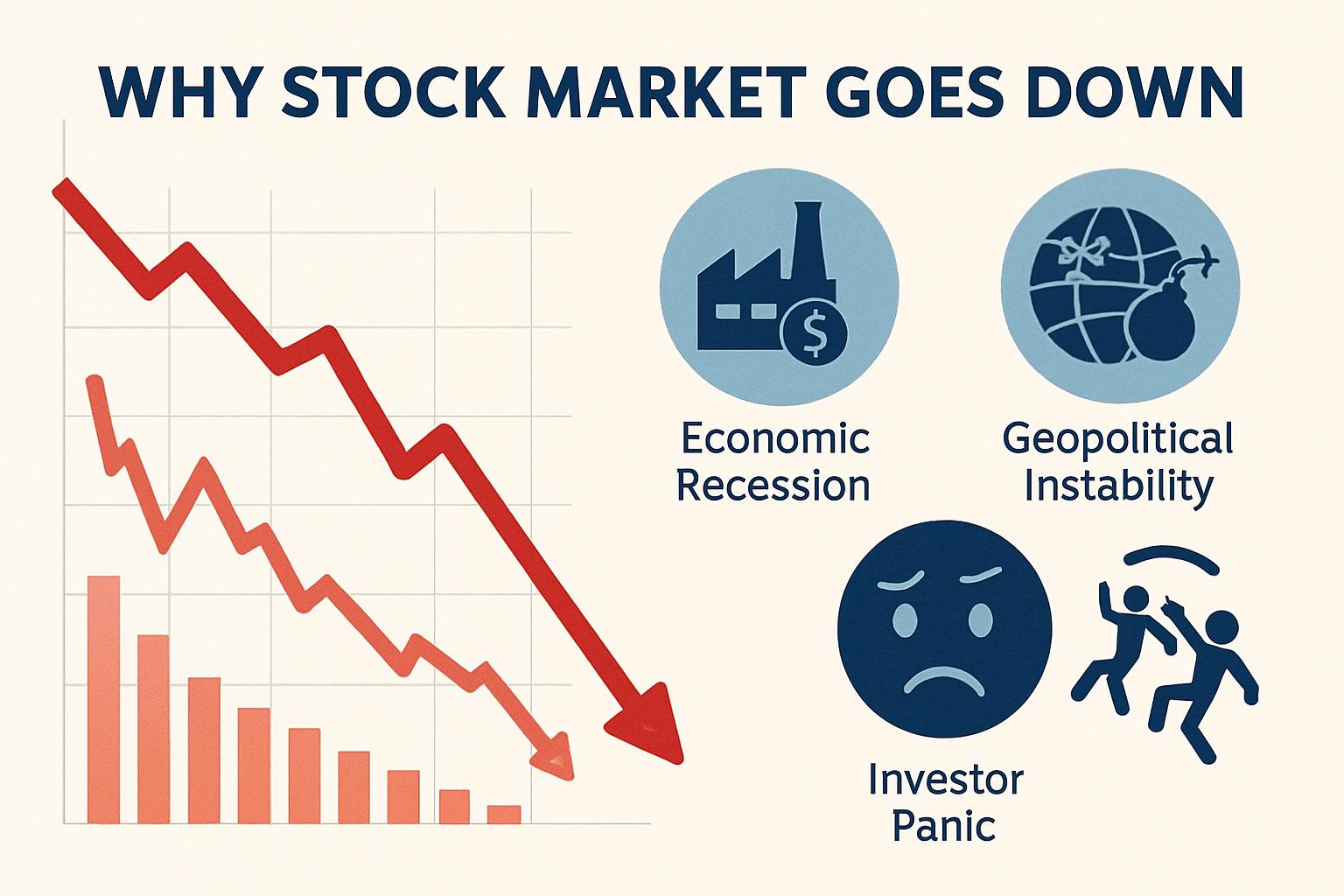
The stock market, a dynamic barometer of economic health and corporate prospects, is inherently prone to fluctuations. While periods of growth often capture headlines and fuel investor optimism, downturns are an equally integral, albeit often unsettling, part of its cyclical nature. When stocks fall, it can trigger anxiety, prompt questions about financial stability, and challenge investment strategies. Understanding why stocks are down is not merely an academic exercise; it’s crucial for making informed decisions, managing risk, and maintaining a resilient financial outlook.
Market corrections, bear markets, and general periods of decline are rarely attributable to a single factor. Instead, they typically emerge from a complex interplay of macroeconomic forces, corporate performance, investor psychology, and unforeseen global events. This article delves into the multifaceted reasons behind stock market downturns, exploring the key drivers that can send prices tumbling and offering insights into navigating these challenging periods.
Macroeconomic Headwinds: The Broad Economic Picture
The health of the broader economy is perhaps the most significant determinant of stock market performance. When macroeconomic conditions deteriorate, it creates a challenging environment for businesses, which inevitably translates into lower stock valuations.
Interest Rate Hikes and Monetary Policy
Central banks, such as the U.S. Federal Reserve, wield powerful tools to influence the economy, chief among them being interest rates. When inflation is high, central banks often raise interest rates to cool down the economy by making borrowing more expensive. This has several ripple effects on the stock market:
- Reduced Corporate Profitability: Higher borrowing costs cut into company profits, especially for businesses with significant debt or those needing capital for expansion.
- Lower Consumer Spending: Increased rates can deter consumers from taking out loans for large purchases (homes, cars), reducing demand for goods and services.
- Alternative Investment Appeal: Higher interest rates make “safer” investments like bonds and savings accounts more attractive, drawing money away from potentially riskier equities.
- Discounting Future Earnings: Higher discount rates, used by analysts to value future corporate earnings, result in lower present-day valuations for stocks. Growth stocks, whose value is heavily reliant on future earnings potential, are particularly vulnerable.
Inflationary Pressures
Inflation, the general increase in prices and fall in the purchasing value of money, can be a major disruptor for stock markets. While moderate inflation is a sign of a healthy growing economy, runaway inflation erodes corporate profits and consumer purchasing power.
- Increased Costs for Businesses: Companies face higher costs for raw materials, labor, and transportation, which can compress profit margins if they cannot pass these costs onto consumers.
- Reduced Consumer Demand: When everything costs more, consumers have less discretionary income, leading to a drop in demand for non-essential goods and services.
- Uncertainty: High inflation creates economic uncertainty, making it difficult for businesses to plan and for investors to forecast future earnings, leading to a risk-off sentiment.
Economic Slowdown and Recession Fears
A significant deceleration in economic activity, characterized by declining GDP, rising unemployment, and reduced industrial output, signals an economic slowdown or, worse, a recession.
- Lower Corporate Earnings: During an economic slowdown, consumer and business spending declines, directly impacting corporate revenues and profits.
- Increased Unemployment: Job losses reduce consumer confidence and spending, perpetuating a downward spiral.
- Risk Aversion: Investors become highly risk-averse during economic contractions, pulling money out of stocks and into perceived safer assets. The anticipation of a recession often triggers market declines long before an official declaration.
Supply Chain Disruptions
Globalized economies are highly interdependent. Disruptions to supply chains, whether due to pandemics, geopolitical events, or natural disasters, can significantly impede economic activity.
- Production Delays and Shortages: Companies struggle to obtain necessary components or deliver finished goods, leading to lost sales and production bottlenecks.
- Increased Costs: Supply chain inefficiencies often result in higher freight costs, increased inventory holding costs, and reliance on more expensive alternative suppliers.
- Reduced Profitability: These cost pressures directly impact a company’s bottom line and, by extension, its stock price.
Corporate Performance & Investor Sentiment: Micro and Psychological Factors
Beyond the broad strokes of macroeconomics, the individual performance of companies and the collective mood of investors play critical roles in determining stock market direction.
Disappointing Earnings Reports
Individual stock prices, and by extension the broader market, are heavily influenced by corporate earnings. When companies report earnings that fall short of analyst expectations, or provide a pessimistic outlook for future quarters, their stock prices can plummet.
- Earnings Misses: A company that fails to meet consensus earnings estimates often sees a sharp decline as investors re-evaluate its future profitability.
- Weak Guidance: Even if current earnings are strong, a cautious or negative outlook for upcoming periods can signal trouble ahead, causing investors to sell.
- Sector-Wide Impact: If multiple major companies within a sector report poor results, it can drag down the entire industry and potentially contribute to a broader market downturn.
Valuation Concerns and Market Bubbles
Periods of sustained market growth can sometimes lead to inflated stock valuations, where prices detach from underlying fundamental value.
- Overvalued Stocks: When stock prices climb faster than corporate earnings or economic growth, they can become overvalued. This often happens during periods of irrational exuberance.
- Market Bubbles: Extreme overvaluation in a particular sector or the entire market can lead to a “bubble,” which, when it bursts, results in sharp and rapid declines as prices correct to more realistic levels. The dot-com bubble of the late 1990s is a classic example.
- Higher Risk Premium: As valuations become stretched, the implied future returns become lower, meaning investors demand a higher risk premium to hold these assets, making them more susceptible to sell-offs.
Loss of Investor Confidence and Panic Selling
Investor sentiment, driven by fear and greed, is a powerful, albeit often irrational, force in the market.
- Erosion of Confidence: Negative news, whether economic, corporate, or geopolitical, can erode investor confidence, leading to widespread doubt about future market prospects.
- Fear and Greed Cycle: In a downturn, fear can quickly overwhelm logic, leading to panic selling. Investors rush to liquidate positions to avoid further losses, which exacerbates the decline, creating a self-fulfilling prophecy.
- Herd Mentality: The tendency for investors to follow the actions of a larger group, even if those actions are not rational, can amplify market movements, both up and down.
Geopolitical & Unforeseen Events: External Shocks
The global landscape is fraught with unpredictable events that can send shockwaves through financial markets, often irrespective of underlying economic or corporate fundamentals.
International Conflicts and Trade Wars
Geopolitical tensions can create significant uncertainty and disrupt global commerce.
- Supply Chain Disruption: Conflicts can block shipping lanes, halt production in affected regions, and cause commodity prices (like oil and gas) to spike.
- Sanctions and Tariffs: Trade wars and economic sanctions disrupt established trade relationships, increase costs for businesses, and reduce market access, impacting companies reliant on international trade.
- Investment Uncertainty: Geopolitical instability makes investors wary, leading to capital flight from affected regions and a general preference for safer assets.
Pandemics and Natural Disasters
Events that profoundly impact human life and infrastructure can bring economic activity to a halt.
- Public Health Crises: A global pandemic, like COVID-19, can lead to lockdowns, travel restrictions, and widespread illness, severely impacting labor availability, consumer behavior, and supply chains.
- Infrastructure Damage: Earthquakes, hurricanes, and other natural disasters can destroy property, disrupt transportation, and halt production, leading to significant economic losses.
- Demand Shock: Both types of events can lead to sudden and severe drops in demand for various goods and services, as well as production capacity.
Regulatory Changes and Political Instability
Government policies and political environments can have a direct and often immediate impact on specific industries and the broader market.
- New Regulations: Stricter environmental controls, antitrust measures, or changes in tax policy can increase costs for businesses or limit their growth potential.
- Political Uncertainty: Elections, government shutdowns, or shifts in political ideology can create uncertainty about future policies, making investors hesitant to commit capital.
- Nationalization or Expropriation Risk: In some regions, political instability can even raise the specter of governments seizing private assets, a significant deterrent to investment.
The Anatomy of a Downturn: Correction vs. Bear Market
It’s important to differentiate between typical market pullbacks and more severe, prolonged declines. Not all downturns are created equal.
Defining a Market Correction
A market correction is generally defined as a decline of at least 10% from a recent peak in a stock index (like the S&P 500).
- Frequency: Corrections are a normal and relatively frequent occurrence, often happening once every year or two on average.
- Duration: They are typically short-lived, lasting anywhere from a few weeks to a few months.
- Cause: Corrections often occur after periods of rapid gains, serving to “correct” excessive optimism or valuations, or in response to minor economic hiccups.
Understanding a Bear Market
A bear market is a more severe and prolonged downturn, characterized by a decline of 20% or more from recent highs.
- Severity: Bear markets represent a deeper and more sustained period of pessimism.
- Duration: They can last for several months or even years, often coinciding with an economic recession.
- Impact: Bear markets typically see widespread declines across sectors and can be psychologically challenging for investors. They often signify a fundamental shift in economic or corporate prospects.
Historical Context and Frequency
Understanding the historical patterns reveals that downturns are not anomalies but rather predictable components of market cycles. Since 1950, the S&P 500 has experienced numerous corrections and bear markets. While painful, each has eventually been followed by a recovery and new highs, demonstrating the market’s long-term upward bias.
Navigating the Downturn: Strategies for Investors
While the reasons for a stock market downturn can be complex and varied, investors are not powerless. Strategic planning and emotional discipline are key to weathering these periods.
Maintain a Long-Term Perspective
Perhaps the most crucial strategy is to remember that market downturns are temporary. For long-term investors, periods of decline can be viewed as opportunities rather than threats. Focusing on your long-term financial goals can help you avoid making impulsive, fear-driven decisions. History unequivocally shows that markets recover and eventually surpass previous peaks.
Rebalance and Diversify Your Portfolio
A diversified portfolio, spread across different asset classes (stocks, bonds, real estate), geographies, and sectors, helps mitigate risk. During a downturn, some assets may perform better than others. Rebalancing involves selling off assets that have performed well and buying those that have underperformed to maintain your target allocation. This forces you to “buy low” and “sell high.”
Consider Dollar-Cost Averaging
Dollar-cost averaging involves investing a fixed amount of money at regular intervals, regardless of market fluctuations. When prices are high, your fixed investment buys fewer shares; when prices are low, it buys more. This strategy helps reduce the average cost per share over time and removes the emotional element of trying to time the market. Downturns are particularly beneficial for dollar-cost averagers as their fixed contributions acquire more shares at reduced prices.
Focus on Quality Companies
During periods of uncertainty, focus your investments on fundamentally strong companies with solid balance sheets, consistent earnings, competitive advantages, and proven management teams. These “quality” businesses are typically more resilient during economic slowdowns and are well-positioned to recover strongly when the market turns. Avoid speculative or highly leveraged companies that may struggle to survive a prolonged downturn.
Avoid Emotional Decisions
Panic selling is one of the most detrimental actions an investor can take during a market downturn. It locks in losses and prevents participation in the inevitable recovery. Similarly, trying to “time the bottom” by waiting for the absolute lowest point is notoriously difficult and often leads to missed opportunities. Stick to your pre-determined investment plan and avoid letting fear dictate your actions. Consult with a financial advisor if anxiety becomes overwhelming.
Conclusion
Stock market downturns are a multifaceted phenomenon, stemming from a complex interplay of macroeconomic pressures, corporate performance, investor psychology, and global events. From rising interest rates and inflation to geopolitical conflicts and unforeseen pandemics, the reasons “why stocks are down” are rarely singular and often reinforce one another.
While unsettling, these periods are a natural and necessary part of the market cycle. They serve to flush out excesses, reset valuations, and create opportunities for disciplined, long-term investors. By understanding the underlying causes of market volatility and adopting strategic, emotionally disciplined approaches, investors can navigate these turbulent waters, preserve their capital, and position themselves for future growth when the tides inevitably turn. The key is to see beyond the immediate fear and embrace the enduring truth of market resilience and the power of a well-considered, long-term investment strategy.
aViewFromTheCave is a participant in the Amazon Services LLC Associates Program, an affiliate advertising program designed to provide a means for sites to earn advertising fees by advertising and linking to Amazon.com. Amazon, the Amazon logo, AmazonSupply, and the AmazonSupply logo are trademarks of Amazon.com, Inc. or its affiliates. As an Amazon Associate we earn affiliate commissions from qualifying purchases.