
For countless investors worldwide, the allure of passive income through dividends is a powerful motivator. Among the myriad investment vehicles available, exchange-traded funds (ETFs) have risen to prominence, offering diversified exposure to various markets with ease. One such ETF, the Vanguard S&P 500 ETF (VOO), stands out as a cornerstone for many portfolios. Tracking the performance of the S&P 500 Index, VOO provides a simple, low-cost way to invest in 500 of the largest U.S. companies. But beyond capital appreciation, a common question for both new and experienced investors is: When exactly does VOO pay dividends, and how can I benefit from them?
Understanding the dividend schedule and the mechanics behind it is crucial for effective financial planning, especially for those relying on investment income or leveraging dividend reinvestment for compounding returns. This comprehensive guide will demystify VOO’s dividend payouts, offering insights into its schedule, the underlying mechanisms, and strategic considerations for investors.
The Basics of VOO and Dividend Investing
Before diving into the specifics of VOO’s dividend schedule, it’s essential to lay a foundational understanding of what VOO is and how dividends function within the context of ETFs.
What is VOO? A Gateway to the S&P 500
VOO is an exchange-traded fund offered by Vanguard, one of the world’s largest investment management companies. Its primary objective is to track the performance of the S&P 500 Index, which comprises 500 of the largest publicly traded companies in the United States, selected by S&P Dow Jones Indices based on criteria like market size, liquidity, and sector representation. Investing in VOO essentially means investing in a slice of the American economy’s top performers. It offers instant diversification across a broad range of industries, reducing the idiosyncratic risk associated with investing in individual stocks. For many, VOO represents a core, long-term holding that aims for steady growth coupled with regular income. Its low expense ratio is a significant draw, ensuring that more of an investor’s returns remain in their pocket rather than being eroded by fees.
Understanding Dividends in the Context of ETFs
A dividend is a distribution of a portion of a company’s earnings, decided by its board of directors, to its shareholders. When you own shares in a company that pays dividends, you receive a payout, typically in cash, on a regular basis. In the case of an ETF like VOO, the situation is slightly different but follows the same principle. VOO itself doesn’t “earn” profits in the way a company does; rather, it holds shares of the 500 companies within the S&P 500. Many of these underlying companies pay their own dividends to VOO as a shareholder. VOO then collects these dividends from its constituent companies and, after deducting its minimal operating expenses, distributes them to its own shareholders—you, the investor—who own shares of VOO. This mechanism makes VOO a “pass-through” vehicle for dividends, effectively consolidating the income streams from hundreds of companies into a single, manageable payout.
Why Invest in VOO for Dividends?
Investing in VOO for dividends offers several compelling advantages. Firstly, it provides exposure to a diversified stream of dividend income from a broad base of established, financially sound companies. This diversification mitigates the risk associated with relying on dividends from a single company. If one company cuts or suspends its dividend, the impact on VOO’s overall payout is typically minimal. Secondly, VOO’s low expense ratio means more of the dividend income you receive translates into net gains. Thirdly, for long-term investors, the combination of capital appreciation (as the S&P 500 grows over time) and consistent dividend payments provides a robust strategy for wealth accumulation. These dividends can either be taken as income or, perhaps more powerfully, reinvested to buy more shares of VOO, leveraging the magic of compound interest.
VOO’s Dividend Distribution Schedule and Key Dates
Knowing when to expect your dividend payments from VOO is crucial for financial planning and understanding the rhythm of your investment income. VOO, like many equity ETFs, follows a predictable schedule.
Quarterly Payouts: The Standard for VOO
VOO typically pays dividends on a quarterly basis. This means investors can expect four dividend distributions per year. While the exact payment dates can vary slightly from year to year, these payouts usually occur in March, June, September, and December. These months correspond to the end of the standard financial quarters, aligning with when many of the underlying S&P 500 companies also make their dividend payments. Vanguard announces the specific dates for each quarter well in advance, allowing investors to anticipate their income. It’s important to remember that these are the dates when the dividends are paid to your brokerage account, not necessarily when they are declared or when you need to own the shares.
Decoding Important Dividend Dates: Ex-Dividend, Record, and Payment
To be eligible for a dividend payment from VOO, or any dividend-paying security, understanding three key dates is paramount:
- Declaration Date: This is the date when Vanguard’s board officially announces the dividend, including the amount, the record date, and the payment date.
- Ex-Dividend Date: This is arguably the most critical date for investors. To receive the dividend, you must purchase VOO shares before the ex-dividend date. If you buy VOO shares on or after the ex-dividend date, you will not be entitled to the upcoming dividend payment. Conversely, if you sell your shares on or after the ex-dividend date, you will still receive the dividend. The stock price typically drops by the amount of the dividend on the ex-dividend date to reflect that new purchasers will not receive the dividend. The ex-dividend date is usually set one business day before the record date.
- Record Date: On this date, Vanguard’s transfer agent checks its records to determine which shareholders are eligible to receive the dividend. Only investors who are officially recorded as shareholders by the end of this day will receive the payout. You must have owned the shares before the ex-dividend date to be on record by the record date.
- Payment Date: This is the date when the dividend is actually paid out to eligible shareholders. The funds are typically deposited into your brokerage account on this day.
For example, if the ex-dividend date for VOO is March 20th, and you purchase shares on March 19th, you will receive the dividend. If you purchase on March 20th or later, you will not. The payment date might then be around March 26th. Keeping track of these dates is essential for any investor aiming to capture dividend income.
Historical Payout Trends and Future Expectations
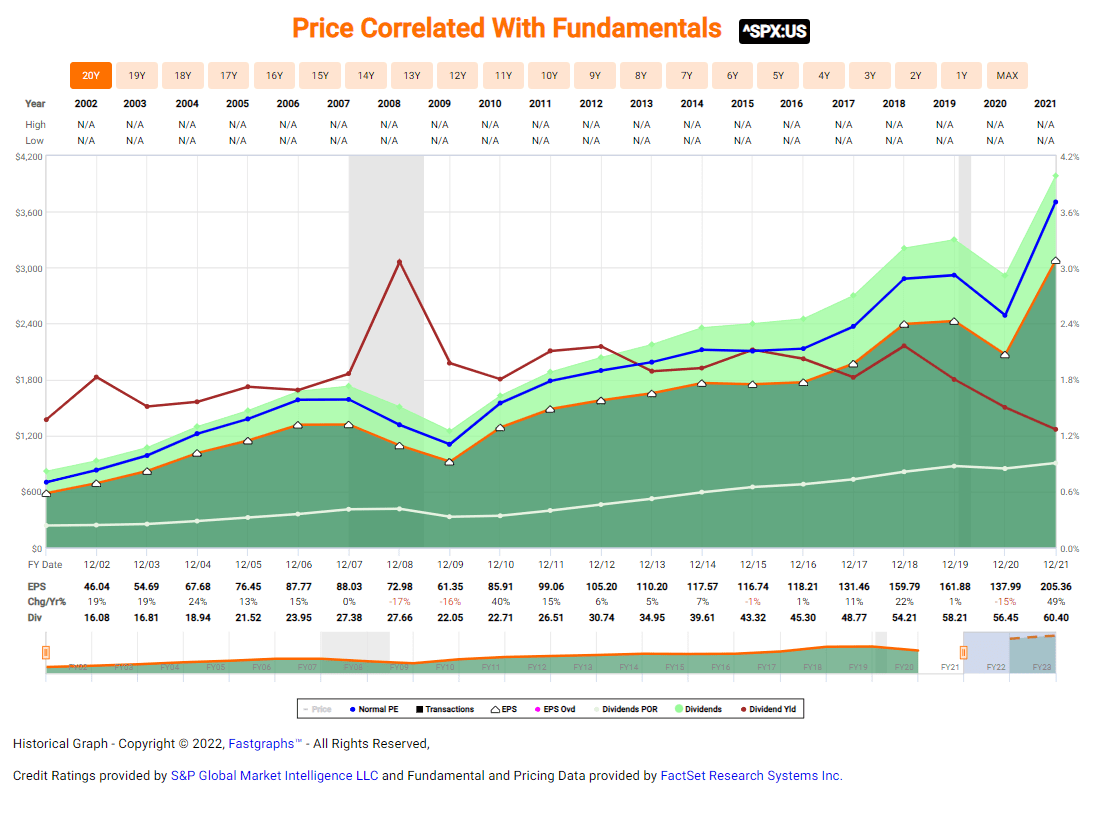
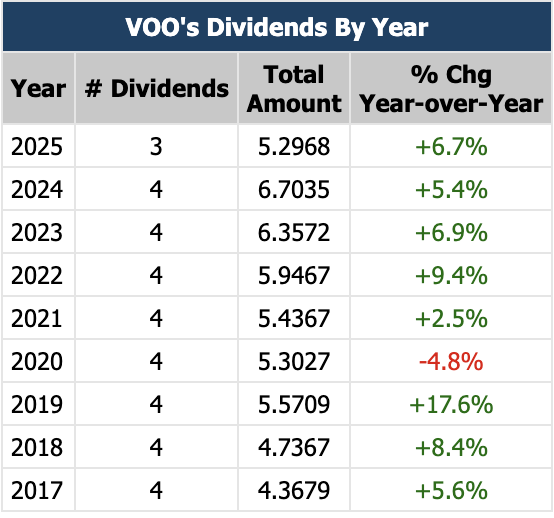
Historically, VOO’s dividend payments have generally shown a trend of increasing over time, reflecting the growth and profitability of the underlying S&P 500 companies. As these companies grow their earnings, many tend to increase their dividend payouts, which VOO then passes on to its shareholders. However, it’s crucial to understand that past performance is not indicative of future results. Dividend amounts can fluctuate based on the performance of the constituent companies, economic conditions, and their respective dividend policies. During periods of economic downturn, some companies might reduce or suspend their dividends, which could, in turn, affect VOO’s overall payout. While VOO offers a diversified and relatively stable dividend stream, investors should always manage expectations and understand that dividend income is not guaranteed to grow or even remain constant year after year.
Reinvesting vs. Receiving: Maximizing Your VOO Dividends
Once you understand when VOO pays dividends, the next strategic decision is what to do with them. Investors typically have two primary options: receive the dividends as cash or reinvest them. Each approach has its own merits and implications.
The Power of Dividend Reinvestment (DRIP)
Dividend Reinvestment Plans (DRIPs) are a highly favored strategy for long-term investors, particularly those focused on compounding wealth. With a DRIP, instead of receiving cash, your VOO dividends are automatically used to purchase additional shares or fractional shares of VOO. This process has a powerful compounding effect:
- More Shares: Each dividend payment buys more shares.
- More Dividends: These newly acquired shares then generate their own dividends in subsequent quarters.
- Accelerated Growth: This cycle accelerates the growth of your investment over time, as your capital base continually expands.
Many brokerage platforms offer automatic dividend reinvestment for ETFs like VOO. It’s a “set it and forget it” strategy that removes the temptation to spend the dividend income and systematically increases your holdings, benefiting from dollar-cost averaging if the share price fluctuates. Over decades, the impact of compounding through DRIPs can significantly enhance total returns compared to simply receiving dividends as cash.
Taking Cash: When and Why You Might Choose It
While dividend reinvestment is powerful for wealth accumulation, receiving VOO dividends as cash is a perfectly valid and often necessary option for certain investors. This strategy is particularly suitable for:
- Income Generation: Retirees or those in early retirement who rely on investment income to cover living expenses. For them, VOO’s quarterly dividends can provide a predictable stream of supplemental income.
- Diversification of Funds: Investors who prefer to allocate their dividend cash to other investment opportunities, perhaps to rebalance their portfolio, invest in a different asset class, or contribute to other financial goals outside of VOO.
- Short-Term Needs: Individuals who might have specific short-term cash flow needs that their regular income doesn’t cover.
Choosing to take cash means you forego the immediate compounding benefits within VOO itself. However, it provides greater liquidity and flexibility, allowing you to deploy your funds wherever they are most needed or strategically advantageous at that moment. The choice between reinvesting and receiving cash should align with your personal financial goals, time horizon, and current financial situation.
Tax Implications of VOO Dividends
Regardless of whether you choose to reinvest or receive VOO dividends as cash, they are generally considered taxable income in non-tax-advantaged accounts (like a regular brokerage account). VOO’s dividends are typically classified as “qualified dividends,” which means they are taxed at lower long-term capital gains rates for eligible taxpayers, rather than higher ordinary income tax rates. This is a significant tax advantage compared to interest income or non-qualified dividends.
However, if VOO is held within a tax-advantaged account such as a Roth IRA or a Traditional IRA, the tax implications change:
- Roth IRA: Dividends grow and can be withdrawn tax-free in retirement.
- Traditional IRA/401(k): Dividends grow tax-deferred, meaning you won’t pay taxes on them until you withdraw funds in retirement (at which point they’re taxed as ordinary income).
Understanding these tax implications is crucial for optimizing your investment strategy and avoiding unexpected tax liabilities. Consulting with a tax professional is always recommended for personalized advice.
Analyzing VOO’s Dividend Yield and Performance
Beyond the schedule and distribution methods, it’s insightful to understand how VOO’s dividend yield fits into its overall performance and how it compares within the broader investment landscape.
What is Dividend Yield and How to Interpret It for VOO
Dividend yield is a financial ratio that shows how much a company (or ETF) pays out in dividends each year relative to its share price. It is calculated as:
Dividend Yield = (Annual Dividend Per Share / Current Share Price) × 100%
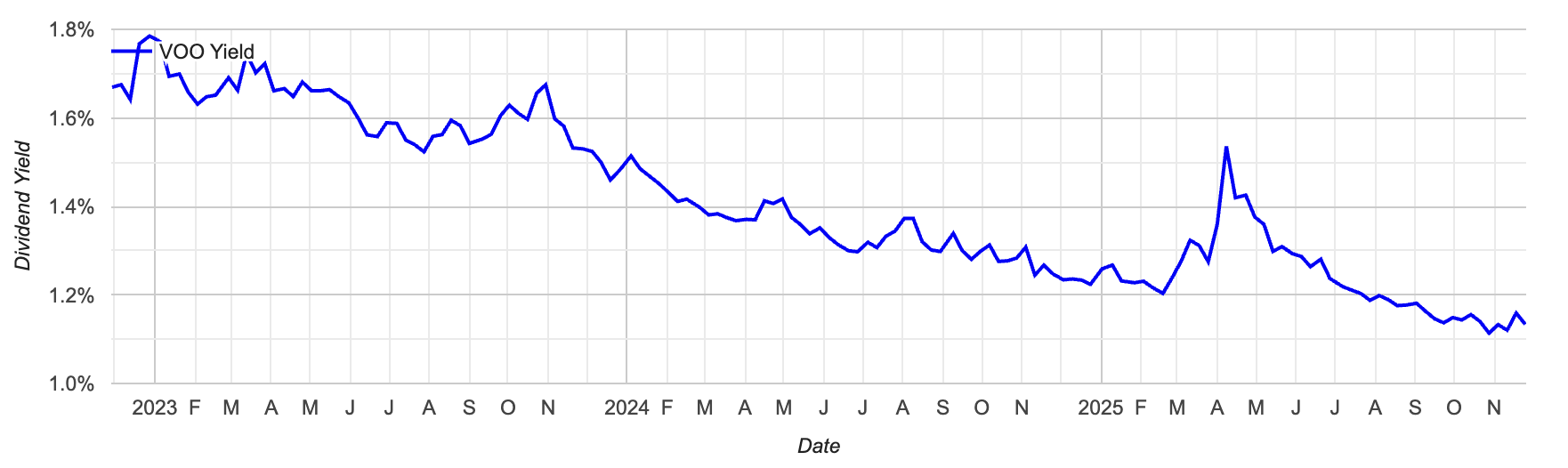
For VOO, the dividend yield reflects the aggregate dividends from all its underlying S&P 500 holdings, adjusted for the ETF’s share price. VOO’s dividend yield is generally modest, typically ranging from 1.5% to 2% annually. This is because the S&P 500 consists of many growth-oriented companies that reinvest a larger portion of their earnings back into their business rather than paying them out as dividends. While a higher dividend yield might seem more attractive at first glance, it’s crucial to interpret it in context. A very high yield can sometimes signal financial distress in a company, whereas a moderate yield from a well-diversified ETF like VOO indicates a sustainable payout from stable, growing companies. For VOO, the dividend yield should be viewed as one component of its total return, rather than the sole reason for investment.
VOO’s Total Return: Beyond Just Dividends
It’s vital for investors to consider VOO’s total return, which encompasses both capital appreciation (the increase in the ETF’s share price) and dividend income. For an index-tracking ETF like VOO, capital appreciation is often the more significant contributor to long-term returns compared to the dividend yield alone. The S&P 500 is known for its long-term growth trajectory, reflecting the innovation and expansion of the American economy.
Focusing solely on dividend yield without considering capital growth would provide an incomplete picture of VOO’s investment potential. An ETF with a lower dividend yield but strong capital appreciation can often outperform a higher-yielding investment that experiences little or no share price growth. VOO offers a balanced approach: exposure to capital growth from 500 leading companies, complemented by a consistent stream of dividend income that can be reinvested to amplify returns.
Comparing VOO’s Dividend Profile to Other Investments
When evaluating VOO’s dividend profile, it’s useful to compare it to other investment options:
- High-Yield Stocks/ETFs: Some individual stocks or specialized ETFs (e.g., those focused on REITs or high-dividend sectors) offer significantly higher dividend yields, often 4-8% or more. However, these investments typically come with higher risk, less diversification, and potentially lower capital appreciation.
- Bonds: Traditional bonds or bond ETFs offer fixed income, which can be more predictable than equity dividends. Their yields vary based on interest rates and credit risk. While often more stable, bonds generally offer lower long-term growth potential than equities.
- Growth Stocks/ETFs: Many growth-oriented stocks or ETFs (e.g., those focused on technology) pay little to no dividends, prioritizing reinvestment in the company for rapid expansion. Their appeal lies almost entirely in capital appreciation.
VOO sits in a sweet spot, offering broad market diversification, reliable if modest dividends, and strong long-term capital growth potential. It’s often considered a core “total market” or “core equity” holding that provides a blend of income and growth, making it a versatile component in a well-rounded portfolio.
Strategic Considerations for VOO Investors
Integrating VOO effectively into an overall financial strategy requires considering its role within a broader portfolio and aligning it with personal financial objectives.
VOO as a Core Holding in a Diversified Portfolio
Many financial advisors recommend VOO, or a similar S&P 500 index fund, as a core holding in a diversified investment portfolio. Its broad market exposure and low cost make it an excellent foundation upon which to build. By holding VOO, investors gain exposure to large-cap U.S. equities, which can then be complemented by other asset classes such as international stocks, small-cap stocks, bonds, or real estate, depending on individual risk tolerance and financial goals. For those seeking simplicity, VOO alone can provide significant diversification within the U.S. equity market.
Long-Term Growth vs. Short-Term Income Needs
The decision to invest in VOO, and how to manage its dividends, should be driven by your individual financial goals and time horizon.
- Long-Term Growth: If your primary goal is long-term wealth accumulation for retirement or other distant goals, dividend reinvestment (DRIP) for VOO is often the most effective strategy. The compounding effect over decades can dramatically increase your total returns.
- Short-Term Income: If you are nearing or in retirement and need a consistent income stream, receiving VOO’s quarterly dividends as cash can provide valuable support for living expenses. While VOO’s yield is modest, its reliability from a diversified basket of companies makes it a relatively stable income source compared to individual high-yield stocks.
It’s important to continuously reassess these needs as your life stages and financial situation evolve.
Staying Informed: Where to Find VOO Dividend Information
To keep abreast of VOO’s dividend announcements and performance, several reliable sources are available:
- Vanguard’s Official Website: The most authoritative source is Vanguard’s own website (vanguard.com). Navigate to the VOO product page, where you’ll find detailed information on its performance, holdings, and dividend distribution history, including ex-dividend, record, and payment dates.
- Brokerage Account Statements: Your brokerage firm (e.g., Fidelity, Schwab, E*TRADE) will provide statements detailing dividend payments, reinvestments, and year-end tax forms.
- Financial News Outlets and Data Providers: Reputable financial news websites (e.g., Wall Street Journal, Bloomberg, Yahoo Finance) and investment data platforms (e.g., Morningstar, Seeking Alpha) also publish dividend information for VOO and other ETFs. Be sure to check the “Dividends” or “Distribution” tab on their respective VOO pages.
Regularly reviewing these sources ensures you are always informed about your VOO investment and its dividend schedule, allowing you to make timely and informed financial decisions.
In conclusion, VOO is a foundational ETF that provides consistent quarterly dividends, typically in March, June, September, and December. Understanding the mechanics of these payments, from ex-dividend dates to the choice between reinvestment and cash, empowers investors to leverage VOO effectively for both long-term growth and income generation. By integrating VOO strategically and staying informed, investors can harness the power of America’s leading companies to build and grow their wealth.
aViewFromTheCave is a participant in the Amazon Services LLC Associates Program, an affiliate advertising program designed to provide a means for sites to earn advertising fees by advertising and linking to Amazon.com. Amazon, the Amazon logo, AmazonSupply, and the AmazonSupply logo are trademarks of Amazon.com, Inc. or its affiliates. As an Amazon Associate we earn affiliate commissions from qualifying purchases.