
The Dow Jones Industrial Average (DJIA), often simply referred to as “the Dow,” is one of the most recognizable and frequently cited stock market indices in the world. For decades, it has served as a primary barometer for the health of the U.S. stock market and, by extension, the broader American economy. When financial news reports mention “the market is up” or “the market is down,” they are often referring to the performance of the Dow. However, despite its widespread recognition, many investors and casual observers alike may not fully understand what the Dow truly represents, how it is constituted, or why its specific selection of stocks matters.

The Dow is not a simple average of all stocks, nor does it encompass the entire U.S. equity market. Instead, it is a price-weighted index composed of just 30 large, publicly traded companies that are intended to be representative of various key sectors within the U.S. economy. These companies are selected for their prominence, stability, and historical significance, making the Dow a snapshot of some of America’s most established corporate giants. Understanding which companies comprise the Dow, how they are chosen, and the implications of their inclusion offers crucial insights into both the index itself and the broader landscape of financial markets.
Understanding the Dow Jones Industrial Average (DJIA)
To truly appreciate “what are the stocks in the Dow,” one must first grasp the foundational principles and historical context of this iconic index. It’s more than just a number; it’s a living testament to American industrial and economic evolution.
A Historical Perspective
The Dow Jones Industrial Average was created in May 1896 by Charles Dow, editor of The Wall Street Journal and co-founder of Dow Jones & Company. Initially, the index comprised just 12 industrial companies, a reflection of the burgeoning industrial era in the United States. These early constituents included rail companies, sugar refiners, leather manufacturers, and tobacco companies – industries that were the titans of their time. The original intent was to provide a simple, easily understandable measure of the market’s overall direction, offering investors a quick gauge of economic health.
Over the decades, the index expanded its scope, first to 20 stocks in 1916 and then to its current 30 stocks in 1928. This expansion mirrored the increasing complexity and diversification of the U.S. economy. While the “Industrial” in its name suggests a focus on manufacturing, the Dow has long evolved beyond this narrow definition to include companies from various sectors, reflecting the dynamic shifts in economic dominance from heavy industry to technology, finance, and consumer services. This historical journey underscores the Dow’s adaptability and its continued relevance as a proxy for the evolving economic landscape.
More Than Just an Average: The Price-Weighted Index
A critical characteristic distinguishing the Dow from other major indices like the S&P 500 is its price-weighted methodology. Unlike market-capitalization-weighted indices, where a company’s influence is proportional to its total market value (share price multiplied by shares outstanding), the Dow assigns influence based solely on the stock’s per-share price. This means that a company with a higher stock price will have a greater impact on the index’s movement than a company with a lower stock price, even if the latter has a significantly larger overall market capitalization.
For example, if Company A’s stock trades at $300 and Company B’s at $100, a $10 increase in Company A’s stock price will move the Dow more than a $10 increase in Company B’s price, irrespective of which company is larger in terms of total market value. This weighting scheme is a historical relic from a time before sophisticated computing power, when simply adding up prices and dividing was the easiest way to calculate an average. To maintain continuity when stock splits, dividends, or company changes occur, the sum of the 30 stock prices is divided by a “Dow Divisor” rather than simply 30. This divisor is adjusted frequently to ensure that the index’s value accurately reflects only the price movements of its component stocks, preventing artificial jumps or drops due to structural changes.
Why Only 30 Stocks? The Balance of Representation
The decision to limit the Dow to 30 stocks is rooted in a balance between comprehensive representation and practical simplicity. While 30 stocks may seem a small number to represent an entire economy, the committee responsible for its selection aims for these companies to be leading entities within their respective sectors, embodying a significant portion of the U.S. market’s value and influence. The idea is that these 30 giants collectively provide a reliable pulse of corporate America.
This selective approach allows the Dow to remain a concise and easily digestible indicator, frequently cited in news headlines and financial discussions. While it doesn’t offer the breadth of an index like the S&P 500, its focused nature means that each constituent company carries substantial weight and is typically a household name. This makes the Dow a powerful symbol, even if its methodology is sometimes criticized for its limitations in fully capturing the vast complexity of modern markets.
The Illustrious 30: Who Makes the Cut?
The composition of the Dow is not static; it evolves to reflect significant shifts in the U.S. economy. Understanding the criteria and historical changes helps illuminate the index’s enduring relevance.
Selection Criteria and the Committee
The process for selecting the 30 companies that comprise the Dow is less about rigid mathematical formulas and more about qualitative judgment. The selections are made by the editors of The Wall Street Journal, a panel that serves as the Dow Jones Averages Committee. While there are no strict rules, several guiding principles influence their decisions:
- Reputation and Size: Companies must be large, well-established, and have an excellent reputation. They are typically leaders in their industries.
- Sustained Growth: The chosen companies are usually those with a history of strong earnings and consistent growth, indicating long-term viability and influence.
- Investor Interest: The stocks should be of interest to a large number of investors.
- Sector Representation: While not strictly adhering to quotas, the committee aims for a diverse representation of major sectors of the U.S. economy (e.g., technology, finance, healthcare, consumer goods, industrials, energy) to ensure the index remains a broad economic barometer.
- Publicly Traded: The company must be publicly listed on either the New York Stock Exchange (NYSE) or the Nasdaq Stock Market.
Crucially, the committee avoids adding companies that are already well-represented by existing Dow components within the same industry, striving for distinct economic exposure. The goal is to pick companies whose performance significantly impacts the broader economy.
Evolution of the Dow Components: A Dynamic Index
The phrase “Industrial Average” might conjure images of smokestacks and factories, but the Dow’s composition has dramatically shifted over its long history. Companies are regularly added and removed to ensure the index continues to reflect current economic realities. For example, General Electric, one of the original 1896 constituents, was removed in 2018, marking the end of an era. Similarly, companies like Kraft Foods, AT&T, and Alcoa have been replaced over time.
Recent additions reflect the growing importance of technology, healthcare, and software in the modern economy. For instance, Apple (added 2015), Salesforce (added 2020), Amgen (added 2020), and Honeywell (added 2020) replaced older, less representative companies. These changes underscore the committee’s efforts to keep the Dow relevant, ensuring it mirrors the current drivers of economic growth rather than resting on historical laurels. Reasons for changes often include:
- Decline in Sector Relevance: When an industry loses its economic prominence.
- Mergers and Acquisitions: When a component company is acquired.
- Bankruptcy or Significant Decline: When a company faces severe financial distress.
- Shift in Economic Landscape: To incorporate new, influential sectors or companies.
Current Landscape: A Snapshot of Diversity (as of early 2024, subject to change)
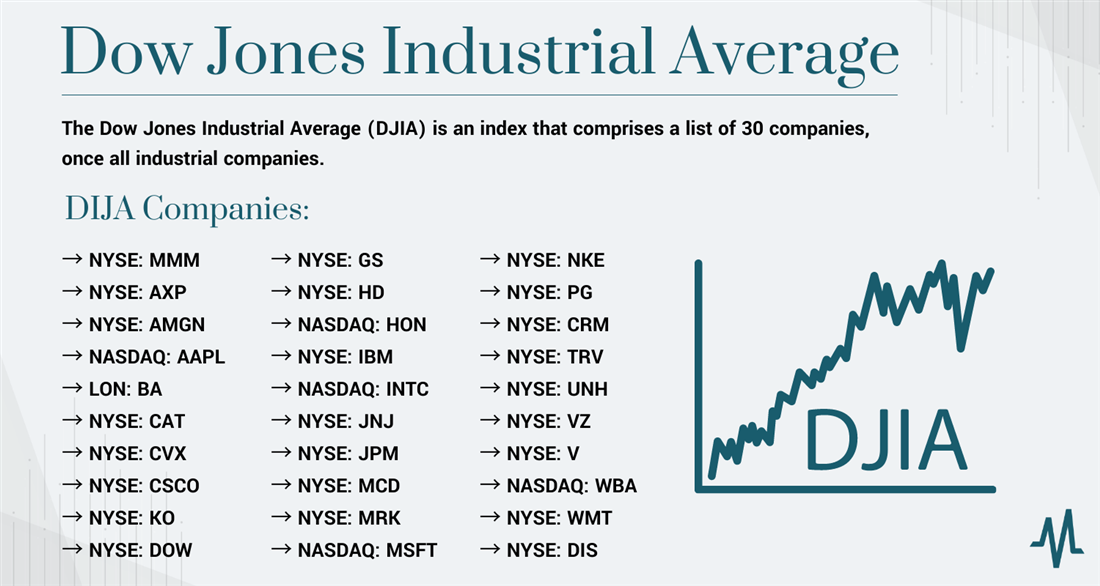
While a definitive, real-time list of the 30 Dow components would require constant updating, here is a representative overview of the types of industries and prominent companies that typically make up the index:
- Technology: Giants like Apple, Microsoft, Salesforce, and Intel represent the digital economy’s backbone.
- Financial Services: Banks and financial institutions such as JPMorgan Chase, Goldman Sachs, and Visa are crucial for economic liquidity and growth.
- Healthcare: Pharmaceutical and biotechnology leaders like Johnson & Johnson, Merck, and Amgen highlight the importance of the healthcare sector.
- Consumer Discretionary/Staples: Companies like Walmart, Home Depot, McDonald’s, Nike, and Coca-Cola illustrate consumer spending power.
- Industrials: Boeing, Caterpillar, and Honeywell still carry the torch for traditional industry, though often with a high-tech twist.
- Energy: Chevron represents the vital energy sector.
This diverse array showcases how the Dow has evolved from a purely industrial measure into a comprehensive cross-section of American corporate might. These 30 companies, individually and collectively, wield immense influence over global markets and represent the foundational pillars of the U.S. economy.
The Dow’s Role in Investment Strategy and Economic Barometer

The Dow Jones Industrial Average is more than just a list of 30 companies; it plays a multifaceted role in the financial world, serving as both an economic indicator and a basis for investment products.
As an Economic Indicator
For over a century, the Dow has been the go-to benchmark for reporting on the stock market’s daily performance. Its movements are closely watched by investors, policymakers, and the general public, often framed as a quick pulse of the nation’s economic health. A rising Dow is typically interpreted as a sign of business confidence and economic expansion, while a falling Dow can signal concerns about a slowdown or recession.
However, it’s crucial to acknowledge the Dow’s limitations as a sole economic indicator. With only 30 large-cap companies, it does not represent the thousands of smaller public companies that also contribute significantly to economic activity. Furthermore, its price-weighted methodology means that the influence of certain high-priced stocks can sometimes disproportionately skew its movements, potentially giving a misleading impression of broader market sentiment or economic trends. While useful as a historical and quick-reference tool, sophisticated analysis often requires looking at broader indices and a wider range of economic data.
Investing in the Dow
For investors interested in gaining exposure to the Dow’s performance, directly owning all 30 individual stocks can be capital-intensive and impractical due to the high share prices of some components. Instead, several investment vehicles allow investors to track the Dow more efficiently:
- Exchange Traded Funds (ETFs): The most popular way to invest in the Dow is through an ETF like the SPDR Dow Jones Industrial Average ETF (DIA). This fund holds the 30 stocks in roughly the same proportion as their weight in the index, allowing investors to buy a single share and gain diversified exposure to all 30 components.
- Index Funds: Mutual funds that track the Dow also exist, providing a professionally managed option for broader market exposure.
- Derivatives: More advanced investors can use futures and options contracts based on the Dow to speculate on its movements or to hedge existing portfolios.
Investing in a Dow-tracking product provides instant diversification across 30 major U.S. companies and sectors, offering a relatively stable and historically proven avenue for long-term growth. It’s often viewed as a “blue-chip” investment, representing a collection of established, financially sound companies.
Diversification and the Dow
While investing in a Dow-tracking fund provides diversification across its 30 components, it’s essential for investors to understand that this alone does not constitute a fully diversified investment portfolio. The Dow focuses on large-cap U.S. companies, omitting exposure to:
- Small and Mid-Cap Companies: Smaller companies often have different growth drivers and risk profiles.
- International Markets: The Dow provides no direct exposure to companies based outside the U.S., which can be crucial for global diversification.
- Fixed Income: Bonds and other fixed-income securities are vital for portfolio stability and income generation.
- Alternative Investments: Commodities, real estate, and other assets can further enhance diversification.
Therefore, while the Dow offers a concentrated view of American corporate strength, a well-rounded investment strategy typically involves combining Dow-centric investments with other asset classes and market segments to mitigate risk and capture a broader range of investment opportunities. The Dow should be seen as one valuable piece of a larger, diversified portfolio.
Criticisms and Alternatives to the Dow
Despite its prestige and long history, the Dow Jones Industrial Average faces significant criticisms, particularly concerning its methodology and limited scope. Understanding these shortcomings helps investors make more informed decisions and appreciate the value of alternative indices.
The Price-Weighted Dilemma
The most significant and frequently cited criticism of the Dow is its price-weighted methodology. As discussed, this means a stock’s influence on the index is determined solely by its per-share price, not by its overall market capitalization (total value of the company). This can lead to distortions:
- Disproportionate Influence: A company with a very high stock price but a relatively smaller market cap can exert more influence on the Dow’s movement than a company with a lower stock price but a much larger market cap. This creates a disconnect where the index’s movements may not accurately reflect the collective market value changes of its constituent companies.
- Impact of Stock Splits: When a high-priced stock undergoes a stock split, its price per share drops, instantly reducing its influence on the Dow, even if the company’s fundamental value and market cap remain unchanged. This necessitates adjustments to the Dow Divisor, which can be complex and sometimes lead to confusion.
This archaic weighting system, a vestige of early financial calculations, is often seen as less reflective of modern market dynamics compared to market-capitalization-weighted indices.
Limited Representation
Another major criticism stems from the Dow’s narrow scope. Comprising only 30 companies, it offers a highly concentrated view of the U.S. stock market.
- Mega-Cap Bias: The 30 components are exclusively large, well-established corporations, often referred to as “blue-chip” stocks. This means the Dow does not represent the performance of small-cap or mid-cap companies, which often exhibit different growth patterns and risk profiles crucial to the broader economy.
- Sector Gaps: While the committee strives for diversity, 30 companies simply cannot encompass all the innovative and growing sectors of the U.S. economy. Many critical industries or rapidly expanding companies may be excluded, giving an incomplete picture of overall market health and future growth drivers.
- Lack of Breadth: The sheer number of publicly traded companies in the U.S. is in the thousands. Relying solely on the Dow overlooks the vast majority of these enterprises, some of which may be significant contributors to economic growth and job creation.
These limitations suggest that while the Dow provides a snapshot of America’s corporate titans, it is far from a comprehensive representation of the entire U.S. equity market.
Broader Market Indices: A More Comprehensive View
Due to the Dow’s limitations, most financial professionals and serious investors look to other, broader market indices for a more accurate and comprehensive assessment of market performance:
- S&P 500: Widely considered the best benchmark for large-cap U.S. equities, the S&P 500 is a market-capitalization-weighted index that tracks 500 of the largest publicly traded companies in the United States. Its broader scope and market-cap weighting make it a more representative indicator of the overall health of the U.S. stock market.
- NASDAQ Composite: This index comprises all common equities listed on the Nasdaq stock market. It is heavily weighted towards technology and growth companies, making it an excellent barometer for the tech sector’s performance.
- Russell 2000: This index tracks the performance of approximately 2,000 small-cap U.S. companies. It is often used as a benchmark for small-cap stocks, which can offer higher growth potential but also carry greater risk.
- Wilshire 5000: This is the broadest market index, attempting to track nearly all publicly traded U.S. companies. It offers the most comprehensive view of the total U.S. equity market.
For investors, understanding these alternatives is crucial. While the Dow remains a historical and easily digestible reference point, a holistic investment strategy and market analysis should incorporate a diverse range of indices to gain a truly comprehensive understanding of market trends and economic performance.
Conclusion
The Dow Jones Industrial Average, with its iconic status and long history, continues to be a focal point in financial discourse. It represents a curated selection of 30 of America’s most influential and historically significant companies, intended to provide a quick pulse of the U.S. stock market and broader economic health. From its humble beginnings with 12 industrial firms to its current diverse composition, the Dow has evolved to reflect the shifting landscape of American enterprise, incorporating titans from technology, finance, healthcare, and consumer goods.
However, its distinctive price-weighted methodology and limited scope of 30 mega-cap companies present inherent limitations. While the Dow offers valuable insights into the performance of established blue-chip companies, it does not fully represent the vast breadth and complexity of the entire U.S. equity market, nor does it encompass smaller businesses or all economic sectors.
For the savvy investor and informed citizen, understanding “what are the stocks in the Dow” is a foundational step, but it must be viewed within a broader context. While the Dow remains a powerful symbol and a convenient shorthand for market trends, a comprehensive financial perspective necessitates examining a range of indices, including the S&P 500, NASDAQ Composite, and Russell 2000, to gain a more complete and nuanced understanding of investment opportunities and economic dynamics. Ultimately, the Dow serves as a venerable, though imperfect, window into the ongoing narrative of American capitalism.
aViewFromTheCave is a participant in the Amazon Services LLC Associates Program, an affiliate advertising program designed to provide a means for sites to earn advertising fees by advertising and linking to Amazon.com. Amazon, the Amazon logo, AmazonSupply, and the AmazonSupply logo are trademarks of Amazon.com, Inc. or its affiliates. As an Amazon Associate we earn affiliate commissions from qualifying purchases.