
For many investors looking to tap into the growth potential of innovation-driven companies, the Invesco QQQ Trust (QQQ) is a familiar and frequently discussed exchange-traded fund (ETF). Often simply referred to as “QQQ,” this fund has become a popular vehicle for gaining exposure to some of the world’s most dynamic and influential companies. But beyond its ticker symbol, a fundamental question remains for both novice and seasoned investors alike: what stocks actually comprise QQQ? Understanding the underlying holdings, sector allocation, and rebalancing methodology of QQQ is crucial for anyone considering it as part of their investment strategy. This article will delve deep into the composition of QQQ, providing an insightful look into the innovation engine it represents and helping you determine if it aligns with your financial objectives.

Understanding QQQ: An Introduction to the Invesco QQQ Trust
Before we dissect its components, it’s essential to grasp what QQQ is and how it functions as an investment product. Unlike investing in individual stocks, QQQ offers a diversified approach by bundling shares of multiple companies into a single, tradable asset.
What is an ETF and How Does QQQ Fit In?
An Exchange-Traded Fund (ETF) is a type of investment fund that holds a collection of underlying assets, such as stocks, bonds, or commodities. ETFs trade on stock exchanges throughout the day, much like individual stocks, providing investors with liquidity and flexibility. They are popular for their diversification benefits, typically lower expense ratios compared to actively managed mutual funds, and transparency regarding their holdings.
QQQ is one of the most well-known and largest ETFs in the market. It is passively managed, meaning its primary objective is not to outperform a benchmark, but rather to replicate the performance of a specific underlying index. This brings us to the core of QQQ’s identity: the Nasdaq-100 Index.
The Nasdaq-100 Index: QQQ’s Benchmark
The Invesco QQQ Trust tracks the Nasdaq-100 Index. This index comprises 100 of the largest domestic and international non-financial companies listed on the Nasdaq Stock Market. Crucially, it excludes financial companies, which is a significant distinguishing factor from broader market indices like the S&P 500. The Nasdaq-100 is known for its heavy concentration in growth-oriented sectors, particularly technology, but also includes companies from telecommunications, biotechnology, retail, and industrial sectors. The index is market-capitalization weighted, meaning companies with larger market values have a greater impact on the index’s performance and, consequently, a larger weighting within QQQ. This capitalization-weighting methodology means that a few mega-cap companies can exert significant influence over the ETF’s returns.
Why Investors Consider QQQ
Investors are drawn to QQQ for several compelling reasons. Firstly, it offers convenient, diversified exposure to a basket of leading innovative companies, many of which are household names. This provides an efficient way to invest in a segment of the market known for its strong growth potential. Secondly, its focus on non-financial companies within the Nasdaq-100 means it often captures companies at the forefront of technological advancement and disruption. Lastly, as an ETF, QQQ benefits from relatively low expense ratios and the ease of trading, making it accessible for a wide range of investors seeking growth opportunities.
Delving into QQQ’s Core Holdings: The Tech Giants and Beyond
The true essence of “what stocks are in QQQ” lies in examining its underlying portfolio. While often associated almost exclusively with technology, a closer look reveals a more nuanced, albeit still tech-heavy, composition.
The Dominance of Mega-Cap Technology
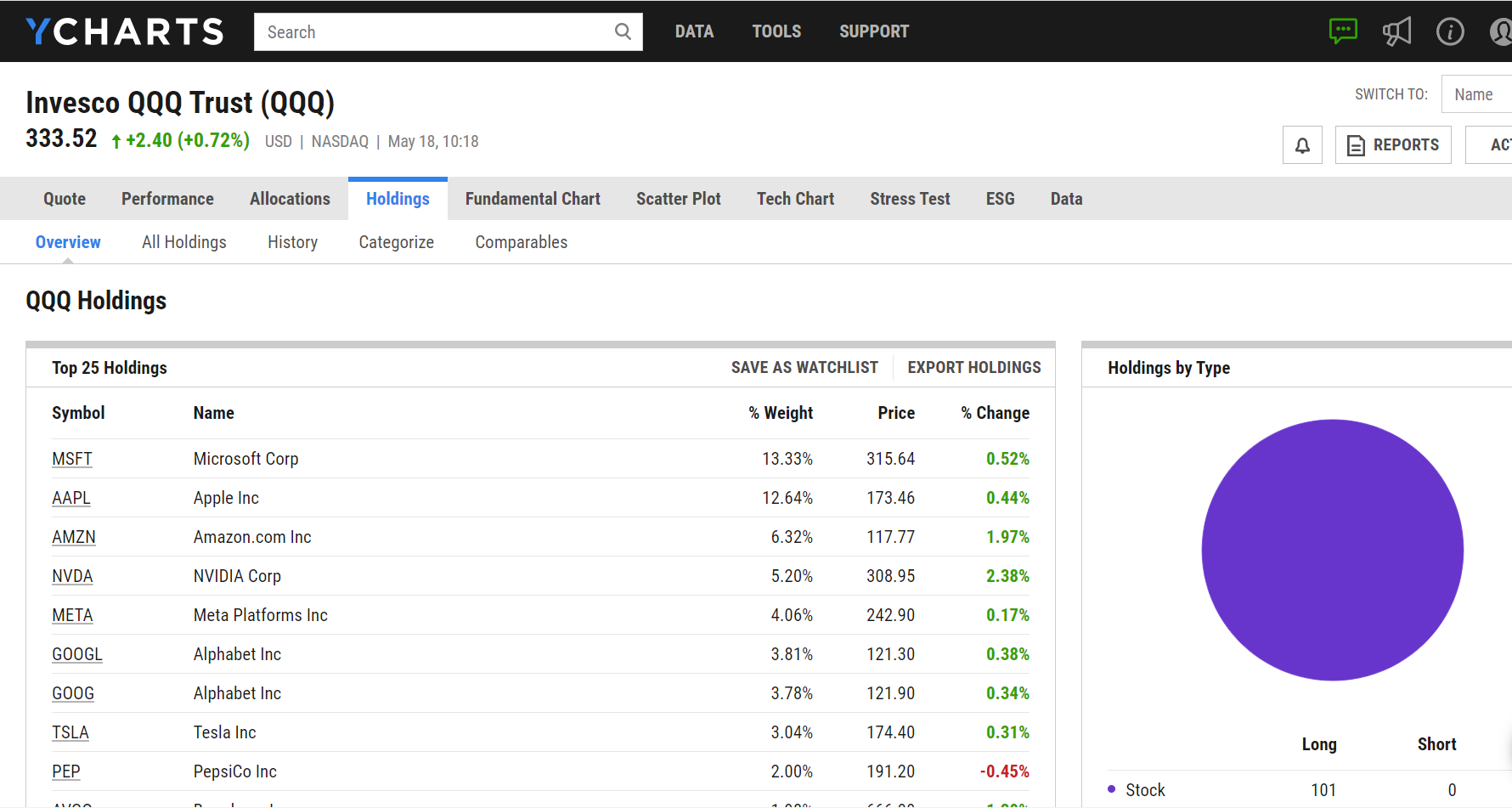
Anyone familiar with the Nasdaq-100 knows that a handful of mega-cap technology companies command a significant portion of the index’s, and thus QQQ’s, weighting. Companies like Apple (AAPL), Microsoft (MSFT), Amazon (AMZN), NVIDIA (NVDA), Alphabet (GOOGL, GOOG), Meta Platforms (META), and Tesla (TSLA) consistently rank among the top holdings. These companies, often referred to as “the Magnificent Seven” or a similar grouping, represent massive market capitalizations and have a profound impact on QQQ’s performance due to their sheer size and innovative leadership. Their products and services permeate nearly every aspect of modern life, driving substantial revenue and profit growth. This concentration in a few dominant players means that QQQ’s performance is heavily influenced by the fortunes of these market leaders.
Beyond FAANG: Diversification within Innovation
While the tech giants are prominent, QQQ isn’t only about them. The Nasdaq-100 seeks to capture the broader landscape of innovation. This means QQQ also holds shares in companies across various other sectors, all characterized by strong growth potential and innovation. For instance, you’ll find companies in:
- Communication Services: Beyond Meta and Alphabet, this includes companies like Netflix (NFLX) and Comcast (CMCSA), which are crucial players in media and entertainment, and internet services.
- Consumer Discretionary: Amazon is a giant here, but other notable companies include Starbucks (SBUX), PepsiCo (PEP), and Lululemon (LULU), representing diverse consumer spending patterns.
- Healthcare: Biotech and pharmaceutical innovators such as Amgen (AMGN), Moderna (MRNA), and Regeneron Pharmaceuticals (REGN) are integral components, focusing on cutting-edge medical advancements.
- Industrials: Companies like Honeywell (HON) and Applied Materials (AMAT) represent advanced manufacturing and industrial technology, often leveraging digital solutions to enhance efficiency and productivity.
- Other Technology: Beyond the absolute giants, QQQ includes a broad array of other technology firms specializing in software, semiconductors, cybersecurity, and cloud computing, such as Broadcom (AVGO), Adobe (ADBE), and Cisco Systems (CSCO).
This broader inclusion demonstrates that while technology is the primary driver, QQQ offers a more diverse slice of innovation than a mere collection of a few tech behemoths.
Key Sectors Represented in QQQ
To put it into perspective, here’s a general breakdown of the primary sectors typically represented in QQQ, ordered by approximate weighting (though these percentages fluctuate):
- Information Technology: By far the largest sector, often accounting for over 50% of the fund. This includes software, hardware, semiconductors, and IT services.
- Communication Services: Typically ranges from 15-20%, encompassing social media, streaming, telecommunications, and internet content.
- Consumer Discretionary: Often 10-15%, including e-commerce, automotive, luxury goods, and leisure.
- Health Care: Usually 5-10%, focusing on biotechnology, pharmaceuticals, and medical devices.
- Industrials, Consumer Staples, Utilities: These sectors tend to have smaller, but still meaningful, representation, reflecting specific innovative companies within those domains that meet Nasdaq-100 criteria.
It is critical to remember that financial companies are explicitly excluded from the Nasdaq-100, which differentiates QQQ from other broad-market ETFs.
The Dynamic Nature of QQQ’s Portfolio
While the general composition of QQQ might seem stable, the underlying portfolio is dynamic. The Nasdaq-100 Index, and by extension QQQ, is not static; it undergoes regular adjustments to ensure it accurately reflects the market and adheres to its methodology.

Rebalancing and Index Adjustments
The Nasdaq-100 Index is rebalanced quarterly, and its composition is reviewed annually. During these reviews, companies can be added or removed based on specific criteria, such as market capitalization, liquidity, and adherence to non-financial classification. For instance, a company might be added if its market cap grows significantly and it meets all other index requirements, or removed if it no longer meets those criteria (e.g., being acquired, delisted, or falling below a certain market cap threshold). These adjustments ensure that QQQ remains true to its mandate of tracking the 100 largest non-financial companies on the Nasdaq.
Impact of Market Performance on Holdings
Beyond scheduled rebalances, the market-capitalization weighting itself introduces dynamism. As individual stock prices within the Nasdaq-100 fluctuate, their weighting within QQQ changes. If a top holding like Apple experiences a significant price surge, its proportion in QQQ will naturally increase, assuming no other changes. Conversely, a substantial drop in a large component’s stock price will reduce its weighting. This means that QQQ’s exposure to certain companies is constantly shifting based on their real-time market performance, allowing the fund to naturally emphasize companies that are growing faster or have increased in value.
Understanding Concentration Risk
The dynamic nature and market-cap weighting of QQQ lead to a significant concentration risk. A relatively small number of mega-cap stocks can dominate the fund. While these companies have historically been strong performers, their outsized influence means that if these few top holdings experience a downturn, it can disproportionately impact the entire QQQ fund. Investors in QQQ are essentially making a concentrated bet on the continued leadership and growth of these dominant players and the sectors they represent. This is an important consideration for risk management and portfolio diversification.
Evaluating QQQ as an Investment Vehicle
Deciding whether QQQ is the right investment for you involves weighing its potential benefits against its inherent risks, always in the context of your personal financial goals and risk tolerance.
Potential Benefits: Growth and Innovation Exposure
The primary draw of QQQ is its strong exposure to growth and innovation. Historically, the companies within the Nasdaq-100 have demonstrated robust growth, driven by technological advancements, market dominance, and global reach. Investing in QQQ provides an efficient way to participate in this growth without the need to pick individual winning stocks from a volatile sector. It offers diversification across 100 companies, mitigating some of the specific company risks inherent in single-stock investing, while still focusing on a high-growth segment.
Potential Risks: Sector Concentration and Volatility
However, QQQ is not without its risks. The most significant is its sector concentration, primarily in technology and growth-oriented companies. While this can lead to high returns during bull markets for these sectors, it also means QQQ can be more volatile than broader market indices. During periods when technology stocks or growth stocks underperform, QQQ’s returns can suffer considerably. Its exclusion of financial stocks and limited exposure to traditional value sectors also means it lacks the diversification offered by more encompassing total market funds. Furthermore, the market-cap weighting means that if a few dominant companies falter, the impact on QQQ is substantial.
Who is QQQ For? (Investor Profile)
QQQ is generally best suited for investors who:
- Are looking for growth exposure, particularly in the technology and innovation sectors.
- Have a higher risk tolerance and can withstand periods of increased volatility.
- Already have a well-diversified portfolio and are looking to add a growth component, rather than relying on QQQ as their sole investment.
- Believe in the long-term prospects of leading non-financial companies on the Nasdaq.
It may be less suitable for risk-averse investors, those nearing retirement, or those seeking broad market exposure with lower volatility.
Integrating QQQ into Your Investment Strategy
For those who decide QQQ aligns with their investment philosophy, the next step is to understand how to effectively integrate it into a broader portfolio strategy.
As a Core Growth Component
Some investors choose to allocate a significant portion of their “growth” segment of their portfolio to QQQ. This allows them to capture the upside potential of the Nasdaq-100 companies, betting on their continued innovation and market expansion. In this scenario, QQQ serves as a primary driver of capital appreciation within a diversified portfolio that also includes exposure to value stocks, international markets, and fixed income.
Complementing a Diversified Portfolio
More commonly, QQQ is used to complement an already diversified portfolio. For instance, an investor might hold a broad-market ETF like one tracking the S&P 500 (which includes financial stocks and a broader range of sectors) or a total U.S. stock market fund, and then add a smaller percentage of QQQ to “tilt” their portfolio more towards growth and technology. This strategy aims to capture QQQ’s growth potential while mitigating some of its concentration risk through broader diversification elsewhere.
Long-Term vs. Short-Term Considerations
While QQQ is traded daily, it is generally considered a long-term investment. Its inherent volatility means that short-term trading can be risky and unpredictable. Most successful QQQ investors embrace a buy-and-hold strategy, weathering market ups and downs with the belief that the underlying innovation and growth of the Nasdaq-100 companies will ultimately drive long-term returns. Investors should always align their investment horizon with the characteristics of the fund, and for QQQ, a longer-term outlook is typically recommended.
In conclusion, understanding what stocks are in QQQ reveals a powerful concentration in leading technology and growth-oriented companies. While this offers significant potential for capital appreciation, it also comes with inherent risks of sector concentration and volatility. By carefully assessing its composition, potential benefits, and risks, investors can make an informed decision about whether the Invesco QQQ Trust has a place in their well-constructed investment portfolio.
aViewFromTheCave is a participant in the Amazon Services LLC Associates Program, an affiliate advertising program designed to provide a means for sites to earn advertising fees by advertising and linking to Amazon.com. Amazon, the Amazon logo, AmazonSupply, and the AmazonSupply logo are trademarks of Amazon.com, Inc. or its affiliates. As an Amazon Associate we earn affiliate commissions from qualifying purchases.