
In an increasingly digital world, web applications have become the backbone of modern business, communication, and entertainment. From sophisticated e-commerce platforms and interactive social networks to powerful enterprise resource planning (ERP) systems and personal productivity tools, web applications are ubiquitous, driving innovation and shaping user experiences. Unlike static websites, web applications offer dynamic, interactive functionalities, allowing users to perform complex tasks, manage data, and engage in real-time interactions. Developing a web application is a multifaceted process that demands a blend of technical expertise, strategic planning, and a deep understanding of user needs. This comprehensive guide will walk you through the essential stages, technologies, and best practices involved in bringing a web application to life, adhering strictly to the technological facets of software development.

I. Understanding the Fundamentals of Web Application Development
Before diving into the development process, it’s crucial to grasp what a web application truly is, its core components, and why organizations and individuals choose this path for their digital solutions.
What is a Web Application?
A web application (often shortened to “web app”) is an application program that is stored on a remote server and delivered over the Internet through a web browser. Unlike traditional desktop applications that are installed directly on a user’s device, web apps do not require installation and are accessible from any device with an internet connection and a compatible browser. They offer enhanced flexibility, cross-platform compatibility, and centralized data management. The key differentiator from a static website is its interactivity and capacity for user-specific functionality, data manipulation, and complex transactions.
Key Components of a Web Application
Every web application, regardless of its complexity, typically consists of three fundamental layers that work in harmony:
- Frontend (Client-side): This is everything the user sees and interacts with directly in their web browser. It includes the user interface (UI), design elements, interactive features, and content. Frontend development involves languages like HTML (for structure), CSS (for styling), and JavaScript (for interactivity). Frameworks and libraries such as React, Angular, and Vue.js streamline the creation of rich, responsive user interfaces.
- Backend (Server-side): This is the “brain” of the web application, operating behind the scenes on a server. It handles logic, data processing, user authentication, security, and communication with the database. Backend languages commonly include Python (with frameworks like Django/Flask), Node.js (with Express), Ruby (with Rails), PHP (with Laravel), and Java (with Spring). The backend processes requests from the frontend, performs necessary operations, and sends data back to the client.
- Database: This component is responsible for storing, organizing, and retrieving all the application’s data. It could be user profiles, product inventories, transaction histories, or any other persistent information. Databases can be relational (SQL databases like PostgreSQL, MySQL, SQL Server) or non-relational (NoSQL databases like MongoDB, Cassandra, Redis), each chosen based on the application’s specific data structure and scalability requirements.
Why Develop a Web Application?
The decision to develop a web application is often driven by several compelling advantages:
- Accessibility and Reach: Web apps are accessible from anywhere, on any device, simply by opening a web browser. This broad reach eliminates geographical barriers and device-specific compatibility issues.
- Cross-Platform Compatibility: Unlike native mobile or desktop apps, web apps automatically adapt to various operating systems and screen sizes, saving development time and resources.
- Centralized Updates and Maintenance: Updates are applied to the server-side, making them instantly available to all users without requiring individual downloads or installations. This simplifies maintenance and ensures everyone is on the latest version.
- Scalability: Web applications can be designed to handle increasing loads of users and data by scaling server resources, making them suitable for growing businesses and popular services.
- Cost-Effectiveness: Often, web application development can be more cost-effective than developing separate native applications for multiple platforms.
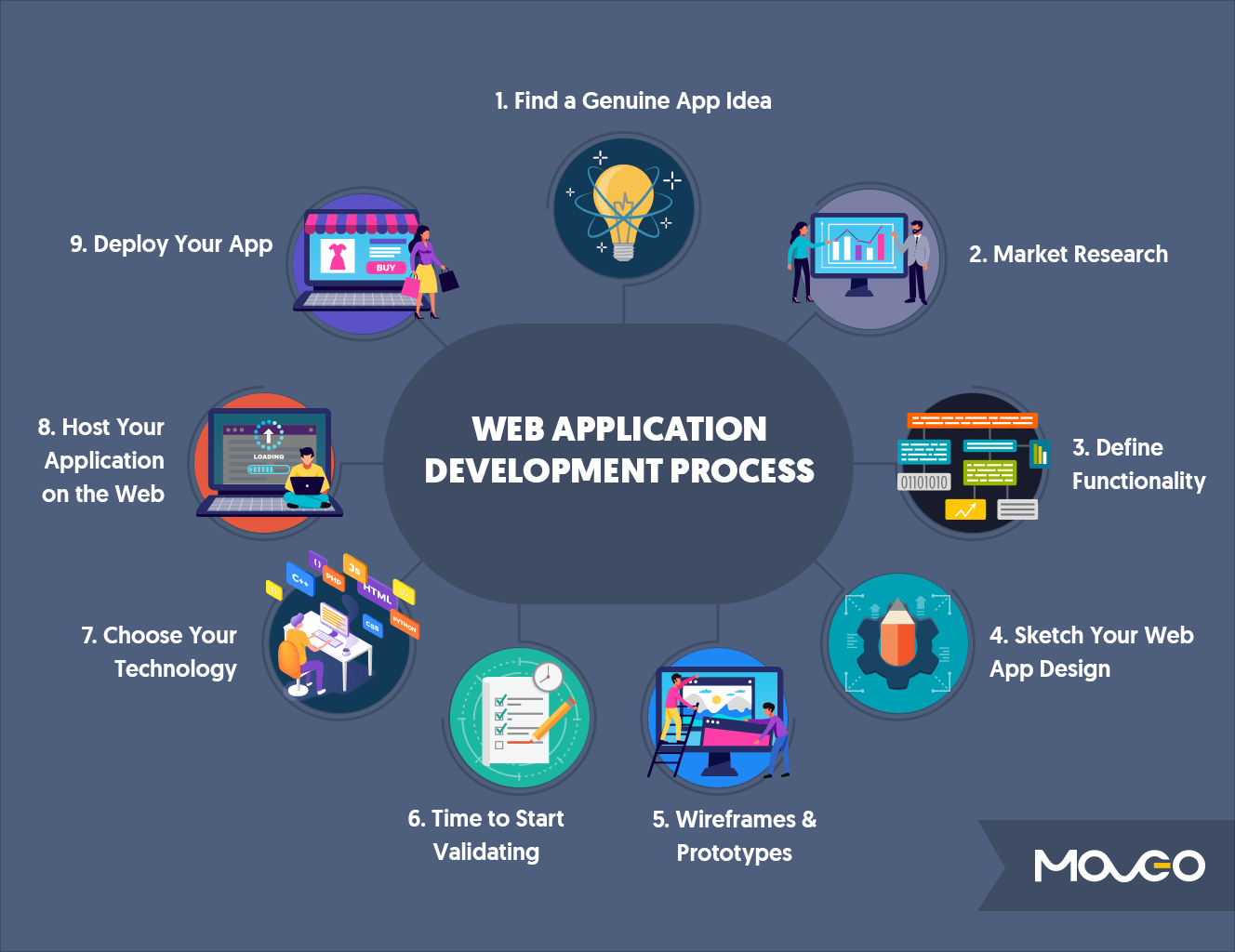
II. The Web Application Development Lifecycle: A Step-by-Step Guide
Developing a web application is a structured journey, typically following a lifecycle that ensures thorough planning, efficient execution, and robust deployment. Understanding these phases is critical for successful project delivery.
Phase 1: Planning and Discovery
This initial phase is arguably the most critical. It lays the groundwork for the entire project, defining what needs to be built and why.
- Requirements Gathering: Collaborating with stakeholders to thoroughly understand the problem the application will solve, its target audience, and key functionalities. This involves interviews, workshops, and user stories.
- Scope Definition: Clearly outlining the features and functionalities that will be included in the initial release (Minimum Viable Product – MVP) and those slated for future iterations.
- Wireframing and Prototyping: Creating skeletal outlines (wireframes) and interactive models (prototypes) of the user interface to visualize the application’s flow and layout before coding begins. This helps in gathering early feedback and refining the user experience (UX).
- UX/UI Design: Translating wireframes into polished visual designs, focusing on aesthetics, usability, accessibility, and brand consistency. This stage produces mockups and design systems.
Phase 2: Technology Stack Selection
Choosing the right combination of programming languages, frameworks, and tools is paramount. This decision impacts development speed, scalability, performance, security, and the long-term maintainability of the application.
- Frontend Frameworks: Deciding between popular JavaScript libraries/frameworks like React.js, Angular, Vue.js, or Svelte, based on project requirements, team expertise, and desired performance characteristics.
- Backend Languages/Frameworks: Selecting a server-side technology like Python (Django/Flask), Node.js (Express), Ruby (Rails), PHP (Laravel), or Java (Spring Boot) that aligns with the application’s complexity, data processing needs, and scalability goals.
- Database Choices: Determining whether a relational (SQL) database like PostgreSQL or MySQL, or a non-relational (NoSQL) database like MongoDB or Cassandra, best suits the data structure and access patterns.
- Cloud Deployment: Planning for infrastructure, choosing a cloud provider (AWS, Azure, Google Cloud Platform), and considering containerization technologies like Docker and orchestration tools like Kubernetes.
Phase 3: Development and Coding
This is where the actual construction of the web application takes place, translating designs and requirements into functional code.
- Frontend Development: Building the user interface and user experience, implementing responsive designs, interactive components, and connecting to the backend via APIs.
- Backend Development: Writing server-side logic, developing APIs (Application Programming Interfaces) to handle requests, processing data, managing user authentication, and integrating with the database.
- API Integration: Ensuring seamless communication between the frontend, backend, and any third-party services (e.g., payment gateways, external data sources) through well-defined APIs.
Phase 4: Testing and Quality Assurance
Thorough testing is crucial to identify and rectify bugs, performance issues, and security vulnerabilities before deployment, ensuring a stable and reliable application.
- Unit Testing: Testing individual components or functions of the code in isolation to ensure they work as expected.
- Integration Testing: Verifying that different modules or services of the application work correctly when combined.
- User Acceptance Testing (UAT): Involving end-users or stakeholders to test the application in a real-world scenario, ensuring it meets business requirements and user expectations.
- Performance Testing: Evaluating the application’s responsiveness, stability, and scalability under various load conditions.
- Security Testing: Identifying potential vulnerabilities and ensuring robust protection against cyber threats.
Phase 5: Deployment and Launch
Once thoroughly tested, the application is ready to be released to the public or target users.
- Server Setup and Configuration: Provisioning and configuring servers (physical, virtual, or cloud-based) to host the application.
- Continuous Integration/Continuous Deployment (CI/CD): Implementing automated pipelines for building, testing, and deploying code changes, streamlining the release process.
- Go-Live: Making the application accessible to users, which often involves domain registration, DNS configuration, and final server adjustments.
Phase 6: Maintenance and Iteration
The development journey doesn’t end with launch. Post-deployment activities are vital for long-term success.
- Bug Fixes and Updates: Addressing any unforeseen issues or vulnerabilities that emerge post-launch.
- Feature Enhancements: Continuously improving the application based on user feedback, market trends, and evolving business needs.
- Monitoring and Analytics: Tracking application performance, user behavior, and system health to identify areas for optimization and future development.
- Security Audits: Regular security checks and updates to protect against new threats.
III. Essential Technologies and Tools for Modern Web Development
The landscape of web development is dynamic, with new technologies emerging constantly. However, a core set of tools and technologies forms the foundation of most modern web applications.
Frontend Technologies
- HTML (HyperText Markup Language): The standard language for creating web pages and web applications, providing structure and content.
- CSS (Cascading Style Sheets): Used to style the appearance of web content, including colors, fonts, layout, and responsiveness.
- JavaScript: An indispensable scripting language that enables interactivity, dynamic content, and complex client-side functionalities.
- Frameworks & Libraries:
- React.js: A declarative, component-based JavaScript library for building user interfaces, maintained by Facebook.
- Angular: A comprehensive, opinionated framework for building large-scale single-page applications, maintained by Google.
- Vue.js: A progressive framework known for its simplicity and versatility, often favored for smaller to medium-sized projects or integrating into existing ones.
Backend Technologies
- Node.js (with Express.js): A JavaScript runtime environment that allows server-side scripting, often paired with the minimalist Express.js framework for building fast, scalable network applications.
- Python (with Django/Flask): Python is renowned for its readability and extensive libraries. Django is a high-level, “batteries-included” framework for rapid development, while Flask is a lightweight microframework offering more flexibility.
- Ruby (with Rails): Ruby on Rails is a convention-over-configuration framework known for its developer-friendliness and productivity, ideal for quickly building robust applications.
- PHP (with Laravel): PHP remains a dominant server-side language, and Laravel is a powerful, elegant framework that simplifies complex tasks with an expressive syntax.
- Java (with Spring Boot): Java is a highly performant and secure language, widely used in enterprise-level applications, with Spring Boot simplifying the creation of stand-alone, production-grade Spring applications.
Databases
- SQL Databases (Relational):
- PostgreSQL: An open-source object-relational database system known for its robustness, feature set, and high performance.
- MySQL: A popular open-source relational database, widely used for web applications due to its reliability and ease of use.
- Microsoft SQL Server: A commercial relational database management system from Microsoft.
- NoSQL Databases (Non-Relational):
- MongoDB: A document-oriented database that stores data in flexible, JSON-like documents, excellent for handling large volumes of unstructured data.
- Redis: An in-memory data structure store, used as a database, cache, and message broker, known for its extreme speed.
Cloud Platforms
- Amazon Web Services (AWS): The most comprehensive and widely adopted cloud platform, offering a vast array of services from computing and storage to machine learning.
- Microsoft Azure: Microsoft’s cloud computing service, providing a wide range of services for building, deploying, and managing applications.
- Google Cloud Platform (GCP): Google’s suite of cloud computing services, known for its strong data analytics and machine learning capabilities.
Version Control
- Git: A distributed version control system that tracks changes in source code during software development, allowing multiple developers to collaborate efficiently.
- Platforms: GitHub, GitLab, and Bitbucket are popular web-based hosting services for Git repositories, offering collaboration features, issue tracking, and CI/CD integration.
Other Development Tools
- Integrated Development Environments (IDEs): Visual Studio Code, WebStorm, Sublime Text, Atom – provide comprehensive features for coding, debugging, and project management.
- Package Managers: npm (Node.js), pip (Python), Bundler (Ruby) – automate the process of installing, updating, and managing project dependencies.
- API Testing Tools: Postman, Insomnia – used to test and document APIs during development.
IV. Best Practices for Successful Web Application Development
Adopting best practices throughout the development lifecycle can significantly improve the quality, maintainability, and longevity of your web application.
Prioritize User Experience (UX) and User Interface (UI)
A well-designed, intuitive, and aesthetically pleasing interface is crucial for user adoption and satisfaction. Invest in user research, usability testing, and professional design to create an experience that is both functional and enjoyable.
Embrace Agile Methodologies
Agile approaches like Scrum or Kanban promote iterative development, continuous feedback, and adaptability to change. This allows teams to deliver value incrementally, respond quickly to new requirements, and ensure the final product meets evolving user needs.
Write Clean, Maintainable, and Scalable Code
Adhere to coding standards, use clear naming conventions, comment your code, and refactor regularly. This makes the codebase easier to understand, debug, and extend, facilitating long-term maintenance and collaboration. Design for scalability from the outset, considering future growth in users and data.
Implement Robust Security Measures
Security should be a non-negotiable aspect at every stage. Protect against common vulnerabilities such as SQL injection, cross-site scripting (XSS), and cross-site request forgery (CSRF). Implement strong authentication and authorization, use HTTPS, encrypt sensitive data, and regularly update dependencies. Conduct security audits and penetration testing.
Focus on Performance Optimization
Slow web applications frustrate users and lead to high abandonment rates. Optimize images, minify CSS and JavaScript, leverage browser caching, use content delivery networks (CDNs), and optimize database queries to ensure fast loading times and a smooth user experience.
Plan for Scalability from Day One
Anticipate future growth. Design your application architecture to handle increased traffic and data volumes without significant re-engineering. This might involve using microservices, load balancers, database sharding, and horizontally scalable cloud services.
V. Navigating Challenges and Future Trends
Developing web applications comes with its own set of challenges, but also exciting opportunities fueled by emerging technologies.
Common Pitfalls to Avoid
- Scope Creep: Uncontrolled expansion of project scope and requirements, leading to delays and budget overruns. Strict scope management is vital.
- Poor Planning: Inadequate initial planning can result in a misaligned product, technical debt, and frequent rework.
- Inadequate Testing: Rushing the testing phase often leads to buggy applications, poor user experiences, and costly post-launch fixes.
- Ignoring Security: Overlooking security can have catastrophic consequences, including data breaches, reputational damage, and legal liabilities.
- Technical Debt: Prioritizing quick fixes over clean code and proper architecture can accumulate technical debt, making future development slow and complex.
The Rise of Serverless Computing and Microservices
These architectural patterns are gaining traction. Serverless computing allows developers to build and run applications without managing servers, abstracting infrastructure concerns. Microservices break down applications into small, independent services, improving scalability, resilience, and development agility.
AI Integration and Machine Learning
Artificial intelligence and machine learning are increasingly integrated into web applications for personalized experiences, intelligent search, predictive analytics, automation, and advanced data processing capabilities.
Progressive Web Apps (PWAs) and Real-time Capabilities
PWAs combine the best of web and mobile apps, offering offline capabilities, push notifications, and fast loading times. Real-time technologies like WebSockets enable interactive features such as live chat, collaborative editing, and instant notifications, enhancing user engagement.

Low-Code/No-Code Platforms
These platforms are democratizing application development by allowing users to create web applications with minimal to no coding. While they offer speed and accessibility, understanding the underlying development principles remains crucial for complex or highly customized solutions.
Developing a web application is a rewarding endeavor that empowers businesses and individuals to create impactful digital experiences. By understanding the core components, diligently following the development lifecycle, leveraging the right technologies, and adhering to best practices, you can navigate the complexities and build a robust, scalable, and user-centric web application that stands the test of time and technology. The journey is continuous, marked by learning, iteration, and adaptation to the ever-evolving digital landscape, but with a solid foundation, success is within reach.
aViewFromTheCave is a participant in the Amazon Services LLC Associates Program, an affiliate advertising program designed to provide a means for sites to earn advertising fees by advertising and linking to Amazon.com. Amazon, the Amazon logo, AmazonSupply, and the AmazonSupply logo are trademarks of Amazon.com, Inc. or its affiliates. As an Amazon Associate we earn affiliate commissions from qualifying purchases.