
Elon Musk’s name is virtually synonymous with Tesla, the electric vehicle and clean energy giant. As the company’s CEO, product architect, and arguably its most prominent public face, his personal stake in Tesla is a subject of intense interest to investors, analysts, and the general public alike. Understanding the extent and nature of Musk’s ownership is crucial, as it provides insights into corporate governance, leadership incentives, and the potential impact on the company’s stock performance. This exploration delves into the financial intricacies of Elon Musk’s Tesla holdings, examining how his stake has evolved, its significance to the company’s valuation, and what it means for the financial health and future direction of one of the world’s most valuable companies.
The Significance of Founder Stock Ownership
For any publicly traded company, the level of ownership held by its founder or CEO is a powerful indicator of commitment, alignment of interests, and the concentration of voting power. In Tesla’s case, Elon Musk’s substantial stake goes far beyond mere financial investment; it is deeply intertwined with the company’s identity, strategic vision, and market perception.
Aligning Interests and Long-Term Vision
A significant ownership stake incentivizes a CEO to make decisions that prioritize the long-term health and profitability of the company. When the CEO’s personal wealth is heavily tied to the company’s stock performance, their interests are directly aligned with those of other shareholders. This alignment suggests that management decisions will likely be geared towards sustainable growth, increased shareholder value, and strategic foresight, rather than short-term gains or personal enrichment disconnected from company success. For a visionary leader like Musk, whose ambitious goals often require substantial capital investment and long development cycles, this personal financial commitment reinforces trust among investors that he is truly “in it for the long haul.”
Concentrated Voting Power and Control
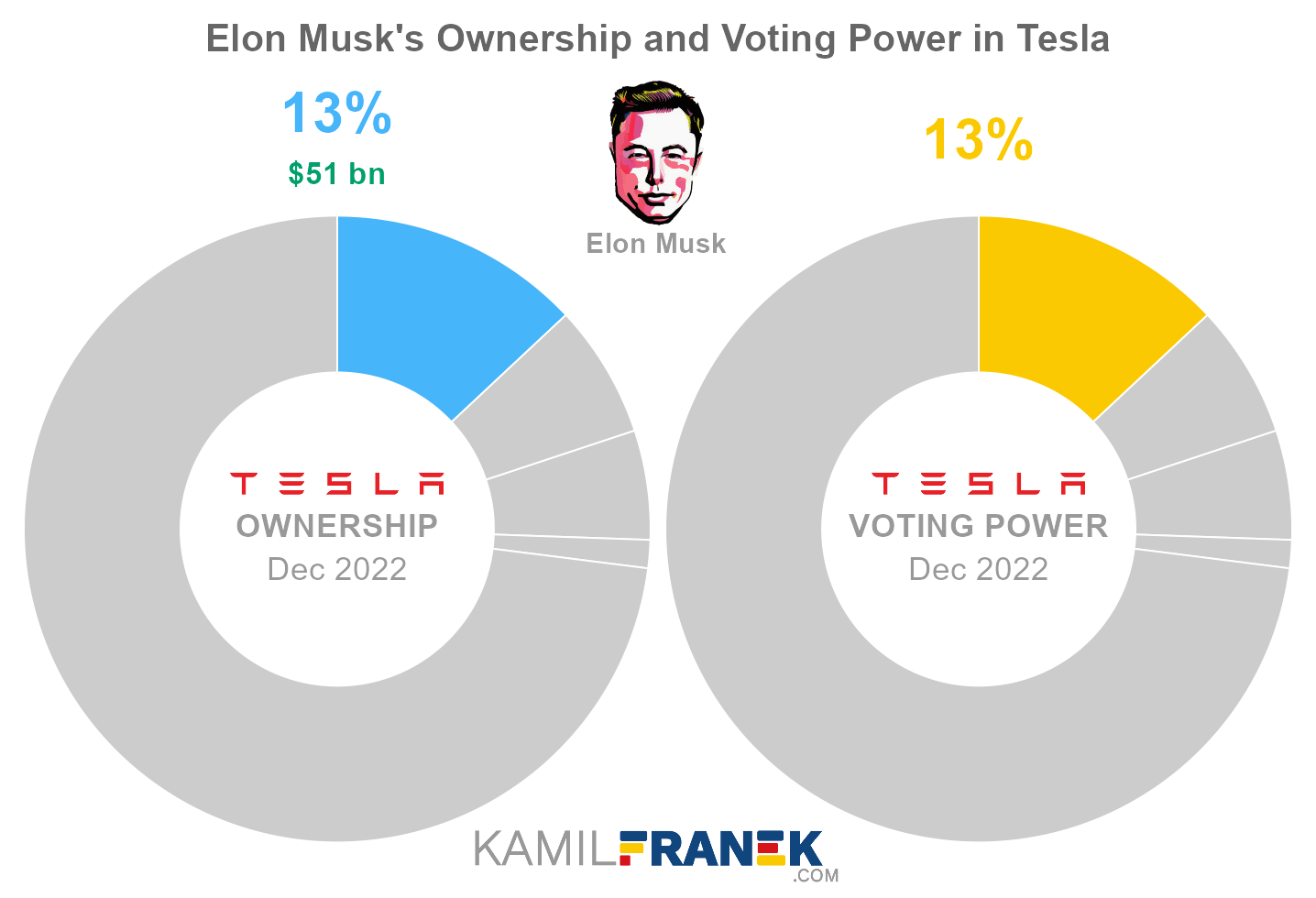
Beyond financial alignment, a large ownership stake translates into significant voting power. While the exact percentage of stock ownership held by Musk fluctuates due to various factors—including stock sales, exercise of options, and new compensation grants—his position as one of Tesla’s largest individual shareholders gives him considerable influence over corporate decisions. This power can manifest in several ways: influencing board appointments, approving major strategic initiatives, and even fending off hostile takeover attempts. For a company as innovative and often controversial as Tesla, this concentrated control allows Musk to execute his unique vision without as much resistance as a CEO with less personal skin in the game might encounter. However, it also means that the company’s direction is heavily dependent on the judgment and decisions of one individual, a factor that some investors might view as both a strength and a potential risk.
Market Perception and Investor Confidence
Elon Musk’s ownership is a significant factor in how the market perceives Tesla. His personal brand, entrepreneurial reputation, and relentless pursuit of ambitious goals are intrinsically linked to Tesla’s market narrative. A strong ownership position signals to investors that the leader believes in the company’s future prospects, acting as a potent vote of confidence. This can significantly influence investor sentiment, especially during periods of market volatility or when the company faces challenges. The perception of Musk’s unwavering commitment, backed by his substantial financial stake, often helps to sustain investor interest and confidence, contributing to Tesla’s often-premium valuation compared to traditional automotive manufacturers. Conversely, any significant reduction in his stake, especially without a clear explanation, can trigger concerns about his long-term commitment and potentially impact the stock price negatively.
Elon Musk’s Evolving Stake in Tesla
Elon Musk’s ownership percentage in Tesla has been anything but static since the company’s inception. It has changed dramatically over the years due to a complex interplay of compensation packages, strategic stock sales, and the exercise of stock options. Understanding this evolution is key to grasping the dynamics of his financial relationship with the company.
Early Ownership and Compensation Structure
Musk was an early investor and chairman of Tesla before taking on the CEO role. His initial stake was built through a combination of personal investment and founder shares. As Tesla grew and went public, his compensation increasingly shifted away from traditional cash salaries, aligning instead with performance-based stock options. This model, common for tech founders, tied his personal wealth directly to the company’s valuation and operational milestones. A notable example is his 2012 compensation package, which awarded him significant stock options contingent on Tesla achieving specific market capitalization and operational goals. This structure ensured that his financial gains were directly linked to creating immense shareholder value.
The Landmark 2018 Performance Award
Perhaps the most significant chapter in Musk’s evolving ownership came with the approval of his 2018 performance-based compensation package. This unprecedented grant of 20.3 million stock options (split into 12 tranches, each representing 1.69 million options) was designed to incentivize Musk to propel Tesla’s market capitalization from under $60 billion to an astonishing $650 billion over a decade, alongside achieving aggressive revenue and profitability targets. Each tranche vested only if Tesla hit a specific market capitalization milestone (in $50 billion increments) and either a revenue or adjusted EBITDA target. The successful vesting of these tranches over subsequent years dramatically increased Musk’s potential ownership and net worth, but it required an extraordinary level of performance from the company. The design of this package meant that Musk only benefited financially if the company, and by extension its shareholders, also saw exponential growth.
Strategic Stock Sales and Tax Implications
Despite the vesting of vast amounts of stock options, Musk’s direct ownership percentage has seen fluctuations due to strategic sales. A primary driver for these sales has been tax obligations. When stock options vest and are exercised, the difference between the strike price and the market price is considered taxable income. Given the massive value of Musk’s option grants, the resulting tax bill has often been astronomical, requiring him to sell a portion of the newly acquired shares to cover these taxes. For example, in late 2021, Musk sold billions of dollars worth of Tesla stock, largely to satisfy tax obligations related to the exercise of options from his 2012 package.
Another significant period of stock sales occurred in 2022, primarily to fund his acquisition of Twitter (now X). These sales, totaling tens of billions of dollars, temporarily reduced his direct stake in Tesla and sparked considerable debate among investors about his commitment to the EV company. While these sales were substantial, it’s crucial to distinguish between selling existing shares and exercising new options. Each time new tranches of the 2018 package vested, Musk’s potential ownership increased, even if he subsequently sold some shares for liquidity or tax purposes. As of early 2024, after accounting for recent stock awards, his ownership generally hovers between 13-20% depending on how restricted stock units and options are calculated, though these figures can vary with market conditions and new grants.
Implications of Musk’s Holdings for Investors
Elon Musk’s substantial and dynamic ownership in Tesla carries profound implications for both current and prospective investors. His stake influences everything from corporate governance and investor confidence to the company’s strategic direction and potential for future share dilution.

Investor Confidence and Market Valuation
Musk’s high personal stake is often viewed as a strong vote of confidence in Tesla’s future. For many investors, his continued, significant ownership signals his belief in the company’s long-term vision and ability to execute. This can contribute to Tesla’s premium valuation, as the market often assigns a higher multiple to companies led by founders with substantial equity. Investors might be more willing to overlook short-term challenges or controversies, believing that Musk’s deeply vested interest will ultimately guide the company through them. His ownership is a critical element of Tesla’s “story stock” appeal, where the narrative and leadership are as important as traditional financial metrics. However, this also means that any perceived wavering in his commitment, or significant, unexplained reductions in his stake, can lead to sharp negative reactions in the market, as witnessed during some of his stock sales in 2022.
Governance and Shareholder Influence
With a large ownership percentage, Musk commands significant voting power, which centralizes decision-making authority. This can be a double-edged sword for other shareholders. On one hand, it allows for swift and decisive action, enabling Tesla to pursue ambitious projects without extensive internal debate or external pressure from activist investors. This agility is a hallmark of many successful founder-led companies. On the other hand, it means that the company’s direction is heavily dependent on Musk’s personal judgment, which at times has been unpredictable or controversial. Minority shareholders have less power to influence corporate strategy or challenge management decisions, even if they disagree with them. This concentration of power raises questions about corporate governance and the balance of interests, a factor that institutional investors particularly scrutinize.
Potential for Future Stock Sales and Dilution
The existence of outstanding stock options and unvested performance awards means there’s a continuous potential for changes in Musk’s ownership and, by extension, for some level of share dilution. As more options vest and are exercised, new shares enter the market, which can slightly dilute the ownership percentage of existing shareholders. While this is a common practice for executive compensation, the sheer scale of Musk’s potential awards means that these events are closely watched. Furthermore, the possibility of future large-scale stock sales by Musk for personal liquidity, new ventures, or tax obligations always looms. While such sales are part of a financially active leader’s reality, they can create short-term selling pressure on the stock and trigger investor concern about his long-term focus on Tesla, even if those concerns are ultimately unfounded. Investors must weigh the benefits of a highly incentivized CEO against the potential for dilution and the market impact of future stock movements.
Understanding Share-Based Compensation and Its Impact
Share-based compensation is a cornerstone of executive pay at high-growth companies like Tesla, designed to tightly link leadership incentives with shareholder returns. For Elon Musk, this has been the primary mechanism through which he accrues and maintains his substantial stake, but it also has broader implications for Tesla’s financial statements and stock dynamics.
Stock Options vs. Restricted Stock Units (RSUs)
Musk’s compensation has predominantly involved stock options rather than Restricted Stock Units (RSUs). The key difference is that stock options give the holder the right to buy shares at a pre-determined price (the strike price) within a certain period, while RSUs are a promise to deliver actual shares after a vesting period, often tied to performance or time. For Musk’s massive 2018 performance award, it was structured as options. This means he had to exercise these options (pay the strike price) to convert them into actual shares, often necessitating selling a portion of those shares to cover the significant tax liability that arises at the time of exercise. This process generates cash for the company (from the strike price) but also results in a higher tax bill for the executive compared to RSUs, where the tax is typically on the full market value of the shares upon vesting.
Accounting for Share-Based Compensation
From a company’s financial perspective, share-based compensation is a non-cash expense that impacts earnings. When stock options or RSUs are granted, their fair value is recognized as an expense over the vesting period in the company’s income statement. While this doesn’t involve an immediate cash outflow, it reduces reported profits and can affect financial ratios. For Tesla, given the size of Musk’s awards and those of other executives and employees, share-based compensation expenses are significant. Investors need to understand how these expenses are accounted for and their impact on GAAP (Generally Accepted Accounting Principles) earnings, as they often lead to a divergence between reported net income and actual cash flow generated by operations. This distinction is crucial for a complete financial analysis of the company.
Dilution and Equity Value
The exercise of stock options and the vesting of RSUs result in an increase in the number of outstanding shares. This phenomenon is known as share dilution. Each new share issued represents a smaller piece of the company’s overall equity for existing shareholders. While often necessary to incentivize key talent, significant dilution can be a concern for investors, as it can reduce earnings per share (EPS) and dilute their voting power. For Tesla, the potential dilution from Musk’s compensation packages is closely monitored. However, the intent behind such large performance-based grants is that the increase in market capitalization and company value driven by the incentivized executive far outweighs the dilutive effect on a per-share basis. The calculation of fully diluted shares, which includes all exercisable options and convertible securities, is a critical metric for investors to assess the true ownership landscape and potential future impacts on per-share metrics.
Future Outlook: Musk’s Stock and Tesla’s Trajectory
The future relationship between Elon Musk’s ownership stake and Tesla’s trajectory remains a pivotal point of interest for investors and the market. His decisions regarding his shares, coupled with the company’s strategic evolution, will continue to shape investor confidence and the financial narrative.
Long-Term Commitment and Incentives
While Musk’s attention is famously divided among multiple ventures (SpaceX, X, Neuralink, Boring Company), his substantial financial stake in Tesla provides a powerful incentive for his continued dedication to its success. The design of his compensation packages, particularly the 2018 award, has ensured that his personal wealth is almost entirely tied to Tesla’s market performance. This structure suggests that he remains highly motivated to drive the company toward its ambitious goals, from ramping up vehicle production and expanding into new energy solutions to advancing AI and robotics. Any significant, sustained reduction in his holdings, beyond tax-related sales or specific liquidity needs, would be scrutinized heavily and could signal a shift in his long-term focus, potentially impacting investor sentiment. Conversely, maintaining or even increasing his stake through new performance awards would reinforce his commitment.
Shareholder Demands and Governance Changes
Recently, shareholders have shown increasing interest in Musk’s compensation and ownership. A notable event was the Delaware Chancery Court’s decision in early 2024 to invalidate Musk’s 2018 compensation package, citing concerns over conflicts of interest and the board’s independence. While Tesla’s board has indicated it will seek to re-approve a similar or new compensation package, this event highlights the ongoing tension between extraordinary executive incentives and corporate governance principles. Any new compensation structure for Musk will be closely watched by investors, not just for its size but also for its transparency, performance metrics, and the process by which it’s approved. Future governance changes, potentially driven by investor pressure or regulatory scrutiny, could impact the dynamics of Musk’s ownership and his influence over the company.

Impact on Tesla’s Valuation and Strategic Direction
Musk’s stock ownership and the capital markets’ perception of his leadership are inextricably linked to Tesla’s valuation. As Tesla continues its transition from primarily an automotive company to a broader AI, robotics, and energy entity, Musk’s vision and financial backing will be critical. His ability to secure capital, attract top talent, and navigate complex technological and regulatory landscapes is bolstered by his significant personal investment. The market often prices in a “Musk premium” due to his reputation for innovation and execution. Therefore, his continued financial commitment and effective leadership, underpinned by his substantial stock ownership, will likely remain a key factor in Tesla’s ability to fund its expansive future projects, sustain its growth trajectory, and maintain its premium valuation in the global financial markets. Any shifts in his ownership or the market’s perception of his long-term involvement will undoubtedly have profound consequences for Tesla’s financial future.
aViewFromTheCave is a participant in the Amazon Services LLC Associates Program, an affiliate advertising program designed to provide a means for sites to earn advertising fees by advertising and linking to Amazon.com. Amazon, the Amazon logo, AmazonSupply, and the AmazonSupply logo are trademarks of Amazon.com, Inc. or its affiliates. As an Amazon Associate we earn affiliate commissions from qualifying purchases.