
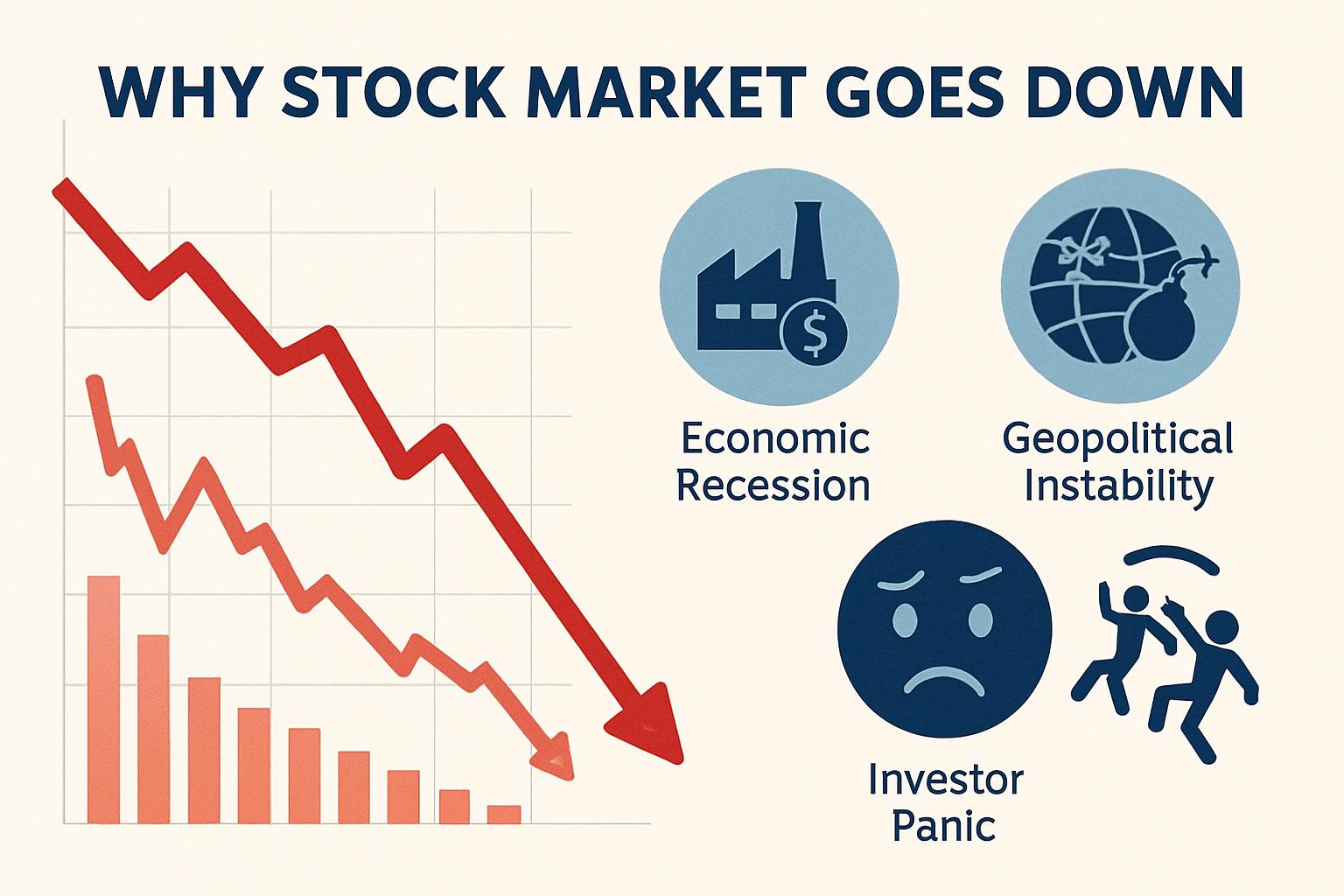
The ebb and flow of the stock market are inherent to its nature. While periods of sustained growth often dominate headlines, the inevitable downturns can be unsettling, prompting investors, analysts, and everyday citizens to ask a fundamental question: “Why are stocks down?” Understanding the multifaceted reasons behind market declines is crucial for making informed financial decisions, maintaining perspective, and navigating the inherent volatility of investing. Stock market downturns are rarely attributable to a single factor; instead, they typically arise from a complex interplay of macroeconomic forces, geopolitical events, corporate performance, and prevailing investor sentiment.
In recent times, a confluence of significant global events and shifts in economic paradigms has created an environment ripe for market corrections and sustained declines. From inflationary pressures reminiscent of decades past to unprecedented geopolitical tensions, the factors at play are both systemic and nuanced. This article delves into the primary drivers behind current stock market weakness, offering a professional and insightful analysis to help demystify the complex forces at work.
I. Macroeconomic Headwinds: The Broad Strokes
The health of the broader economy is perhaps the most significant determinant of stock market performance. When the economic landscape becomes challenging, companies face increased costs, reduced demand, and uncertainty, all of which weigh heavily on their valuations. A series of powerful macroeconomic headwinds have coalesced to create a particularly challenging environment for equity markets.
Inflationary Pressures and Eroding Purchasing Power
One of the most pervasive issues dominating economic discourse is inflation. After decades of relatively subdued price increases, many economies have experienced a surge in inflation, driven by a combination of factors including robust post-pandemic demand, supply chain bottlenecks, and significant fiscal stimulus. When the cost of goods and services rises rapidly, it erodes the purchasing power of consumers and increases operational costs for businesses. For investors, high inflation means that the real return on their investments diminishes unless their gains significantly outpace the inflation rate. Moreover, companies often struggle to pass on all increased costs to consumers, leading to compressed profit margins and lower earnings expectations, which directly impact stock prices. The persistent nature of current inflation has prompted central banks worldwide to take aggressive action, which brings us to the next crucial factor.
Rising Interest Rates and Their Impact on Valuations
In response to persistent inflation, central banks, most notably the U.S. Federal Reserve, have embarked on aggressive campaigns of interest rate hikes. The primary objective of raising interest rates is to cool down an overheating economy by making borrowing more expensive, thereby reducing demand and theoretically bringing inflation under control. However, higher interest rates have a profound impact on the stock market. Firstly, they increase the cost of capital for businesses, making it more expensive for companies to borrow money for expansion, investment, or even to service existing debt. This can dampen future growth prospects. Secondly, and perhaps more critically for valuations, higher interest rates reduce the present value of future earnings. In financial modeling, a higher discount rate (influenced by interest rates) means that a company’s projected future profits are worth less today, leading analysts to lower their price targets and investors to demand lower prices for stocks. Growth stocks, which often promise significant future earnings but may have limited current profits, are particularly vulnerable to this effect.
Fears of Economic Recession and Slowing Growth
The aggressive monetary tightening aimed at combating inflation carries an inherent risk: pushing the economy into a recession. A recession is characterized by a significant decline in economic activity spread across the economy, lasting more than a few months, normally visible in real GDP, real income, employment, industrial production, and wholesale-retail sales. Investors constantly monitor economic indicators for signs of an impending slowdown. Fears of a recession directly impact stock prices because a contracting economy typically means lower corporate earnings, higher unemployment, and reduced consumer spending. Businesses facing decreased demand and tightening credit are less attractive investment propositions. The uncertainty surrounding the likelihood and severity of a recession causes investors to become risk-averse, pulling capital out of equities and moving towards safer assets like government bonds or cash, further contributing to stock market declines.
The Looming Specter of Quantitative Tightening
Beyond raising benchmark interest rates, some central banks have also initiated “quantitative tightening” (QT). This involves reducing the size of their balance sheets by selling off government bonds and other assets accumulated during periods of quantitative easing (QE). During QE, central banks injected liquidity into the financial system, which often supported asset prices, including stocks. Conversely, QT effectively withdraws liquidity from the market. This reduction in the money supply can lead to higher long-term interest rates, tighter credit conditions, and reduced availability of capital for investment. By making money scarcer and more expensive, QT acts as an additional drag on economic growth and corporate profitability, compounding the negative effects of interest rate hikes on equity valuations.
II. Geopolitical Instability and Global Uncertainty
Beyond the immediate economic levers, the geopolitical landscape plays a significant, often unpredictable, role in shaping market sentiment and influencing investment decisions. Global events can introduce layers of uncertainty that prompt investors to adopt a more cautious stance, leading to sell-offs.
International Conflicts and Their Economic Ripple Effects
Major international conflicts, such as the war in Ukraine, introduce immense uncertainty into global markets. The direct human and economic costs are staggering, but the ripple effects are felt worldwide. Conflicts can disrupt critical supply chains, particularly for essential commodities like oil, natural gas, and agricultural products, leading to price spikes and exacerbating inflation. Sanctions imposed on aggressor nations can also have unintended consequences, disrupting global trade flows and impacting the profitability of multinational corporations. The constant threat of escalation or the expansion of hostilities makes investors wary, as geopolitical tensions are notoriously difficult to predict or quantify in terms of their economic impact, leading to a flight to safety and away from riskier assets like stocks.
Trade Tensions and Supply Chain Disruptions
Even without outright military conflict, trade tensions between major economic powers can significantly depress market sentiment. Tariffs, trade barriers, and disputes over intellectual property can hinder international commerce, increase costs for businesses, and reduce corporate profits. Coupled with the lingering effects of the pandemic, such as factory shutdowns and logistical challenges, global supply chains have been stretched thin. These disruptions mean that companies struggle to source raw materials, components, or finished goods, leading to production delays, increased transportation costs, and ultimately, higher prices for consumers or reduced profitability for businesses. The inability to reliably and cost-effectively move goods globally creates a persistent headwind for corporate earnings and, consequently, for stock valuations.
Political Instability and Policy Uncertainty
Domestic and international political instability can also contribute to market downturns. Sudden changes in government, policy reversals, or prolonged political deadlock can create an unpredictable operating environment for businesses. Uncertainty regarding future tax policies, regulatory frameworks, or trade agreements makes it difficult for companies to plan and invest for the long term. Similarly, an unstable political climate within a major economic bloc or country can deter foreign investment and lead to capital flight. Investors prefer stability and predictability, and when these are lacking, they often choose to reduce their exposure to equities until the political landscape becomes clearer, leading to increased market volatility and downward pressure on stock prices.
III. Corporate Performance and Sector-Specific Challenges
Ultimately, stock prices are intrinsically linked to the performance and prospects of the underlying companies. When corporate earnings falter or specific sectors face significant headwinds, it directly translates into market declines.
Disappointing Earnings and Revenue Growth
The most direct link between a company and its stock price is its financial performance. During periods of economic stress, companies often report disappointing earnings and revenue growth. Higher operating costs (due to inflation), reduced consumer spending, and increased borrowing costs all eat into profit margins. When companies miss their earnings targets or provide lower-than-expected forward guidance, investors typically react by selling shares, leading to immediate drops in stock prices for individual companies and, if widespread, for the broader market. A consistent trend of negative earnings revisions across multiple sectors is a strong indicator of a struggling market.
Increased Cost of Capital and Debt Servicing
As interest rates rise, companies with significant debt burdens face an increased cost of servicing that debt. This means a larger portion of their revenue must go towards interest payments rather than reinvestment, dividends, or share buybacks. For companies that rely heavily on borrowing for expansion or operational needs, higher interest rates can stifle growth and even threaten solvency in extreme cases. This is particularly true for companies that piled on debt during periods of historically low interest rates. Investors become wary of companies with precarious balance sheets in a rising rate environment, leading to devaluations.
Industry-Specific Headwinds and Regulatory Scrutiny
Beyond macroeconomic and geopolitical factors, specific industries can face unique challenges that contribute to broader market downturns or lead to significant declines in particular sectors. For example, a tech sector that benefited immensely from pandemic-driven digital transformation might now face slower growth, increased competition, or regulatory scrutiny concerning data privacy or antitrust issues. Energy companies might grapple with volatile commodity prices and pressures for decarbonization. Real estate sectors could be affected by rising mortgage rates and declining demand. When a major sector experiences a significant downturn due to these specific pressures, it can have a disproportionate impact on overall market indices, especially in economies heavily weighted towards certain industries.
IV. Investor Sentiment and Market Psychology
While fundamental factors drive long-term trends, short-to-medium term market movements are heavily influenced by the collective psychology and sentiment of investors. Fear, uncertainty, and herd mentality can accelerate declines even when underlying fundamentals might not fully justify the extent of the sell-off.
The Power of Fear and Herd Mentality
Fear is a powerful emotion in financial markets. When prices begin to fall, panic can set in, leading to indiscriminate selling by investors who fear further losses. This “herd mentality” can create a self-fulfilling prophecy, where initial declines trigger more selling, pushing prices down further, irrespective of a company’s actual long-term prospects. Social media and instantaneous news cycles can amplify this effect, leading to rapid market shifts. While professional investors aim for rational decision-making, the collective psychology of the market can often override logic, especially during periods of heightened uncertainty, contributing significantly to market downturns.
Reduced Risk Appetite and Flight to Safety
During uncertain times, investors’ risk appetite typically diminishes. They become less willing to hold assets perceived as risky, such as growth stocks or emerging market equities, and instead seek “safe haven” assets. These often include government bonds (especially those from stable economies like the U.S. Treasury), gold, and even cash. The reallocation of capital from equities to safer assets naturally leads to sell-offs in the stock market. This “flight to safety” is a common characteristic of bear markets and periods of heightened geopolitical or economic stress, reflecting a fundamental shift in investor preferences towards capital preservation over aggressive growth.
Technical Indicators and Market Corrections
Beyond fundamental analysis, many investors and traders rely on technical analysis, which involves studying past market data, primarily price and volume, to forecast future price movements. When key technical indicators, such as moving averages or support levels, are breached downwards, it can trigger automated selling or prompt technically-minded investors to liquidate positions, believing that further declines are imminent. Major market indices falling below significant psychological levels (e.g., Dow Jones below 30,000) or entering officially defined “bear market” territory (a 20% or more decline from recent highs) can further erode sentiment, reinforce negative perceptions, and accelerate selling pressure.
V. The Path Forward: Navigating Volatility
Understanding “why stocks are down” is the first step toward effectively navigating challenging market periods. While the current environment presents significant headwinds, history shows that market downturns are a normal, albeit uncomfortable, part of the investing cycle. For investors, a clear strategy and an even temperament are paramount.
The Importance of Long-Term Perspective
Perhaps the most critical lesson from market history is the power of a long-term perspective. While short-term volatility can be jarring, equity markets have historically trended upwards over extended periods. Economic cycles ebb and flow, but innovation, productivity, and corporate earnings generally grow over decades. For long-term investors, market downturns can even present opportunities to acquire quality assets at lower valuations. Resisting the urge to panic sell during corrections and maintaining focus on long-term financial goals is a cornerstone of successful investing.
Diversification as a Shield
Diversification across different asset classes (equities, bonds, real estate, commodities), geographies, and sectors remains a vital strategy for mitigating risk. While diversification doesn’t guarantee profits or protect against all losses, it can help cushion the blow of downturns by ensuring that not all your investments are exposed to the same risks. When one part of your portfolio is struggling, another might be holding steady or even performing well, providing a buffer against overall portfolio declines.
Reassessing Your Risk Tolerance
Market downturns are an opportune time to reassess your personal risk tolerance. Are you truly comfortable with the level of volatility you’re experiencing? Does your current asset allocation align with your emotional capacity to withstand market fluctuations? For some, a period of decline might reveal that their portfolio was too aggressive, prompting a rebalancing towards a more conservative mix. For others, it might reinforce their conviction in their long-term strategy, enabling them to weather the storm confidently.
Opportunities in Dislocation
Finally, market downturns, while painful, often create significant opportunities for discerning investors. When the market is driven by fear and indiscriminate selling, the prices of fundamentally strong companies can fall far below their intrinsic value. For those with capital and a disciplined approach, bear markets can be ideal times to invest in high-quality businesses at attractive prices, positioning themselves for substantial gains when market sentiment eventually turns and economic conditions improve. This requires careful research, patience, and a willingness to go against the prevailing pessimistic tide.
In conclusion, the current downturn in stock markets is a complex tapestry woven from global economic shifts, geopolitical tensions, corporate performance challenges, and the powerful forces of investor psychology. While the reasons are diverse and interconnected, understanding them provides a clearer lens through which to view the present and plan for the future, reaffirming the enduring principles of disciplined, long-term investing.
aViewFromTheCave is a participant in the Amazon Services LLC Associates Program, an affiliate advertising program designed to provide a means for sites to earn advertising fees by advertising and linking to Amazon.com. Amazon, the Amazon logo, AmazonSupply, and the AmazonSupply logo are trademarks of Amazon.com, Inc. or its affiliates. As an Amazon Associate we earn affiliate commissions from qualifying purchases.