
NVIDIA Corporation (NVDA) stands as a titan in the technology sector, renowned for its graphics processing units (GPUs) that power everything from high-end gaming and professional visualization to the cutting edge of artificial intelligence and data centers. As a cornerstone of the modern digital economy, NVIDIA’s stock performance has been nothing short of spectacular, attracting immense interest from investors worldwide. For many, the journey of investing in a high-growth company like NVIDIA often involves encountering events such as stock splits. These corporate actions, while not altering the fundamental value of a company, significantly impact share price, accessibility, and investor psychology. This article delves into NVIDIA’s history of stock splits, examining the “when” and “why” behind these decisions and their broader implications for both the company and its shareholders, offering crucial insights for anyone looking to understand the dynamics of such a powerful investment.

Understanding Stock Splits: More Than Just Dividing Shares
A stock split is a corporate action in which a company divides its existing shares into multiple new shares. While it might seem like a simple mathematical adjustment, the decision to split a stock carries strategic weight, often signaling a company’s success and future outlook. It’s crucial for investors to grasp that a stock split does not change the total market capitalization of the company; rather, it changes the number of shares outstanding and, consequently, the price per share. For example, in a 2-for-1 split, an investor who previously owned one share at $200 would now own two shares at $100 each. The total value of their holding remains the same, but the composition of that holding changes.
What is a Stock Split?
At its core, a stock split is a mechanism used by companies to increase the number of their outstanding shares by dividing each existing share. The ratio of the split dictates how many new shares an investor receives for each old share they hold. Common ratios include 2-for-1, 3-for-1, 4-for-1, or even 3-for-2. The primary effect is a proportional reduction in the stock’s price per share. While the number of shares an individual investor holds increases, their percentage ownership of the company remains unchanged. Similarly, the company’s total market capitalization—calculated as the share price multiplied by the number of shares outstanding—is unaffected immediately after the split. The decision for a company’s board of directors to approve a stock split is often a response to a sustained period of significant share price appreciation, indicating robust growth and investor demand.
The Rationale Behind Splits
Companies undertake stock splits for several strategic reasons, all of which are designed to enhance shareholder value and market appeal. The most prominent reason is to make the stock more accessible and affordable to a wider range of investors, particularly individual retail investors. When a stock’s price climbs to hundreds or even thousands of dollars per share, it can become prohibitive for smaller investors to purchase full shares, especially for those with limited capital or those using fractional share investing platforms. By lowering the per-share price, a split effectively puts the stock within reach of more potential buyers, thereby increasing its liquidity. Increased liquidity means there are more buyers and sellers in the market, making it easier to trade the stock and potentially narrowing the bid-ask spread. Furthermore, a stock split can act as a psychological signal from management, conveying confidence in the company’s future growth prospects. While it doesn’t fundamentally alter the company’s financials, the perception of an “affordable” stock and the positive sentiment often associated with splits can sometimes create a temporary boost in demand.
NVIDIA’s Stock Split History: A Chronicle of Growth and Accessibility
NVIDIA’s journey as a publicly traded company has been marked by explosive growth, transforming from a graphics card pioneer into a dominant force in AI and data centers. Over its history, NVIDIA has executed several stock splits, each reflecting a period of significant appreciation in its stock price and a strategic move to maintain accessibility for investors. These splits are not just historical footnotes; they are milestones that underscore the company’s relentless innovation and market leadership.
The Early Years: Positioning for Growth (1990s – early 2000s)
NVIDIA went public in 1999, and its rapid ascent in the burgeoning PC gaming and graphics market quickly led to its first stock splits. The company’s innovative GPU technology set new benchmarks for visual computing, driving demand for its products and, consequently, its stock.
- June 28, 2000: 2-for-1 Stock Split. Less than a year after its IPO, NVIDIA executed its first split. This decision came during a period of intense growth in the tech sector and reflected the early success of its GeForce series graphics cards. The split helped manage the rising share price, making it more attractive to a broader investor base in a booming market.
- September 12, 2002: 2-for-1 Stock Split. Following its initial success, NVIDIA continued to solidify its position in the graphics market. The company’s second 2-for-1 split indicated sustained growth and a strong market reception to its product innovations. This period saw NVIDIA’s GPUs becoming standard in high-performance computing, further driving shareholder value.
Navigating the Tech Boom and Beyond (2000s – 2010s)
As NVIDIA diversified its product offerings and expanded into new markets beyond just gaming, its stock continued its upward trajectory. The company successfully navigated the challenges and opportunities of the mid-2000s, cementing its reputation as a technological innovator.
- September 7, 2006: 2-for-1 Stock Split. NVIDIA’s third 2-for-1 split occurred as the company was making significant inroads into new markets, including professional visualization and early forms of general-purpose GPU (GPGPU) computing. This split allowed NVIDIA to maintain its appeal to a wide range of investors as its share price continued to reflect its expanding influence.
- September 21, 2007: 3-for-2 Stock Split. A relatively smaller split ratio compared to its predecessors, the 3-for-2 split in 2007 still signified continued robust growth and investor confidence. This period was characterized by NVIDIA’s ongoing innovation in graphics technology and its early ventures into what would become the massive market for parallel computing and AI accelerators.
The AI Era and Recent Splits (2020s onwards)
The 2020s ushered in the era of artificial intelligence and machine learning, areas where NVIDIA’s GPU technology proved to be uniquely suited and indispensable. This accelerated demand for its chips, particularly for data centers and AI development, propelled NVIDIA’s stock to unprecedented heights, necessitating its most recent and significant stock split.
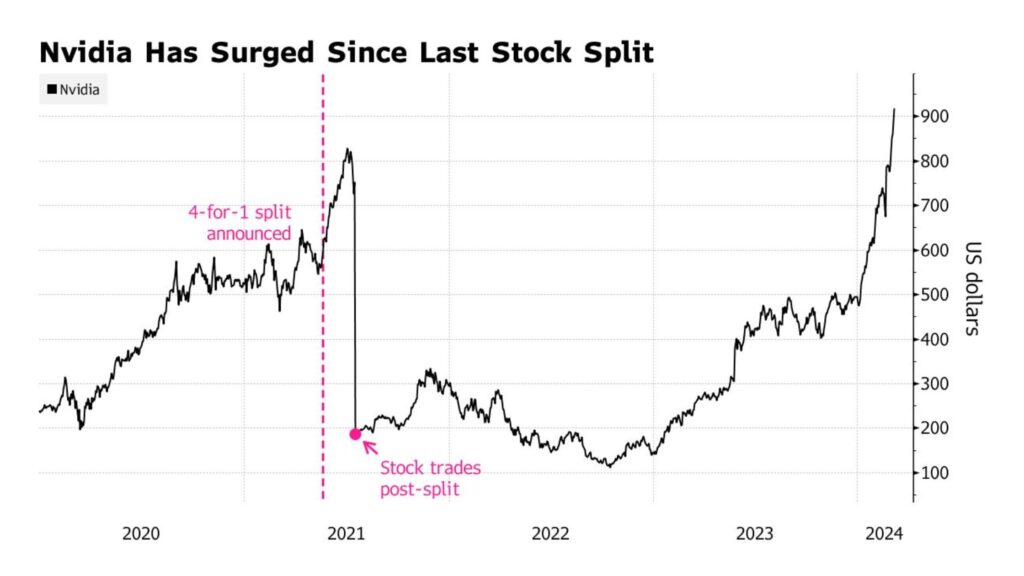
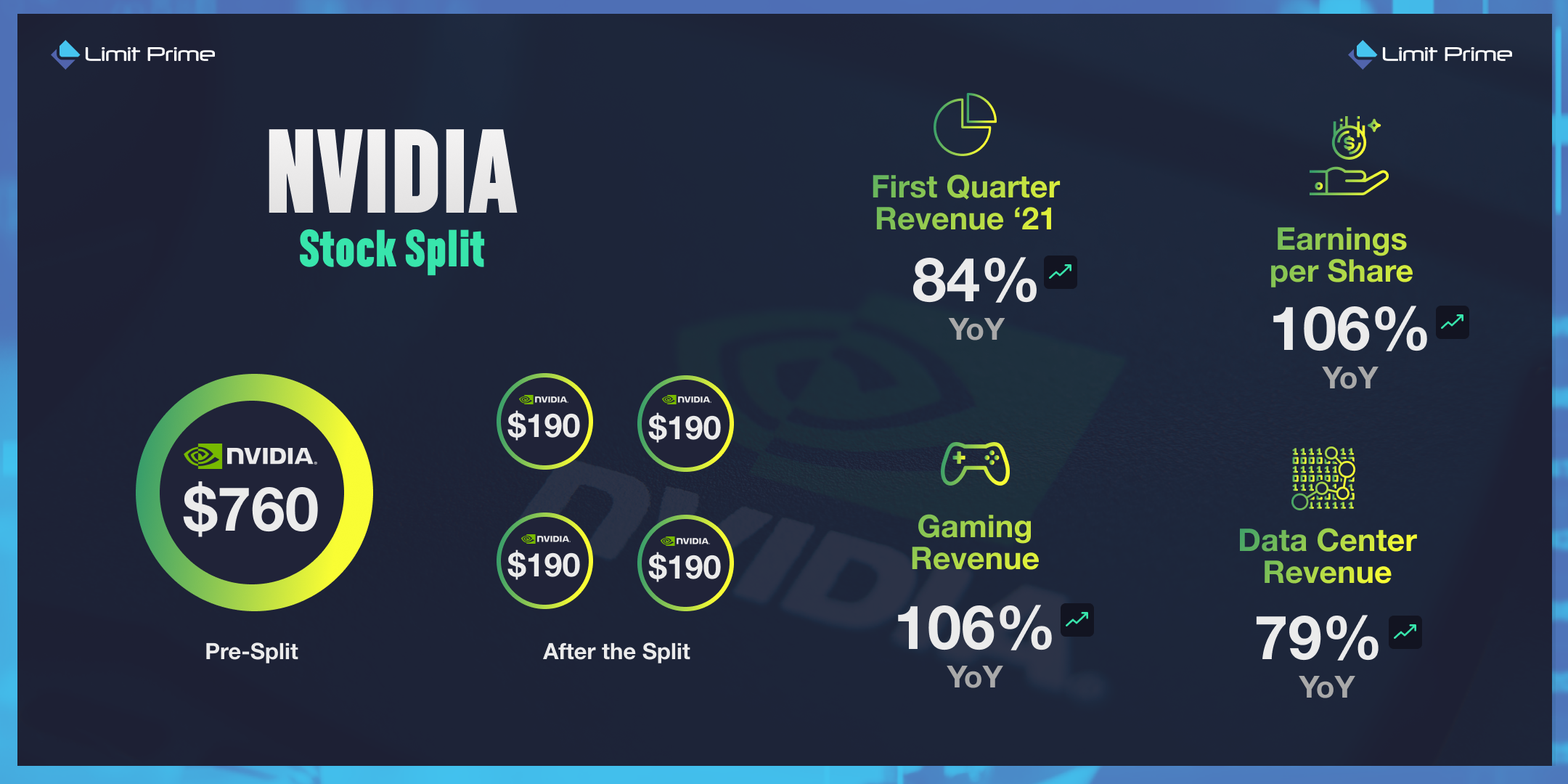
- July 20, 2021: 4-for-1 Stock Split. This was NVIDIA’s most recent and largest split to date. Occurring amidst a massive surge in demand for AI and data center solutions during and post-pandemic, NVIDIA’s stock price had soared, making it one of the most valuable tech companies globally. The 4-for-1 split dramatically reduced the per-share price, making it highly accessible to a new generation of retail investors and allowing the company to retain its position as a favored stock for diversified portfolios.
In total, NVIDIA has executed five stock splits over its history as a public company. These splits collectively represent a testament to its consistent innovation, market leadership, and the extraordinary value it has created for its shareholders over decades.
The Impact of NVIDIA’s Splits on Investors and Market Perception
While a stock split is often described as a purely cosmetic change, its effects ripple through investor behavior and market dynamics. For a high-profile company like NVIDIA, these impacts are particularly pronounced, influencing everything from trading volumes to investor demographics. Understanding these effects is crucial for any investor looking beyond the headline numbers.
Increased Accessibility and Liquidity
One of the most immediate and tangible impacts of a stock split, especially a significant one like NVIDIA’s 4-for-1 split in 2021, is the dramatic improvement in the stock’s accessibility. When a share price climbs into the hundreds or even thousands of dollars, it can be a barrier for individual investors, particularly those with smaller portfolios or those who prefer to buy whole shares rather than fractional ones. By lowering the price per share, NVIDIA effectively opened its stock to a much broader audience. This influx of new, smaller investors typically leads to increased trading volume and enhanced liquidity. Higher liquidity means that there are more buyers and sellers in the market at any given time, making it easier and often cheaper for investors to execute trades without significantly impacting the stock price. For a company as actively traded as NVIDIA, this continuous inflow of retail capital can provide an additional layer of market stability and demand.
The “Wealth Effect” and Investor Psychology
Beyond the purely mechanical changes, stock splits often trigger a positive psychological effect on investors. Even though the intrinsic value of an investor’s holdings remains unchanged post-split, many perceive a lower-priced stock as “cheaper” or “more affordable.” This perception can lead to a surge in buying interest, particularly from those who might have previously viewed the stock as too expensive. This psychological boost, sometimes referred to as a “wealth effect” (though distinct from economic wealth effect theories), can generate positive momentum for the stock. Existing shareholders, now holding more shares, might feel a greater sense of “ownership” and satisfaction, even if their overall portfolio value hasn’t fundamentally changed. This positive sentiment, while not based on fundamental financial shifts, can nonetheless contribute to a supportive market environment for the stock in the short to medium term.
Signaling Confidence and Future Growth
A stock split is rarely a random event; it’s a deliberate decision by a company’s board of directors, often seen as a vote of confidence in the company’s future prospects. When a company’s stock price has grown significantly enough to warrant a split, it indicates sustained strong performance and expectations for continued growth. By splitting the stock, management implicitly communicates to the market that they believe the current growth trajectory will persist, and the stock price will likely continue to appreciate, eventually making the “new” lower price per share climb once again. For NVIDIA, each of its five splits has reinforced its image as a growth-oriented, innovative leader. This signal can attract long-term institutional investors who seek companies with robust growth stories and stable management, further solidifying the company’s market position and investor appeal.
Beyond the Split: What Drives NVIDIA’s Long-Term Value?
While stock splits are interesting milestones in a company’s history, they are ultimately side effects of fundamental business success. For NVIDIA, the true drivers of its long-term value lie in its core business strength, relentless innovation, and dominant market position. Investors looking to understand NVIDIA’s enduring appeal must look beyond the mechanics of share division and delve into what makes the company a technological powerhouse.
Core Business Strength
NVIDIA’s strength emanates from its foundational role in critical, high-growth sectors. Its GPUs are not just for gaming; they are the backbone of modern computing. The company holds a near-monopoly in high-end discrete GPUs for gaming and has an overwhelming share in the market for AI data center accelerators. This dual dominance provides robust revenue streams. Its gaming division consistently innovates with new architectures and features, while its data center business is experiencing exponential growth, fueled by the insatiable demand for AI, machine learning, and high-performance computing (HPC). Beyond these, NVIDIA is also making significant strides in professional visualization, autonomous vehicles, and enterprise software solutions, creating a diverse yet integrated ecosystem of products and platforms that ensures sustained relevance and demand.
Innovation and Market Leadership
NVIDIA’s competitive edge is primarily driven by its unparalleled commitment to research and development and its culture of innovation. The company consistently pushes the boundaries of GPU technology, introducing new architectures (like Hopper and Blackwell), software platforms (CUDA, cuDNN), and services that empower developers and industries worldwide. This continuous innovation allows NVIDIA to stay several steps ahead of competitors, creating significant barriers to entry for newcomers. Its ecosystem approach, combining powerful hardware with extensive software development tools, creates a sticky platform that is difficult for customers to leave. This market leadership is not just about producing the fastest chips; it’s about defining the future of computing across diverse applications, from scientific discovery to creating immersive metaverse experiences.
Financial Performance and Future Outlook
The reflection of NVIDIA’s core strengths and innovation is consistently seen in its financial performance. The company has demonstrated impressive revenue growth, strong profit margins, and robust free cash flow generation over many years. Its financial health allows for continued investment in R&D, strategic acquisitions, and returns to shareholders. Looking ahead, the future outlook for NVIDIA remains incredibly strong. The secular trends of AI adoption, increasing data center needs, and advancements in graphics technology are long-term tailwinds that directly benefit NVIDIA’s core businesses. As AI becomes more integrated into every industry and aspect of life, NVIDIA’s position as the leading enabler of this revolution ensures its continued growth and relevance, making it a compelling long-term investment proposition that extends far beyond any single stock split event.
Navigating Future Investment Decisions with NVIDIA
For investors, understanding NVIDIA’s stock split history offers valuable context, but it’s only one piece of the puzzle. Making informed investment decisions requires a comprehensive approach that prioritizes fundamental analysis over transient market events. While splits can create opportunities, they should not be the sole basis for an investment.
Splits as a Catalyst, Not a Fundamental Driver
It’s crucial to remember that stock splits are corporate actions designed to manage share price and liquidity; they do not fundamentally alter the underlying value or financial health of a company. A split simply divides the existing pie into more slices without changing the size of the pie itself. Therefore, while a split might generate positive market sentiment and increase short-term trading interest, it should not be considered a primary driver for an investment decision. Investors should view splits as an indicator of past success and management’s confidence, but always ground their decisions in a thorough understanding of the company’s business fundamentals.
The Importance of Due Diligence
Successful investing in a company like NVIDIA hinges on rigorous due diligence. This involves analyzing its financial statements (revenue growth, profitability, balance sheet strength), evaluating its competitive landscape and market position, understanding its product roadmap and innovation pipeline, and assessing the quality of its management team. Investors should research NVIDIA’s dominance in AI, its expanding data center business, its ongoing innovation in gaming, and its ventures into new markets like autonomous vehicles. A deep dive into these fundamental aspects will provide a much clearer picture of NVIDIA’s intrinsic value and future growth potential than merely observing its stock split history.
Long-Term vs. Short-Term Perspectives
NVIDIA’s journey has been one of consistent, long-term growth driven by technological innovation. Its stock splits have served to make this growth more accessible over time. For investors, this history underscores the value of a long-term investment horizon. While short-term fluctuations and the excitement around events like splits can be tempting, the most significant returns often come from holding shares of fundamentally strong companies over extended periods, allowing compounding to work its magic. Focusing on NVIDIA’s long-term strategic vision, its role in shaping future technologies, and its consistent financial performance will likely yield better results than attempting to trade on the immediate aftermath of a stock split.
In conclusion, NVIDIA has split its stock five times, each instance marking a period of significant growth and a strategic move to enhance investor accessibility. While these events are testament to the company’s remarkable success, savvy investors understand that the true value of NVIDIA lies in its unparalleled innovation, market dominance, and robust financial performance. For those navigating the complexities of the stock market, NVIDIA’s story serves as a powerful reminder: stock splits are significant signposts, but the real journey of wealth creation is powered by fundamental analysis and a patient, long-term perspective.
aViewFromTheCave is a participant in the Amazon Services LLC Associates Program, an affiliate advertising program designed to provide a means for sites to earn advertising fees by advertising and linking to Amazon.com. Amazon, the Amazon logo, AmazonSupply, and the AmazonSupply logo are trademarks of Amazon.com, Inc. or its affiliates. As an Amazon Associate we earn affiliate commissions from qualifying purchases.