
In the dynamic world of investing, discerning investors constantly seek vehicles that offer the potential for accelerated returns. Among the myriad of available options, leveraged Exchange-Traded Funds (ETFs) have carved out a niche, captivating those with a higher risk tolerance and a keen eye on market movements. Standing out prominently in this segment is TQQQ, officially known as the ProShares UltraPro QQQ. This particular ETF is a powerful, yet complex, instrument designed to deliver three times (3x) the daily performance of its underlying index, the NASDAQ-100.
Understanding TQQQ goes beyond merely knowing its ticker symbol; it requires a deep dive into the mechanics of leveraged products, the nuances of its daily rebalancing, and a clear-eyed assessment of its inherent risks and potential rewards. It is not a traditional long-term investment tool, but rather a specialized product best understood and utilized by sophisticated investors or those willing to dedicate significant time to market analysis and risk management. This article aims to demystify TQQQ, exploring its operational principles, its suitability for various investment strategies, and the critical considerations one must undertake before incorporating it into a financial portfolio.

Decoding Leveraged Exchange-Traded Funds (ETFs)
Before dissecting TQQQ specifically, it’s crucial to grasp the foundational concepts of ETFs and, subsequently, the additional layer of complexity introduced by leverage. This understanding forms the bedrock for appreciating TQQQ’s unique characteristics and potential implications for an investor’s capital.
The Foundation: How Standard ETFs Work
An Exchange-Traded Fund (ETF) is an investment fund that holds assets such as stocks, commodities, or bonds, and trades on stock exchanges much like regular stocks. ETFs offer diversification, often tracking a specific index (like the S&P 500 or NASDAQ-100), sector, or commodity. They provide investors with a cost-effective and liquid way to gain exposure to a broad range of assets without having to buy individual components. Unlike mutual funds, ETFs can be bought and sold throughout the trading day at market prices, offering flexibility and transparency. They typically have lower expense ratios than actively managed mutual funds and can be tax-efficient.
The Mechanism of Leverage in ETFs
Leveraged ETFs represent a specialized sub-category of ETFs designed to amplify the returns of an underlying index or benchmark. These funds use financial derivatives, such as futures contracts, options, and swaps, along with borrowed capital, to achieve their stated leverage objective. For instance, a 2x leveraged ETF aims to deliver twice the daily return of its benchmark, while a 3x leveraged ETF, like TQQQ, strives for three times the daily return. This means if the underlying index goes up by 1% on a given day, a 3x leveraged ETF aims to go up by 3% (before fees and expenses). Conversely, if the index falls by 1%, the leveraged ETF aims to fall by 3%. The appeal lies in the potential for significant gains when the market moves favorably, but this also inherently magnifies losses.
The Critical Role of Daily Rebalancing
One of the most vital, yet often misunderstood, aspects of leveraged ETFs is their “daily reset” or “daily rebalancing” mechanism. Leveraged ETFs are designed to achieve their stated multiple on a daily basis. This means the fund’s exposure to the underlying index is reset at the end of each trading day to maintain the desired leverage ratio (e.g., 3x). While this daily rebalancing ensures the fund consistently targets its leverage, it has profound implications for returns over periods longer than a single day. Compounding, volatility drag, and path dependency can cause the actual returns of a leveraged ETF over weeks, months, or years to significantly deviate from simply multiplying the underlying index’s return over the same period. This deviation is particularly pronounced during volatile periods or extended sideways markets, often leading to performance decay.
TQQQ Unveiled: ProShares UltraPro QQQ
With the general principles of leveraged ETFs established, we can now focus specifically on TQQQ, understanding its target, structure, and operational goals. This insight is crucial for any investor considering this powerful instrument.
The Underlying Index: NASDAQ-100
TQQQ’s performance is tied directly to the NASDAQ-100 Index. The NASDAQ-100 is a modified capitalization-weighted index composed of 100 of the largest non-financial companies listed on the NASDAQ stock market. It is heavily weighted towards growth sectors such as technology, telecommunications, retail, and biotechnology. Companies like Apple, Microsoft, Amazon, Google (Alphabet), and Tesla are prominent components. Because of its concentration in these high-growth, often volatile sectors, the NASDAQ-100 itself can experience significant swings, which are then further amplified by TQQQ’s leverage. Understanding the nature and composition of this underlying index is paramount, as TQQQ essentially offers a magnified bet on the daily movements of these prominent technology and growth companies.
The 3x Multiplier Explained
As its name suggests (UltraPro), TQQQ aims to provide 300% of the daily performance of the NASDAQ-100 Index. This “3x multiplier” is achieved through a complex array of financial engineering, primarily utilizing futures contracts and swap agreements. For every dollar invested in TQQQ, the fund seeks to gain exposure equivalent to three dollars’ worth of the NASDAQ-100’s daily movements. This aggressive leverage is what makes TQQQ so attractive during strong bull runs, offering the potential for rapid wealth accumulation. However, it is also the primary driver of its extreme risk profile, as even small downward movements in the NASDAQ-100 can lead to substantial percentage losses in TQQQ on a daily basis.
Objectives and Structure of TQQQ
The stated investment objective of ProShares UltraPro QQQ is to seek daily investment results that correspond to three times (3x) the daily performance of the NASDAQ-100 Index. It is important to reiterate that this objective is for daily performance. TQQQ is managed by ProShares, a leading provider of leveraged and inverse ETFs. The fund employs sophisticated strategies and instruments to maintain its leverage ratio, which involves constant monitoring and rebalancing. Due to its structure, TQQQ is primarily intended for sophisticated investors who actively monitor their positions and understand the profound implications of daily compounding and volatility on long-term returns. It is generally not recommended for investors seeking passive, buy-and-hold strategies for extended periods.
Navigating the High-Stakes World of TQQQ: Opportunities and Hazards

Investing in TQQQ is akin to driving a high-performance sports car: it offers exhilarating speed and power, but also demands precision, skill, and an acute awareness of the road’s conditions. Its unique structure presents both compelling opportunities for accelerated gains and significant hazards that can quickly erode capital.
The Allure of Magnified Gains in Upward Trends
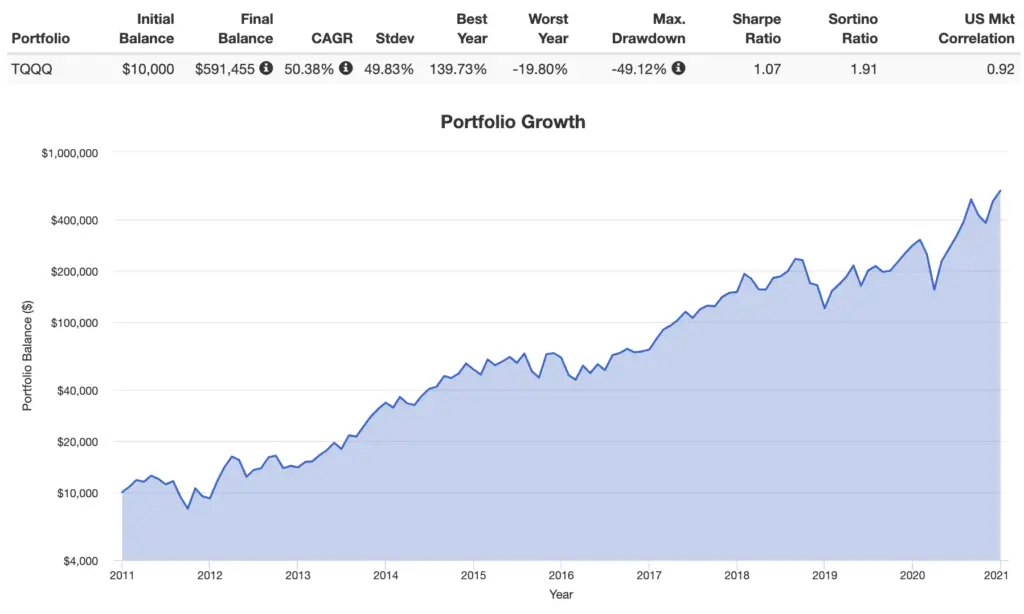
The primary attraction of TQQQ is its potential to deliver outsized returns during strong upward trending markets. If the NASDAQ-100 rises by 2% on a given day, TQQQ is designed to rise by approximately 6%. Over several consecutive positive days, this compounding effect can lead to very rapid portfolio growth, far exceeding what would be achieved by investing directly in the NASDAQ-100 or a non-leveraged ETF tracking it. For investors with a strong bullish conviction about the tech sector and the broader market, and a belief that such trends will be sustained over a short-to-medium term, TQQQ offers an avenue to capitalize significantly on these movements. It can be a powerful tool for short-term tactical plays during confirmed uptrends.
The Drastic Impact of Compounding and Volatility Drag
While compounding can be an investor’s best friend in an upward trend, it becomes a formidable adversary during periods of high volatility or downward movements. Due to the daily rebalancing, the impact of compounding over multiple days, weeks, or months can lead to significantly different results than simply multiplying the underlying index’s cumulative return by three. This phenomenon is often referred to as “volatility drag” or “beta decay.”
Consider a scenario where the NASDAQ-100 goes up 10% one day and down 10% the next. The index is almost back to where it started (down slightly). However, TQQQ would likely be up 30% on day one, and then down 30% of the new higher value on day two. The resulting loss for TQQQ would be significantly greater than the minor loss in the underlying index, leaving the TQQQ investor with a much larger deficit. This effect means that even if the NASDAQ-100 finishes flat over a period, TQQQ is likely to show a substantial loss if there was significant daily volatility along the way.
Performance in Sideways and Downtrending Markets
TQQQ performs particularly poorly in sideways or range-bound markets. Even if the NASDAQ-100 ends a month at the same level it started, if it experienced daily ups and downs, the daily rebalancing and compounding effect will almost certainly lead to a loss for TQQQ. In downtrending markets, the losses are naturally amplified. If the NASDAQ-100 falls by 1% for 10 consecutive days, an investor in TQQQ would experience cumulative losses far exceeding 30%. This makes TQQQ an extremely unsuitable instrument for bearish market conditions or periods of uncertainty. Its directional bet makes it highly vulnerable to adverse market shifts.
TQQQ’s Role for Short-Term Traders
Given the significant impact of daily rebalancing and volatility drag, TQQQ is almost exclusively recommended for short-term trading. It is not designed to be a “buy-and-hold” investment for months or years. Day traders, swing traders, and those who actively manage their portfolios and can monitor market conditions closely may use TQQQ to express a strong, short-term bullish conviction on the NASDAQ-100. For these investors, TQQQ offers the leverage needed to potentially generate significant returns from brief market movements, provided they are correct in their timing and direction.
Prudent Investment Strategies and Risk Management with TQQQ
The high-risk, high-reward nature of TQQQ necessitates a stringent approach to investment strategy and risk management. Without these safeguards, even experienced investors can face substantial capital erosion.
Essential Due Diligence and Market Analysis
Before even considering TQQQ, an investor must conduct thorough due diligence not only on the ETF itself but also on the broader market and the NASDAQ-100’s prospects. This involves understanding macroeconomic trends, geopolitical events, company-specific news within the NASDAQ-100, and technical analysis of the index. TQQQ is highly sensitive to market sentiment and momentum. Relying on gut feelings or incomplete information is a recipe for significant losses. A robust understanding of current market direction and potential catalysts for strong upward movement is critical.
Implementing Strict Position Sizing and Stop-Loss Orders
Given TQQQ’s amplified volatility, conservative position sizing is paramount. Allocating a small percentage of one’s total portfolio to TQQQ, proportionate to one’s conviction and risk tolerance, is a wise strategy. Never overcommit capital that you cannot afford to lose. Furthermore, the use of strict stop-loss orders is not just recommended, but essential. A stop-loss order automatically sells your position if the price falls to a predetermined level, limiting potential losses. This proactive risk management tool is vital for preventing catastrophic drawdowns, especially during sudden market reversals or unexpected news events. Without a predefined exit strategy for losses, TQQQ can rapidly deplete capital.
Considering Alternatives and Diversification
For most long-term investors, traditional, non-leveraged ETFs that track the NASDAQ-100 (such as QQQ) or a broader market index (like SPY) are more appropriate. These offer exposure to the same underlying assets without the added complexity and risk of daily leverage and volatility decay. For those seeking some level of enhanced returns without the extreme risk of TQQQ, less aggressively leveraged ETFs (e.g., 1.5x or 2x) might be considered, though they still carry significant risks compared to unleveraged options. Diversification across different asset classes, sectors, and geographies remains a cornerstone of prudent long-term investing, and TQQQ should only ever represent a very small, speculative portion of a highly diversified portfolio, if at all.
The Imperative of Professional Financial Guidance
Due to its complexity and inherent risks, TQQQ is not suitable for novice investors or those without a comprehensive understanding of leveraged products. Consulting with a qualified financial advisor is highly recommended before investing in TQQQ. A professional can help assess an individual’s risk tolerance, financial goals, and overall portfolio strategy, determining whether such a specialized instrument has any place in their investment plan. They can also educate investors on the intricacies of leveraged ETFs and guide them in developing appropriate risk management protocols.
In conclusion, TQQQ is a potent financial tool designed for a very specific purpose: to provide amplified daily returns on the NASDAQ-100 Index. While its potential for rapid gains during strong bull markets is undeniable, it comes hand-in-hand with an equally rapid potential for significant losses, particularly in volatile or sideways markets due to the effects of daily rebalancing and compounding. It is unequivocally a short-term trading instrument, demanding active management, rigorous risk controls, and a sophisticated understanding of market dynamics. For the vast majority of investors seeking long-term wealth accumulation, TQQQ represents a speculative venture best avoided, or approached with extreme caution and professional guidance.
aViewFromTheCave is a participant in the Amazon Services LLC Associates Program, an affiliate advertising program designed to provide a means for sites to earn advertising fees by advertising and linking to Amazon.com. Amazon, the Amazon logo, AmazonSupply, and the AmazonSupply logo are trademarks of Amazon.com, Inc. or its affiliates. As an Amazon Associate we earn affiliate commissions from qualifying purchases.