
The question “who founded Microsoft” often evokes immediate recognition of Bill Gates, a name synonymous with technological revolution and immense wealth. Yet, the full story of Microsoft’s genesis is a richer tapestry, woven from the combined genius, ambition, and foresight of two childhood friends: Bill Gates and Paul Allen. Their collaborative vision didn’t just create a company; it fundamentally reshaped the landscape of personal computing, ushering in an era where software became the engine of innovation and an accessible tool for millions worldwide. To understand Microsoft’s origins is to understand a pivotal moment in technological history, a tale of audacious ideas transforming into a global phenomenon that continues to influence our digital lives today.

The Formative Years: A Shared Vision Takes Root
Long before Microsoft became a household name, its foundations were laid in the intellectual curiosity and burgeoning technological fascination of two young men growing up in Seattle, Washington. Their paths converged at a crucial time, fueled by a nascent industry on the cusp of explosion.
Early Passions and Friendship: Gates, Allen, and the Lakeside School
Bill Gates and Paul Allen met at the exclusive Lakeside School in Seattle during the late 1960s. Their friendship was forged over a shared, intense fascination with computers, an esoteric subject at the time accessible only through large, expensive mainframes. Lakeside was one of the few schools fortunate enough to have a teletype terminal connected to a General Electric time-sharing computer, a luxury that instantly captivated the two precocious students. Gates, with his relentless drive and analytical mind, and Allen, with his more laid-back but equally brilliant and intuitive approach, formed an inseparable duo.
They spent countless hours at the terminal, often skipping other classes, learning to program in BASIC and FORTRAN. This wasn’t merely a hobby; it was an obsession that saw them diving deep into the intricacies of hardware and software, often spotting flaws in commercial systems and proposing solutions. They even co-founded a small venture called Traf-O-Data while still in high school, creating a computer program to analyze traffic count data for local municipalities. This early entrepreneurial experience, though not a roaring success, provided invaluable lessons in software development, business management, and the practical application of their burgeoning skills. It cemented their belief in the transformative power of software and their potential to build something significant together.
The Altair 8800 and the Spark of Opportunity: BASIC Interpreter
The pivotal moment that truly ignited the idea of Microsoft came in December 1974. Paul Allen, then working for Honeywell, spotted an article on the cover of Popular Electronics magazine featuring the Altair 8800. This microcomputer kit, produced by Micro Instrumentation and Telemetry Systems (MITS), was a revelation. It was the first truly affordable personal computer, albeit one that required users to assemble it and program it themselves using cumbersome machine code via front-panel switches.
Allen rushed to show the magazine to Gates, then a student at Harvard. They immediately grasped the profound implications: if personal computers were going to become widespread, they would need accessible software, particularly programming languages that ordinary people could use. Without such software, the Altair was little more than an expensive paperweight for most users. Gates and Allen realized that the burgeoning microcomputer industry was a “gold rush” waiting to happen, and the most valuable commodity wouldn’t be the hardware itself, but the software that made it functional and useful.
They boldly contacted MITS, claiming to have a BASIC interpreter ready for the Altair, a bluff designed to get their foot in the door. In reality, they didn’t have a working interpreter. For the next eight weeks, Gates and Allen worked feverishly – Allen on the emulator and the operating environment, and Gates on the interpreter code – often pulling all-nighters. They developed the software using Harvard’s mainframe, cross-compiling it for the Altair’s Intel 8080 processor, a remarkable feat of engineering given the primitive tools available. Allen flew to Albuquerque, New Mexico, where MITS was based, to demonstrate their creation. Against all odds, the program worked flawlessly on the Altair, marking the birth of Altair BASIC and, more importantly, the foundation of a company dedicated to writing software for personal computers.
Microsoft’s Genesis: From Albuquerque to World Domination
The success of Altair BASIC wasn’t just a technical triumph; it was the catalyst that propelled Gates and Allen to formally establish their company, initially named “Micro-Soft” (a portmanteau of “microcomputer” and “software”), in Albuquerque.
Officially Incorporating: The Birth of a Software Powerhouse
In April 1975, Bill Gates and Paul Allen officially founded Microsoft. Albuquerque, home of MITS, became their initial base of operations. Their early years were characterized by intense work, a small but dedicated team, and a relentless focus on creating powerful and efficient software tools. They continued to develop and license various versions of BASIC for other burgeoning microprocessors and systems, gradually building a reputation for high-quality, reliable programming languages. They also expanded into other languages like FORTRAN and COBOL, recognizing the need for a comprehensive suite of developer tools.
A crucial early business decision was to license their software rather than selling it outright, allowing them to collect royalties and retain intellectual property rights. This model, innovative for the time, would prove incredibly lucrative and become a cornerstone of the software industry. Despite early challenges, including software piracy and the transient nature of the nascent PC market, Gates and Allen remained steadfast in their belief that software would drive the computing revolution. They moved their headquarters back to the Seattle area (Bellevue, Washington) in 1979, seeking better access to talent and a more vibrant tech ecosystem.
The IBM Deal: A Strategic Masterstroke and OS Dominance (MS-DOS)
Microsoft’s true breakout moment, the deal that cemented its place in computing history, came in 1980 with IBM. The established mainframe giant, seeing the potential in personal computing, was developing its own Personal Computer (PC) and needed an operating system. IBM initially approached Digital Research, creator of the popular CP/M operating system, but negotiations stalled. In a stroke of immense good fortune and Gates’ shrewd negotiating skills, IBM turned to Microsoft.
Microsoft, surprisingly, did not have a proprietary operating system ready for the Intel 8086 processor IBM intended to use. However, Gates knew of a small company called Seattle Computer Products (SCP) that had developed an operating system called QDOS (Quick and Dirty Operating System), later renamed 86-DOS. In an audacious move, Microsoft purchased QDOS outright from SCP for a mere $50,000, then rebranded and modified it as MS-DOS.
The masterstroke, however, was in the licensing agreement with IBM. Rather than selling MS-DOS to IBM for a one-time fee, Gates insisted on licensing it to IBM on a per-unit basis, while retaining the right to license MS-DOS to other hardware manufacturers. IBM, perhaps underestimating the future dominance of the PC architecture and the importance of the operating system, agreed. This decision proved to be an unparalleled strategic victory for Microsoft. As IBM PCs became the industry standard and “IBM PC compatibles” flooded the market, virtually every PC manufacturer had to license MS-DOS from Microsoft. This single deal launched Microsoft into stratospheric growth, establishing its operating system as the de facto standard and laying the groundwork for unprecedented market dominance.
The Era of Windows: Democratizing Computing
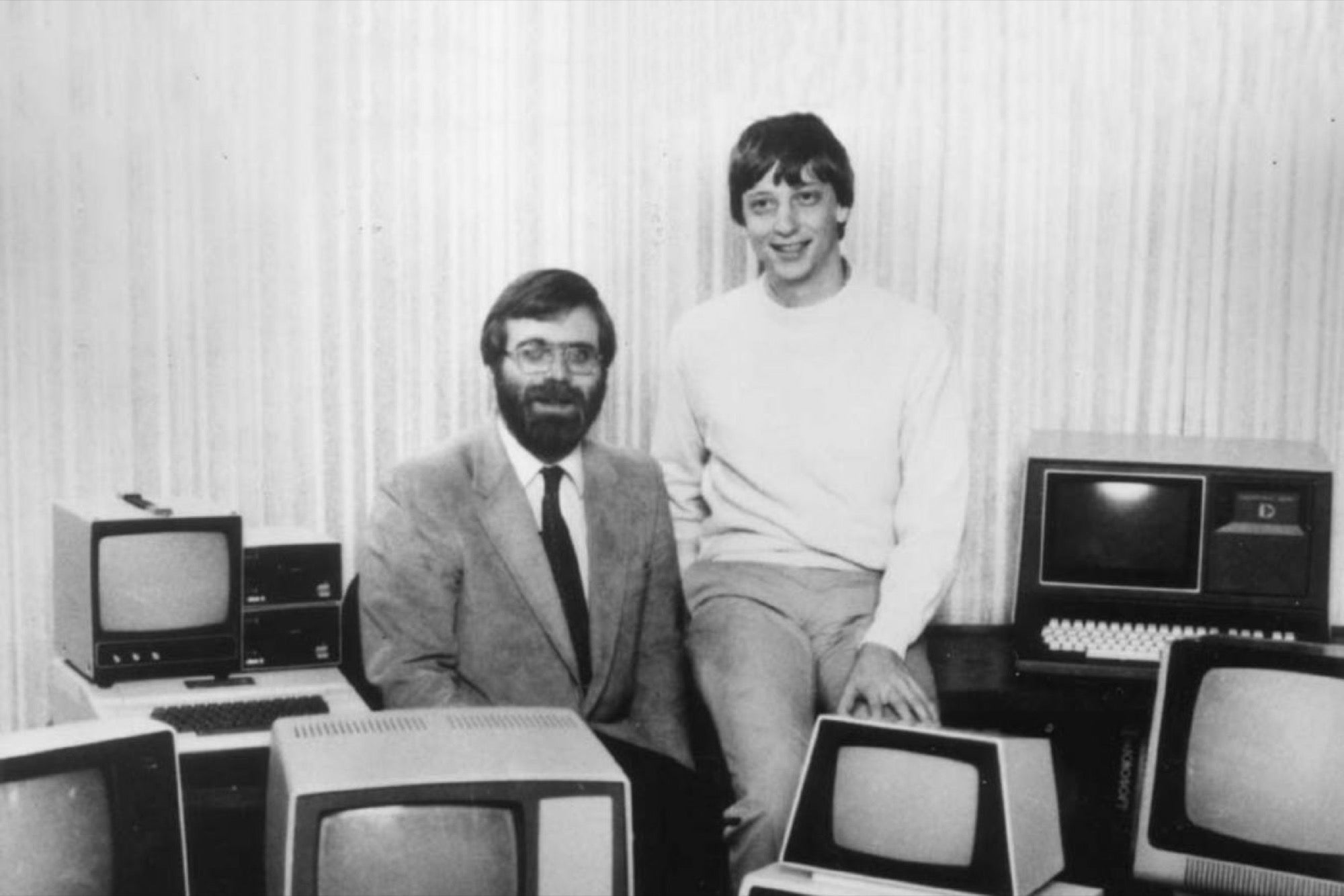
With MS-DOS firmly entrenched as the command-line interface standard for personal computers, Microsoft was well-positioned to drive the next major paradigm shift in computing: the graphical user interface (GUI).
From GUI to Global Standard: The Rise of Windows
While MS-DOS was powerful, it required users to memorize complex commands, making computing inaccessible to many. Apple’s Macintosh, launched in 1984, famously introduced a user-friendly GUI to the masses, albeit on proprietary and expensive hardware. Microsoft, having seen early GUI work at Xerox PARC and recognizing the intuitive power of visual interfaces, had already begun work on its own GUI-based operating environment.
In November 1985, Microsoft released Windows 1.0. Initially, it was more of a graphical shell running on top of MS-DOS than a full operating system. It faced an uphill battle against Apple’s more polished interface and existing DOS applications. However, Microsoft’s commitment to making computing more accessible was unwavering. They steadily improved Windows with subsequent versions, most notably Windows 3.0 in 1990, which offered significant performance enhancements and a more robust user interface.
The real breakthrough came with Windows 95. Launched with an unprecedented marketing campaign, Windows 95 represented a fundamental shift. It integrated the operating system and the GUI seamlessly, introduced the Start button, taskbar, and plug-and-play functionality, and provided a truly user-friendly experience. Its broad compatibility with hardware and software, combined with Microsoft’s existing dominance from MS-DOS, made Windows 95 an instant success. It democratized computing like never before, bringing a graphical interface to millions of homes and businesses worldwide and solidifying Windows as the undisputed global standard for personal computer operating systems.
Innovation Beyond the OS: Office, Internet Explorer, and More
Microsoft’s strategic vision extended far beyond operating systems. Recognizing that users needed applications to truly harness the power of their PCs, the company systematically built and acquired a suite of productivity software that became indispensable. The Microsoft Office suite, comprising applications like Word, Excel, and PowerPoint, became the industry standard for business and personal productivity. Its integration with Windows and consistent user experience created a powerful ecosystem, further entrenching Microsoft’s position.
The advent of the internet in the mid-1990s presented a new frontier, and Microsoft, initially slow to react, quickly pivoted. With Bill Gates’ famous “Internet Tidal Wave” memo, the company aggressively moved to integrate internet capabilities into Windows and Office. Internet Explorer, bundled with Windows, became the dominant web browser, playing a critical role in the “browser wars” of the late 1990s. This period also saw Microsoft expand into servers (Windows Server), development tools (.NET), gaming (Xbox), and various other technologies, demonstrating its continuous drive for innovation and market expansion across the entire technology stack.
Enduring Legacies and Evolving Leadership
The impact of Bill Gates and Paul Allen on the technology industry is immeasurable. Their partnership and the company they founded laid the groundwork for the modern digital age, but their contributions did not end with their active leadership roles.
Gates’ Transition and Philanthropy: A New Chapter
Bill Gates, the driving force behind Microsoft’s aggressive expansion and technical direction for decades, began transitioning out of his day-to-day role in the early 2000s. In 2000, he stepped down as CEO, handing the reins to Steve Ballmer, a long-time friend and colleague. Gates remained as Chief Software Architect, focusing on technical strategy, but by 2008, he had fully transitioned out of his full-time role at Microsoft to dedicate his time to the Bill & Melinda Gates Foundation.
The Foundation, established in 2000, quickly became the largest private charitable foundation in the world. Leveraging the immense wealth generated by Microsoft, Gates shifted his relentless drive from software dominance to global philanthropy, focusing on health, poverty reduction, and education. His work through the Foundation has had a profound impact on combating diseases like malaria and polio, improving sanitation, and promoting agricultural development in developing countries. This second act of Bill Gates’ career has demonstrated a powerful commitment to using the fruits of technological success for the betterment of humanity, cementing his legacy not just as a tech titan but as a global humanitarian.
Allen’s Visionary Investments and Enduring Impact
Paul Allen, who famously resigned from Microsoft in 1983 due to Hodgkin’s lymphoma (from which he later recovered), pursued a different, yet equally impactful, path. While his direct involvement in Microsoft’s daily operations ceased early, his initial vision and technical brilliance were foundational to the company’s existence. After leaving Microsoft, Allen became a prolific investor, philanthropist, and patron of arts and science, establishing Vulcan Inc., a private company that managed his diverse business and philanthropic interests.
Allen’s portfolio included investments in technology, media, and real estate, and he was the owner of several professional sports teams, including the Seattle Seahawks (NFL) and the Portland Trail Blazers (NBA). His philanthropic endeavors were vast, ranging from brain research (Allen Institute for Brain Science) to artificial intelligence (Allen Institute for AI) and space exploration (Stratolaunch, SpaceShipOne). He also founded the Museum of Pop Culture (MoPOP) in Seattle. Allen’s post-Microsoft career showcased a broad intellectual curiosity and a deep commitment to pushing the boundaries of human knowledge and experience, reflecting the same visionary spirit that led him to co-found Microsoft. He passed away in 2018, leaving behind an extraordinary legacy of innovation and generosity.
Microsoft Today: Post-Founders and Future Tech Frontiers
Microsoft, under the leadership of Satya Nadella since 2014, has undergone a significant transformation, proving that a company’s identity can evolve beyond its founders’ direct influence. While Gates remains a technology advisor and Allen’s legacy is woven into its history, Nadella has steered Microsoft into new frontiers, embracing cloud computing (Azure), artificial intelligence, and mixed reality, and fostering a more open-source friendly culture.
The company continues to be a dominant force in enterprise software, gaming, and cloud services, adapting to new technological paradigms while building upon the robust foundation laid by its founders. The spirit of innovation, the drive to make technology accessible, and the ambition to shape the future of computing – all hallmarks instilled by Bill Gates and Paul Allen – continue to define Microsoft, demonstrating the enduring power of their original vision.

Conclusion
The story of who founded Microsoft is a compelling narrative of innovation, collaboration, and strategic genius. Bill Gates and Paul Allen, two technically brilliant and fiercely ambitious young men, saw the future of computing not in mainframes, but in personal machines powered by accessible software. Their decision to create a BASIC interpreter for the Altair 8800 was the spark, the formal incorporation of Microsoft was the commitment, and the IBM deal was the launchpad to unparalleled success.
Through their combined efforts, they democratized personal computing, first with MS-DOS and then, most profoundly, with Windows, making technology an integral part of everyday life for billions. Their journey from a small startup in Albuquerque to a global technology behemoth is a testament to their foresight and relentless dedication. While their individual paths diverged and their roles evolved, their foundational contributions to Microsoft and the broader technology landscape remain a cornerstone of the digital world we inhabit today, marking them as true pioneers of the modern technological age.
aViewFromTheCave is a participant in the Amazon Services LLC Associates Program, an affiliate advertising program designed to provide a means for sites to earn advertising fees by advertising and linking to Amazon.com. Amazon, the Amazon logo, AmazonSupply, and the AmazonSupply logo are trademarks of Amazon.com, Inc. or its affiliates. As an Amazon Associate we earn affiliate commissions from qualifying purchases.