
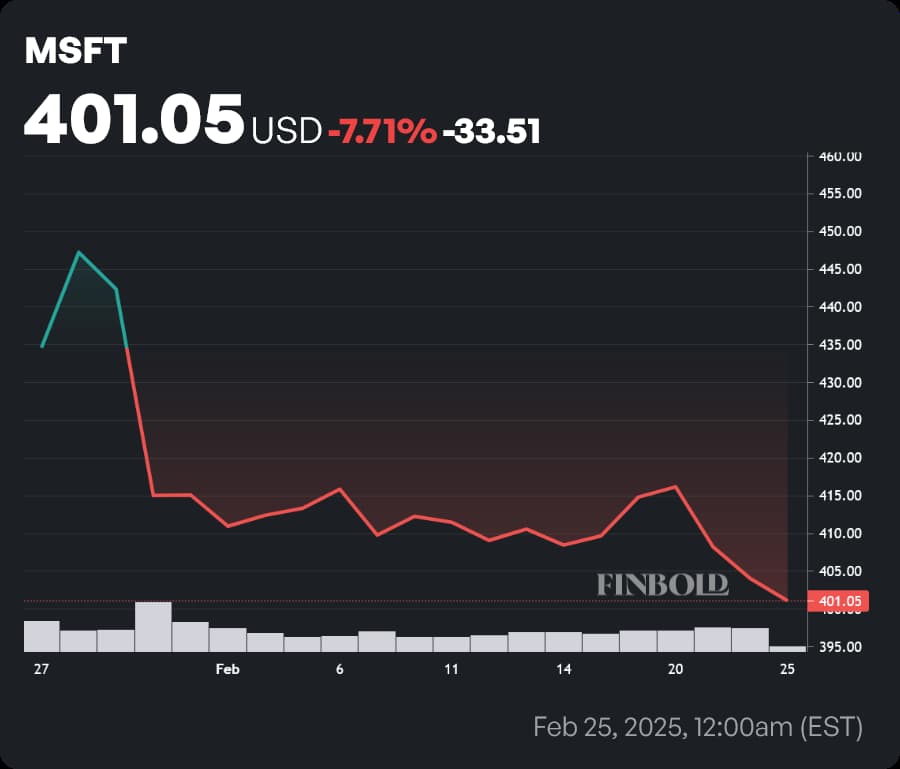
For investors and market watchers alike, a sudden dip in the stock price of a technology titan like Microsoft (MSFT) inevitably sparks curiosity and concern. Given its formidable market capitalization, diverse revenue streams spanning cloud computing, software, gaming, and hardware, and its pivotal role in the global economy, Microsoft’s stock movements often reflect broader market sentiment or point to specific internal or external catalysts. A single day’s downturn, while potentially alarming at first glance, is a common occurrence in the dynamic world of equity markets. Understanding the multifaceted reasons behind such fluctuations requires a deep dive into macroeconomic trends, company-specific news, industry dynamics, and investor psychology.

This article will explore the potential drivers behind a hypothetical daily decline in MSFT’s stock price, offering insights into the complex interplay of factors that influence even the most robust companies. It’s crucial to remember that daily movements rarely define a company’s long-term trajectory, but they do provide valuable snapshots of prevailing market conditions and investor sentiment.
Macroeconomic Headwinds and Broader Market Dynamics
Even a fundamentally strong company like Microsoft is not immune to the gravitational pull of broader economic forces. Often, a dip in MSFT’s stock can be attributed to pressures originating far beyond its own balance sheet.
Broader Market Corrections and Sector Rotations
One of the most common reasons for a blue-chip stock like Microsoft to be down on a particular day is a broader market correction. If major indices such as the S&P 500 or the Nasdaq Composite — which Microsoft heavily influences due to its weight — experience a widespread sell-off, even high-performing stocks tend to get dragged down. This can be driven by a general shift in investor sentiment, perhaps triggered by economic data, geopolitical events, or a wave of profit-taking. For instance, if institutional investors are de-risking their portfolios across the board, they might sell a portion of their holdings in large-cap tech stocks, including MSFT, regardless of any specific negative news pertaining to Microsoft itself.
Moreover, sector rotation can play a role. Investors frequently shift capital between different sectors based on economic outlooks. In periods of high inflation or rising interest rates, there might be a rotation out of growth-oriented tech stocks (which derive much of their value from future earnings) and into more value-oriented or defensive sectors. This rebalancing act, while not a direct indictment of Microsoft’s business, can lead to temporary dips in its stock price as capital flows elsewhere.
Interest Rate Expectations and Inflation Concerns
The Federal Reserve’s monetary policy, particularly its stance on interest rates, significantly impacts the valuation of growth stocks. When interest rates rise or are expected to rise, the future earnings of companies become less valuable in present terms, as they are discounted at a higher rate. Since a significant portion of Microsoft’s value is derived from its future growth prospects, especially in areas like Azure cloud services and AI, higher interest rates can put downward pressure on its valuation.
Similarly, persistent inflation can erode purchasing power and potentially increase operating costs for businesses. While Microsoft has significant pricing power, concerns about inflation can dampen overall consumer and enterprise spending, which could indirectly affect demand for Microsoft’s products and services over the long term. Investor anxiety regarding the Fed’s next move or sustained inflationary pressures can lead to a sell-off in tech stocks as investors re-evaluate risk-adjusted returns.
Geopolitical Events and Global Instability
In an interconnected global economy, geopolitical tensions can send ripples through financial markets worldwide. Major events such as trade disputes, military conflicts, or significant political shifts in key regions can introduce uncertainty, disrupt supply chains, and impact international business operations. While Microsoft is a diversified global company, it has substantial exposure to various international markets. Escalating tensions or a sudden geopolitical crisis can lead to a general flight to safety among investors, prompting them to shed riskier assets, including equities, regardless of a company’s fundamental health. This flight often manifests as a temporary dip across the market, pulling MSFT down with it.
Company-Specific Catalysts and Industry Dynamics
While macroeconomic factors paint a broad picture, often a specific piece of news or a shift in competitive landscape directly impacts a company’s stock performance.
Analyst Ratings and Price Target Adjustments
Financial analysts from reputable investment banks constantly monitor major companies, issuing research reports, earnings estimates, and price targets. A downgrade of Microsoft’s stock by a prominent analyst, a reduction in its price target, or even a nuanced report expressing caution about its near-term prospects can trigger a sell-off. These reports, often distributed widely to institutional investors, can influence trading decisions, especially among algorithmic trading systems designed to react swiftly to such pronouncements. Even if the underlying fundamentals of Microsoft remain strong, a change in Wall Street’s consensus can create immediate downward pressure.
Competitive Pressures and Market Share Shifts
Microsoft operates in highly competitive industries. In cloud computing, it battles Amazon Web Services (AWS) and Google Cloud. In gaming, Sony and Nintendo are formidable rivals. In enterprise software, countless specialized players vie for market share. News suggesting that a competitor has gained a significant edge, launched a disruptive product, or secured a major contract could cast a shadow on Microsoft’s future growth prospects. For instance, a report indicating a slowdown in Azure’s market share growth or increased competition in its gaming subscription services could lead investors to re-evaluate their outlook for MSFT. While Microsoft generally maintains strong positions, any perceived erosion of its competitive moat can spook investors.
Regulatory Scrutiny and Antitrust Concerns
Large technology companies, including Microsoft, are increasingly under the microscope of regulatory bodies worldwide. Concerns over market dominance, data privacy, and competitive practices can lead to investigations, potential fines, or mandated changes to business models. News of a new antitrust probe, a significant lawsuit, or an unfavorable regulatory ruling, even if it pertains to an industry peer, can trigger investor anxiety across the tech sector, including MSFT. The uncertainty associated with regulatory action can weigh heavily on a company’s stock, as it introduces potential costs, operational restrictions, and long-term strategic impediments. For example, ongoing discussions about regulating AI or specific cloud services could dampen investor enthusiasm temporarily.
Internal News or Rumors
Sometimes, a stock dip can be linked to internal company news or even unconfirmed rumors circulating within financial circles. This could include reports of a major executive departure, unexpected product delays, a security breach (even if minor), or changes in internal corporate strategy. While Microsoft is generally transparent, some information might leak or be subject to speculation before an official announcement. Such news, even if it’s eventually debunked or minor in impact, can cause a knee-jerk reaction from traders and investors, leading to temporary price declines.
Earnings Reports and Forward Guidance Impact
Quarterly earnings reports are pivotal moments for publicly traded companies, often leading to significant stock movements based on how results align with, or diverge from, analyst and investor expectations.
Disappointing Quarterly Results
Even if Microsoft posts what seem like strong revenue and earnings figures, the stock can fall if those numbers fail to meet the market’s exceptionally high expectations. Investors often “price in” anticipated growth, and if the actual results — whether it’s revenue, earnings per share, or specific segment growth (like Azure) — fall short of consensus estimates, a sell-off can occur. The market tends to be forward-looking, and even a slight miss can be interpreted as a sign of slowing momentum or tougher times ahead. The bar for a company of Microsoft’s stature is exceptionally high, and merely meeting expectations is often not enough to drive the stock higher; beating them significantly is usually required.
Weakened Forward Guidance
Perhaps even more impactful than past results is a company’s forward guidance. When Microsoft issues a cautious outlook for the upcoming quarter or the full fiscal year, indicating lower-than-expected revenue or profit growth, it can trigger a substantial stock decline. This is because guidance provides insight into management’s perception of future business conditions and demand. A conservative forecast might suggest challenges in key segments, increased operational costs, or a general slowdown in client spending. For instance, if Microsoft hints at a deceleration in cloud growth or a weaker-than-anticipated PC market, investors might recalibrate their models, leading to a downward revision of MSFT’s intrinsic value.
Sector-Specific Performance within Microsoft
Microsoft’s business is highly diversified, encompassing Office 365, Windows, Xbox, Surface hardware, LinkedIn, and its sprawling Azure cloud platform. Sometimes, overall results might be strong, but a significant underperformance in one key segment could be enough to cause concern. For example, if Azure’s growth, which is a major driver of future value, shows signs of deceleration, or if Windows OEM revenue is particularly weak, investors might focus on these soft spots rather than the overall strength. This granular scrutiny means that even with solid aggregate numbers, an isolated weakness can prompt a negative reaction.
Technical Analysis and Algorithmic Trading Effects
Beyond fundamentals and news, the technical landscape of a stock and the mechanisms of modern trading can also contribute to daily price movements.
Key Support Levels Breached
Technical analysts study chart patterns, trading volumes, and various indicators to predict future price movements. If MSFT’s stock price falls below a significant technical support level – a price point where buying interest has historically emerged – it can trigger further selling. This is often exacerbated by algorithmic trading systems, which are programmed to execute trades automatically when certain technical thresholds are crossed. A breach of a 50-day or 200-day moving average, for example, can be seen as a bearish signal, leading to increased selling pressure.
Volume and Volatility
Unusually high trading volume on a down day can signal strong conviction behind the selling pressure, suggesting that large institutional investors might be offloading shares. Conversely, a dip on low volume might be interpreted as less significant. Increased volatility, perhaps due to options expiration or broader market uncertainty, can amplify price swings, causing MSFT to move more dramatically in either direction on a given day. These factors, while not tied to Microsoft’s fundamentals, can create and exaggerate short-term price movements.
The Long-Term Perspective: Beyond Daily Fluctuations
While dissecting the reasons for a daily stock dip is valuable for understanding market mechanics, it’s equally important for investors to maintain a long-term perspective.
Microsoft’s Fundamental Strengths and Diversification
Microsoft boasts an enviable financial position, a robust balance sheet, and a diversified portfolio of market-leading products and services. Its cloud business, Azure, continues to be a growth engine, while its enterprise software (Office 365) and Windows ecosystem maintain significant market share and provide stable recurring revenue. Furthermore, Microsoft’s aggressive investments in Artificial Intelligence (AI) position it strongly for future growth, integrating AI across its entire product suite. The company’s consistent innovation, strategic acquisitions (like LinkedIn and Activision Blizzard), and strong leadership underscore its resilience. These fundamental strengths typically buffer the company against sustained long-term declines, even in the face of short-term volatility.
Investor Mindset: Opportunity or Caution?
For long-term investors, a single day’s decline in MSFT, if not tied to a fundamental impairment of its business model or future prospects, can be seen as a potential buying opportunity. Dollar-cost averaging strategies or simply adding to positions on dips can be effective approaches for those confident in Microsoft’s enduring value proposition. Conversely, for short-term traders, a downward movement might signal a quick exit. The key is to differentiate between temporary noise and genuine shifts in the company’s financial health or competitive standing. Investors should scrutinize whether the reasons for the dip are temporary market sentiment shifts or indicative of a more profound, lasting challenge to Microsoft’s business.
In conclusion, a daily decline in Microsoft’s stock price is rarely attributable to a single factor. More often, it’s a complex interplay of macroeconomic trends, company-specific news, competitive dynamics, regulatory concerns, and technical trading patterns. For investors, understanding these various influences is crucial, but equally important is the ability to filter out daily market noise and focus on the company’s robust fundamentals and long-term strategic vision. While today’s dip might spark questions, Microsoft’s track record of innovation and adaptability suggests that temporary fluctuations are often just a blip in its impressive growth story.
aViewFromTheCave is a participant in the Amazon Services LLC Associates Program, an affiliate advertising program designed to provide a means for sites to earn advertising fees by advertising and linking to Amazon.com. Amazon, the Amazon logo, AmazonSupply, and the AmazonSupply logo are trademarks of Amazon.com, Inc. or its affiliates. As an Amazon Associate we earn affiliate commissions from qualifying purchases.