
In the vast and often intricate world of financial markets, understanding the various indices and benchmarks is paramount for investors, analysts, and anyone looking to gauge the health and direction of the economy. Among the most frequently cited and closely watched is the Nasdaq Composite Index. Far more than just a number on a screen, the Nasdaq Composite is a dynamic barometer, particularly for the technology-driven segment of the market, offering deep insights into innovation, growth, and investor sentiment.
At its core, the Nasdaq Composite is a market-capitalization-weighted index of all the common equities and similar securities listed on the Nasdaq Stock Market. While often synonymous with tech giants, it actually encompasses a broad spectrum of companies, from disruptive startups to established industry leaders across various sectors. Its significance stems from its unique composition and the story it tells about technological advancement and the evolving landscape of American, and indeed global, enterprise.
For individual investors, deciphering the Nasdaq Composite is not merely an academic exercise; it’s a critical component of informed decision-making. Whether you’re planning for retirement, saving for a major purchase, or simply looking to grow your wealth, understanding what drives this index can illuminate investment opportunities, highlight potential risks, and provide a clearer picture of market trends. This article will demystify the Nasdaq Composite, exploring its structure, its importance, and how it serves as an indispensable tool in the investor’s arsenal, all within the context of sound financial strategy.
Understanding the Nasdaq Ecosystem
To truly grasp the essence of the Nasdaq Composite, one must first appreciate the ecosystem from which it originates: the Nasdaq Stock Market itself. Often overshadowed by the performance of its indices, the Nasdaq market is a foundational element in modern finance, distinct in its history and operational philosophy.
The Nasdaq Stock Market: A Hub for Innovation
The Nasdaq Stock Market, an acronym for the National Association of Securities Dealers Automated Quotations, was founded in 1971. Its inception marked a significant departure from traditional, floor-based exchanges like the New York Stock Exchange (NYSE). Nasdaq was pioneering as the world’s first electronic stock market, designed to facilitate trades through a computer network rather than a physical trading floor. This innovative approach allowed for faster execution, greater transparency, and lower transaction costs, fundamentally altering the landscape of securities trading.
From its earliest days, Nasdaq attracted a different breed of company. It became the favored listing venue for burgeoning technology firms, biotechnology companies, and other high-growth enterprises that valued its forward-thinking infrastructure and global reach. Over the decades, this reputation solidified, making Nasdaq the gravitational center for companies pushing the boundaries of innovation. Today, it hosts a diverse array of companies, but its legacy and current prominence remain deeply intertwined with the tech sector, listing household names like Apple, Microsoft, Amazon, Google (Alphabet), and Meta (Facebook). Its electronic nature continues to evolve, incorporating advanced algorithms and AI-driven systems to maintain its competitive edge in a globalized financial market.
What is a Composite Index?
Before diving into the specifics of the Nasdaq Composite, it’s helpful to understand the general concept of a “composite index.” In finance, an index is a statistical measure of change in an economy or a securities market. It provides a snapshot of the performance of a specific segment of the market or an overall market. A “composite” index, in particular, is designed to represent the performance of a broad collection of underlying assets or securities.
Unlike a sector-specific index that tracks, say, only energy stocks, a composite index aims for wider coverage. The Nasdaq Composite, for instance, reflects the performance of all eligible common stocks listed on the Nasdaq Stock Market. This comprehensive nature makes it a valuable indicator of overall market sentiment and economic health, especially concerning the growth-oriented companies that characterize the Nasdaq exchange. It serves as a benchmark against which investors can measure the performance of their own portfolios or individual stocks, offering a holistic view of a significant portion of the global equity market.
Deconstructing the Nasdaq Composite Index
Understanding the Nasdaq Composite requires peeling back its layers to examine its constituents, its weighting methodology, and how it stands apart from other major market benchmarks. These elements collectively explain its unique character and why it’s monitored so closely by investors.
Components and Composition: More Than Just Tech
While the Nasdaq Composite is heavily associated with technology, its composition is broader than many assume. The index includes all common stocks and similar securities listed on the Nasdaq Stock Market, which means it comprises over 3,000 companies. While tech giants like Apple, Microsoft, Amazon, Alphabet, and Meta Platforms do exert a significant influence due to their large market capitalizations, the index also includes companies from sectors such as healthcare, biotechnology, retail, finance, and industrials.
This diversity is crucial. Although technology and growth stocks tend to dominate headlines and often drive the index’s movements, the presence of thousands of other companies means the Composite isn’t a pure tech index. It’s a reflection of the innovation and growth sectors of the U.S. economy, where technology often plays a foundational role, but the specific industries represented are varied. This makes it a robust indicator for trends beyond just Silicon Valley, offering a view into the broader entrepreneurial spirit thriving across different economic segments listed on the exchange.
Market-Capitalization Weighting: How Influence is Measured
The Nasdaq Composite is a market-capitalization-weighted index. This means that companies with larger market capitalizations (stock price multiplied by the number of outstanding shares) have a greater impact on the index’s value than companies with smaller market caps. If Apple, with its trillion-dollar valuation, moves by 1%, it will affect the index far more significantly than a smaller biotechnology company moving by 10%.
This weighting methodology is a double-edged sword. On one hand, it accurately reflects the total value and economic influence of the largest companies within the index, providing a realistic portrayal of where investor capital is most concentrated. On the other hand, it can lead to situations where a handful of extremely large companies can disproportionately drive the index’s performance, potentially masking the performance of hundreds of smaller companies. This inherent characteristic means that an investor tracking the Nasdaq Composite is largely tracking the performance of its biggest constituents, often the tech megacaps.
Key Differences from Other Major Indices
The Nasdaq Composite is often compared to other prominent U.S. stock market indices, most notably the S&P 500 and the Dow Jones Industrial Average (DJIA), but crucial distinctions exist:
- S&P 500: Like the Nasdaq Composite, the S&P 500 is a market-capitalization-weighted index. However, it comprises 500 of the largest U.S. companies chosen by Standard & Poor’s based on criteria like market size, liquidity, and sector representation. While it includes many tech companies, it is generally considered a broader representation of the large-cap U.S. economy across all major sectors. The Nasdaq Composite, by contrast, includes all common stocks listed on the Nasdaq exchange, regardless of size (though large companies dominate its weighting), with a historical skew towards growth and technology.
- Dow Jones Industrial Average (DJIA): The DJIA is a price-weighted index of 30 “blue-chip” U.S. companies. Its price-weighted methodology means that stocks with higher share prices have a greater impact on the index, regardless of their market capitalization. It’s a much narrower index, focusing on established industrial and consumer-oriented giants, and is less representative of the broader market or the technology sector specifically than either the Nasdaq Composite or the S&P 500.
These differences highlight the unique role of the Nasdaq Composite as a specific lens through which to view the performance of the growth-oriented, technology-heavy segment of the U.S. equity market.
Why the Nasdaq Composite Matters to Investors
For investors navigating the complexities of the financial markets, the Nasdaq Composite is more than just a statistical figure; it’s a vital tool offering critical insights into specific market segments and broader economic trends. Its unique composition makes it a go-to benchmark for those focusing on innovation and growth.
A Barometer for Growth and Technology Stocks
The Nasdaq Composite has long served as the primary benchmark for the performance of growth-oriented companies, particularly those in the technology sector. Due to its historical inclination towards listing innovative firms, movements in the Composite are often seen as a direct reflection of investor confidence and performance within these dynamic industries. When the Nasdaq Composite is trending upwards, it often signals strong performance from technology, biotechnology, and other high-growth sectors, suggesting robust innovation, increasing consumer adoption of new technologies, and a generally optimistic economic outlook for future-oriented businesses. Conversely, a significant downturn in the Composite can indicate headwinds for these sectors, perhaps due to rising interest rates, regulatory concerns, or a shift in market sentiment away from speculative growth towards value stocks. For investors with a significant allocation to tech or growth stocks, the Composite is an indispensable daily check on their portfolio’s pulse.
Identifying Market Trends and Sector Performance
Beyond just being a growth barometer, the Nasdaq Composite can reveal broader market trends. Because of its electronic nature and global reach, it often reacts quickly to shifts in investor sentiment and economic data. Observing its movements relative to other indices like the S&P 500 or the Dow Jones Industrial Average can highlight rotational shifts in the market—for example, when investors are favoring growth over value, or vice versa.
Furthermore, within the Composite itself, the performance of its largest constituents often signals sector-specific trends. For instance, strong performance from software-as-a-service (SaaS) companies within the index might indicate a boom in cloud computing, while a dip in semiconductor stocks could point to supply chain issues or softening demand for electronics. By analyzing the Composite, investors can gain a nuanced understanding of which industries are thriving and which are struggling, informing decisions about sector allocation and identifying potential investment opportunities or areas of caution.
Diversification and Risk Assessment
While the Nasdaq Composite itself is a highly concentrated index due to its market-cap weighting and strong representation of a few mega-cap tech stocks, understanding its behavior is crucial for diversification and risk assessment within an investor’s overall portfolio. For those seeking diversification, simply investing solely in a Nasdaq-tracking fund might not provide sufficient breadth across different economic sectors. A well-diversified portfolio might combine exposure to the Nasdaq with investments tracking broader market indices, international markets, bonds, or other asset classes.
Moreover, the Composite’s inherent volatility, driven by the often higher-risk, higher-reward nature of growth companies, makes it a key indicator for assessing portfolio risk. During periods of economic uncertainty or rising interest rates, growth stocks, and thus the Nasdaq Composite, can experience greater fluctuations than more stable, value-oriented parts of the market. Investors can use the Composite’s movements as a signal to review their risk tolerance, rebalance their portfolios, and ensure their asset allocation aligns with their financial goals and comfort level with market swings. Understanding the Nasdaq Composite’s role in a diversified portfolio enables investors to make more strategic decisions, mitigating concentration risk while still participating in the potential upside of innovative companies.
Investing in the Nasdaq Composite
For investors looking to gain exposure to the growth-oriented companies represented by the Nasdaq Composite, there are several practical avenues. These methods allow individuals to participate in the potential upside of the index’s constituents without necessarily buying every single stock.
Indirect Investment: ETFs and Mutual Funds
The most common and accessible way for individual investors to gain exposure to the Nasdaq Composite is through indirect investment vehicles like Exchange Traded Funds (ETFs) and mutual funds. These funds pool money from multiple investors to buy a basket of securities that track a specific index.
- ETFs (Exchange Traded Funds): Many ETFs are designed to replicate the performance of the Nasdaq Composite. These funds hold the underlying stocks in proportions similar to their weighting in the index. ETFs offer several advantages: they are traded like individual stocks on an exchange throughout the day, providing liquidity; they typically have lower expense ratios compared to actively managed mutual funds; and they offer immediate diversification across all the companies in the Composite. Popular examples include ETFs that track the Nasdaq 100 (a subset of the Composite’s largest 100 non-financial companies, even more tech-heavy) or broader Nasdaq funds.
- Mutual Funds: While less common for direct tracking of the entire Nasdaq Composite, some mutual funds aim to replicate or outperform specific segments of the Nasdaq or broader growth categories where Nasdaq-listed stocks are prominent. Investors purchase units or shares in the fund, and the fund manager handles the buying and selling of underlying securities. Mutual funds are typically priced once a day after market close and can sometimes have higher fees, but they also offer professional management.
Both ETFs and mutual funds provide a convenient and cost-effective way to achieve broad exposure to the Nasdaq Composite without the complexity and capital requirements of buying individual stocks.
Direct Investment: Individual Stocks and Index Funds
While indirect investment is popular, some investors opt for more direct approaches.
- Individual Stocks: Investors can choose to buy individual stocks of companies listed on the Nasdaq Stock Market. This allows for greater control and the potential for higher returns if specific companies outperform the index. However, it also comes with significantly higher risk, as the performance of a few individual stocks can be much more volatile than a diversified index. It requires thorough research, continuous monitoring, and a deep understanding of each company’s fundamentals and market position. This approach is not about tracking the Composite but about selecting specific companies that happen to be part of it.
- Index Funds (Specific Type): While often used interchangeably with ETFs, traditional index mutual funds also exist that specifically aim to track the Nasdaq Composite. These are similar to other mutual funds in terms of trading mechanics (once daily pricing) but are passively managed to mirror the index’s performance, offering diversification and lower fees than actively managed funds.
For most individual investors, especially those without extensive financial knowledge or time for active management, ETFs or index mutual funds that track the Nasdaq Composite or its closely related indices (like the Nasdaq 100) are generally the recommended approach for gaining exposure.
Considerations for Long-Term and Short-Term Investors
Regardless of the chosen investment vehicle, investors in the Nasdaq Composite must consider their investment horizon and risk tolerance.
- Long-Term Investors: For those with a long-term perspective (e.g., investing for retirement), the Nasdaq Composite can be an attractive component of a growth-oriented portfolio. Historically, growth and technology stocks have delivered strong returns over extended periods, driven by innovation and economic expansion. Long-term investors can ride out the inevitable short-term volatility, focusing on the potential for compounding returns over decades. A “buy and hold” strategy for a Nasdaq-tracking ETF or fund is often suitable here.
- Short-Term Investors/Traders: Short-term traders might seek to capitalize on the Nasdaq Composite’s volatility, attempting to profit from its daily or weekly fluctuations. This requires sophisticated technical analysis, a deep understanding of market sentiment, and robust risk management strategies. Short-term trading in a highly volatile index like the Nasdaq Composite is inherently risky and generally not recommended for novice investors or those without significant capital they are prepared to lose. Derivatives like futures and options based on the Nasdaq 100 (NDX) are popular among experienced traders for speculating on short-term movements.
Ultimately, investing in the Nasdaq Composite or its components should align with an investor’s overall financial plan, risk appetite, and investment goals, emphasizing the importance of prudent financial decision-making.
The Nasdaq Composite’s Historical Significance and Future Outlook
The Nasdaq Composite is not just a present-day benchmark; it’s a living history book of technological advancement and market cycles. Understanding its past helps contextualize its current role and offers clues about its potential future trajectory.
Tracking Market Cycles and Economic Shifts
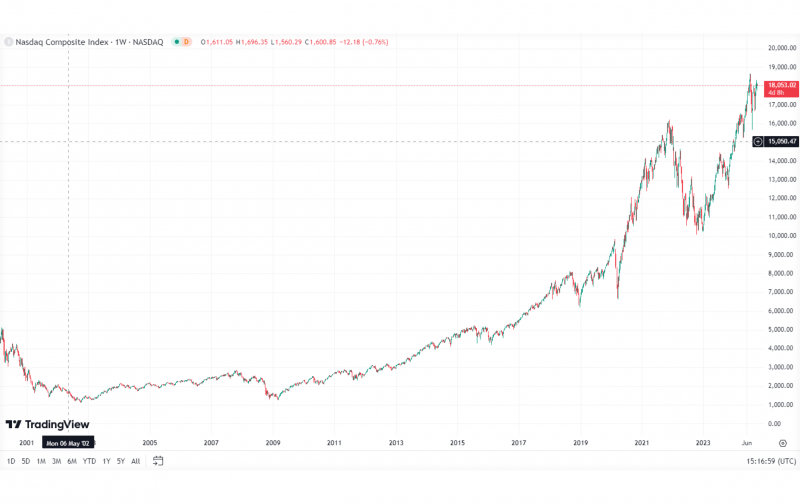
Since its inception in 1971, the Nasdaq Composite has been a crucial indicator of market cycles, particularly those driven by technological innovation. Its journey has mirrored significant economic shifts, including periods of rapid expansion and sharp contractions.
- The Dot-Com Bubble (Late 1990s – Early 2000s): Perhaps its most iconic historical chapter, the Nasdaq Composite soared to unprecedented heights during the dot-com bubble, reflecting rampant speculation in internet-related companies. Its subsequent crash in 2000 served as a stark reminder of market exuberance and the inherent risks of overvalued growth stocks. This period underscored its role as a key barometer for innovation-driven bubbles and busts.
- The Global Financial Crisis (2008-2009): Like other indices, the Composite experienced a significant downturn during the financial crisis, demonstrating its sensitivity to broader economic shocks. However, its recovery was propelled by the resilience and resurgence of its technology components, highlighting their increasingly central role in the global economy.
- Post-2008 Growth and the Pandemic (2010s – Present): The 2010s saw a sustained bull run, largely fueled by the consistent growth of tech giants. The COVID-19 pandemic, surprisingly, accelerated this trend, as digital transformation became paramount, further cementing the Nasdaq Composite’s status as a beneficiary of structural economic shifts towards technology and remote work.
Through these cycles, the Nasdaq Composite has provided invaluable lessons in market psychology, the valuation of growth companies, and the long-term power of technological innovation.
The Influence of Global Events and Technological Advancements
The future trajectory of the Nasdaq Composite will undoubtedly continue to be shaped by two primary forces: global macroeconomic events and the relentless pace of technological advancement.
Global events, such as geopolitical tensions, changes in monetary policy (like interest rate hikes), supply chain disruptions, and new regulatory frameworks, can significantly impact investor sentiment and corporate profitability, subsequently affecting the Composite. For example, rising interest rates often make future earnings of growth companies (which trade on future potential) less attractive, potentially leading to pullbacks in the index. Similarly, a global recession could dampen consumer and business spending on technology, affecting revenues.
However, the underlying engine of the Nasdaq Composite remains technological innovation. Emerging technologies like Artificial Intelligence (AI), quantum computing, biotechnology breakthroughs, renewable energy solutions, and advancements in cybersecurity are poised to create new industries and redefine existing ones. Companies at the forefront of these innovations, many of which are or will be listed on Nasdaq, will likely drive the index’s growth in the coming decades. The Composite will continue to be a leading indicator of how these transformative technologies are being valued and adopted by the market.

Navigating Volatility and Opportunities
Looking ahead, investors in the Nasdaq Composite must be prepared for continued volatility, a characteristic inherent to growth and technology stocks. Rapid technological shifts can lead to quick obsolescence for some companies while catapulting others to new heights. The competitive landscape is fierce, and disruptions are constant.
Despite this volatility, the opportunities presented by the companies within the Nasdaq Composite are immense. For long-term investors, the index offers exposure to the sectors most likely to define the future economy. Strategic investing involves understanding these dynamics, staying informed about technological trends, and maintaining a diversified portfolio that balances growth with stability. The Nasdaq Composite will remain a critical benchmark for those seeking to harness the power of innovation in their investment journey, demanding both foresight and a disciplined approach to risk and return.
aViewFromTheCave is a participant in the Amazon Services LLC Associates Program, an affiliate advertising program designed to provide a means for sites to earn advertising fees by advertising and linking to Amazon.com. Amazon, the Amazon logo, AmazonSupply, and the AmazonSupply logo are trademarks of Amazon.com, Inc. or its affiliates. As an Amazon Associate we earn affiliate commissions from qualifying purchases.