
Blockchain technology has emerged as one of the most transformative innovations of the 21st century, often discussed in the same breath as the internet itself for its potential to reshape digital interactions. While widely known as the underlying technology for cryptocurrencies like Bitcoin, blockchain’s utility extends far beyond digital money. At its core, it represents a revolutionary way to record and share information, establishing an unprecedented level of security, transparency, and immutability. Understanding blockchain is no longer optional for tech enthusiasts and professionals; it’s a necessity for comprehending the evolving digital landscape. This article will delve into what blockchain technology truly is, dissect its operational mechanics, explore its defining characteristics, and shed light on its diverse applications and future trajectory, all through a strictly technological lens.
Demystifying Blockchain: A Distributed Ledger Explained
At its most fundamental level, a blockchain is a distributed, decentralized public ledger. Imagine a ledger that isn’t held by a single entity but is instead replicated and shared across a vast network of computers. Every transaction or piece of data added to this ledger is recorded as a “block,” which is then cryptographically linked to the previous block, forming a “chain.” This continuous, growing chain of records is what gives the technology its name: blockchain.
The Core Idea: Immutability and Decentralization
The power of blockchain stems from two core principles: immutability and decentralization. Decentralization means there is no central authority controlling the network. Instead, participants (nodes) collectively maintain and validate the ledger. This distributed nature makes the system incredibly resilient to attacks and censorship, as there’s no single point of failure to target. If one node goes down, the rest of the network continues to operate seamlessly.
Immutability refers to the property that once data is recorded on the blockchain, it cannot be altered or deleted. Each block contains a cryptographic hash of the previous block, creating a tamper-proof chain. Any attempt to modify an old block would change its hash, subsequently invalidating the hash in the next block and breaking the entire chain. This would immediately be detected by the network, rendering the alteration impossible without unanimous consensus from the majority of participants – an incredibly difficult and computationally expensive task.
Analogy: The Digital Ledger Book
To grasp this concept, consider a traditional ledger book used in accounting. In a centralized system, one person holds the book and records all transactions. If that person is dishonest or their book is destroyed, the integrity of the records is compromised. Now, imagine if every person in a large group held an identical copy of that ledger. When a transaction occurs, it’s broadcast to everyone, and each person independently verifies and records it in their own book. To change an entry, you’d have to convince every single person to change their book simultaneously, which is practically impossible. This shared, synchronized, and tamper-resistant digital ledger is the essence of blockchain.
The Mechanics Behind the Magic: How Blockchain Works
Understanding the “what” is only part of the story; the true genius of blockchain lies in its operational mechanics. It’s a symphony of cryptographic functions, network protocols, and consensus algorithms working in concert to maintain an honest and secure record.
Blocks: The Data Containers
Each “block” on the blockchain is essentially a container for data. While the specific data varies depending on the blockchain’s purpose (e.g., transaction details for cryptocurrencies, identity records for supply chains), every block typically contains:
- Transaction Data: A list of verified transactions (or other data payloads).
- Timestamp: The time and date the block was created.
- Nonce: A random number used in the mining process (Proof of Work).
- Cryptographic Hash of the Current Block: A unique digital fingerprint of the block’s content.
- Cryptographic Hash of the Previous Block: This crucial link connects the blocks, forming the chain.
The size of a block is typically fixed or capped, meaning once it reaches its capacity or a certain time interval passes, it’s sealed and prepared to be added to the chain.
Chains: Cryptographic Linking
The “chain” aspect is formed by the cryptographic hash pointer. Each new block contains the hash of the block that immediately preceded it. This creates an unbreakable, chronological link. If someone were to tamper with an old block, its hash would change. Since the next block in the chain still holds the original hash, the link would be broken, and the alteration would be immediately detectable. This interwoven cryptographic relationship is the foundation of blockchain’s immutability.
Nodes and the Network: Distribution and Consensus
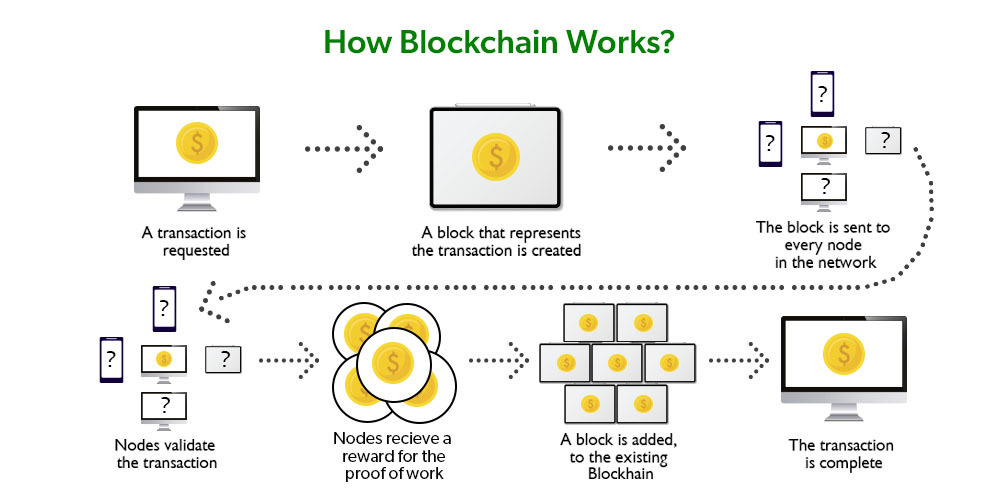
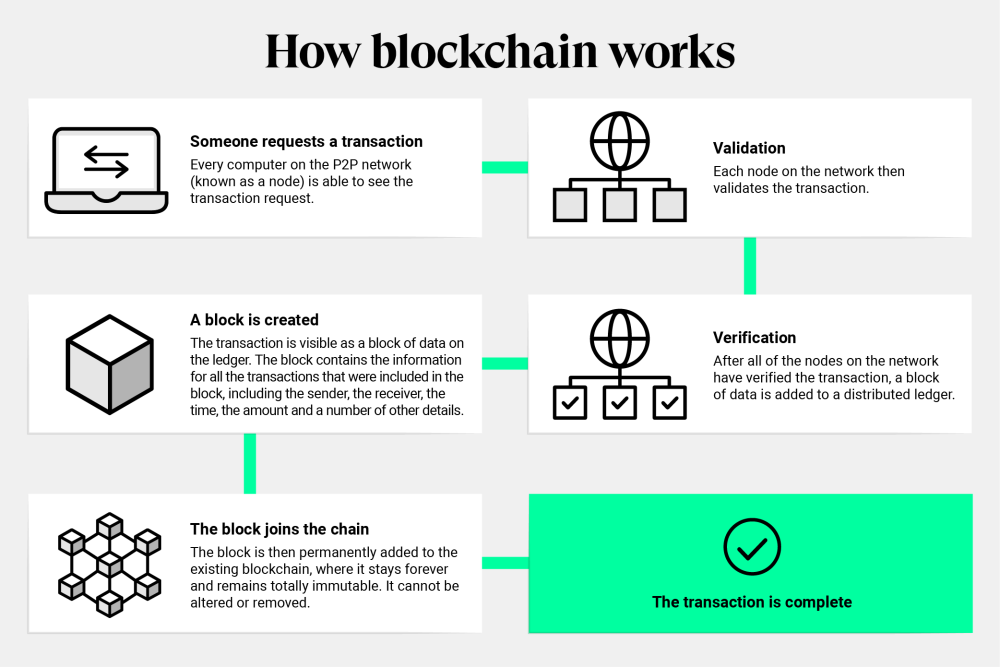
A blockchain operates on a peer-to-peer (P2P) network of computers called “nodes.” Each node maintains a complete and up-to-date copy of the entire blockchain ledger. When a new transaction occurs, it’s broadcast to the network.
Here’s the simplified process:
- Transaction Initiation: A user initiates a transaction (e.g., sending cryptocurrency, recording a data entry).
- Verification: The transaction is broadcast to the network and validated by nodes. This involves checking digital signatures, ensuring the sender has sufficient funds/permissions, and verifying other protocol rules.
- Block Creation (Mining/Staking): Once verified, transactions are gathered into a new block. For a block to be added to the chain, it must first be “mined” (in Proof of Work systems) or “validated” (in Proof of Stake systems).
- Proof of Work (PoW): Miners compete to solve a complex computational puzzle (finding a “nonce” that, when combined with the block data, produces a hash below a certain target). This process is energy-intensive but makes it incredibly difficult to tamper with the chain. The first miner to solve the puzzle broadcasts the new block to the network.
- Proof of Stake (PoS): Validators are chosen to create new blocks based on the amount of cryptocurrency they “stake” (lock up) as collateral. This is generally more energy-efficient.
- Consensus: Other nodes on the network receive the newly proposed block. They verify its validity (checking all transactions, cryptographic links, and the proof of work/stake). If the majority of nodes agree that the block is valid, it is added to their copy of the blockchain.
- Chain Extension: Once added, the new block becomes the latest official record, and the process repeats for subsequent transactions.
This consensus mechanism ensures that all copies of the ledger across the network remain synchronized and accurate, even in the presence of malicious actors.
Cryptography: The Foundation of Security
Cryptography is the backbone of blockchain security. Two key cryptographic techniques are vital:
- Hash Functions: These mathematical algorithms take an input of any size (e.g., a block of data) and produce a fixed-size, unique output called a “hash” or “digest.” Even a tiny change in the input data results in a drastically different hash, making them ideal for detecting tampering. They are one-way functions, meaning it’s computationally infeasible to reverse-engineer the original data from its hash.
- Digital Signatures: Based on public-key cryptography, digital signatures allow users to cryptographically sign their transactions. This proves the sender’s identity and ensures that the transaction has not been altered since it was signed. Each user has a public key (like an account number) and a private key (like a password). The private key signs the transaction, and the public key verifies it.
Key Characteristics Defining Blockchain Technology
Beyond its operational mechanics, blockchain is defined by a set of core characteristics that bestow its transformative potential across various technological domains.
Decentralization: No Single Point of Control

As discussed, decentralization is paramount. By distributing the ledger across thousands of nodes worldwide, blockchain eliminates the need for a central authority or intermediary. This reduces vulnerability to cyberattacks, censorship, and corruption. It empowers users with greater control over their data and transactions, fostering trust through verifiable protocols rather than reliance on third parties.
Immutability: Once Written, Forever Stored
The cryptographic linking of blocks ensures that once a transaction or data entry is recorded on the blockchain and sufficient subsequent blocks have been added, it becomes virtually impossible to alter or delete. This creates an unchangeable historical record, providing an unparalleled level of data integrity and auditability. For industries requiring high levels of trust and verifiable history, such as supply chain or legal documentation, this feature is invaluable.
Transparency: Open Yet Anonymous
Most public blockchains are transparent in that all transactions are visible to anyone on the network. Anyone can view the ledger and trace transactions. However, these transactions are linked to cryptographic addresses, not personal identities, offering a degree of anonymity. While the transaction history is open, the identities of the participants can remain pseudonymous. This “transparent anonymity” allows for accountability without compromising personal privacy.
Security: Hashing and Proof of Work/Stake
Blockchain’s security is multi-layered. Cryptographic hashing ensures data integrity within blocks and across the chain. Digital signatures guarantee transaction authenticity. Furthermore, the consensus mechanisms, particularly Proof of Work (PoW), add an immense layer of security. The sheer computational power required to alter past blocks makes such an attack economically prohibitive. For example, a “51% attack” (where a single entity controls more than half of the network’s computing power) is theoretically possible but practically unfeasible for large, established blockchains due to the astronomical cost and scale involved. Proof of Stake (PoS) offers different security guarantees, incentivizing honest behavior through economic penalties for malicious validators.
Beyond Digital Cash: Transformative Applications of Blockchain
While its origins are rooted in digital currency, the technological framework of blockchain lends itself to a vast array of applications far beyond finance. Its ability to create immutable, transparent, and secure records has opened doors for innovation across numerous industries.
Supply Chain Management and Provenance
Blockchain can revolutionize supply chains by providing an unalterable, shared record of product journeys from origin to consumer. Each step—manufacturing, shipping, customs, retail—can be recorded as a transaction on the blockchain. This offers unprecedented transparency, allowing companies and consumers to verify the authenticity, origin, and ethical sourcing of products. It can trace contamination in food, combat counterfeit goods, and optimize logistics by making every participant accountable.
Identity Management and Digital Credentials
Traditional identity systems are often centralized and vulnerable to data breaches. Blockchain offers a path toward self-sovereign identity, where individuals control their digital identities. Instead of relying on a single authority, users can store verified credentials (e.g., academic degrees, medical records, government IDs) on a blockchain, selectively sharing them with third parties as needed, without revealing unnecessary personal data. This enhances privacy, security, and portability of digital identity.
Smart Contracts and Decentralized Applications (dApps)
Smart contracts are self-executing contracts with the terms of the agreement directly written into lines of code. They run on the blockchain, automatically executing when predefined conditions are met. This eliminates the need for intermediaries, reduces costs, and ensures tamper-proof execution. Smart contracts are the backbone of Decentralized Applications (dApps), which are applications that run on a blockchain network rather than a centralized server. dApps range from decentralized finance (DeFi) platforms to gaming, social media, and governance tools, all operating without central control.
Healthcare Data Sharing and Research
Blockchain can address critical challenges in healthcare, such as fragmented patient data, privacy concerns, and inefficiencies in data sharing for research. Patients could control access to their medical records, granting permissions to doctors, specialists, or researchers via blockchain. This ensures data integrity, improves interoperability between different healthcare systems, and accelerates medical research by facilitating secure and auditable data exchange while maintaining patient privacy.
The Road Ahead: Challenges and the Evolution of Blockchain
Despite its immense potential, blockchain technology is still evolving and faces significant technological hurdles that need to be addressed for widespread adoption.
Scalability and Performance Hurdles
One of the most pressing challenges is scalability. Current public blockchains often struggle with transaction throughput compared to traditional centralized systems like Visa, which can process tens of thousands of transactions per second. Blockchains like Bitcoin and Ethereum (pre-merge) are limited in the number of transactions they can process per second, leading to network congestion and higher transaction fees during peak times. Researchers and developers are actively working on solutions like sharding, layer-2 scaling solutions (e.g., Lightning Network, Optimism, Arbitrum), and alternative consensus mechanisms (e.g., PoS, DAGs) to enhance transaction speed and capacity.
Interoperability Across Blockchains
Currently, different blockchain networks often operate in isolation, much like disparate computer networks before the internet. This lack of interoperability hinders the seamless exchange of data and assets between different blockchains. For blockchain to reach its full potential, protocols and technologies that allow various blockchains to communicate and interact (e.g., cross-chain bridges, Cosmos, Polkadot) are crucial. This will enable a more connected and efficient decentralized ecosystem.
Regulatory and Environmental Considerations
While not purely technical, these factors significantly influence technological development and adoption. The energy consumption of Proof of Work blockchains like Bitcoin has drawn environmental scrutiny, pushing the industry towards more sustainable consensus mechanisms like Proof of Stake. Additionally, the evolving regulatory landscape poses challenges for developers and businesses building blockchain-based solutions, requiring careful navigation of legal frameworks concerning data privacy, securities, and digital assets. Developers must design systems with compliance in mind, integrating features that allow for necessary oversight without compromising decentralization where appropriate.
The Future of Decentralized Tech
Looking forward, blockchain technology is poised to become an invisible yet integral part of the digital infrastructure. We can expect advancements in quantum-resistant cryptography to safeguard against future threats, further development of zero-knowledge proofs for enhanced privacy, and the proliferation of decentralized autonomous organizations (DAOs) for new models of governance. As the technology matures and these challenges are overcome, blockchain will likely move beyond niche applications and underpin a new era of secure, transparent, and trustless digital interactions, fundamentally reshaping how we manage data, conduct transactions, and interact online. Its journey from a niche crypto innovation to a foundational technology is well underway, promising a decentralized future.
aViewFromTheCave is a participant in the Amazon Services LLC Associates Program, an affiliate advertising program designed to provide a means for sites to earn advertising fees by advertising and linking to Amazon.com. Amazon, the Amazon logo, AmazonSupply, and the AmazonSupply logo are trademarks of Amazon.com, Inc. or its affiliates. As an Amazon Associate we earn affiliate commissions from qualifying purchases.