
The dream of a new car often comes with the reality of a car loan. While the initial excitement of driving off the lot is exhilarating, the monthly payments can feel like a persistent burden. For many, the goal isn’t just to make the minimum payment but to accelerate the repayment process, freeing up cash flow, reducing overall interest paid, and achieving financial independence sooner. This aspiration is not merely a wish; it’s an achievable financial strategy, especially when armed with the right tools.
Enter the “pay off faster calculator”—a powerful, yet often underutilized, financial instrument that transforms abstract financial concepts into actionable plans. This article will delve into the mechanisms of car loans, explore effective strategies for rapid repayment, demonstrate how to wield a calculator for maximum benefit, and provide practical steps to navigate your journey to a debt-free vehicle. By understanding the levers you can pull and quantifying their impact, you can move from merely paying your car loan to actively conquering it.

Understanding Your Car Loan: The Fundamentals
Before you can strategically accelerate your car loan repayment, it’s crucial to grasp the core components that dictate how much you pay and for how long. A car loan isn’t just a simple sum; it’s a financial product with specific terms designed to allow you to purchase an asset over time, for a cost.
Key Loan Terms to Master
At the heart of every car loan are several critical terms that directly influence your financial commitment:
- Principal: This is the original amount of money you borrowed to purchase the vehicle. Every payment you make chipping away at the principal is money you get closer to owning the car outright.
- Interest Rate (APR): The Annual Percentage Rate (APR) is the cost of borrowing money, expressed as a yearly percentage. It’s the fee the lender charges you for the privilege of using their capital. A higher APR means you pay more for the same amount of borrowed money.
- Loan Term: This refers to the duration, typically in months, over which you’re scheduled to repay the loan. Common terms range from 36 to 72 months, or even longer. While a longer term can result in lower monthly payments, it almost invariably leads to significantly more interest paid over the life of the loan.
- Monthly Payment: This is the fixed amount you agree to pay each month. It’s calculated based on the principal, interest rate, and loan term, ensuring the loan is fully repaid by the end of the term.
Understanding how these elements interact is fundamental. Your monthly payment isn’t just reducing the principal; a significant portion, especially in the early stages of the loan, goes towards paying the accrued interest.
The Cost of Interest Over Time
The true cost of a car loan extends far beyond the sticker price of the vehicle. It’s the principal plus the total interest paid over the loan term. The longer your loan term and the higher your interest rate, the more you’ll pay in interest. This is where the concept of compounding interest, though often discussed in the context of investments, also plays a role in debt. While not compounding on the interest itself in the same way, the interest on the principal accrues daily, and a longer repayment period gives it more time to build up.
For example, a $30,000 car loan at 5% APR over 60 months might result in total interest paid of around $3,950. Extend that to 72 months, and even with slightly lower monthly payments, your total interest could jump to over $4,900. This nearly $1,000 difference for just an extra year highlights the insidious nature of interest over extended periods. Realizing this potential savings is a primary motivator for accelerated repayment.
Why Paying Faster Makes Financial Sense
The benefits of paying off your car loan ahead of schedule are multifaceted and compelling:
- Significant Interest Savings: This is often the most immediate and tangible benefit. Every extra dollar you pay towards the principal reduces the amount on which future interest is calculated, leading to a direct and substantial reduction in the total cost of your car.
- Faster Debt Freedom: Eliminating a car loan frees up a significant chunk of your monthly budget. This liberated cash flow can then be redirected towards other financial goals, such as saving for a down payment on a house, investing for retirement, or tackling other higher-interest debts.
- Improved Debt-to-Income Ratio: A lower debt-to-income (DTI) ratio is favorable for future borrowing, as it signals to lenders that you have a healthy financial standing.
- Reduced Financial Stress: Carrying less debt can lead to a considerable reduction in financial anxiety, providing a greater sense of security and control over your personal finances.
- Asset Ownership: You gain full ownership of your vehicle sooner, removing the lender’s lien and giving you complete flexibility with the asset.
Strategies for Accelerating Your Car Loan Repayment
Armed with an understanding of your loan’s mechanics, you can now explore proactive strategies to reduce your repayment timeline and save money. These methods range from consistent small adjustments to capitalizing on larger windfalls.
The Power of Extra Payments
This is perhaps the simplest and most effective strategy. Even seemingly small additional payments can have a dramatic impact over time.
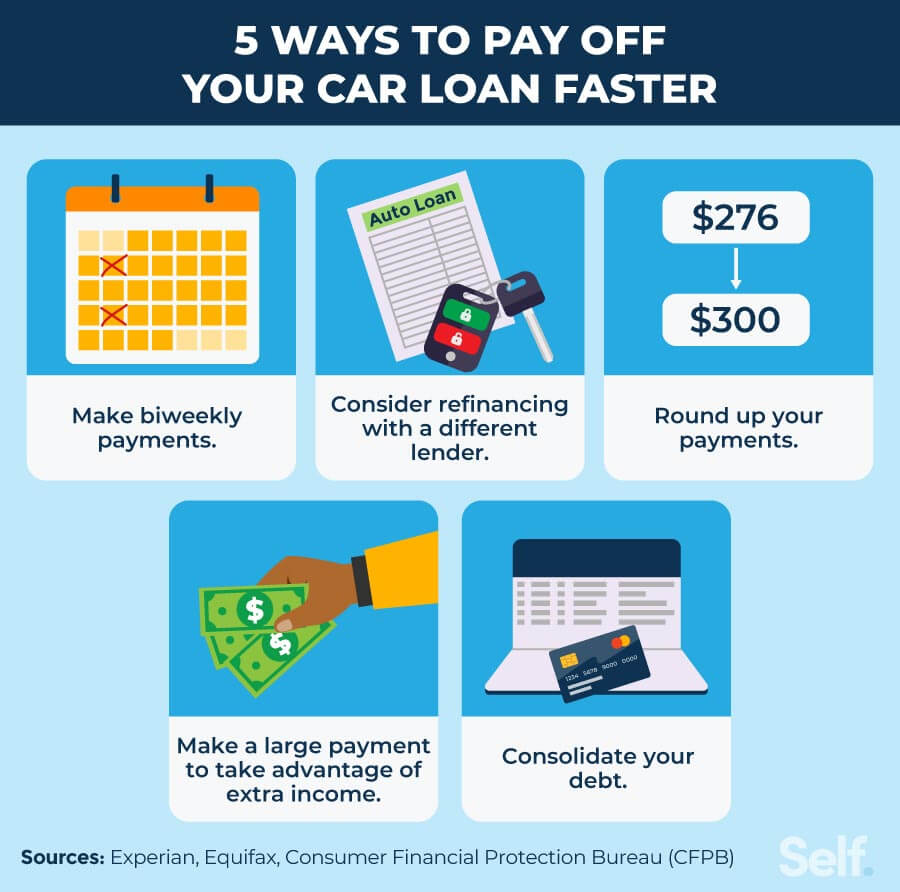
- Bi-Weekly Payments: Instead of one monthly payment, split your payment in half and pay it every two weeks. Since there are 26 bi-weekly periods in a year, this effectively results in 13 full monthly payments instead of 12. That extra payment each year goes directly to the principal, significantly reducing your loan term and total interest.
- Rounding Up Your Payment: If your payment is $375, consider paying $400. That extra $25 a month, while seemingly insignificant, adds up to $300 a year directed purely at reducing your principal.
- Adding a Fixed Amount: If you receive a raise or find extra cash in your budget, commit to adding a consistent fixed amount (e.g., an extra $50 or $100) to each monthly payment.
The beauty of extra payments lies in their direct impact on the principal, which immediately reduces the basis for future interest calculations.
Lump Sum Payments: Capitalizing on Windfalls
When unexpected money comes your way, resist the urge to splurge. Instead, consider directing these funds towards your car loan. This could include:
- Tax Refunds: A common source of lump-sum cash for many individuals.
- Work Bonuses: Use a portion or all of your annual bonus to make a significant dent in your principal.
- Inheritances or Gifts: If you receive a financial gift, consider prioritizing debt repayment.
- Selling Unused Items: Clear out clutter and use the proceeds to chip away at your loan.
Lump sum payments have an outsized impact, as they immediately reduce your principal by a large amount, shaving off significant interest and time.
Refinancing for Better Terms
Refinancing involves taking out a new loan to pay off your existing car loan, ideally with more favorable terms. This strategy is particularly effective if:
- Interest Rates Have Dropped: If market rates are lower than when you originated your loan, refinancing could secure you a lower APR.
- Your Credit Score Has Improved: A better credit score signals lower risk to lenders, potentially qualifying you for a significantly lower interest rate.
- You Want a Shorter Term: While a lower interest rate is ideal, you could also refinance into a shorter loan term to accelerate repayment, understanding that your monthly payments will likely increase.
Always compare the new loan’s interest rate, fees, and overall cost to your current loan to ensure it’s a truly beneficial move.
The Snowball and Avalanche Methods
These popular debt reduction strategies can be applied effectively to car loans:
- Debt Snowball: Focus on paying off your smallest debt first, regardless of interest rate. Once that’s paid, take the money you were paying on it and add it to the payment of your next smallest debt. The psychological wins of quickly eliminating smaller debts can provide immense motivation.
- Debt Avalanche: Prioritize paying off debts with the highest interest rates first. This method saves you the most money in interest over time, making it mathematically superior, though it may take longer to see the first debt eliminated.
For a car loan that might be your only debt, or one of several, these methods provide a structured approach to accelerated repayment.
The “Pay Off Faster Calculator”: Your Essential Financial Tool
All the strategies discussed above gain immense clarity and impact when coupled with a powerful financial tool: the car loan payoff calculator. This isn’t just a simple addition machine; it’s a dynamic simulator that can project the future of your finances based on your input.
What a Car Loan Calculator Does

A sophisticated “pay off faster calculator” typically performs several key functions:
- Calculates Original Amortization Schedule: It can show you your current repayment timeline and the total interest you’re scheduled to pay.
- Projects Impact of Extra Payments: This is its core strength. You can input various extra payment scenarios (e.g., an extra $50/month, a $1,000 lump sum, bi-weekly payments) and instantly see:
- Your new, earlier payoff date.
- The total amount of interest saved.
- The total number of payments reduced.
- Compares Refinancing Scenarios: Some calculators allow you to input new loan terms (interest rate, term) to compare the savings against your current loan.
- Visualizes Data: Many calculators offer graphs or charts that clearly illustrate the difference between your original repayment schedule and your accelerated one, making the financial impact tangible.
How to Effectively Use the Calculator
Using the calculator is straightforward but requires accurate data and a willingness to experiment:
- Gather Your Current Loan Information: You’ll need your original loan amount, current outstanding principal balance, current interest rate (APR), and remaining loan term (in months). This information can usually be found on your loan statements or by contacting your lender.
- Input Your Current Loan Details: Enter these figures into the designated fields on the calculator. This establishes your baseline.
- Experiment with Extra Payments: Start simple. What if you added just $25 extra per month? How about $50? Then try a larger lump sum. Note how each change impacts your payoff date and interest savings.
- Compare Scenarios: Run multiple simulations. Which strategy feels most achievable? Which one yields the best results for your budget?
- Focus on Key Metrics: Pay close attention to the “interest saved” and “new payoff date.” These are the most compelling indicators of progress.
- Consider Bi-Weekly Payments: If the calculator has this option, see the impact of splitting your payment and paying every two weeks.
The calculator demystifies the repayment process, turning it into a game where every extra payment is a strategic move, bringing you closer to winning.
Beyond the Calculator: Planning and Execution
While the calculator is an indispensable planning tool, it’s crucial to remember that it only provides the plan. The real work lies in the execution. The calculator can show you that an extra $50 per month will save you $800 and shave 6 months off your loan, but you still need to find that $50 and consistently apply it. This bridge between planning and action is where true financial discipline comes into play.
Practical Steps and Best Practices for Implementation
Transforming your calculated savings into real-world results requires a systematic approach. Here are practical steps and best practices to ensure you stick to your accelerated repayment plan.
Budgeting for Extra Payments
The first and most critical step is to find the money for those extra payments. This involves a thorough review of your monthly budget:
- Track Your Spending: Understand exactly where your money is going.
- Identify Areas for Cutbacks: Are there subscriptions you don’t use, discretionary spending you can reduce, or ways to save on groceries or entertainment?
- Automate Savings: If possible, set up an automatic transfer from your checking account to a dedicated “extra car payment” savings fund, or directly to your loan principal if your lender allows it.
- “Pay Yourself First”: Treat your extra car payment as a non-negotiable expense, just like rent or utilities.
Integrate your accelerated payment strategy directly into your monthly financial plan.
Automating Your Payments
Consistency is key. The easiest way to ensure you make those extra payments is to automate them.
- Set Up Recurring Payments: Most lenders allow you to set up automatic recurring payments for more than your minimum due.
- Bi-Weekly Automation: If pursuing a bi-weekly strategy, ensure your bank or lender can accommodate this payment frequency.
- Direct Principal Payments: Confirm with your lender that any extra payments you make are indeed applied directly to the principal balance, rather than being held as an advance on future payments. This is crucial for maximizing interest savings.
Automation removes the need for constant vigilance and reduces the chance of forgetting or rationalizing away an extra payment.
Monitoring Your Progress
Seeing the tangible results of your efforts is a powerful motivator.
- Regularly Check Loan Statements: Look for updates on your principal balance and the interest saved.
- Re-run Calculator Scenarios: Periodically re-enter your current outstanding balance into the calculator. See how much closer you are to your goal and how your initial extra payment projections are playing out.
- Celebrate Milestones: Acknowledge when you pay off a certain percentage of the loan, or when you save your first $500 in interest. These small victories keep you engaged and committed.
Staying Motivated
The journey to debt freedom can be long, so maintaining motivation is essential.
- Visualize the End Goal: Imagine the day you make your final payment. What will you do with that freed-up cash flow?
- Share Your Goals (Carefully): While not everyone needs to know your finances, sharing your goals with a supportive partner or trusted friend can provide accountability.
- Focus on the “Why”: Remind yourself why you want to pay off the loan faster – whether it’s for financial freedom, to save for a down payment, or simply for peace of mind.
Common Pitfalls to Avoid
While the path to accelerated car loan repayment is clear, there are potential missteps to be aware of.
Overextending Your Budget
Aggressive repayment is commendable, but not at the expense of your financial well-being. Don’t cut so deep into your budget that you can’t cover essential living expenses, build an emergency fund, or save for retirement. A balanced approach ensures long-term success.
Neglecting Other High-Interest Debts
If your car loan has a relatively low interest rate (e.g., 3-5%) but you have credit card debt with rates of 15-25%, prioritizing the car loan might not be the most financially optimal strategy. Always tackle the highest interest rate debts first to minimize overall interest paid, unless the psychological win of the debt snowball is more critical for your motivation.
Not Checking for Prepayment Penalties
While increasingly rare for car loans, some lenders may impose a prepayment penalty if you pay off your loan early. Always review your loan agreement or contact your lender to confirm there are no such clauses before implementing an aggressive repayment strategy.
Falling Back into Old Habits
Once your car loan is paid off, resist the urge to immediately take on new, unnecessary debt. Use the freed-up cash flow wisely—continue saving, invest, or direct it towards other financial goals. Maintaining the discipline you cultivated during your repayment journey is key to long-term financial health.
Conclusion
Paying off your car loan faster is more than just a financial maneuver; it’s a strategic step towards greater financial freedom and control. By understanding the fundamentals of your loan, implementing proven repayment strategies like extra payments and lump sums, and critically, by leveraging the insightful power of a “pay off faster calculator,” you can transform an often-daunting debt into a manageable, conquerable goal. The calculator serves as your compass, guiding you through various scenarios and illuminating the most efficient path to being debt-free.
Armed with knowledge and the right tools, you’re not just making payments; you’re actively shaping your financial future. Take the first step today: gather your loan details, fire up a car loan calculator, and embark on your accelerated journey to car ownership, free from monthly car payments. Your future self (and your wallet) will thank you.
aViewFromTheCave is a participant in the Amazon Services LLC Associates Program, an affiliate advertising program designed to provide a means for sites to earn advertising fees by advertising and linking to Amazon.com. Amazon, the Amazon logo, AmazonSupply, and the AmazonSupply logo are trademarks of Amazon.com, Inc. or its affiliates. As an Amazon Associate we earn affiliate commissions from qualifying purchases.