
Purchasing a car is one of the most significant financial decisions many individuals make, second only perhaps to buying a home. For most, this involves securing an auto loan, transforming a large upfront cost into a series of manageable monthly payments. However, simply knowing your monthly payment isn’t enough; truly understanding how that number is derived and what factors influence it is crucial for sound financial planning. Without this knowledge, you risk overpaying, misunderstanding the true cost of your vehicle, or even getting trapped in a cycle of debt. This article will demystify the process, providing you with the tools and knowledge to confidently calculate your auto payment and make informed financial decisions.

Understanding the Core Components of Your Auto Loan
Before diving into complex formulas, it’s essential to grasp the fundamental elements that constitute any auto loan. Each component plays a critical role in determining your monthly payment and the total cost of borrowing.
Principal Loan Amount
The principal loan amount is the actual sum of money you borrow to purchase the vehicle. This isn’t necessarily the sticker price of the car. Instead, it’s typically the car’s purchase price minus any down payment you make and any value you get from a trade-in vehicle. For instance, if a car costs $30,000, and you put down $5,000 and trade in a vehicle worth $3,000, your principal loan amount would be $22,000. Keeping this amount as low as possible is paramount, as it directly reduces the amount of interest you will pay over the loan’s lifetime.
Interest Rate (APR)
The interest rate, often expressed as an Annual Percentage Rate (APR), is the cost of borrowing the principal loan amount. It’s the lender’s fee for providing you with the money. Your APR is influenced by several factors, including your credit score, the current market interest rates, the loan term, and the lender’s policies. A higher APR means you’ll pay more in interest over the life of the loan, significantly increasing your total cost and monthly payment. Even a difference of one or two percentage points can translate to hundreds or thousands of dollars over several years, underscoring the importance of securing the lowest possible rate.
Loan Term
The loan term refers to the duration, typically expressed in months or years, over which you agree to repay the loan. Common terms range from 36 months (3 years) to 84 months (7 years). The loan term has a dual impact:
- Shorter terms (e.g., 36 or 48 months): Result in higher monthly payments but lower total interest paid because you’re paying off the principal more quickly, giving interest less time to accrue.
- Longer terms (e.g., 72 or 84 months): Result in lower monthly payments, making the car seem more affordable. However, you’ll pay significantly more in total interest over the longer period, and you risk owing more than the car is worth (being “upside down” or “underwater”) as depreciation outpaces your principal payments.
Down Payment and Trade-In
As mentioned, a down payment is an initial lump sum you pay towards the car’s purchase price. A trade-in is the value of your old vehicle applied towards the purchase of the new one. Both effectively reduce the principal loan amount, thereby lowering your monthly payments and the total interest you’ll accrue. A substantial down payment is often recommended as it immediately reduces your debt burden and can sometimes qualify you for a better interest rate from the lender.
The Auto Loan Payment Formula Demystified
While various online calculators can crunch these numbers for you, understanding the underlying formula provides a deeper insight into how your payments are structured. The standard formula used for calculating amortizing loans, like auto loans, is as follows:
The Standard Amortization Formula
The formula to calculate your monthly auto loan payment (M) is:
$$M = P [ i(1 + i)^n ] / [ (1 + i)^n – 1]$$
Where:
- M = Your monthly loan payment
- P = The principal loan amount (the amount you borrowed)
- i = Your monthly interest rate (your annual APR divided by 12)
- n = The total number of payments (your loan term in years multiplied by 12)
Breaking Down the Variables
Let’s elaborate on how to correctly derive ‘i’ and ‘n’ for use in the formula:
-
Calculating ‘i’ (Monthly Interest Rate): Your APR is an annual rate. To use it in a monthly payment calculation, you must convert it to a monthly rate and express it as a decimal.
- Example: If your APR is 6%, first convert it to a decimal: 6% / 100 = 0.06.
- Then, divide by 12 for the monthly rate: 0.06 / 12 = 0.005. So,
i = 0.005.
-
Calculating ‘n’ (Total Number of Payments): Your loan term is usually given in years. Convert it to months to represent the total number of payments you will make.
- Example: If your loan term is 5 years, then 5 years * 12 months/year = 60 months. So,
n = 60.
- Example: If your loan term is 5 years, then 5 years * 12 months/year = 60 months. So,
The Power of Online Calculators
While understanding the formula is empowering, for quick and accurate calculations, especially when comparing multiple scenarios, online auto loan calculators are invaluable. Most bank websites, financial aggregators, and even car manufacturer sites offer free tools. These calculators allow you to input various principal amounts, interest rates, and loan terms to instantly see the resulting monthly payment. They are excellent for scenario planning, helping you determine how changes to your down payment or loan term affect affordability.
Practical Application: Step-by-Step Calculation Guide
Let’s walk through a concrete example to solidify your understanding of the auto loan payment calculation.
Gathering Your Data
Before you begin, you need to have a clear understanding of your key financial parameters:
- Car Price: Let’s assume the car you want costs $30,000.
- Desired Down Payment: You plan to put down $5,000.
- Trade-in Value: You have an old car worth $0 (for simplicity, but could be a significant factor).
- Estimated APR: Based on your credit score, you estimate an APR of 6.5%.
- Desired Loan Term: You’re looking for a loan term of 60 months (5 years).
Calculating the Principal Loan Amount (P)
First, determine the actual amount you need to borrow:
- Car Price – Down Payment – Trade-in Value = Principal
- $30,000 – $5,000 – $0 = $25,000
- So, P = $25,000
Determining Your Monthly Interest Rate (i)
Convert your annual APR to a monthly decimal rate:
- APR as a decimal: 6.5% / 100 = 0.065
- Monthly Interest Rate (i): 0.065 / 12 = 0.00541667 (It’s crucial to use as many decimal places as possible for accuracy).
Finding the Total Number of Payments (n)
Convert your loan term in years to total months:
- Loan Term in Months (n): 5 years * 12 months/year = 60
- So, n = 60
Plugging into the Formula
Now, substitute these values into the amortization formula:
$$M = P [ i(1 + i)^n ] / [ (1 + i)^n – 1]$$
- Calculate
(1 + i): $1 + 0.00541667 = 1.00541667$ - Calculate
(1 + i)^n: $(1.00541667)^{60} approx 1.385312$ - Calculate
i(1 + i)^n: $0.00541667 * 1.385312 approx 0.0075038$ - Calculate
(1 + i)^n – 1: $1.385312 – 1 = 0.385312$ - Divide step 3 by step 4: $0.0075038 / 0.385312 approx 0.0194738$
- Multiply by the Principal (P): $25,000 * 0.0194738 = textbf{$486.845}$
Therefore, your estimated monthly auto payment would be approximately $486.85.
Beyond the Monthly Payment: Hidden Costs and Financial Implications
While calculating the monthly payment is a primary concern, it’s just one piece of the larger financial puzzle. Smart car buyers look beyond this single number to understand the full financial commitment.
Total Cost of the Loan
Calculating the total cost of the loan reveals how much you’re truly paying for the privilege of borrowing. This is simply the sum of all your monthly payments:
- Total Payments = Monthly Payment * Total Number of Payments
- Total Interest Paid = Total Payments – Principal Loan Amount
Using our example:
- Total Payments = $486.85 * 60 = $29,211.00
- Total Interest Paid = $29,211.00 – $25,000 = $4,211.00
This illustrates that while you borrowed $25,000, you will actually pay back $29,211 over five years due to interest. Longer terms, even with slightly lower payments, can significantly increase this total interest figure.
Additional Costs to Consider
Your auto loan payment covers only the principal and interest of the car itself. However, car ownership comes with many other financial obligations that must be factored into your overall budget:
- Sales Tax: A one-time tax on the purchase price, often financed or paid separately.
- Registration and Licensing Fees: Annual costs to keep your vehicle legal.
- Auto Insurance: A mandatory and often substantial ongoing expense. Premiums vary widely based on your vehicle, driving record, age, and location.
- Maintenance and Repairs: Regular oil changes, tire rotations, and unexpected repairs are inevitable.
- Fuel Costs: A recurring expense that fluctuates with gas prices and your driving habits.
- Extended Warranties: Optional but can add significantly to the overall cost.
Ignoring these can lead to a distorted view of affordability and financial strain.
Impact on Your Budget
A new car payment impacts your overall financial health. Lenders often look at your debt-to-income (DTI) ratio—the percentage of your gross monthly income that goes towards debt payments. A high DTI can make it harder to qualify for future loans (like a mortgage) and indicates a potentially strained budget. Ensure your auto payment, combined with other expenses, leaves you with sufficient disposable income for savings, emergencies, and other life goals. Asking “how much car can I truly afford?” considering all expenses, is more important than simply “can I afford the monthly payment?”
Strategies to Reduce Your Auto Payment and Total Cost
Proactive financial planning can significantly lower your auto expenses:
- Increase Your Down Payment: The more you pay upfront, the less you borrow, leading to lower monthly payments and less total interest.
- Improve Your Credit Score: A higher credit score signals lower risk to lenders, allowing you to qualify for lower APRs.
- Choose a Shorter Loan Term: If your budget allows, a shorter term drastically reduces the total interest paid, even if monthly payments are higher.
- Negotiate the Car Price: A lower purchase price means a lower principal loan amount.
- Shop for Better Interest Rates: Don’t just accept the first rate offered by the dealership. Get pre-approved by banks or credit unions to compare rates.
- Consider a Less Expensive Car: Align your vehicle choice with your actual financial capacity, not just your desires.
Leveraging Financial Tools for Auto Loan Management
In today’s digital age, various financial tools can simplify the process of calculating, understanding, and managing your auto loan.
Spreadsheets (Excel/Google Sheets)
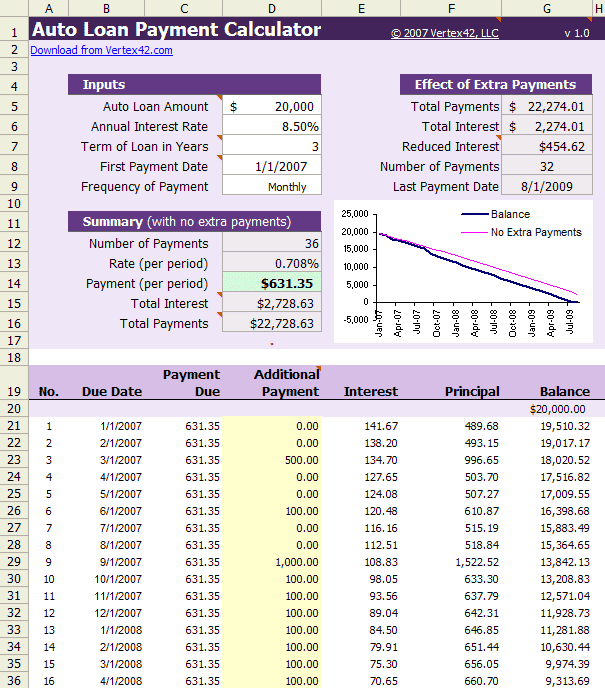
For those comfortable with basic spreadsheet functions, building your own auto loan calculator in Excel or Google Sheets offers immense flexibility. You can create different scenarios by changing interest rates, terms, and down payments, and immediately see the impact. Furthermore, you can build an amortization schedule to visualize how each payment is split between principal and interest over the loan’s life. This level of detail empowers you to see your principal balance decrease over time, which can be highly motivating.
Online Loan Calculators
As mentioned earlier, online calculators are fantastic for quick comparisons. Most financial institutions and automotive websites provide them. They are user-friendly, require minimal input, and instantly show results. Use them to:
- Compare different loan offers: Plug in APRs from various lenders to see who offers the best deal.
- Determine affordability: Adjust the car price or down payment to find a monthly payment that fits your budget.
- Evaluate trade-offs: See how extending a loan term might lower your monthly payment but increase total interest.
Amortization Schedules
An amortization schedule is a table detailing each periodic loan payment, showing how much of the payment is applied to the interest and how much to the principal. Early in the loan term, a larger portion of your payment goes towards interest. As you approach the end of the term, more of your payment is allocated to the principal. Understanding this breakdown can inform decisions, such as whether to make extra principal payments to save on interest and pay off the loan faster. Many online calculators generate these schedules automatically, or you can create one in a spreadsheet.

Conclusion
Calculating your auto payment is more than just plugging numbers into a formula; it’s a fundamental exercise in financial literacy and planning. By understanding the principal, interest rate, and loan term, and by taking into account additional costs of car ownership, you empower yourself to make intelligent decisions. Leveraging practical tools and strategies can help you secure the best possible loan terms, minimize your overall expenses, and ensure that your new vehicle is a source of joy, not financial stress. Approach your next car purchase with confidence, armed with the knowledge to navigate the financial complexities effectively.
aViewFromTheCave is a participant in the Amazon Services LLC Associates Program, an affiliate advertising program designed to provide a means for sites to earn advertising fees by advertising and linking to Amazon.com. Amazon, the Amazon logo, AmazonSupply, and the AmazonSupply logo are trademarks of Amazon.com, Inc. or its affiliates. As an Amazon Associate we earn affiliate commissions from qualifying purchases.