
The question “how many companies in Dow Jones” appears simple, yet it unlocks a deeper understanding of one of the world’s most enduring and frequently referenced stock market indices. At its core, the Dow Jones Industrial Average (DJIA) tracks precisely 30 large, publicly-owned companies based in the United States. But this seemingly straightforward number belies a rich history, a nuanced selection process, and a significant, albeit sometimes misunderstood, influence on the global financial landscape. For anyone navigating the complex world of personal finance, investing, or business economics, comprehending the DJIA is not merely about knowing a count, but understanding what these 30 companies represent, how they are chosen, and their role as a barometer for market sentiment and economic health.

This article delves into the specifics of the Dow, exploring its composition, the criteria for inclusion, its historical relevance, and its practical implications for investors. We will unpack why this small, exclusive club of companies continues to capture headlines and influence decisions, despite the existence of much broader market indices.
The Anatomy of an Iconic Index: Understanding the DJIA
To truly appreciate the Dow Jones Industrial Average, one must first grasp its fundamental structure and purpose. It’s more than just a list of companies; it’s a carefully curated snapshot of American industrial and economic might.
What is the Dow Jones Industrial Average?
The Dow Jones Industrial Average is a price-weighted average of 30 significant stocks traded on the New York Stock Exchange (NYSE) and the NASDAQ. Founded by Charles Dow in 1896, it is the second-oldest U.S. market index after the Dow Jones Transportation Average. The “Industrial” in its name is largely a historical vestige, as the index today includes companies from various sectors, far beyond traditional heavy industries. These companies are often referred to as “blue-chip” stocks, signifying their size, stability, long operational history, and generally strong financial performance.
Unlike market-capitalization-weighted indices (like the S&P 500), where companies with larger market values have a greater impact on the index’s movement, the DJIA is price-weighted. This means that stocks with higher share prices carry more weight in the average’s calculation. A one-dollar change in a higher-priced stock will have a greater effect on the Dow’s value than a one-dollar change in a lower-priced stock, regardless of the companies’ overall market capitalization. This unique weighting methodology is a defining characteristic and a frequent point of discussion among financial analysts.
Historical Context and Evolution
The Dow’s journey began with just 12 companies, predominantly industrial giants of the late 19th century, such as General Electric (which was a continuous component for over a century until 2018), American Cotton Oil, and U.S. Leather. Its creation aimed to provide a simple, accessible measure of the stock market’s performance, serving as an early indicator of the health of the broader American economy.
Over the decades, the index expanded to 20 stocks in 1916 and finally to its current 30 companies in 1928. This expansion reflected the growth and diversification of the U.S. economy. The continuous evolution of its components, with companies being added and removed over time, ensures that the Dow remains relevant to the current economic landscape, even as the “industrial” label has become somewhat anachronistic. It has survived numerous economic booms, busts, wars, and technological revolutions, cementing its status as a historical benchmark.
Why Just 30 Companies?
The selection of only 30 companies, particularly when compared to comprehensive indices like the S&P 500 (which tracks 500 companies), is a deliberate choice that underpins the Dow’s specific purpose. The goal of the DJIA is not to be a perfect representation of the entire market, but rather a snapshot of the largest, most influential, and financially sound corporations that are widely held by institutional and individual investors.
This limited number allows the index to serve as a focused barometer, offering insights into the performance of established market leaders. While it might miss the nuances of smaller sectors or emerging growth companies, it effectively captures the pulse of the well-capitalized, mature segments of the U.S. economy. For many investors, these 30 companies represent the bedrock of American corporate success, making their collective performance a critical indicator for broader market sentiment.
Selection Criteria: Curating the Elite
The decision of which companies make it into the Dow’s exclusive group of 30 is not arbitrary. It involves a rigorous, albeit flexible, process overseen by a committee. Understanding these criteria provides insight into what makes a company a true “blue chip” and how the index strives to maintain its relevance.
The Role of the Averages Committee
The selection and removal of companies from the DJIA is managed by a committee comprising representatives from S&P Dow Jones Indices and The Wall Street Journal. This committee meets periodically to review the index’s components, considering potential changes to ensure it accurately reflects the U.S. stock market and the broader economy. Their decisions are based on a set of general principles rather than rigid rules, allowing for adaptability to evolving market conditions.
The committee doesn’t just pick the largest companies; they look for companies with excellent reputations, a history of sustained growth, and broad investor interest. This discretionary approach contrasts with many other indices that have strict quantitative entry requirements, giving the Dow a unique qualitative edge.
Industry Representation and Sector Balance
While the name “Industrial” might suggest a focus on manufacturing, the modern DJIA aims for a reasonable representation of the U.S. equity market across various sectors. The committee seeks to ensure that the index is not overly concentrated in any single industry and that it includes companies from key economic segments like technology, healthcare, finance, consumer goods, and industrials.
For instance, the addition of Salesforce (CRM) in 2020 and the removal of ExxonMobil (XOM) highlighted a shift from traditional energy and manufacturing towards cloud computing and software. These changes reflect the committee’s commitment to evolving the index to mirror the structural changes and growth drivers within the U.S. economy, keeping it relevant to today’s investment landscape. The composition is thus a dynamic reflection of economic powerhouses.
Maintaining “Blue-Chip” Status
Companies included in the Dow are expected to maintain their “blue-chip” status. This implies they are leaders in their respective industries, possess strong brand recognition, have a history of profitability, and demonstrate financial stability. They typically have large market capitalizations, high liquidity, and are widely held by institutional investors.
Changes to the Dow’s components usually occur when a company’s business has substantially altered its market relevance, or when corporate actions like mergers, acquisitions, or significant financial distress necessitate a review. The goal is to ensure the 30 companies collectively provide a continuous, reliable measure of the market’s high-performing segment. The exit of a company like General Electric, once a cornerstone, underscored that even long-standing giants are not immune to falling out of favor if their influence wanes.
The Dow’s Significance and Influence
Despite its relatively small number of components and its price-weighted methodology, the Dow Jones Industrial Average wields considerable influence. It’s often the first index mentioned in news reports and serves as a quick reference point for investors and the public alike.
A Barometer for the U.S. Economy
For many, the Dow is synonymous with the health of the American economy. Its daily movements are closely watched, with significant gains often interpreted as signs of economic strength and sharp declines as harbingers of trouble. While this interpretation is an oversimplification given the index’s limited scope, its historical prominence has ingrained this perception deeply into collective financial consciousness.
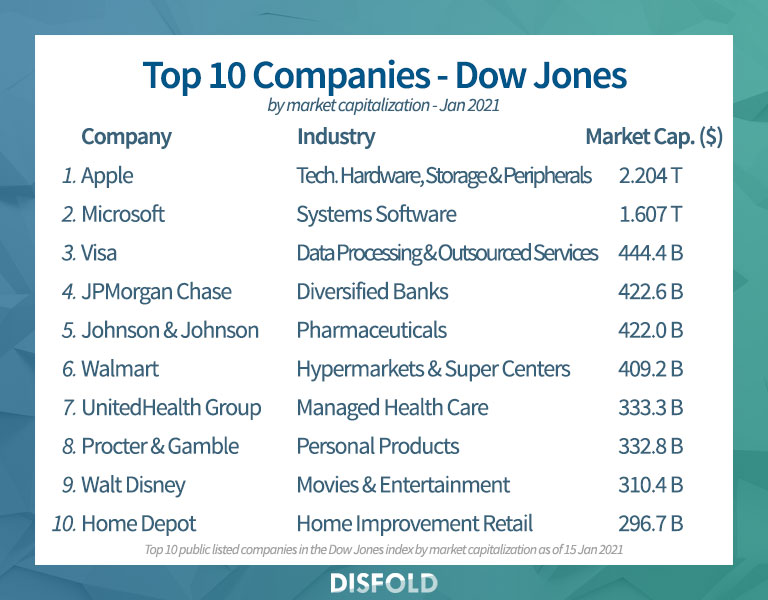
Economists and analysts often dissect the performance of its individual components to gauge sector-specific trends or the overall strength of corporate earnings. When companies like Apple, Microsoft, or Johnson & Johnson, all Dow components, report strong earnings or offer optimistic outlooks, it tends to instill confidence across the broader market.
Investor Sentiment and Market Psychology
The Dow’s performance frequently dictates investor sentiment. A “Dow up” headline can create a sense of optimism, while a “Dow down” headline might trigger anxiety. This psychological impact, though not always rational or fully representative of individual portfolio performance, is a powerful force in financial markets. Traders and analysts pay close attention to the Dow’s intraday movements, especially at market open and close, using them as signals for broader market direction.
For individual investors, following the Dow can provide a simplified view of market trends, though it’s crucial to understand that their own diversified portfolios may not perfectly mirror the Dow’s performance. It serves as a narrative anchor around which market conversations often revolve.
Diversification and Portfolio Strategy
While the Dow itself only contains 30 stocks, its components are often integral to diversified investment portfolios. Many index funds and ETFs track not just the Dow, but broader indices where these blue-chip companies are significant constituents. Investors looking for exposure to large-cap U.S. equities will invariably find themselves invested in many of the companies that make up the Dow.
However, financial advisors typically caution against solely relying on the Dow as a measure of portfolio health or as the sole investment vehicle. A truly diversified portfolio will include exposure to a wider range of companies, sectors, and asset classes to mitigate risk and capture growth opportunities beyond the 30 industrial giants. Nevertheless, understanding the Dow’s components and their performance is a critical part of any comprehensive investment strategy.
Understanding the Dow’s Limitations and Criticisms
Despite its iconic status, the Dow is not without its critics. Its methodology and limited scope lead to several inherent limitations that serious investors and financial professionals must understand.
Price-Weighted Limitations
The most significant criticism of the DJIA is its price-weighted methodology. As mentioned, a higher-priced stock has a greater impact on the index than a lower-priced stock, regardless of the company’s actual market value. This can lead to distortions where a small, relatively insignificant price movement in a high-priced stock can sway the entire index more than a substantial percentage change in a lower-priced, but perhaps larger, company.
For example, a company with a $100 stock price and a $100 billion market cap might have less influence on the Dow than a company with a $300 stock price and a $50 billion market cap if their share prices move by the same dollar amount. This contradicts the common understanding of “market impact,” which typically aligns with market capitalization. This makes the Dow less representative of overall market wealth than market-cap-weighted indices.
Limited Scope and Representation
With only 30 companies, the Dow inherently offers a very limited view of the vast U.S. stock market. It omits thousands of publicly traded companies, including those in emerging sectors, mid-cap, and small-cap segments that often drive significant growth and innovation. This narrow focus means the Dow cannot fully capture the nuances, breadth, or true performance of the entire economy.
For instance, the rise of biotechnology or renewable energy companies might not be fully reflected in the Dow until these industries mature and produce companies large enough to merit inclusion. Consequently, investors who rely solely on the Dow might miss out on significant investment opportunities or misunderstand broader market trends.
The Future of the Dow in a Modern Investment Landscape
In an era dominated by sophisticated financial tools, algorithmic trading, and granular data analysis, questions arise about the Dow’s continued relevance. Is an index designed in the 19th century still suitable for interpreting 21st-century markets?
While its role as the definitive market barometer has been somewhat eclipsed by broader indices like the S&P 500, the Dow retains its cultural and historical significance. It remains an easily digestible headline number, a familiar touchstone for the general public, and a topic of frequent discussion among financial commentators. Its simplicity is both its strength and its weakness. As long as blue-chip companies continue to anchor the U.S. economy, the Dow, with its 30 hand-picked components, will likely continue to hold a prominent, if evolving, place in the financial lexicon.
Navigating the Dow in a Modern Investment World
For today’s investors, the Dow serves multiple purposes. It’s a historical reference, a quick market sentiment gauge, and a collection of companies worth studying. However, informed decisions require looking beyond its simple count of 30.
Monitoring Dow Components
Staying informed about the current list of Dow companies is crucial for any investor wishing to track this index. The components are not static, and changes can have implications for sectors and investor sentiment. Financial news outlets, investment platforms, and the official S&P Dow Jones Indices website regularly update this information. Understanding which companies are in and out, and the rationale behind these changes, offers valuable insights into the committee’s perception of economic shifts.

Investing in the Dow: ETFs and Index Funds
While one cannot directly “invest in the Dow” as a singular entity, investors can gain exposure to its performance through various financial products. Exchange-Traded Funds (ETFs) and index funds that specifically track the Dow Jones Industrial Average are popular choices. These funds hold shares of all 30 component companies in proportions that mimic the index’s price-weighted methodology.
Investing in such a fund provides instant diversification across the Dow’s blue-chip companies and offers a straightforward way to participate in their collective performance without having to buy each stock individually. This approach aligns with the “Money” category by providing practical financial tools for investment. However, investors should also consider the expense ratios of these funds and their overall fit within a broader, well-diversified portfolio that likely extends beyond just these 30 companies.
In conclusion, the answer to “how many companies in Dow Jones” is a definitive 30. But this number is merely the gateway to understanding a complex and deeply influential financial index. The Dow Jones Industrial Average, with its carefully selected cohort of leading American enterprises, continues to serve as an important, albeit sometimes limited, indicator of economic health and market sentiment. For those navigating the world of personal finance and investing, appreciating the Dow’s structure, its historical journey, its strengths, and its limitations is essential for making informed financial decisions in a constantly evolving global market.
aViewFromTheCave is a participant in the Amazon Services LLC Associates Program, an affiliate advertising program designed to provide a means for sites to earn advertising fees by advertising and linking to Amazon.com. Amazon, the Amazon logo, AmazonSupply, and the AmazonSupply logo are trademarks of Amazon.com, Inc. or its affiliates. As an Amazon Associate we earn affiliate commissions from qualifying purchases.