
Navigating the annual tax season can feel like a daunting task, a complex financial puzzle that requires careful attention to detail and a thorough understanding of the ever-evolving tax code. For millions of Americans, tax preparation services like H&R Block offer a beacon of assistance, promising simplicity, accuracy, and peace of mind. However, a common question arises for those considering their services: “How much does it truly cost to file taxes with H&R Block?”
The answer, as with many financial decisions, is not a single, straightforward figure. Instead, it’s a dynamic range influenced by a multitude of factors, primarily the complexity of your financial situation, the specific level of service you require, and the chosen method of filing. This comprehensive guide will dissect H&R Block’s pricing structure, helping you understand the variables at play and empowering you to make an informed decision that aligns with your financial needs and budget.

Understanding H&R Block’s Service Spectrum
H&R Block has evolved far beyond its traditional brick-and-mortar offices, now offering a versatile suite of services designed to cater to a broad spectrum of taxpayers. Their offerings generally fall into three main categories: self-prepared online options, hybrid services with professional review, and full-service in-person preparation. Each comes with its own price point and feature set.
Free Online Filing Options: When Basic Suffices
For a significant portion of the population, particularly those with simpler tax situations, H&R Block provides a genuinely free online filing option. This service is typically designed for individuals who:
- File a basic federal Form 1040.
- Have income primarily from W-2 wages.
- Claim the standard deduction.
- Have basic credits like the Child Tax Credit or Earned Income Tax Credit.
- Possess limited investment income (e.g., interest under $1,500).
The H&R Block Free Online product allows users to prepare and e-file both federal and, in many cases, state returns at no cost. It’s an excellent solution for students, young professionals, and retirees with straightforward financial profiles. The platform guides you step-by-step, making it accessible even for first-time filers. However, it’s crucial to ensure your situation truly qualifies for the free tier, as complexity beyond these basic parameters will necessitate an upgrade.
Stepped-Up Online Filing Packages: For More Complex Situations
As your financial life grows more intricate, so too does the need for more robust tax preparation tools. H&R Block offers several tiered online packages, each building upon the previous one with added features and capabilities, and naturally, an increasing cost. These typically include:
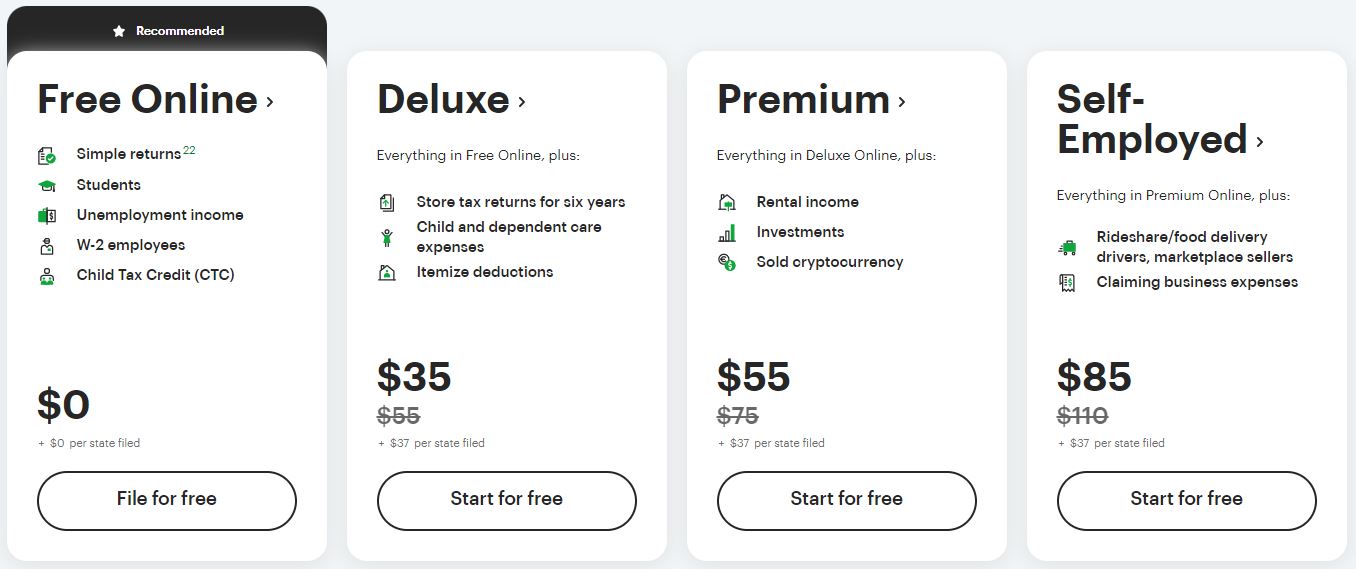
- Deluxe: Ideal for homeowners, those with significant deductions, and individuals who itemize. This package often supports Schedules A (Itemized Deductions) and B (Interest and Ordinary Dividends). It’s designed for users who want to maximize their deductions beyond the standard amount, such as mortgage interest, property taxes, and charitable contributions. The price for the Deluxe package typically ranges from $30 to $50 for federal, with an additional fee for state filing.
- Premium: Aimed at investors and rental property owners. This tier adds support for Schedules D (Capital Gains and Losses), E (Supplemental Income and Loss, including rental real estate), and K-1 income. If you’ve sold stocks, have mutual funds, or own rental properties, the Premium package provides the necessary forms and guidance. Federal pricing for Premium usually falls between $50 and $80, plus state fees.
- Self-Employed: Specifically tailored for freelancers, independent contractors, small business owners, and gig workers. This comprehensive package handles Schedule C (Profit or Loss from Business) for reporting business income and expenses, as well as estimated tax payments. It often includes specialized guidance for common self-employment deductions and simplified bookkeeping tools. The Self-Employed package is the most expensive online option, typically costing $80 to $120 for federal, with separate state charges.
These online packages offer a high degree of flexibility and convenience, allowing you to work on your taxes at your own pace from anywhere with an internet connection. They provide audit support, maximum refund guarantees, and sometimes even live chat assistance.
In-Person and Tax Pro Review Services: The Hybrid and Full-Service Approach
For taxpayers who prefer professional assurance or simply want to hand off the entire process, H&R Block offers services that integrate human expertise.
- Tax Pro Review: This is a hybrid service where you prepare your taxes online using one of H&R Block’s paid software packages, but then a certified tax professional reviews your return before you file it. The pro checks for accuracy, identifies potential missed deductions or credits, and ensures compliance. This service provides a valuable layer of security and expertise, bridging the gap between DIY and full-service preparation. The cost for Tax Pro Review is an additional fee on top of your chosen online software package, and it can vary significantly based on the complexity of your return, often starting from an additional $40 and going upwards.
- In-Person Tax Preparation: The traditional H&R Block experience. You visit a local office, sit down with a tax professional, and they prepare your return from start to finish. This is the most hands-on and personalized service, ideal for individuals with very complex tax situations, those uncomfortable with technology, or anyone who simply values the peace of mind that comes from a professional handling everything. Given the personalized attention and expertise, this is the most expensive option. The fees are typically based on the forms required, the time spent, and the complexity of your return. A basic in-person federal return might start around $80 to $100, but can easily climb to several hundred dollars or more for complex returns involving business income, multiple investments, or foreign assets. State returns are almost always an additional charge.
Factors Influencing Your H&R Block Filing Costs
Beyond the general service tiers, several specific elements contribute to the final price tag you’ll encounter when filing with H&R Block. Understanding these can help you anticipate costs and potentially reduce them.
Complexity of Your Tax Situation
This is arguably the most significant determinant of cost. The more forms, schedules, and calculations required for your return, the higher the fee.
- Income Sources: A simple W-2 income leads to lower costs. Multiple W-2s, 1099-NEC for contract work, K-1s from partnerships, investment income (1099-B, 1099-DIV), rental income, or foreign income significantly increase complexity and cost.
- Deductions and Credits: While some basic credits (like the Child Tax Credit) might be included in lower tiers, claiming itemized deductions (Schedule A), business expenses (Schedule C), or specialized credits (e.g., energy credits, education credits) will push you into higher-priced packages or professional services.
- Life Events: Major life changes like marriage, divorce, purchasing a home, starting a business, or having a child can dramatically alter your tax situation and subsequently, the cost of preparation due to new forms and calculations.
Chosen Filing Method: DIY vs. Guided vs. Full Service
As discussed, your choice of how you interact with H&R Block directly correlates with the price:
- DIY Online (Free to Self-Employed Tier): This is generally the most cost-effective, as you’re doing most of the work yourself.
- Tax Pro Review: Adds a professional review fee on top of your DIY software cost, offering a middle ground.
- In-Person (Full Service): This is the premium option, where the professional handles everything, resulting in the highest fees.
The trade-off is often between your time, your comfort level with tax forms, and your budget.
State Tax Filings: An Additional Layer
For most individuals, state tax returns are a separate filing requirement from federal taxes. While H&R Block’s free federal online option often includes free state filing, their paid online packages and in-person services almost always charge an additional fee for each state return filed. This fee can range from $30 to $60 per state, depending on the complexity and the chosen federal package. If you lived or worked in multiple states during the tax year, these state filing fees can add up quickly.
Add-on Services and Guarantees
H&R Block offers various supplementary services that can provide additional peace of mind or convenience but come with extra costs:
- Audit Support: This service provides assistance if your return is selected for an audit. While many packages include basic audit guidance, more comprehensive audit defense services are often an extra purchase.
- Identity Theft Protection: Optional services to monitor for and help resolve tax-related identity theft.
- Refund Advance Loans: Short-term loans against your expected federal tax refund. While convenient, these often come with fees or are structured such that the fee is deducted from your refund.
- Worry-Free Guarantee: A paid add-on that typically includes audit assistance, a dedicated tax expert to represent you, and reimbursement for any penalties or interest if H&R Block makes an error.
While these add-ons can be valuable for specific situations, it’s important to evaluate if the additional cost is justified for your individual needs.
Maximizing Value and Minimizing Costs with H&R Block
Even within H&R Block’s structured pricing, there are strategies you can employ to ensure you’re getting the best value for your money and avoiding unnecessary expenses.
Leveraging Early Bird Specials and Discounts
Tax season often kicks off with promotional pricing, especially for online software products. H&R Block, like its competitors, frequently offers “early bird” discounts in the weeks leading up to and immediately following the New Year. Filing earlier in the season can sometimes secure a lower price for paid online packages. Additionally, keep an eye out for potential discounts for students, military personnel, or returning customers. Some credit card companies or financial institutions may also partner with H&R Block to offer special rates.
Choosing the Right Package for Your Needs
One of the most common ways people overpay is by selecting a tax software package that has more features than they truly need. Conversely, choosing a package that’s too basic can lead to missed deductions or errors, potentially costing you more in the long run through penalties or missed refunds.
- Assess your tax situation honestly: Before you even start, list all your income sources, major expenses, and any significant life changes.
- Match features to needs: If you only have W-2 income and take the standard deduction, the free online option is likely sufficient. If you own a home, the Deluxe package is probably your starting point. If you have extensive investments or are self-employed, Premium or Self-Employed are necessary.
- Don’t automatically assume complexity: A simple investment portfolio might still fit within a lower tier if capital gains are minimal and transactions are few.
H&R Block’s online platform typically includes a “where do I start?” questionnaire or a simple interview process that helps guide you to the appropriate product based on your answers. Utilize this tool to avoid guesswork.
Taking Advantage of Free Resources and Tools
Even if you opt for a paid service, H&R Block provides a wealth of free resources that can help you prepare and understand your taxes better:
- Tax Calculators: Tools to estimate your refund, calculate withholdings, or project self-employment taxes.
- Knowledge Base and Articles: Extensive libraries of articles explaining various tax topics, deductions, credits, and filing requirements.
- Tax Tips and Checklists: Guidance on what documents to gather and common mistakes to avoid.
Educating yourself through these free resources can make the filing process smoother, reduce the chances of needing costly expert intervention for simple questions, and ensure you’re aware of potential deductions you might qualify for.
H&R Block vs. Alternatives: A Cost-Benefit Perspective
When evaluating H&R Block’s pricing, it’s beneficial to briefly consider the broader market. Competitors like TurboTax offer similar tiered software products, often at comparable price points, though their specific features and user interfaces differ. FreeTaxUSA provides very affordable federal and state filing options, often for a fraction of the cost of major players, but with less extensive customer support. Local CPAs and enrolled agents offer highly personalized service, but at a significantly higher cost, often ranging from $200 to $1,000+ depending on complexity.
The value proposition of H&R Block lies in its strong brand reputation, extensive network of physical offices, robust online platform, and various guarantees. For many, the brand recognition, user-friendly interface, and the option for professional review or in-person assistance justify the cost. They provide a balance between DIY affordability and professional assurance.
Choosing H&R Block is often worth it for individuals who:
- Value a trusted brand with decades of experience.
- Appreciate a well-designed, intuitive online platform.
- Want access to physical locations for in-person support or questions.
- Seek the security of professional review or full-service preparation for complex returns.
- Prioritize strong guarantees for accuracy and audit support.
If your financial situation is very basic, a truly free online service might suffice. If it’s extremely complex and you require year-round tax planning or specialized business advice, a dedicated CPA might be more appropriate. H&R Block expertly fills the large middle ground, offering a scalable solution for a wide variety of taxpayers.
Conclusion: Making an Informed Decision for Your Tax Filing
The cost of filing taxes with H&R Block is not a fixed expense but rather a spectrum reflecting the diversity of taxpayer needs and financial situations. From genuinely free online filing for basic returns to premium full-service professional preparation, H&R Block offers a comprehensive range of options.
To make the most informed and cost-effective decision, begin by thoroughly understanding your own tax situation. Identify your income sources, deductions, and credits, and consider your comfort level with technology and tax forms. Then, carefully match your needs to H&R Block’s tiered services, keeping an eye out for early bird specials and discounts. Remember to account for potential state filing fees and any desired add-on services.
Ultimately, the “best” option isn’t about finding the cheapest price, but rather finding the service that provides the right balance of accuracy, convenience, support, and affordability for your unique circumstances. By taking a proactive and informed approach, you can navigate tax season with confidence, knowing you’ve chosen a filing solution that offers both peace of mind and financial prudence.
aViewFromTheCave is a participant in the Amazon Services LLC Associates Program, an affiliate advertising program designed to provide a means for sites to earn advertising fees by advertising and linking to Amazon.com. Amazon, the Amazon logo, AmazonSupply, and the AmazonSupply logo are trademarks of Amazon.com, Inc. or its affiliates. As an Amazon Associate we earn affiliate commissions from qualifying purchases.