
In the intricate world of personal finance and business, numbers often tell a story far beyond their face value. Among these, percentages play a particularly crucial role, offering a standardized way to compare values, calculate growth, or quantify change. While large percentages might grab headlines, it’s often the seemingly small figures, like 2.5 percent, that have a profound and often underestimated impact on our financial well-being. Understanding “how much is 2.5 percent in money” is not merely a mathematical exercise; it’s a fundamental step toward mastering your finances, whether you’re dealing with savings, investments, loans, or everyday expenses. This article will delve into the practical applications of 2.5 percent, illustrating its significance across various monetary contexts and empowering you to leverage this understanding for better financial decisions.
The Fundamentals: Calculating 2.5%
Before we explore its impact, let’s firmly grasp the mechanics of calculating 2.5 percent of any given monetary amount. This basic understanding is the bedrock upon which all subsequent financial insights are built.
Basic Calculation Methods
Calculating a percentage involves converting the percentage into a decimal or fraction and then multiplying it by the base amount. For 2.5 percent, there are a few straightforward methods:
- Decimal Conversion: The most common and efficient method is to convert the percentage to a decimal by dividing it by 100.
- 2.5% ÷ 100 = 0.025
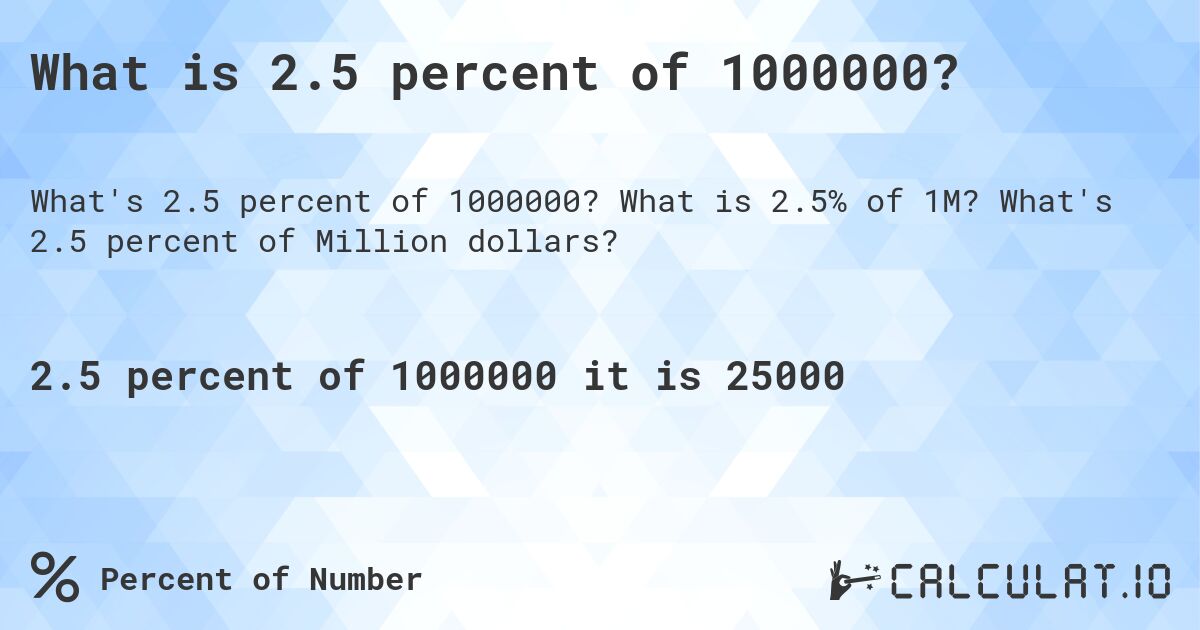
- To find 2.5% of any number, simply multiply that number by 0.025. For example, 2.5% of $1,000 is $1,000 * 0.025 = $25.
- Fractional Method: Less common for decimals but conceptually useful, you can express 2.5% as a fraction:
- 2.5/100, which simplifies to 25/1000 or 1/40.
- So, finding 2.5% of a number is equivalent to dividing that number by 40. For instance, $1,000 / 40 = $25.
- Mental Math Tricks: For quick estimates, you can break it down.
- Find 10% (move decimal one place left), then 5% (half of 10%), then 2.5% (half of 5%).
- Example for $1,000:
- 10% of $1,000 = $100
- 5% of $1,000 = $50 (half of $100)
- 2.5% of $1,000 = $25 (half of $50)
Practical Examples with Different Base Amounts
The actual monetary value of 2.5% changes dramatically depending on the base amount it’s applied to. This illustrates why proportional thinking is so crucial in finance.
- $100: 2.5% of $100 is $2.50. This might represent a small discount on a purchase or a negligible fee.
- $1,000: 2.5% of $1,000 is $25. This could be the interest earned on a small savings account, a modest commission, or a minor budget line item.
- $10,000: 2.5% of $10,000 is $250. This sum becomes more significant, potentially representing a quarterly investment return, a noticeable fee on a transaction, or a down payment on a larger purchase.
- $100,000: 2.5% of $100,000 is $2,500. At this scale, 2.5% can be a substantial amount, such as annual interest on a mortgage, a significant management fee on an investment portfolio, or a sales commission on a property.
- $1,000,000: 2.5% of $1,000,000 is $25,000. This is a considerable sum that could represent annual investment gains, a significant portion of a business’s profit margin, or a substantial advisory fee.
These examples clearly demonstrate that while the percentage remains constant, its monetary impact scales directly with the principal amount. This principle underpins nearly every financial decision we make.
Where 2.5% Appears in Your Personal Finances
The ubiquitous nature of percentages means that 2.5% pops up in countless financial scenarios, directly influencing your income, expenses, savings, and debt.
Savings and Investments
For many, 2.5% might represent a modest yet respectable return in certain savings and investment vehicles.
- Interest Rates on Savings Accounts: In periods of higher interest rates, or with specific high-yield savings accounts, a 2.5% Annual Percentage Yield (APY) can be an attractive rate. While seemingly small, it means your money is growing, albeit modestly, without significant risk. Over time, especially with larger sums, this consistent growth can be meaningful.
- Returns on Conservative Investments: Certain bonds, money market funds, or stable dividend stocks might offer average annual returns around 2.5%. For investors seeking capital preservation and modest income, this can be a reasonable target.
- Inflation Impact: Crucially, 2.5% can also represent an inflation rate. If the cost of living increases by 2.5% annually, any investment or savings account yielding less than 2.5% is effectively losing purchasing power. Understanding this provides a crucial benchmark for evaluating the real return on your money.
Borrowing and Debt
On the flip side, 2.5% can represent a cost when it comes to borrowing.
- Credit Card Interest: While 2.5% annual interest on a credit card would be incredibly low and rare (typical rates are much higher, often 15-25% APR), it’s important to differentiate between annual and monthly rates. A 2.5% monthly interest rate translates to a staggering 30% APR (2.5% * 12 months), highlighting how seemingly small monthly percentages can quickly compound into significant debt.
- Loan Interest Rates: A 2.5% interest rate on a personal loan or a mortgage is considered highly favorable. For a mortgage, even a difference of 0.5% can save tens of thousands of dollars over the loan’s lifetime. Understanding what a 2.5% rate means in terms of monthly payments and total interest paid is vital before committing to any loan.
- Fees: Various financial products or services may levy fees expressed as a percentage. A 2.5% origination fee on a loan, for instance, means you pay an extra 2.5% of the loan amount upfront, directly increasing the cost of borrowing.
Income and Expenses
Even in your daily spending and earning, 2.5% plays a role.
- Sales Tax: Depending on your location, sales tax rates can vary. While rarely exactly 2.5%, understanding how a similar percentage adds to the cost of goods is essential for budgeting.
- Discounts and Rebates: A 2.5% discount on a large purchase, say a new appliance or car, can translate to tangible savings. Recognizing and taking advantage of these small percentage reductions can add up.
- Commissions: Many salespeople, real estate agents, or financial advisors earn a commission based on a percentage of the value of a sale or asset. A 2.5% commission on a $500,000 home sale, for example, amounts to $12,500, a significant income for the agent.
- Budgeting: You might allocate 2.5% of your monthly income to a specific savings goal, a discretionary spending category, or a charity donation. This proportional approach helps maintain balance in your budget regardless of income fluctuations.
The Cumulative Impact of 2.5%: Small Percentages, Big Results
The true power, or peril, of 2.5% often lies in its cumulative effect over time. What seems negligible in the short term can grow exponentially or erode significantly over decades.
The Power of Compound Interest
When 2.5% represents an annual return on an investment or savings, the magic of compound interest transforms it from a minor gain into a substantial wealth-building tool.
- Imagine investing $10,000 at a consistent 2.5% annual return.
- After 1 year: $10,250
- After 10 years: $12,800.85
- After 30 years: $20,975.68
- This example, using simple annual compounding, shows that your initial $10,000 more than doubles over three decades, purely from a modest 2.5% return consistently reinvested. The longer the timeframe, the greater the compounding effect, turning small, consistent gains into significant wealth.
The Erosion of Inflation
Conversely, a sustained 2.5% inflation rate, while seeming moderate, can relentlessly eat away at your purchasing power over time.
- If you have $10,000 under your mattress (or in an account earning 0% interest) and inflation averages 2.5% annually, the purchasing power of that $10,000 will be significantly diminished over time.
- After 10 years, it would feel like you only have $7,763 in today’s dollars.
- After 30 years, it would feel like you only have $4,743 in today’s dollars.
- This highlights the critical importance of ensuring your investments at least keep pace with inflation to preserve your real wealth.
Fees and Their Hidden Costs
Investment fees, often expressed as percentages, can also have a devastating cumulative impact, even if they seem small.
- Consider a 2.5% annual management fee on an investment fund. If you have $100,000 invested, that’s $2,500 per year going to fees, not compounding for you.
- Over 30 years, if your portfolio grows to, say, $500,000, that 2.5% fee would be $12,500 per year. These fees can dramatically reduce your net returns and slow down your wealth accumulation, often far more than many investors realize. It’s crucial to be aware of all fees associated with your financial products.
Leveraging 2.5% for Financial Advantage
Understanding the subtle yet powerful influence of 2.5% empowers you to make proactive decisions that can significantly improve your financial standing.
Optimizing Savings & Investments
- Seeking Higher Interest Rates: While 2.5% might be a decent rate for some savings vehicles, actively seeking accounts that offer even slightly higher rates can make a difference. High-yield savings accounts or Certificates of Deposit (CDs) might offer better returns than traditional banks.
- Understanding Risk vs. Reward: A 2.5% return typically comes with low risk. If you’re comfortable with more risk, you might target higher percentage returns from investments like stocks or mutual funds, but it’s important to understand the associated volatility.
- Small, Consistent Contributions: Even if your primary investment returns are 2.5%, consistent, regular contributions to your savings or investment accounts amplify the compounding effect, ensuring you’re continually putting more money to work for you.
Minimizing Debt Costs
- Targeting High-Interest Debt: If you have debt accruing at a rate significantly higher than 2.5%, prioritizing its repayment is often one of the most financially advantageous moves you can make. The money saved on interest compounds in your favor.
- Refinancing Opportunities: If market rates drop, refinancing a loan (like a mortgage) to a lower percentage rate, perhaps even 2.5% or less, can lead to substantial long-term savings on interest and potentially lower monthly payments.
- Avoiding Fees: Be vigilant about any percentage-based fees (e.g., late payment fees, overdraft fees). Avoiding these often represents a 100% return on the money you didn’t have to pay.
Smart Spending & Budgeting
- The Power of Small Discounts: Always consider if a 2.5% discount is worth the effort to obtain it. Over a year, small percentage savings on groceries, utilities, or recurring services can add up to hundreds of dollars.
- Strategic Allocation: When budgeting, consciously allocate a small percentage of your income (like 2.5%) towards specific financial goals, such as an emergency fund, a down payment, or a fun splurge. This proportional approach helps you stay on track regardless of your income level.
Beyond the Number: The Mindset of Percentages in Money
Ultimately, understanding “how much is 2.5 percent in money” is about more than just calculation; it’s about developing a sophisticated financial mindset.
Financial Literacy as a Cornerstone
Embracing percentages is a cornerstone of financial literacy. It allows you to move beyond raw dollar amounts and think proportionally. Is $100 a lot? It depends if it’s 2.5% of your $4,000 income or 2.5% of your $400,000 net worth. This proportional thinking provides clarity and context to all financial figures, enabling more informed decision-making.
Continuous Monitoring and Adjustment
Financial environments are dynamic. Interest rates fluctuate, inflation rises and falls, and investment opportunities evolve. Regularly monitoring how 2.5% (or any percentage) impacts your financial instruments and adjusting your strategies accordingly is crucial. This proactive approach ensures your money is always working as hard as possible for you.
Conclusion
The question “how much is 2.5 percent in money?” opens a window into the nuanced yet impactful world of percentages in finance. From calculating modest interest gains to understanding the insidious erosion of inflation or the significant bite of fees, 2.5% is a prime example of how small numbers can wield immense power over your financial future. By mastering the calculation, recognizing its presence in various financial contexts, appreciating its cumulative effects, and strategically leveraging it, you gain a significant advantage in managing your money. This seemingly small percentage serves as a powerful reminder that in personal finance, attention to detail and a proactive approach to understanding numbers can pave the way for substantial wealth creation and long-term financial security.
aViewFromTheCave is a participant in the Amazon Services LLC Associates Program, an affiliate advertising program designed to provide a means for sites to earn advertising fees by advertising and linking to Amazon.com. Amazon, the Amazon logo, AmazonSupply, and the AmazonSupply logo are trademarks of Amazon.com, Inc. or its affiliates. As an Amazon Associate we earn affiliate commissions from qualifying purchases.