
The question of who invented the calculator does not yield a single name, but rather a lineage of visionary engineers, mathematicians, and tech pioneers. From the brass gears of the 17th century to the sophisticated AI-driven algorithms of the modern era, the calculator represents one of the most significant technological journeys in human history. To understand the “inventor” is to understand the evolution of hardware, the miniaturization of components, and the eventual transition into the software-dominated world we inhabit today.
The Pioneers of Mechanical Calculation
The foundations of modern technology were laid long before the first circuit board was etched. The quest to automate mathematics began as a response to the grueling manual labor of taxation, astronomy, and commerce. While the abacus served humanity for millennia, the true “tech” leap occurred when mechanical automation entered the fray.
Blaise Pascal and the Pascaline
In 1642, a 19-year-old French mathematician named Blaise Pascal developed what is widely considered the first functional mechanical calculator: the Pascaline. Driven by the desire to help his father, a tax collector, Pascal engineered a device using a series of notched wheels and gears. The Pascaline was a marvel of its time, capable of adding and subtracting directly.
Technically, the Pascaline was limited by its “carry” mechanism, which allowed a total to move from the units column to the tens column automatically. While it was not a commercial success due to its high production cost and complexity, it established the fundamental principle that a machine could replicate human cognitive processes—the very seed of what would eventually become artificial intelligence.
Gottfried Wilhelm Leibniz’s Stepped Reckoner
Building on Pascal’s groundwork, the German polymath Gottfried Wilhelm Leibniz took mechanical computation a step further in 1673. He invented the “Stepped Reckoner,” a device that utilized a specialized gear mechanism known as the Leibniz wheel. Unlike the Pascaline, which was largely limited to addition, the Stepped Reckoner could perform multiplication and division through repeated addition and subtraction.
Leibniz’s contribution to the tech world extended beyond hardware; he was a fierce advocate for the binary system. His realization that all logic could be reduced to 0s and 1s provided the theoretical framework for every digital computer and calculator produced in the last century.
Charles Babbage: The Father of Modern Computing
By the 19th century, the demand for precision in navigation and engineering led Charles Babbage to design the Difference Engine and, later, the Analytical Engine. While these were never fully completed during his lifetime, Babbage’s designs introduced the concept of “programmability.” His machines utilized punched cards for input, a memory unit (the “store”), and a processing unit (the “mill”). This architecture remains the blueprint for the modern CPU (Central Processing Unit) found in today’s high-end scientific calculators and smartphones.
The Shift to Electronic Computation
The transition from clanking gears to silent electrons marked the birth of the modern tech era. The mid-20th century saw the emergence of vacuum tubes and transistors, which allowed for speeds that mechanical devices could never achieve.
The Vacuum Tube Era and the ANITA
In the early 1960s, the world saw its first fully electronic desktop calculator: the ANITA (A New Inspiration To Arithmetic). Developed by the Bell Punch Company in the UK, the ANITA utilized vacuum tubes and cold-cathode switching tubes. It was bulky, expensive, and generated significant heat, but it was a technological breakthrough. It eliminated the physical friction of gears, allowing for near-instantaneous results. This was the moment the calculator transitioned from a mechanical gadget to an electronic system.
Transistors and the Miniaturization Revolution
The true catalyst for the modern calculator—and all modern tech—was the invention of the transistor at Bell Labs. Transistors replaced fragile vacuum tubes, allowing for devices that were smaller, faster, and more reliable. In 1964, Sharp (then Hayakawa Electric) introduced the CS-10A, a desktop electronic calculator that used 530 transistors.
This era began the race for “LSI” or Large Scale Integration. Engineers worked feverishly to cram more logic gates onto smaller silicon wafers. This period is critical in tech history because it perfected the manufacturing processes that eventually led to the microprocessor.
The Pocket Calculator: A Milestone in Consumer Tech

The 1970s represented the “Golden Age” of gadget innovation. The dream of a powerful computing device that could fit in a pocket became a reality, forever changing how we interact with technology on a daily basis.
Texas Instruments and the “Cal-Tech” Project
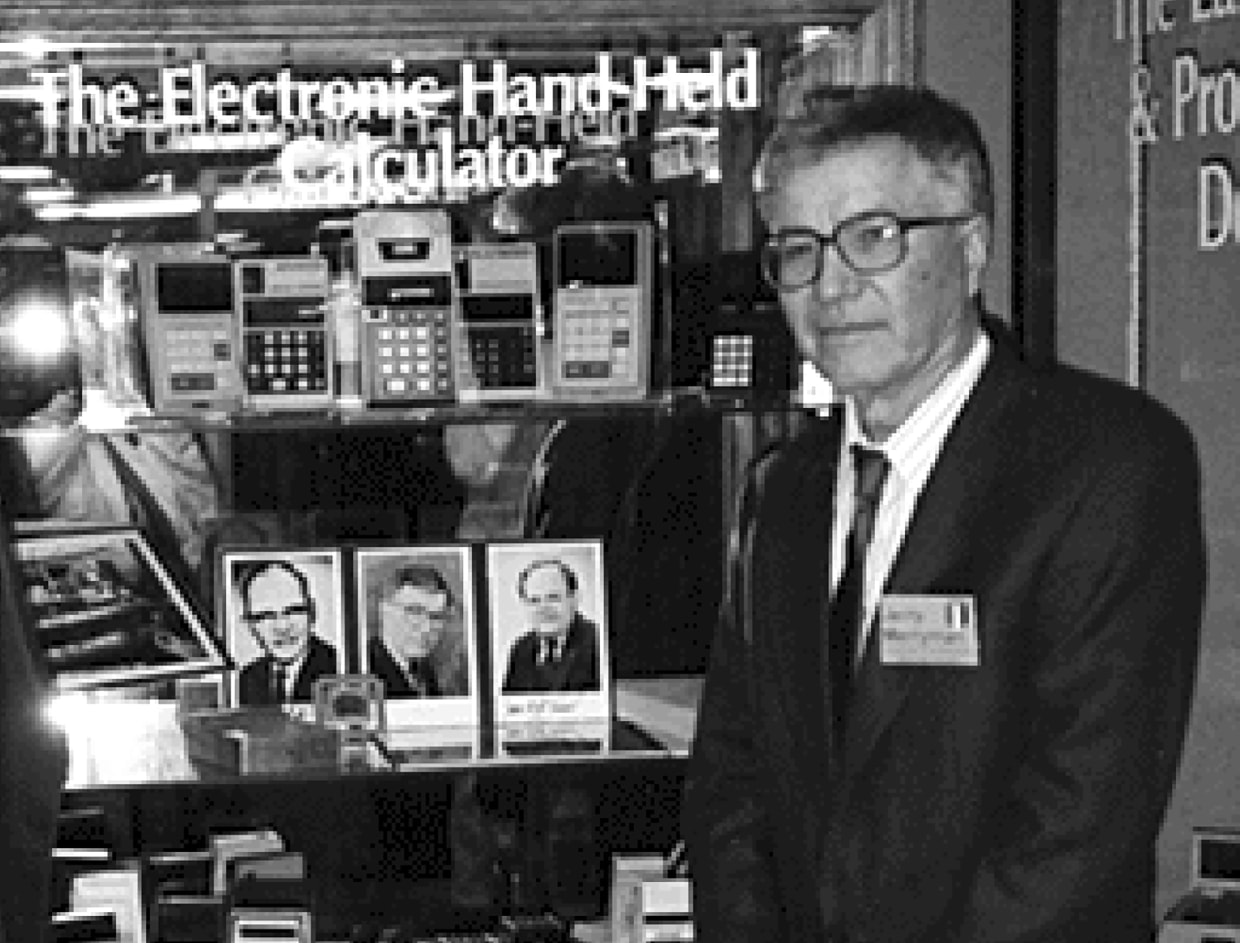
The most pivotal moment in the history of the handheld calculator occurred at Texas Instruments (TI). In 1967, a team led by Jack Kilby—the co-inventor of the integrated circuit—developed the “Cal-Tech.” This prototype could perform basic arithmetic and print results on a small thermal paper tape.
The Cal-Tech was the proof of concept that led to the first commercially available pocket calculators. By 1972, TI released the TI-2500 Datamath, which utilized a single-chip microcomputer. This was a watershed moment for consumer electronics; it proved that complex technology could be miniaturized for the mass market, setting the stage for the personal computer revolution.
The Influence of the Busicom LE-120A
While TI was innovating in the US, Japanese companies were pushing the boundaries of hardware design. The Busicom LE-120A “Handy” was one of the first truly portable calculators to use an LED (Light Emitting Diode) display. This shift from heavy vacuum-fluorescent displays to LEDs was a major leap in battery efficiency and portability. It established the “gadget” aesthetic that would dominate the 1980s and 90s: sleek, plastic, and portable.
Hewlett-Packard and the HP-35
In 1972, Hewlett-Packard (HP) disrupted the market with the HP-35. This was the world’s first scientific pocket calculator. Before the HP-35, complex functions like trigonometry and logarithms required bulky desktop machines or slide rules. HP’s engineering team managed to fit all these functions into a device that could be held in one hand. It used Reverse Polish Notation (RPN), a logic system that appealed to engineers and scientists, further cementing the calculator’s role as an essential tool for high-tech advancement.
Modern AI and Software-Based Calculators
Today, the “calculator” has transcended physical hardware. While physical graphing calculators remain staples in education, the cutting edge of calculation technology has moved into the cloud and onto our mobile devices.
The Transition to Scientific and Graphing Software
In the late 1990s and early 2000s, software like MATLAB, Mathematica, and WolframAlpha redefined what “calculating” meant. These tools are no longer just about arithmetic; they are about symbolic computation, data visualization, and complex modeling. The “inventor” of the modern calculator is now a software engineer. Apps like GeoGebra allow users to manipulate geometric shapes and algebraic equations in real-time, providing an interactive tutorial environment that a physical device cannot match.
AI-Driven Problem Solvers and Cloud Computing
We have entered the era of AI-integrated calculation. Modern tools like Photomath use computer vision to “see” handwritten equations and solve them instantly, providing step-by-step tutorials on the underlying logic. Behind the scenes, these apps utilize neural networks and machine learning to recognize patterns and optimize solutions.
Furthermore, cloud-based engines like WolframAlpha act as “computational knowledge engines.” They don’t just solve 2+2; they can compute the orbital trajectory of a satellite or the protein folding sequence of a virus. The technology has evolved from a tool that assists human memory to a tool that augments human intelligence.
Why the History of the Calculator Matters in Today’s Tech Landscape
The story of the calculator is the story of the semiconductor industry. The same drive for miniaturization that gave us the pocket calculator in the 70s gave us the smartphone in the 2000s.
The Foundation of Digital Security
Calculators were the first consumer devices to require complex logic gates. This logic is the foundation of digital security. Modern encryption—the kind that secures your emails and banking—relies on prime number factorization and modular arithmetic, the very same operations that the pioneers of the calculator sought to automate. Understanding how a calculator processes data helps us understand the vulnerabilities and strengths of our digital world.

Hardware Reviews and the Legacy of Durability
In the world of tech reviews, few devices hold their value like a high-end calculator. A TI-84 Plus or an HP-12C purchased twenty years ago is often still functional and useful today. This speaks to a level of hardware reliability that is rare in the era of “planned obsolescence.” As we review modern gadgets, the calculator stands as a benchmark for what a dedicated, purposeful piece of technology should be.
In conclusion, while we can point to Blaise Pascal for the gears, Jack Kilby for the silicon, and Stephen Wolfram for the algorithmic intelligence, the “inventor” of the calculator is a collective human effort. It is a continuous thread of innovation that has taken us from wooden beads to quantum-ready algorithms, proving that our need to quantify the world is the primary driver of technological progress.
aViewFromTheCave is a participant in the Amazon Services LLC Associates Program, an affiliate advertising program designed to provide a means for sites to earn advertising fees by advertising and linking to Amazon.com. Amazon, the Amazon logo, AmazonSupply, and the AmazonSupply logo are trademarks of Amazon.com, Inc. or its affiliates. As an Amazon Associate we earn affiliate commissions from qualifying purchases.