
Understanding how the cost of living changes over time is fundamental to sound financial planning, both personally and for businesses. Two key metrics—the Consumer Price Index (CPI) and the inflation rate—serve as invaluable compasses in this economic landscape. Far from being mere abstract economic terms, these indicators directly impact your purchasing power, investment strategies, and the overall health of your financial future. This article will demystify CPI and inflation, providing you with a clear, step-by-step guide on their calculation and, crucially, why they matter for your money.

Understanding the Fundamentals: What Are CPI and Inflation?
Before diving into the calculations, it’s vital to grasp what CPI and inflation truly represent. They are interconnected concepts, with CPI acting as the raw data point from which the inflation rate is derived.
What is the Consumer Price Index (CPI)?
The Consumer Price Index (CPI) is a measure of the average change over time in the prices paid by urban consumers for a market basket of consumer goods and services. Think of it as a snapshot of what it costs to maintain a typical standard of living. This “basket” includes a wide range of categories that everyday people spend money on: food and beverages, housing, apparel, transportation, medical care, recreation, education and communication, and other goods and services.
Governments and economic agencies, such as the Bureau of Labor Statistics (BLS) in the United States or Eurostat in the European Union, compile this data meticulously. They track prices for thousands of specific items within these categories across various geographic regions. The CPI is not an actual dollar amount but an index number, representing a price level relative to a base period. A higher CPI indicates that the cost of the basket has increased, while a lower CPI suggests a decrease. It is a critical indicator of the cost of living and the purchasing power of money.
What is Inflation?
Inflation, in its simplest terms, is the rate at which the general level of prices for goods and services is rising, and consequently, the purchasing power of currency is falling. When inflation occurs, a dollar today buys less than it did yesterday. It’s the silent thief of your savings, gradually eroding the value of your money over time.
There are various drivers of inflation, often categorized into:
- Demand-pull inflation: Occurs when aggregate demand in an economy outpaces aggregate supply, leading to higher prices. Too much money chasing too few goods.
- Cost-push inflation: Arises when the cost of producing goods and services increases, forcing businesses to raise their prices to maintain profit margins. This could be due to higher wages, raw material costs, or energy prices.
Understanding inflation is paramount because it affects everything from your daily grocery bill to your retirement savings. High inflation can devalue fixed incomes, make long-term financial planning challenging, and even influence interest rates set by central banks.
The Mechanics of CPI Calculation
Calculating the CPI involves a systematic process of identifying, tracking, and weighting the prices of a representative set of goods and services.
Selecting the Basket of Goods and Services
The first step in calculating CPI is to define the “market basket” that reflects the spending patterns of the target population (typically urban consumers). This basket is not static; it’s periodically updated to reflect changes in consumer preferences and the availability of new goods and services. For example, decades ago, the basket might not have included smartphones or internet services, but today they are essential components.
The categories within the basket are carefully chosen to be representative. These typically include:
- Food and Beverages: Groceries, restaurant meals.
- Housing: Rent, homeowner’s equivalent rent, utilities (electricity, gas, water), furniture.
- Apparel: Clothing, footwear.
- Transportation: New and used vehicles, gasoline, public transit fares, vehicle insurance.
- Medical Care: Doctor visits, hospital services, prescription drugs.
- Recreation: Entertainment, sports equipment, toys.
- Education and Communication: Tuition, school books, internet services, telephone services.
- Other Goods and Services: Personal care products, tobacco.
Each item in the basket is assigned a “weight” based on its relative importance in average consumer spending. For instance, housing typically holds the largest weight because it constitutes a significant portion of most households’ budgets.
Gathering Price Data
Once the basket is defined, price collectors gather data on the prices of these thousands of items from a variety of retail establishments and service providers across different geographical areas. This data collection is typically done monthly to capture price fluctuations in a timely manner.
The process involves:
- Direct observation: Visiting stores and recording prices.
- Surveys: Collecting price data from service providers (e.g., doctors’ offices, universities).
- Online data collection: Utilizing e-commerce platforms for certain goods.
A crucial element here is establishing a base period. This is a reference period (e.g., a specific year or an average of several years) against which prices in other periods are compared. The CPI for the base period is always set to 100.
The CPI Formula Demystified
With the cost of the basket determined for both the current period and the base period, the CPI can be calculated using a straightforward formula:
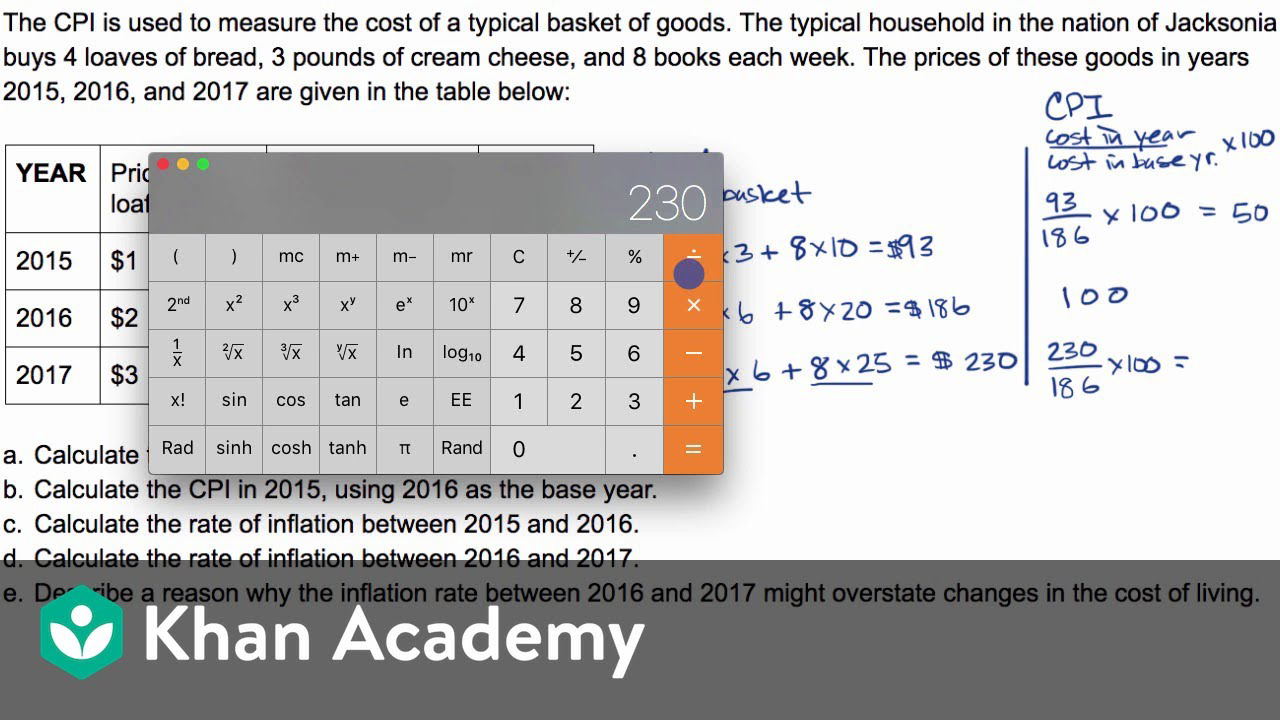
CPI = (Cost of Basket in Current Period / Cost of Basket in Base Period) * 100
Let’s illustrate with a simplified example:
Imagine a hypothetical economy where the consumer basket consists only of three items: Bread, Milk, and Rent.
| Item | Quantity in Basket | Price in Base Year (2020) | Cost in Base Year (2020) | Price in Current Year (2023) | Cost in Current Year (2023) |
|---|---|---|---|---|---|
| Bread | 10 loaves | $2.00 | $20.00 | $2.50 | $25.00 |
| Milk | 5 gallons | $3.00 | $15.00 | $3.50 | $17.50 |
| Rent | 1 month | $1,000.00 | $1,000.00 | $1,200.00 | $1,200.00 |
- Cost of Basket in Base Year (2020): $20.00 + $15.00 + $1,000.00 = $1,035.00
- Cost of Basket in Current Year (2023): $25.00 + $17.50 + $1,200.00 = $1,242.50

Now, apply the CPI formula:
CPI (2023) = ($1,242.50 / $1,035.00) * 100
CPI (2023) ≈ 120.05
This means that, relative to the base year 2020 (where CPI is 100), the cost of the consumer basket in 2023 has increased by approximately 20.05%.
Calculating the Inflation Rate
Once you have CPI data for different periods, calculating the inflation rate becomes simple. Inflation is essentially the percentage change in the CPI over a specific period.
The Inflation Rate Formula
The most common way to express the inflation rate is as the year-over-year percentage change in the CPI. This gives a clear picture of how prices have changed compared to the same month or quarter in the previous year.
Inflation Rate = ((CPI in Current Period – CPI in Previous Period) / CPI in Previous Period) * 100
- Current Period: The most recent CPI value you are interested in.
- Previous Period: The CPI value from the period you are comparing against (e.g., the same month a year ago).
Step-by-Step Example Calculation
Let’s continue with our simplified CPI example. Suppose we calculated the CPI for 2023 as 120.05. Now, let’s say the CPI for the previous year, 2022, was 115.00.
Using the inflation rate formula:
Inflation Rate (2022-2023) = ((CPI in 2023 – CPI in 2022) / CPI in 2022) * 100
Inflation Rate (2022-2023) = ((120.05 – 115.00) / 115.00) * 100
Inflation Rate (2022-2023) = (5.05 / 115.00) * 100
Inflation Rate (2022-2023) ≈ 0.04391 * 100
Inflation Rate (2022-2023) ≈ 4.39%
This calculation tells us that the inflation rate between 2022 and 2023 was approximately 4.39%. In other words, prices, on average, rose by 4.39% during that year. This is the figure often reported in financial news.
Why These Metrics Matter for Your Money
Understanding and tracking CPI and inflation isn’t an academic exercise; it has profound, practical implications for every aspect of your financial life.
Personal Finance Implications
- Purchasing Power: Inflation directly impacts your purchasing power. If your income doesn’t rise at the same rate as inflation, your real income (what your money can actually buy) decreases. This erodes the value of your savings, making it harder to meet future financial goals.
- Budgeting: Awareness of inflation helps you adjust your budget. If you notice rising prices for essentials like food and fuel, you can reallocate funds or seek ways to reduce discretionary spending to maintain your financial stability.
- Savings and Investments: Inflation is a major consideration for investors. Simply putting money in a low-interest savings account might mean that its real value is shrinking. To maintain or grow wealth, investments need to yield returns that at least outpace inflation. This encourages consideration of assets like stocks, real estate, commodities, or inflation-protected securities.
- Wages and Salaries: For employees, inflation is a critical factor in salary negotiations. A raise that is less than the inflation rate effectively means a pay cut in real terms. Knowing the inflation rate empowers you to advocate for cost-of-living adjustments that maintain your standard of living.
- Retirement Planning: Retirees on fixed incomes are particularly vulnerable to inflation. Planning for retirement must account for the erosion of purchasing power over decades.
Business Finance and Economic Impact
- Pricing Strategies: Businesses constantly monitor CPI and inflation to adjust their pricing strategies. Rising input costs (raw materials, labor, energy) due to inflation often necessitate price increases for finished goods and services to maintain profitability.
- Cost Management: Inflation can squeeze profit margins if businesses cannot pass on increased costs to consumers. This forces companies to focus on efficiency, supply chain optimization, and cost-saving measures.
- Monetary Policy: Central banks (like the Federal Reserve in the US) closely watch inflation data when setting monetary policy. If inflation is too high, they might raise interest rates to cool down the economy and curb spending. Conversely, during periods of low inflation or deflation, they might lower rates to stimulate economic activity.
- Investment Decisions: Businesses’ investment decisions are influenced by inflation expectations. High inflation uncertainty can make businesses hesitant to invest in long-term projects, while stable, moderate inflation can indicate a healthy, growing economy.
Tools and Resources for Tracking CPI and Inflation
While understanding the calculations is empowering, you don’t need to manually track prices to stay informed. Several reliable resources provide up-to-date CPI and inflation data.
Official Sources and Data Repositories
- Bureau of Labor Statistics (BLS): For US data, the BLS website (www.bls.gov) is the definitive source for CPI releases, detailed reports, and historical data. They offer various CPI series (e.g., CPI-U for urban consumers, CPI-W for urban wage earners) and detailed breakdowns by expenditure category.
- Eurostat: For the European Union, Eurostat (ec.europa.eu/eurostat) provides harmonized indices of consumer prices (HICP), allowing for comparability across member states.
- National Statistical Agencies: Most countries have their own national statistical offices that publish CPI and inflation data (e.g., Statistics Canada, Office for National Statistics in the UK).
- Central Banks: Central bank websites (e.g., Federal Reserve, European Central Bank) often provide economic data dashboards that include inflation figures and analyses.
Financial Tools and Calculators
Many online tools can help you visualize and interpret inflation data:
- Online Inflation Calculators: Numerous financial websites offer calculators where you can input a past dollar amount and see its equivalent value today, adjusted for inflation.
- Budgeting Apps and Software: Advanced personal finance apps sometimes integrate inflation considerations or allow you to track your spending against inflation trends.
- Investment Platforms: Many investment platforms provide insights into how inflation might affect different asset classes and offer inflation-protected securities (like Treasury Inflation-Protected Securities or TIPS).
By regularly consulting these resources, you can keep a pulse on economic conditions and make more informed financial decisions.
Understanding how CPI and the inflation rate are calculated and, more importantly, what they signify, is a cornerstone of financial literacy. These metrics are not abstract economic jargon but powerful indicators that directly impact your personal budget, your savings’ purchasing power, and your investment returns. By grasping these concepts, you gain a vital tool for navigating the complexities of the economy, allowing you to proactively adjust your financial strategies to protect and grow your wealth in an ever-changing world. Empower yourself with this knowledge, and you’ll be better equipped to make sound decisions that secure your financial future.
aViewFromTheCave is a participant in the Amazon Services LLC Associates Program, an affiliate advertising program designed to provide a means for sites to earn advertising fees by advertising and linking to Amazon.com. Amazon, the Amazon logo, AmazonSupply, and the AmazonSupply logo are trademarks of Amazon.com, Inc. or its affiliates. As an Amazon Associate we earn affiliate commissions from qualifying purchases.