
Supplemental Security Income (SSI) is a critical federal program designed to provide financial assistance to aged, blind, and disabled individuals who have limited income and resources. Unlike Social Security retirement or disability benefits, which are based on past earnings, SSI is a needs-based program funded by general tax revenues. For millions of Americans, understanding how SSI is calculated isn’t just a matter of curiosity; it’s essential for financial stability, budgeting, and ensuring they receive the full benefits they are entitled to.
Navigating the complexities of SSI calculation can be daunting, involving a meticulous assessment of various income types, resource limits, and even living arrangements. The Social Security Administration (SSA), which administers the program, employs a specific methodology to determine an individual’s or couple’s monthly payment. This guide aims to demystify that process, breaking down the key components and offering a clear, insightful look into the financial mechanics behind SSI. Whether you are a prospective applicant, a current recipient, or someone supporting a loved one, grasping these intricacies is fundamental to maximizing benefits and maintaining eligibility.
Understanding the Basics of SSI Eligibility
Before delving into the calculation specifics, it’s imperative to understand the foundational eligibility criteria for SSI. Meeting these initial requirements is the prerequisite for any benefit calculation to even begin. SSI is distinct from Social Security Disability Insurance (SSDI) or retirement benefits; it’s a safety net program for those with demonstrated financial need.
Who Qualifies? Age, Blindness, and Disability Criteria
The “S” in SSI stands for Supplemental Security, but the beneficiaries primarily fall into three categories:
- Aged: Individuals must be 65 years or older.
- Blind: Individuals must meet the SSA’s definition of blindness, which is central visual acuity of 20/200 or less in the better eye with the use of a correcting lens, or a visual field limitation such that the widest diameter of the visual field subtends an angle no greater than 20 degrees.
- Disabled: Individuals must have a medically determinable physical or mental impairment that is expected to result in death, or that has lasted or is expected to last for a continuous period of not less than 12 months, and prevents them from doing any substantial gainful activity (SGA). For children, the disability definition differs slightly, focusing on a severe functional limitation.
Meeting one of these three criteria is the first hurdle. However, merely being aged, blind, or disabled is not enough; the program’s needs-based nature brings income and resource limits into play.
Income and Resource Limits: The Financial Gatekeepers
SSI is a program of last resort, meaning it’s intended for those with little to no other means of financial support. Therefore, strict income and resource limits are applied:
- Income Limit: While there isn’t a fixed “income limit” in the traditional sense like a simple cut-off, your countable income must be below the Federal Benefit Rate (FBR) to receive any SSI. The FBR is the maximum federal SSI payment an eligible individual or couple can receive. In 2024, for example, the FBR is $943 per month for an individual and $1,415 for an eligible couple. Many types of income are partially excluded or disregarded before comparing it to the FBR, which is where the calculation becomes crucial.
- Resource Limit: Resources are assets you own that could be converted to cash and used for your support. For 2024, the resource limit is $2,000 for an individual and $3,000 for a couple. If your countable resources exceed these limits, you are generally ineligible for SSI. We’ll delve deeper into what counts as a resource and what doesn’t.
Citizenship and Residency Requirements
Beyond age, disability, and financial need, applicants must also meet certain citizenship and residency requirements. Generally, an individual must be a U.S. citizen or national, or in certain categories of aliens, and reside in one of the 50 states, the District of Columbia, or the Northern Mariana Islands. Some exceptions apply for children of military personnel temporarily living abroad.
The Core Components of SSI Calculation: Income
The most intricate part of SSI calculation revolves around how the SSA evaluates an applicant’s or recipient’s income. It’s not simply your gross earnings; rather, it’s a carefully crafted system of inclusions, exclusions, and deductions designed to determine your “countable income.” This countable income is then subtracted from the Federal Benefit Rate (FBR) to arrive at your monthly SSI payment.
What Counts as Income?
The SSA broadly categorizes income into several types, all of which are considered during the calculation:
- Earned Income: Wages, net earnings from self-employment, honoraria for services rendered, and sheltered workshop payments. This is often the most significant component for working individuals.
- Unearned Income: This includes money you receive that isn’t from work. Examples are Social Security benefits (retirement, disability, or survivor), pensions, veterans’ benefits, workers’ compensation, unemployment benefits, interest, dividends, and cash from friends or relatives.
- In-Kind Support and Maintenance (ISM): This is non-cash income in the form of food or shelter that you receive. If someone else pays for your food or shelter, or provides it to you for free, its value is typically counted as income. This is a critical factor, as it can significantly reduce your SSI payment, often by applying the “one-third reduction rule” or the “presumed maximum value rule,” which we’ll discuss later.
- Deemed Income: In certain situations, part of the income and resources of people living with you may be “deemed” to you. This applies to a spouse, parent (for a child under 18 or 22 if a student), or sponsor (for certain non-citizens). The SSA assumes a portion of their income is available to support you, even if they don’t directly provide it.
Income Exclusions and Deductions: Reducing Your Countable Income
Not all income you receive is counted dollar-for-dollar against your SSI. The SSA allows for various exclusions and deductions, which are crucial for reducing your “countable income” and, consequently, increasing your SSI payment. Understanding these can make a substantial difference:
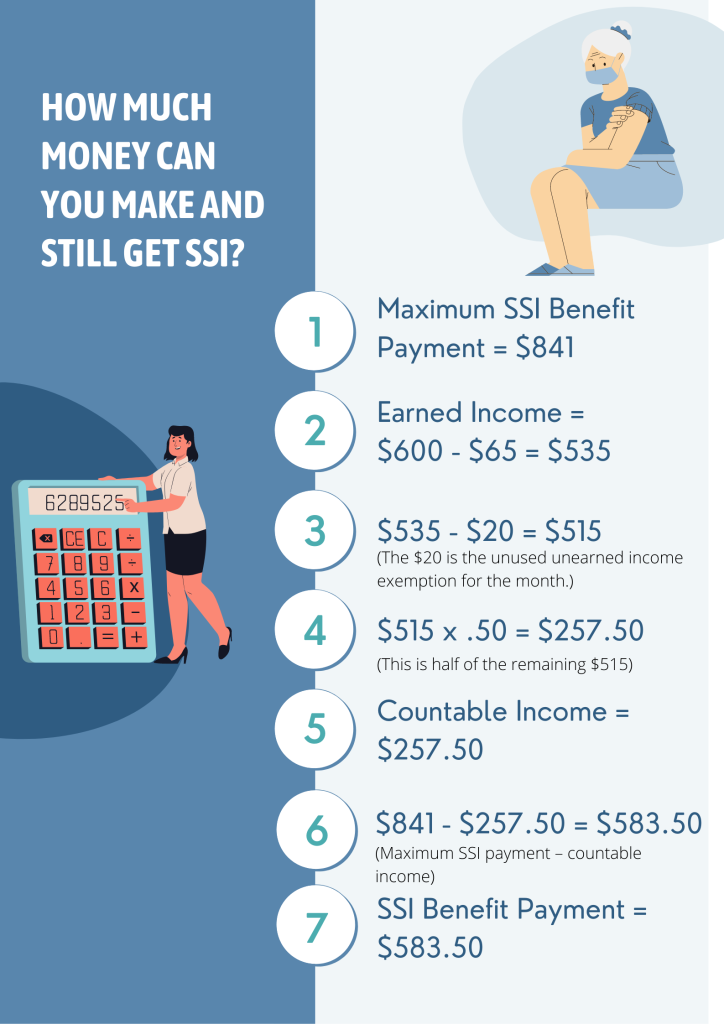
- General Income Exclusion (GIE): The first $20 of most income (earned or unearned) received in a month is not counted. If you have both earned and unearned income, the GIE is first applied to unearned income.
- Earned Income Exclusion (EIE): This is one of the most significant exclusions for those who work. After the $20 GIE (if applicable), an additional $65 of earned income is not counted. After these exclusions, only half of the remaining earned income is counted. This means for every two dollars you earn above these exclusions, only one dollar reduces your SSI payment.
- Example: You earn $1000.
- Subtract $20 GIE (first applied to unearned, but here only earned): $980 remaining.
- Subtract $65 EIE: $915 remaining.
- Divide by 2: $457.50 is your countable earned income.
- Example: You earn $1000.
- Impairment-Related Work Expenses (IRWE): For disabled individuals, the cost of certain items and services that are necessary for you to work due to your impairment (e.g., attendant care, wheelchairs, specialized transportation) can be deducted from your earned income. These are deducted before applying the EIE and half-of-remaining-income rule.
- Blind Work Expenses (BWE): For blind individuals, the cost of any items or services necessary for you to work (e.g., guide dog expenses, special equipment, income tax payments, union dues) can be deducted from your earned income. Unlike IRWE, BWEs are deducted after the EIE but before dividing by two.
- Plan to Achieve Self-Support (PASS): This allows disabled or blind individuals to set aside income and/or resources for a specific period to achieve a work goal (e.g., education, vocational training, starting a business). Income and resources set aside under an approved PASS are excluded from SSI calculations. This is an incredibly powerful tool for promoting self-sufficiency.
The “Countable Income” Formula
The final “countable income” is what truly impacts your SSI payment. It’s derived by taking your gross income, applying all applicable exclusions and deductions, and then adding any countable in-kind support or deemed income.
- Countable Income = (Unearned Income – GIE) + ( (Earned Income – IRWE/BWE – GIE_remaining – EIE) / 2 ) + Countable ISM + Countable Deemed Income. (This formula is a simplified representation; the SSA applies these in a specific order).
Once countable income is determined, it is subtracted from the Federal Benefit Rate (FBR) to arrive at the potential federal SSI payment.
The Role of Resources in SSI Eligibility and Calculation
While income directly influences the amount of your SSI payment, resources act as a gateway to eligibility. If your countable resources exceed the limit, you simply won’t qualify for SSI, regardless of your income level or disability status.
Defining “Resources”
Resources are assets that you own and could convert to cash to use for your support. This includes:
- Cash: Money on hand.
- Bank Accounts: Checking and savings accounts.
- Investments: Stocks, bonds, mutual funds, CDs.
- Real Estate: Property other than your primary residence.
- Vehicles: Additional vehicles beyond the primary one, or a primary vehicle that exceeds a certain value (though most essential vehicles are excluded).
- Life Insurance: Policies with a cash surrender value.
- Other Valuables: Jewelry (beyond wedding/engagement rings), collectibles, etc., if their equity value exceeds certain thresholds.
Resource Exclusions: What Doesn’t Count?
Crucially, not all assets are counted toward the resource limit. The SSA has several significant exclusions designed to allow beneficiaries to maintain essential assets:
- Your Home: The house you live in and the land it’s on, regardless of its value.
- One Vehicle: One automobile used for transportation for you or a member of your household, regardless of its value.
- Household Goods and Personal Effects: Furniture, appliances, clothing, etc., are generally not counted.
- Burial Funds: Up to $1,500 set aside for your burial expenses (and $1,500 for a spouse’s) is excluded.
- Life Insurance Policies: Term life insurance and whole life policies with a face value of $1,500 or less per person.
- Property Essential for Self-Support: Property used in a trade or business, or items necessary for an employee to perform their work.
- ABLE Accounts: Funds in an Achieving a Better Life Experience (ABLE) account (up to a certain limit) for individuals with disabilities onset before age 26.
Resource Limits
As mentioned earlier, the resource limits are straightforward:
- Individual: $2,000
- Couple: $3,000
These limits are strict. If at any point your countable resources exceed these amounts, even for a single day, you can be found ineligible for SSI for that month. It’s vital to monitor your resources carefully.
Impact of Resources on Ongoing Eligibility
Unlike income, which directly reduces your monthly payment, resources are a pass/fail test. If your countable resources are below the limit, you are resource-eligible. If they are above, you are resource-ineligible. There’s no proportional reduction in benefits due to resources; it’s an all-or-nothing scenario for eligibility.
How Living Arrangements Affect Your SSI Payment
Beyond income and resources, your living situation plays a significant, often overlooked, role in determining your final SSI payment amount. The SSA recognizes that the cost of living varies based on who provides for your basic needs, particularly food and shelter.

In-Kind Support and Maintenance (ISM)
In-kind support and maintenance (ISM) refers to food or shelter that someone else provides to you for free, or for less than its fair market value. The SSA considers this as unearned income because it reduces your need to pay for these essentials yourself. ISM can come in various forms:
- Free Rent: Living in a home owned by someone else without paying rent.
- Reduced Rent: Paying less than the fair market value for rent.
- Free Utilities: Someone else paying your electricity, gas, water, or trash removal bills.
- Free Food: Receiving meals from someone else without paying for them.
- Shared Expenses: If you live with others but don’t pay your “pro rata” share of household operating expenses (rent, mortgage, utilities, food), the difference can be considered ISM.
The One-Third Reduction Rule (VTR)
The most common way ISM affects your SSI is through the “Value of the One-Third Reduction” (VTR) rule. This rule applies if you live in another person’s household (not your own apartment or house) and receive both food and shelter from them throughout a month. If the VTR rule applies, your federal SSI payment is reduced by one-third of the Federal Benefit Rate (FBR). This is a flat reduction, regardless of the actual value of the support you receive, as long as it’s below the presumed maximum value.
- Example: If the FBR for an individual is $943, and the VTR rule applies, your federal benefit would be reduced by $943 / 3 = $314.33, resulting in a payment of $628.67 before any other countable income is considered.
Presumed Maximum Value (PMV) Rule
If you receive ISM but the VTR rule doesn’t apply (e.g., you live in your own apartment but someone pays your rent, or you live with someone but only receive free food, not both food and shelter), the SSA applies the “Presumed Maximum Value” (PMV) rule. Under the PMV rule, the value of the ISM is presumed to be one-third of the FBR plus $20 (for the GIE). However, the SSA will not count ISM at more than its actual current market value if you can prove it’s less. This amount (PMV or actual value, whichever is less) is treated as unearned income and is subject to the $20 general income exclusion before being subtracted from the FBR.
Living with Others and Contributing Equally
If you live with other people and share household operating expenses (rent/mortgage, utilities, food), and you pay your fair share, then the SSA generally will not consider you to be receiving ISM. Your fair share is typically your portion of the total household expenses divided by the number of people in the household. Documenting your contributions (e.g., receipts for rent, utility payments) is crucial in such scenarios.
Putting It All Together: A Step-by-Step Calculation Example
Let’s illustrate the SSI calculation process with a hypothetical example for an individual in 2024.
Scenario:
- Applicant: John, a 68-year-old individual, eligible based on age.
- Federal Benefit Rate (FBR) for an individual in 2024: $943.
- Income:
- Social Security Retirement Benefit: $300 per month (unearned income).
- Part-time Job Earnings: $500 per month (earned income).
- Living Arrangement: John lives in his own apartment and pays all his own expenses. No ISM.
- Resources: Well below the $2,000 limit.
Step-by-Step Calculation:
-
Determine Unearned Income Exclusions:
- John has $300 in unearned income (Social Security).
- Apply the $20 General Income Exclusion (GIE) to unearned income first.
- Countable Unearned Income = $300 – $20 = $280.
-
Determine Earned Income Exclusions:
- John has $500 in earned income.
- Since the GIE was fully used against unearned income, there’s no remaining GIE for earned income.
- Apply the $65 Earned Income Exclusion (EIE).
- Remaining Earned Income After EIE = $500 – $65 = $435.
- Countable Earned Income = $435 / 2 = $217.50.
-
Calculate Total Countable Income:
- Total Countable Income = Countable Unearned Income + Countable Earned Income
- Total Countable Income = $280 + $217.50 = $497.50.
-
Determine Federal SSI Payment:
- Subtract Total Countable Income from the Federal Benefit Rate (FBR).
- Federal SSI Payment = FBR – Total Countable Income
- Federal SSI Payment = $943 – $497.50 = $445.50.
So, in this scenario, John would receive a federal SSI payment of $445.50 per month.
State Supplements (Brief Mention)
It’s important to note that many states provide a supplementary payment in addition to the federal SSI payment. These “state supplements” vary widely by state and are often administered by the state itself, though sometimes the SSA administers them. The eligibility rules and amounts for state supplements can depend on your living arrangements and other factors specific to that state. Our calculation example above only covered the federal portion.
Important Considerations and Navigating the System
Understanding the calculation is only one piece of the SSI puzzle. Effectively managing your benefits and maintaining eligibility requires ongoing vigilance and proactive communication with the Social Security Administration. The program is designed with strict rules to prevent fraud and ensure resources go to those most in need.
Reporting Changes Promptly
One of the most critical responsibilities of an SSI recipient is to report changes in income, resources, living arrangements, marital status, or disability status to the SSA promptly. Failure to do so can lead to overpayments, which the SSA will require you to pay back, potentially by reducing future benefits or even pursuing legal action.
- Income Changes: Even small changes in earned or unearned income must be reported.
- Resource Changes: If your bank account balance unexpectedly increases above the limit, or you inherit money, report it immediately.
- Living Arrangement Changes: Moving in with someone, moving out, or changes in who pays for your food and shelter are all critical.
- Marital Status: Marriage or divorce can significantly impact benefits due to spouse deeming rules.
- Disability Status: Improvements in your medical condition that might affect your ability to work.
The SSA generally requires changes to be reported within 10 days after the end of the month in which the change occurred.
The Importance of Accurate Documentation
Maintain thorough records of all your income, expenses, resources, and communications with the SSA. This includes:
- Pay stubs and income statements.
- Bank statements.
- Receipts for rent, utilities, and other household expenses.
- Medical records related to your disability.
- Copies of all correspondence with the SSA.
- Notes from phone calls (date, time, person you spoke with, what was discussed).
Accurate documentation can be invaluable in proving your eligibility, contesting overpayments, or appealing adverse decisions.
Seeking Professional Guidance
The complexity of SSI rules can be overwhelming. Don’t hesitate to seek professional guidance:
- Social Security Administration (SSA): Start by contacting your local SSA office. They can provide personalized information about your specific situation and help clarify rules.
- Advocacy Groups: Many non-profit organizations specialize in assisting individuals with disabilities or low incomes in navigating government benefits. They often provide free advice and representation.
- Financial Advisors/Attorneys: For complex situations, particularly involving trusts, significant assets, or appeals, a financial advisor specializing in government benefits or an attorney experienced in disability law can be invaluable. They can help with strategic financial planning to preserve eligibility.
Appeals Process
If you disagree with an SSA decision regarding your SSI eligibility or payment amount, you have the right to appeal. The appeals process typically involves several stages:
- Reconsideration: A review of your case by someone at the SSA who was not involved in the initial decision.
- Hearing by an Administrative Law Judge (ALJ): An opportunity to present your case and evidence before an independent judge.
- Appeals Council Review: A review of the ALJ’s decision.
- Federal Court Review: The final stage, involving a lawsuit in federal court.
Understanding the appeals process and having strong documentation is crucial if you need to challenge a decision.
Conclusion
The calculation of Supplemental Security Income is a multifaceted process, reflecting the program’s commitment to serving those with the greatest financial need. It’s far more nuanced than simply subtracting your income from a fixed benefit amount; it involves a detailed evaluation of various income types, resource thresholds, and the subtle yet impactful role of living arrangements. By meticulously applying general income exclusions, earned income exclusions, impairment-related work expenses, and carefully assessing in-kind support, the SSA arrives at a “countable income” figure that directly dictates your federal SSI payment.
For current and prospective beneficiaries, mastering these intricacies is not merely an academic exercise but a practical necessity. It empowers you to accurately estimate your benefits, plan your finances, and avoid common pitfalls that could lead to overpayments or loss of eligibility. While the rules can appear complex, remember that they are designed with specific intentions: to provide a vital safety net while encouraging work when possible. Proactive reporting of changes, diligent record-keeping, and not hesitating to seek professional guidance are your strongest allies in navigating the SSI system successfully. Ultimately, a deep understanding of how SSI is calculated is your key to unlocking and maintaining this essential financial support.
aViewFromTheCave is a participant in the Amazon Services LLC Associates Program, an affiliate advertising program designed to provide a means for sites to earn advertising fees by advertising and linking to Amazon.com. Amazon, the Amazon logo, AmazonSupply, and the AmazonSupply logo are trademarks of Amazon.com, Inc. or its affiliates. As an Amazon Associate we earn affiliate commissions from qualifying purchases.