
Interest rates are a ubiquitous force in our financial lives, influencing everything from the cost of our home loans to the growth of our retirement savings. Yet, for many, the mechanics of how these rates are calculated remain a mystery. Understanding the underlying principles of interest rate calculation isn’t just an academic exercise; it’s a fundamental skill for making informed financial decisions, whether you’re a borrower seeking the best loan, a saver looking to maximize returns, or a business owner managing capital.
This comprehensive guide will demystify interest rate calculations, breaking down complex formulas into understandable components. We’ll explore the crucial distinctions between simple and compound interest, delve into practical examples, and equip you with the knowledge to confidently navigate the financial landscape. By the end of this article, you’ll not only know how to calculate interest rates but also why that knowledge is so vital for your financial well-being.

Understanding the Fundamentals of Interest
Before we dive into the calculations, it’s essential to establish a solid understanding of what interest is and the basic elements that define it. Interest is, at its core, the cost of borrowing money or the reward for lending it. It’s the “rent” paid for the use of someone else’s capital.
What is Interest?
In simple terms, interest is a fee paid by a borrower to a lender for the use of borrowed money. Conversely, for a saver or investor, interest is the income earned on money deposited or invested. This financial mechanism underpins almost every transaction involving debt or investment across personal, corporate, and governmental sectors. Without interest, there would be little incentive for lenders to provide capital, and borrowers would have no incentive to return funds promptly. It acts as a crucial lubricant for economic activity, facilitating capital allocation and stimulating growth.
Key Components of Interest
Regardless of the complexity of the calculation, every interest scenario is built upon a few core components:
- Principal (P): This is the initial amount of money borrowed or invested. It’s the base sum upon which interest is calculated. If you take out a $10,000 loan, $10,000 is the principal. If you deposit $5,000 into a savings account, $5,000 is the principal.
- Interest Rate (R): Expressed as a percentage, the interest rate is the charge or return on the principal over a specific period, typically per annum. For calculations, this percentage is almost always converted into a decimal (e.g., 5% becomes 0.05).
- Time (T): This refers to the duration for which the money is borrowed or invested. Time is usually expressed in years. If the interest is calculated for months or days, it must be converted into a yearly equivalent (e.g., 6 months = 0.5 years, 90 days = 90/365 years).
Simple vs. Compound Interest: A Crucial Distinction
The most fundamental distinction in interest calculation lies between simple and compound interest. Understanding which type applies to your financial product is paramount:
- Simple Interest: Interest is calculated only on the original principal amount. It does not factor in any accumulated interest from previous periods. Simple interest is often used for short-term loans or simple investment scenarios.
- Compound Interest: Often referred to as “interest on interest,” compound interest is calculated on the initial principal and also on the accumulated interest from previous periods. This powerful concept can lead to significant growth over time, both for debts and investments. Most long-term financial products, like mortgages, savings accounts, and investments, use compound interest.
Calculating Simple Interest
Simple interest is the easiest form of interest to calculate because it only considers the initial principal. It’s a straightforward calculation ideal for understanding the basic cost of borrowing or earning over a specific, usually shorter, period.
The Simple Interest Formula
The formula for simple interest is elegantly simple:
I = P × R × T
Where:
- I = Total Interest Earned or Paid
- P = Principal Amount (the initial sum)
- R = Annual Interest Rate (as a decimal)
- T = Time Period (in years)
Let’s break down how to apply this with a practical example.
Practical Examples of Simple Interest
Imagine you borrow $1,000 from a friend at a 5% simple annual interest rate for 2 years.
- P = $1,000
- R = 5% = 0.05
- T = 2 years
Using the formula:
I = $1,000 × 0.05 × 2
I = $50 × 2
I = $100
So, after 2 years, you would owe your friend $100 in interest, making the total repayment amount $1,000 (principal) + $100 (interest) = $1,100.
Another example: You invest $5,000 in a certificate of deposit (CD) that offers a 3% simple annual interest rate for 6 months.
- P = $5,000
- R = 3% = 0.03
- T = 6 months = 0.5 years (since time must be in years)
Using the formula:
I = $5,000 × 0.03 × 0.5
I = $150 × 0.5
I = $75
After 6 months, you would earn $75 in simple interest. Your total balance would be $5,000 + $75 = $5,075.
When Simple Interest is Used
Simple interest is typically employed in scenarios where the lending or borrowing period is relatively short, or for financial products specifically designed for its straightforward nature. Common uses include:
- Short-term personal loans: Some informal loans between individuals or certain payday loans might use simple interest.
- Bonds: The coupon payments on many bonds are calculated using simple interest on the bond’s face value.
- Certificates of Deposit (CDs): Some CDs, especially those with shorter terms, might advertise simple interest earnings.
- Specific types of mortgages: While most standard mortgages use compound interest, some niche products might incorporate elements of simple interest calculation.
While straightforward, simple interest is less common for long-term financial products because it doesn’t account for the reinvestment of interest earned, which is where the true power of compounding comes into play.
Mastering Compound Interest Calculations
Compound interest is often hailed as the “eighth wonder of the world” by investors. It’s the process where interest earned on an initial principal is added back to the principal, and then the next interest calculation is based on this new, larger principal. This snowball effect can lead to significantly larger returns or higher costs over time compared to simple interest.
The Power of Compounding
The core concept of compounding is that your money starts earning money, and then that money starts earning money. This exponential growth makes a profound difference, especially over long periods. Consider two investments: one earns 5% simple interest annually, and the other earns 5% compound interest annually. After 30 years, the compound interest investment will have grown far more substantially because the interest earned in early years continually adds to the principal base for future interest calculations. This is why starting to save or invest early is so frequently advised – it maximizes the time available for compounding to work its magic.
The Compound Interest Formula
Calculating compound interest is slightly more complex than simple interest, as it needs to account for the compounding frequency. The standard formula for compound interest is:
A = P (1 + R/N)^(NT)
Where:
- A = The future value of the investment/loan, including interest (Accumulated Amount)
- P = The principal investment amount (the initial deposit or loan amount)
- **R = The annual interest rate (as a decimal)
- N = The number of times that interest is compounded per year
- T = The number of years the money is invested or borrowed for
Deconstructing the Variables
Understanding each variable is key to accurate calculation:
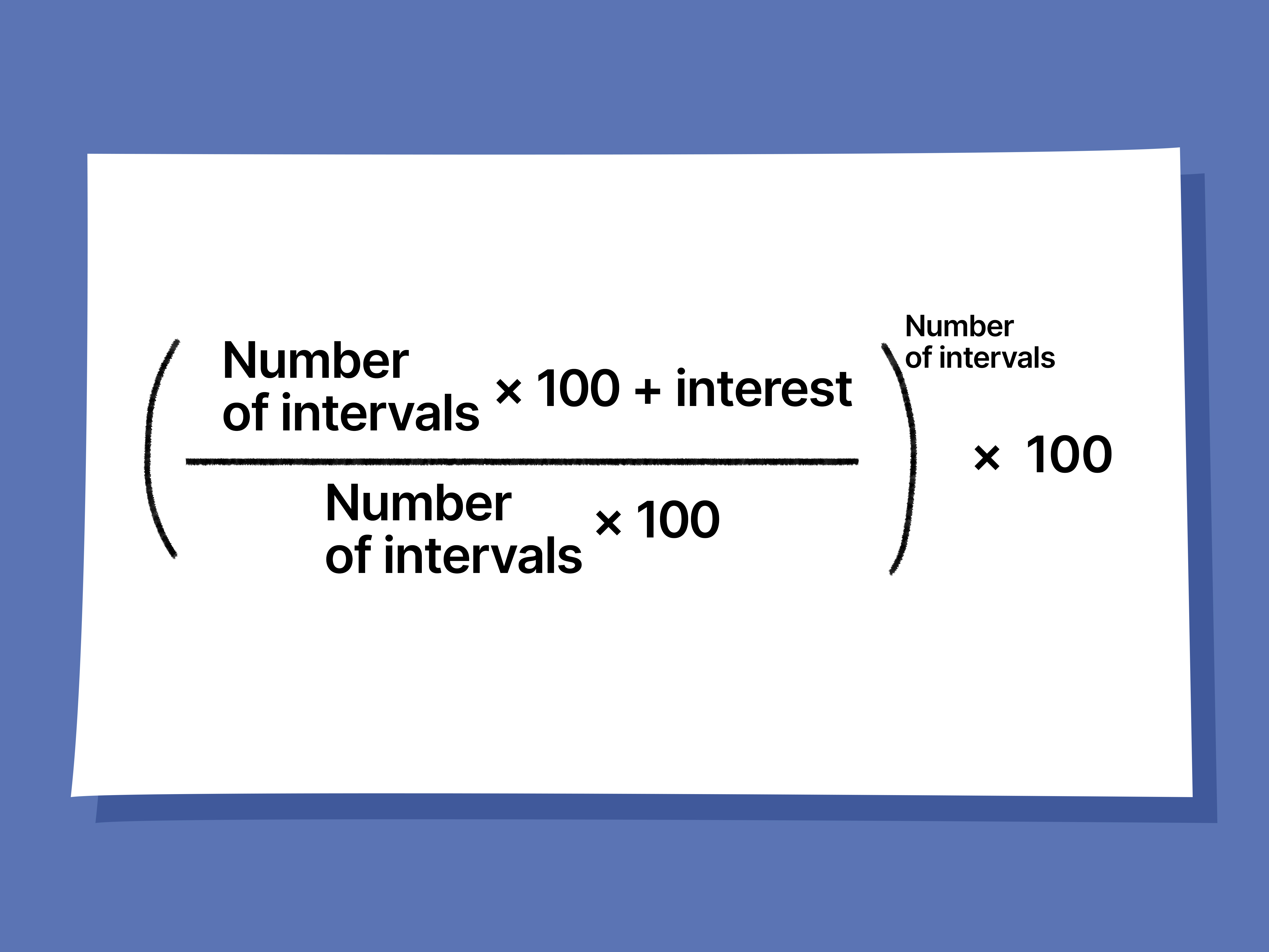
- A (Accumulated Amount): This is the total amount you’ll have at the end of the investment period, including both your initial principal and all the accumulated interest. If you’re calculating a loan, this is the total amount you’d owe.
- P (Principal): As with simple interest, this is your starting amount.
- R (Annual Interest Rate): Always convert the percentage to a decimal (e.g., 6% = 0.06). This is the stated annual rate.
- N (Compounding Frequency): This is a critical variable.
- Annually: N = 1 (interest is compounded once a year)
- Semi-annually: N = 2 (twice a year)
- Quarterly: N = 4 (four times a year)
- Monthly: N = 12 (twelve times a year)
- Daily: N = 365 (most common, especially for savings accounts)
- The more frequently interest is compounded, the faster your money grows (or your debt increases).
- T (Time): The duration of the investment or loan in years.
Let’s illustrate with an example: You deposit $10,000 into a savings account that pays an annual interest rate of 4% compounded quarterly for 5 years.
- P = $10,000
- R = 4% = 0.04
- N = 4 (compounded quarterly)
- T = 5 years
A = $10,000 (1 + 0.04/4)^(4*5)
A = $10,000 (1 + 0.01)^(20)
A = $10,000 (1.01)^(20)
A = $10,000 × 1.22019 (approximately)
A = $12,201.90
After 5 years, your initial $10,000 would have grown to approximately $12,201.90. The total interest earned is A – P = $12,201.90 – $10,000 = $2,201.90. If this were simple interest, it would only be $10,000 * 0.04 * 5 = $2,000. The difference of $201.90 is due to the power of compounding.
Real-World Applications of Compound Interest
Compound interest is the backbone of most significant financial products:
- Savings Accounts & CDs: Most bank savings accounts and certificates of deposit compound interest daily or monthly.
- Investment Accounts: Stocks, bonds, mutual funds, and retirement accounts (401k, IRA) generate returns that compound over time.
- Mortgages: The interest on your home loan compounds, usually monthly, which is why understanding the total cost over the loan’s life is crucial.
- Credit Cards: Credit card interest often compounds daily or monthly, making high balances extremely expensive if not paid off promptly.
Annual Percentage Yield (APY) vs. Annual Percentage Rate (APR)
When dealing with compound interest, two terms frequently appear: APY and APR. Understanding the difference is vital:
- Annual Percentage Rate (APR): This is the annual rate charged for borrowing, or earned by an investor, without taking into account the effects of compounding. It’s the simple interest rate over a year. Lenders typically quote APR for loans (like credit cards or mortgages) as it represents the nominal interest rate.
- Annual Percentage Yield (APY): This is the effective annual rate of return, taking into account the effect of compounding interest. APY provides a more accurate picture of the total interest earned on an investment or paid on a loan over a year, considering the compounding frequency. For example, a 5% APR compounded monthly will have an APY slightly higher than 5%.
APY = (1 + R/N)^N – 1
Where R is the stated annual interest rate (APR as a decimal) and N is the number of compounding periods per year. When comparing savings accounts, always look at the APY. When comparing loans, look at the APR, but be mindful of compounding frequency if an APY equivalent is not provided.
Beyond Basic Calculations: Advanced Concepts and Tools
While the simple and compound interest formulas cover the vast majority of personal finance scenarios, several advanced concepts and tools can provide a more nuanced understanding of interest rates and their impact.
Effective Interest Rate (EIR)
The effective interest rate, sometimes synonymous with APY, provides the true annualized cost of a loan or investment, factoring in not just compounding but also any additional fees or charges associated with the financial product. For instance, a loan might have a low stated interest rate (APR) but include origination fees, processing charges, or other costs that increase the actual financial burden. The EIR gives you the all-in cost, allowing for a more accurate comparison between different financial products.
Loan Amortization
For larger loans like mortgages or car loans, payments are typically structured using an amortization schedule. This process involves breaking down each payment into two components: principal repayment and interest payment. In the early stages of an amortized loan, a larger portion of your payment goes towards interest, with a smaller amount reducing the principal. As the principal decreases over time, the interest portion of your payment also shrinks, and more of your payment is allocated to reducing the principal.
Amortization calculations are complex and usually performed by financial software or online calculators. They allow borrowers to see exactly how their payments are applied over the life of the loan and how much total interest they will pay.
Using Financial Calculators and Software
While manual calculations are great for understanding the principles, real-world financial planning often benefits from dedicated tools:
- Online Interest Rate Calculators: Numerous websites offer free calculators for simple interest, compound interest, loan amortization, and more. These are quick and user-friendly.
- Spreadsheet Software (e.g., Excel, Google Sheets): Programs like Excel have built-in functions (e.g.,
FVfor future value,PMTfor loan payments,RATEfor interest rate) that can handle complex financial calculations, including varying payment schedules and irregular contributions. - Financial Calculators: Dedicated handheld financial calculators (like the Texas Instruments BA II Plus or HP 12c) are indispensable for students and professionals in finance, offering specialized functions for time value of money problems.
Impact of Inflation on Real Interest Rates
It’s also crucial to consider the “real” return on an investment or the “real” cost of a loan, which accounts for inflation. Inflation erodes the purchasing power of money over time.
- Nominal Interest Rate: This is the stated interest rate without accounting for inflation.
- Real Interest Rate: This is the nominal interest rate minus the inflation rate.
If you earn a 5% nominal interest rate on your savings, but inflation is 3%, your real interest rate is only 2%. This means your money’s purchasing power only increased by 2%, not 5%. Conversely, if you borrow at 5% and inflation is 3%, the real cost of your borrowing is effectively 2%. Understanding real interest rates is critical for long-term financial planning and investment strategy.
Why Understanding Interest Rates Matters
Mastering the calculation of interest rates is more than just a mathematical exercise; it’s a critical life skill that empowers you to make astute financial decisions, optimize your wealth, and protect yourself from unfavorable financial arrangements.
For Borrowers: Making Informed Loan Decisions
As a borrower, understanding interest rates allows you to:
- Compare Loan Offers: Accurately assess the true cost of different loans (mortgages, car loans, personal loans) by comparing their APRs and considering compounding frequency.
- Avoid Predatory Lending: Recognize and steer clear of loans with excessively high or deceptively structured interest rates.
- Optimize Repayment Strategies: Understand how extra payments can reduce total interest paid on amortized loans and how compounding impacts credit card debt.
- Budget Effectively: Accurately project monthly interest payments and the total cost of borrowing over time, enabling better financial planning.
For Savers and Investors: Maximizing Returns
For those looking to grow their money, interest rate knowledge is equally crucial:
- Evaluate Savings Products: Compare APYs of different savings accounts, CDs, and money market accounts to ensure your money is working as hard as possible.
- Project Investment Growth: Understand the power of compounding to project the potential growth of your investments over various time horizons, reinforcing the importance of long-term investing.
- Understand Risk vs. Return: Recognize that higher potential returns (often implying higher interest rates or growth) typically come with higher risk.
- Leverage Time: Appreciate how starting early with even modest contributions can lead to substantial wealth accumulation due to compounding.
For Businesses: Cost of Capital and Investment Appraisal
Businesses rely heavily on interest rate calculations for their operational and strategic decisions:
- Assess Loan Costs: Calculate the true cost of business loans, lines of credit, and other financing options to manage cash flow and profitability.
- Evaluate Investment Opportunities: Use discounted cash flow (DCF) analysis, which relies on interest rates (discount rates), to determine the present value of future cash flows and appraise potential projects.
- Manage Working Capital: Optimize trade credit terms and short-term borrowing based on prevailing interest rates.
- Capital Budgeting: Make informed decisions about long-term investments in assets by understanding the cost of capital.

Navigating Economic Landscapes
Interest rates are a primary tool of central banks to manage economic activity. Understanding how these rates are set and their implications helps individuals and businesses alike:
- Understand Economic Signals: Higher interest rates might signal efforts to curb inflation, while lower rates aim to stimulate growth.
- Anticipate Market Changes: Recognize how changes in the federal funds rate can impact mortgage rates, savings yields, and investment returns.
- Strategic Planning: Adjust personal and business financial strategies in response to expected changes in the interest rate environment.
In essence, a firm grasp of interest rate calculations empowers you to become a more confident and effective participant in the financial world, leading to better decisions, stronger financial health, and greater peace of mind.
By equipping yourself with the knowledge of how interest rates are calculated, you gain a powerful tool for financial literacy and empowerment. Whether you’re managing debt, building savings, or investing for the future, understanding these fundamental principles is the cornerstone of sound financial management. Embrace this knowledge, and you’ll be well-prepared to navigate the complexities of the financial world with confidence and insight.
aViewFromTheCave is a participant in the Amazon Services LLC Associates Program, an affiliate advertising program designed to provide a means for sites to earn advertising fees by advertising and linking to Amazon.com. Amazon, the Amazon logo, AmazonSupply, and the AmazonSupply logo are trademarks of Amazon.com, Inc. or its affiliates. As an Amazon Associate we earn affiliate commissions from qualifying purchases.