
In the vast and often complex world of personal finance, business operations, and investment strategies, a foundational understanding of percentages is not merely a mathematical convenience – it is an indispensable life skill. From deciphering a discount on a new purchase to calculating your investment returns, understanding your mortgage interest, or evaluating your tax obligations, percentages are the universal language of financial literacy. This guide will demystify how to find the percentage of a number, embedding these crucial calculations within the context of managing and growing your money. By the end, you’ll not only master the mechanics but also appreciate the profound impact this knowledge has on your financial well-being.

The Foundational Role of Percentages in Personal Finance
Before diving into the “how-to,” it’s vital to grasp “why” percentages are so critical. They provide a standardized way to express proportions, changes, and comparisons, making complex financial data digestible and actionable.
Understanding the Basics: What is a Percentage?
At its core, a percentage represents a part of a whole, specifically “per hundred.” The symbol “%” is universally recognized as meaning “out of 100.” So, 25% means 25 out of 100, or 25/100. This concept allows us to compare different quantities in a standardized manner, regardless of the original total. For instance, whether you save $10 out of $100 or $100 out of $1,000, both represent 10% savings, allowing for an apples-to-apples comparison of your financial efficiency.
Why Percentages are Indispensable for Your Money
The utility of percentages permeates nearly every facet of financial management:
- Budgeting and Expense Tracking: Understanding what percentage of your income goes towards housing, food, or entertainment is crucial for effective budget allocation and identifying areas for savings.
- Saving and Investing: Interest rates on savings accounts, annual returns on investments, and compounding growth are all expressed in percentages. Without this understanding, making informed investment decisions is impossible.
- Loans and Debt: Mortgages, car loans, and credit card interest rates are defined by percentages (Annual Percentage Rate – APR). Knowing how to calculate the cost of borrowing empowers you to choose the most favorable terms.
- Discounts, Sales, and Taxes: From a 20% off coupon to a 7% sales tax or a 15% tip, daily financial transactions rely heavily on percentage calculations.
- Economic Indicators: Inflation rates, unemployment rates, and GDP growth are all reported as percentages, offering insights into the broader economic landscape that impacts your finances.
Mastering percentages isn’t just about arithmetic; it’s about gaining a clearer lens through which to view, analyze, and control your financial destiny.
Mastering the Core Calculation Methods
While the concept is straightforward, there are several methods to calculate the percentage of a number, each useful in different scenarios. Familiarity with all of them will build your financial agility.
Method 1: The Decimal Conversion Approach
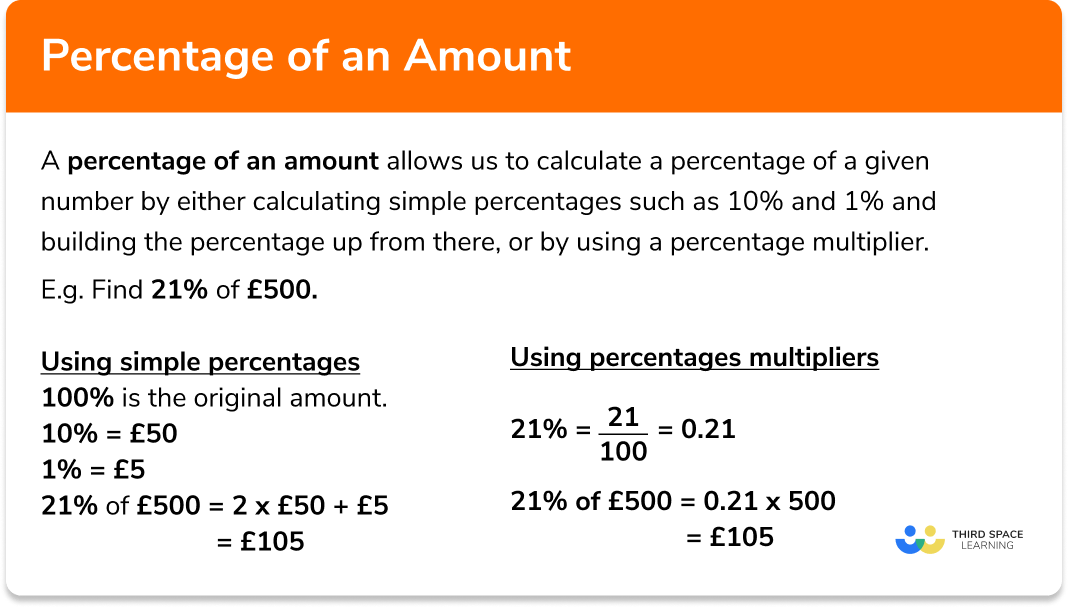
This is arguably the most common and straightforward method, especially with the widespread use of calculators. It involves two simple steps:
- Convert the percentage to a decimal: To do this, divide the percentage by 100 (or simply move the decimal point two places to the left). For example, 25% becomes 0.25, and 7% becomes 0.07.
- Multiply the decimal by the number: The result is the percentage of that number.
Example (Money Context): You want to find 15% of a $50 meal for a tip.
- Convert 15% to a decimal: 15 / 100 = 0.15
- Multiply by the number: 0.15 * $50 = $7.50
So, your tip would be $7.50.
This method is highly efficient for quickly calculating discounts, taxes, or a portion of your income for savings.
Method 2: The Fractional Approach
This method leverages the definition of a percentage as “per hundred.” It’s particularly useful for mental math or when dealing with common percentages that have simple fractional equivalents (e.g., 25% = 1/4, 50% = 1/2).
- Express the percentage as a fraction with a denominator of 100: For example, 20% becomes 20/100.
- Simplify the fraction (optional but often helpful): 20/100 simplifies to 1/5.
- Multiply the fraction by the number:
Example (Money Context): You find a shirt on sale for 25% off its original price of $60.
- Convert 25% to a fraction: 25/100
- Simplify the fraction: 1/4
- Multiply by the number: (1/4) * $60 = $15
The discount is $15, so the shirt would cost $60 – $15 = $45.
This method helps build a deeper conceptual understanding of percentages as parts of a whole.
Method 3: Using Proportions (The “Is Over Of” Method)
This method is versatile because it can be used to find the part, the whole, or the percentage itself. It’s based on the principle that the ratio of a part to a whole is equal to the ratio of its percentage to 100. The common mnemonic is “is/of = %/100”.
- Set up the proportion: (Part / Whole) = (Percentage / 100)
- Fill in the known values: Use ‘x’ for the unknown.
- Solve for ‘x’: Cross-multiply and divide.
Example 1 (Finding the part – same as previous examples): What is 15% of $50?
- x / $50 = 15 / 100
- 100x = 15 * $50
- 100x = $750
- x = $750 / 100 = $7.50
Example 2 (Finding the whole): If $20 is 10% of your total savings goal, what is your total savings goal?
- $20 / x = 10 / 100
- 10x = $20 * 100
- 10x = $2,000
- x = $2,000 / 10 = $200
Your total savings goal is $200.
Example 3 (Finding the percentage): You spent $30 on groceries from your $200 weekly budget. What percentage of your budget did you spend on groceries?
- $30 / $200 = x / 100
- $200x = $30 * 100
- $200x = $3,000
- x = $3,000 / $200 = 15
You spent 15% of your budget on groceries.
The proportional method offers a robust framework for solving a wide array of percentage-related problems in personal finance, providing flexibility when different components are unknown.
Real-World Financial Applications of Percentage Calculations
Beyond the mechanics, the true power of percentage calculations lies in their application to real-world financial scenarios.
Budgeting and Expense Tracking
Effective budgeting hinges on understanding where your money goes.
- Category Allocation: If your monthly net income is $4,000 and you allocate 30% to housing, you calculate 0.30 * $4,000 = $1,200 for rent/mortgage.
- Deviation Analysis: If you budgeted $500 for groceries but spent $600, you can calculate the percentage over budget: (($600 – $500) / $500) * 100 = 20% over budget. This insight allows you to adjust future spending or reallocate funds.
Understanding Loans and Investments
Percentages are the bedrock of credit and investment evaluations.
- Loan Interest: A $10,000 loan at an annual interest rate of 5% means you’ll pay $10,000 * 0.05 = $500 in interest per year (simple interest). Compound interest, where interest is earned on interest, makes this calculation more complex over time but still relies on percentage rates.
- Investment Returns: If your stock portfolio grew from $10,000 to $11,500 in a year, your percentage return is (($11,500 – $10,000) / $10,000) * 100 = 15%. This metric is crucial for comparing investment performance.
Navigating Sales, Discounts, and Taxes
Daily consumer decisions are heavily influenced by percentages.
- Discounts: A retail item originally priced at $120 with a “30% off” sticker means you save $120 * 0.30 = $36. Your final price is $120 – $36 = $84.
- Sales Tax: If a purchase is $75 and the sales tax rate is 8%, the tax amount is $75 * 0.08 = $6. Your total cost is $75 + $6 = $81.
- Tipping: When dining out, a standard 18% tip on a $45 bill is $45 * 0.18 = $8.10.
Assessing Financial Growth and Performance
Tracking financial progress often involves percentage changes.
- Salary Increase: If your salary was $50,000 and increased to $53,000, your percentage raise is (($53,000 – $50,000) / $50,000) * 100 = 6%.
- Inflation Impact: If inflation is 3%, your purchasing power for every $100 effectively decreases by $3 over the year, meaning you’d need $103 to buy what $100 bought previously.
Advanced Percentage Concepts for Savvy Financial Management
While the basics are essential, a deeper dive into more nuanced percentage concepts can significantly enhance your financial acumen.
Percentage Increase and Decrease
These calculations measure the magnitude of change over time, which is fundamental for evaluating growth or depreciation.
- Formula: ((New Value – Original Value) / Original Value) * 100
- Example (Increase): A stock bought for $100 increases to $120. Percentage increase = (($120 – $100) / $100) * 100 = 20%.
- Example (Decrease): A car bought for $30,000 depreciates to $24,000. Percentage decrease = (($24,000 – $30,000) / $30,000) * 100 = -20% (a 20% decrease).
These calculations are vital for tracking investment performance, evaluating property value changes, or understanding the impact of inflation.
Reverse Percentage Calculations
Sometimes, you know the final amount after a percentage change and need to find the original amount. This is common with sales tax, VAT, or discounts.
- To find the original number after a percentage increase: Original Number = Final Number / (1 + (Percentage Increase / 100))
- Example: An item costs $108 after a 8% sales tax. What was the original price?
Original Price = $108 / (1 + (8 / 100)) = $108 / 1.08 = $100.
- Example: An item costs $108 after a 8% sales tax. What was the original price?
- To find the original number after a percentage decrease: Original Number = Final Number / (1 – (Percentage Decrease / 100))
- Example: You paid $75 for a shirt after a 25% discount. What was the original price?
Original Price = $75 / (1 – (25 / 100)) = $75 / 0.75 = $100.
- Example: You paid $75 for a shirt after a 25% discount. What was the original price?
These calculations are invaluable for comparing prices across different tax jurisdictions or understanding the true value of a discounted item.
Percentage Points vs. Percentage Change
This distinction is crucial, especially when interpreting financial news or investment reports.
- Percentage Points: This refers to the arithmetic difference between two percentages.
- Example: If an interest rate increases from 4% to 5%, it’s a 1 percentage point increase.
- Percentage Change: This calculates the relative change between two percentages.
- Example (continuing above): An increase from 4% to 5% is a ((5-4)/4) * 100 = 25% percentage change (a 25% increase in the rate itself).
Misunderstanding this difference can lead to significant misinterpretations of economic and financial data. Always clarify whether a reported change is in percentage points or a percentage change.
Tools and Tips for Effortless Percentage Calculations
While understanding the manual methods is vital, modern tools can simplify and accelerate these calculations, freeing you to focus on the financial implications.
Leveraging Calculators and Spreadsheets
- Standard Calculators: Most basic calculators have a “%” button, but it’s often more reliable to use the decimal conversion method manually to avoid common errors. For instance, to find 15% of 50, you’d type 50 * 0.15 =.
- Spreadsheets (Excel, Google Sheets): These are powerhouses for financial calculations. You can set up formulas that automatically calculate percentages. For example, if cell A1 has your income and B1 has an expense amount, you can calculate the percentage of income spent on that expense with
=B1/A1. For percentages, ensure the cell format is set to “Percentage.” Spreadsheets are essential for budgeting, tracking investments, and financial modeling.
Online Converters and Financial Apps
Numerous online tools and smartphone apps are designed to make percentage calculations quick and easy. Many banking and budgeting apps also integrate percentage functions for analyzing spending or investment performance. While convenient, always double-check the results, especially for significant financial decisions.

Building Intuition and Mental Math Skills
For everyday calculations, developing your mental math skills can be incredibly empowering.
- Break it Down: To find 15% of $80, find 10% ($8) and then half of 10% (5% = $4). Add them together: $8 + $4 = $12.
- Approximate: For quick estimates, round numbers. If you need 18% of $97, think 20% of $100, which is $20. This gives you a ballpark figure to compare against an exact calculation.
This mental agility not only saves time but also provides a built-in check against errors when using other tools.
Understanding how to find a percentage of a number is more than just a mathematical exercise; it’s a fundamental pillar of financial literacy. By mastering the core methods and applying them to various financial scenarios – from budgeting and investing to managing debt and deciphering economic trends – you equip yourself with the confidence and insight needed to make informed decisions. Embrace these skills, leverage the available tools, and transform your relationship with your money from one of passive observation to active, empowered management. The percentage sign, once a potential source of confusion, will become a powerful symbol of your financial control.
aViewFromTheCave is a participant in the Amazon Services LLC Associates Program, an affiliate advertising program designed to provide a means for sites to earn advertising fees by advertising and linking to Amazon.com. Amazon, the Amazon logo, AmazonSupply, and the AmazonSupply logo are trademarks of Amazon.com, Inc. or its affiliates. As an Amazon Associate we earn affiliate commissions from qualifying purchases.