
For anyone navigating the dynamic world of investing, understanding the operational hours of the stock market is foundational. It’s a seemingly simple question with layers of nuance that can significantly impact trading strategies, risk management, and overall investment success. The rhythm of the stock market, dictated by its opening and closing bells, influences everything from immediate price fluctuations to the execution of long-term investment plans. Whether you’re a seasoned day trader, a long-term investor, or simply curious about how financial markets function, knowing when the market is active – and equally important, when it’s not – is indispensable knowledge. This article delves into the standard trading hours, explores the less commonly understood extended sessions, examines global market variations, and discusses the strategic implications for investors in the fast-paced financial landscape.
Understanding Standard U.S. Stock Market Hours
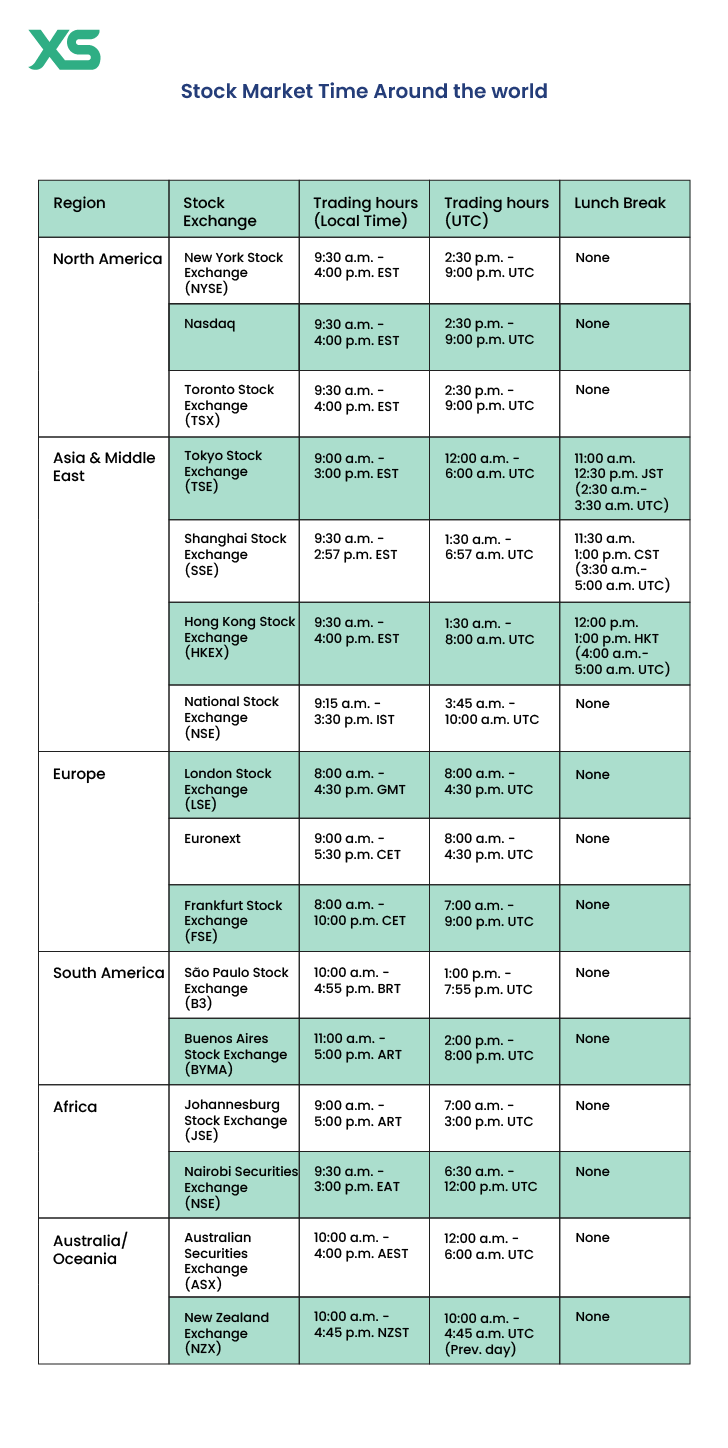
The U.S. stock market, primarily represented by the New York Stock Exchange (NYSE) and the NASDAQ Stock Market, operates on a very structured schedule. These hours are critical for investors as they define the periods of maximum liquidity and price discovery for a vast array of publicly traded companies.
Regular Trading Session
The core of U.S. stock market activity occurs during what is known as the regular trading session. For both the NYSE and NASDAQ, this session runs from 9:30 AM Eastern Time (ET) to 4:00 PM ET on weekdays. During these six and a half hours, the vast majority of trading volume takes place, and the market is typically at its most liquid. This means there are ample buyers and sellers, making it easier to execute trades at competitive prices. The opening bell at 9:30 AM ET often marks a period of high volatility as investors react to overnight news, while the closing bell at 4:00 PM ET frequently sees a surge in activity as traders try to get in or out of positions before the market shuts down. Understanding these core hours is the first step in aligning your trading activities with the market’s pulse.
Pre-Market Trading
While 9:30 AM ET marks the official start of the regular session, trading activity actually begins much earlier. Pre-market trading typically commences at 4:00 AM ET and runs up until the market opens at 9:30 AM ET. This period allows institutional investors, market makers, and even some retail traders to react to news released overnight or early in the morning, such as earnings reports, economic data, or geopolitical developments, before the regular session begins. Trading volume during pre-market hours is generally lower than during regular hours, and spreads (the difference between bid and ask prices) can be wider, indicating less liquidity. This can lead to greater price volatility and potentially larger price swings for individual stocks. Investors engaging in pre-market trading need to be aware of these characteristics and the increased risks associated with them.
After-Hours Trading
Just as trading extends before the market opens, it also continues after the closing bell. After-hours trading usually runs from 4:00 PM ET to 8:00 PM ET, although specific platforms may offer slightly different windows. Similar to pre-market trading, after-hours sessions allow market participants to respond to late-breaking news, such as earnings calls that occur after the market closes, or major corporate announcements. Like pre-market trading, after-hours liquidity tends to be lower, and volatility can be higher. Orders placed during these extended hours may be filled at prices that differ significantly from the regular session’s closing price. Both pre-market and after-hours trading are facilitated by Electronic Communication Networks (ECNs), which match buy and sell orders directly, bypassing the traditional exchange floor.
Extended Hours vs. Regular Hours: Why It Matters
The distinction between extended and regular trading hours is crucial for investors. Regular hours offer deep liquidity, tighter spreads, and generally more stable pricing due to the high volume of participants. Extended hours, conversely, can present opportunities for quick reactions to news but come with inherent risks due to lower liquidity, wider spreads, and increased volatility. For retail investors, engaging in extended-hours trading requires a keen understanding of these dynamics and often sophisticated order types to manage potential price discrepancies. While regular hours are the bedrock of market operations, extended hours offer flexibility for those who can navigate their unique challenges.
Global Perspectives: Major Stock Exchanges Around the World
The financial world doesn’t sleep; when one market closes, another is often just beginning its day. Understanding the operating hours of major international stock exchanges provides a holistic view of global financial activity and highlights the interconnectedness of economies worldwide.
European Markets (e.g., London, Frankfurt)
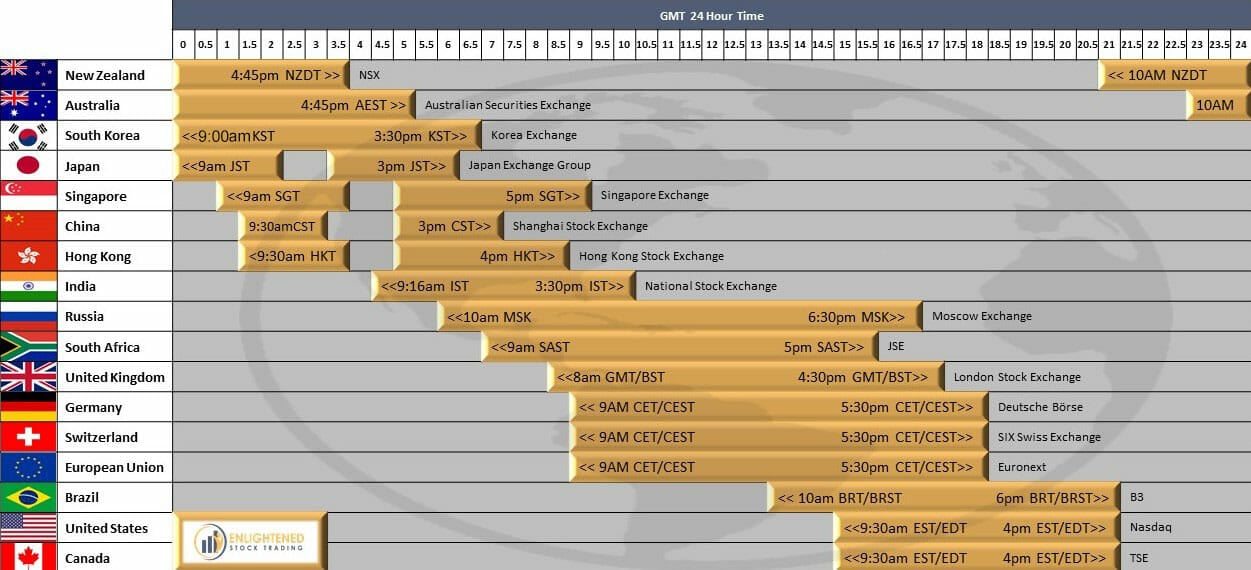
Europe hosts several of the world’s most significant stock exchanges. The London Stock Exchange (LSE), for instance, operates from 8:00 AM to 4:30 PM Greenwich Mean Time (GMT). Given London’s status as a global financial hub, its trading hours often overlap with Asian markets in the morning and with U.S. markets in the afternoon, providing a bridge between major financial regions. Similarly, the Deutsche Börse (Frankfurt Stock Exchange) typically runs from 9:00 AM to 5:30 PM Central European Time (CET). These European markets are crucial for understanding the flow of capital and sentiment across the Eurozone and broader European economies, impacting global commodities, currencies, and multinational corporations.
Asian Markets (e.g., Tokyo, Shanghai)
As trading in the West winds down, Asian markets come alive. The Tokyo Stock Exchange (TSE), one of the largest in Asia, has trading hours from 9:00 AM to 11:30 AM JST (Japan Standard Time) for its morning session, and then from 12:30 PM to 3:00 PM JST for its afternoon session. This midday break is common in several Asian markets. The Shanghai Stock Exchange (SSE) and the Shenzhen Stock Exchange (SZSE), representing mainland China’s robust economy, operate from 9:30 AM to 11:30 AM CST (China Standard Time) for the morning session and 1:00 PM to 3:00 PM CST for the afternoon session. These Asian markets are significant drivers of global growth and are particularly sensitive to developments in manufacturing, technology, and emerging markets.
Overlapping Trading Sessions and Global Impact
The sequential opening and closing of global markets create fascinating periods of overlapping trading sessions. For instance, there’s a significant overlap between European markets and U.S. markets for several hours, typically from around 9:30 AM ET (U.S. open) to 11:30 AM ET (when many European markets are still active). These overlaps are often characterized by increased trading volume and liquidity, as participants from multiple major financial centers are simultaneously active. This global synchronicity means that major news or economic data released in one region can quickly reverberate across markets around the world, underscoring the interconnected nature of the modern financial system. Investors tracking global portfolios or seeking diversification must be attuned to these interconnected hours.
Impact of Weekends and Holidays on Trading
While the daily rhythm of the stock market is crucial, it’s equally important to recognize when the market takes a pause. Weekends and holidays represent complete cessation of trading activity, a period that investors must factor into their planning and strategy.
Recognized U.S. Market Holidays
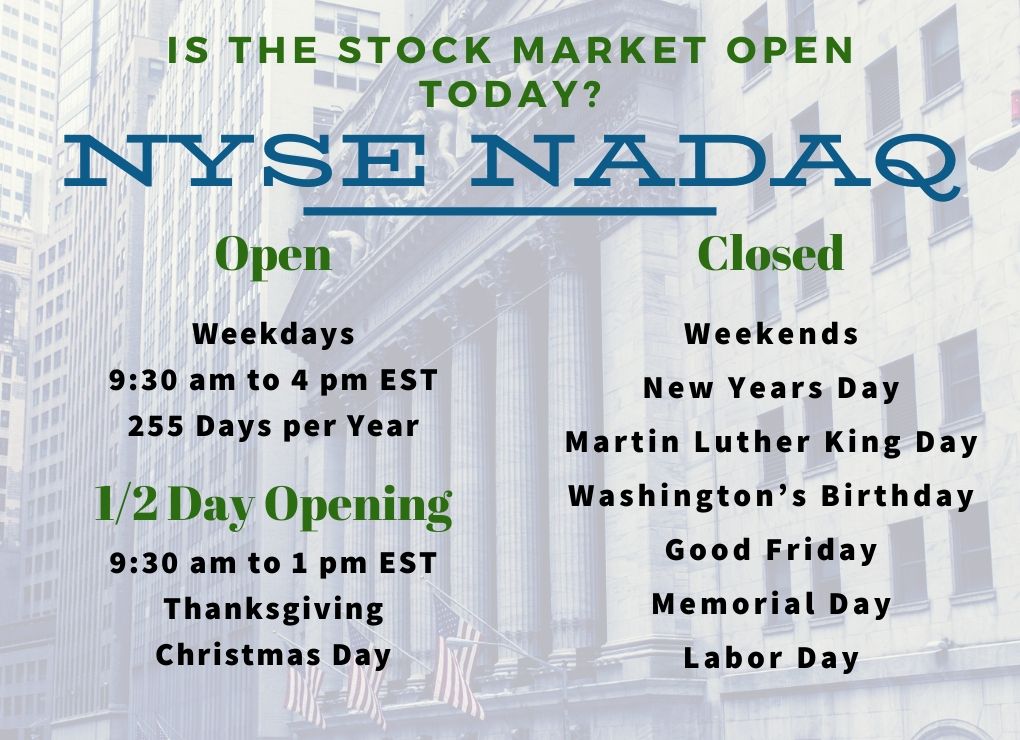
The U.S. stock market observes several federal holidays, during which all trading is halted. These include:
- New Year’s Day
- Martin Luther King, Jr. Day
- Presidents’ Day
- Good Friday
- Memorial Day
- Juneteenth National Independence Day
- Independence Day
- Labor Day
- Thanksgiving Day
- Christmas Day
It’s important to note that if a holiday falls on a Saturday or Sunday, the market often observes it on the preceding Friday or succeeding Monday, respectively. For instance, if Christmas Day falls on a Sunday, the market will typically be closed on the following Monday. These holidays provide a complete break from market activity, allowing investors to disconnect and preventing trading during periods of historically low volume and potential unpredictability.
Half-Day Trading Sessions
In addition to full-day closures, the market sometimes operates on a half-day schedule, typically closing early at 1:00 PM ET. This usually occurs on days immediately preceding or following major holidays, such as the day before Independence Day, the day after Thanksgiving, or Christmas Eve (if it falls on a weekday). These half-days are characterized by significantly reduced trading volume and can sometimes see amplified volatility due to the thinner market. Investors should be aware of these shortened sessions to avoid unexpected order execution delays or price movements.
Planning Around Non-Trading Days
For investors, planning around non-trading days is vital. This means considering how pending orders might be affected, how news released during a holiday closure could impact prices upon reopening, and how to manage portfolio exposure during these periods. For example, if a company releases critical news over a long holiday weekend, the stock might experience a significant gap up or down when the market reopens, as investors rush to react. Long-term investors may find these breaks less impactful, but for active traders or those managing short-term positions, understanding and preparing for market closures is a key aspect of risk management and strategic planning.
Beyond the Clock: Factors Influencing Trading Decisions
While knowing the exact opening and closing times is fundamental, the astute investor recognizes that the clock is just one dimension of market dynamics. Various factors, particularly during different trading sessions, profoundly influence price action and require a deeper understanding.
Volatility and Liquidity During Different Sessions
The concepts of volatility and liquidity are inextricably linked to market hours. During the regular trading session, liquidity is typically highest, meaning there are many buyers and sellers, and trades can be executed quickly with minimal impact on price (tight spreads). This high liquidity generally leads to more efficient price discovery, though volatility can still be significant in response to major news. Conversely, pre-market and after-hours sessions are characterized by lower liquidity. With fewer participants, even relatively small orders can move prices dramatically, leading to wider bid-ask spreads and increased volatility. This creates both opportunities for rapid gains or losses, and heightened risks, particularly for less experienced traders. Understanding these liquidity differences is crucial for selecting appropriate trading strategies and managing risk exposure across various timeframes.
News Events and Market Reactions
News is the lifeblood of financial markets, and its release timing often dictates where and when market reactions will be most pronounced. Major economic reports (e.g., unemployment data, inflation figures), central bank announcements, corporate earnings reports, and geopolitical developments are frequently scheduled outside of regular trading hours, often pre-market or after-hours. This strategic timing allows market participants to digest the information before the regular session begins or after it concludes, theoretically reducing immediate knee-jerk reactions during peak liquidity. However, it also means that the initial price discovery following such news occurs in less liquid extended sessions, potentially leading to sharp price gaps when the market reopens or during the extended hours themselves. Savvy investors closely monitor economic calendars and corporate announcements, understanding that pre-market or after-hours news can set the tone for the entire trading day.
The Role of Electronic Trading and Market Access
The advent of electronic trading platforms and high-frequency trading (HFT) has profoundly altered how markets operate, especially concerning trading hours. ECNs facilitate much of the extended-hours trading, allowing for seamless order matching without human intervention. This democratization of access means that individual investors, through their brokerage accounts, can also participate in pre-market and after-hours sessions, provided their broker offers such functionality. While this offers unprecedented flexibility, it also means that market movements can be extremely fast, often driven by algorithmic trading strategies that react to news in milliseconds. The continuous nature of electronic trading pushes the boundaries of “market hours,” transforming the traditional view of a strictly time-bound exchange into a more fluid, nearly 24/7 global financial network.
Strategic Implications for Investors
Knowing the stock market’s operating hours is not merely an academic exercise; it has direct, tangible implications for how investors approach their strategies, manage risk, and optimize their financial outcomes.
Managing Risk in Extended Hours
For investors considering trading in pre-market or after-hours sessions, risk management is paramount. The lower liquidity and higher volatility during these periods mean that market orders (orders to buy or sell immediately at the best available price) can be filled at prices significantly different from what was expected. Using limit orders, which specify the maximum price you’re willing to pay or the minimum price you’re willing to accept, is often a safer approach during extended hours. Additionally, understanding the potential for price gaps – where a stock opens significantly higher or lower than its previous close – is crucial. Positions held overnight or over a holiday weekend carry the risk of being affected by news that emerges during non-trading hours, leading to these gaps. Active monitoring and careful position sizing become even more critical when venturing beyond regular trading times.
Day Trading vs. Long-Term Investing Strategies
The significance of market hours varies greatly depending on an investor’s strategy. For day traders, who aim to profit from intra-day price movements and close all positions before the market closes, understanding the precise opening and closing minutes, as well as the volatility patterns within the regular session, is absolutely vital. The highest volume and most predictable volatility often occur at the open and close. Conversely, long-term investors or those employing a buy-and-hold strategy may find the precise daily opening and closing times less critical. Their focus is on the fundamental value of companies and multi-year growth trends, making daily fluctuations less impactful. However, even long-term investors need to be aware of holiday closures for settlement purposes and for evaluating their portfolio’s performance over longer periods.
Tools and Platforms for Monitoring Market Hours
In today’s digital age, a wealth of tools and platforms are available to help investors stay informed about market hours and global trading schedules. Most reputable brokerage platforms provide real-time market data, including current pre-market and after-hours quotes, and clearly indicate when extended-hours trading is available. Financial news websites and dedicated market data providers often publish economic calendars that list holiday closures and half-days for various exchanges around the world. Customizable watchlists and alerts can notify investors of specific market events or price movements. Leveraging these technological resources effectively ensures that investors, regardless of their strategy, can make informed decisions based on accurate and timely information, optimizing their engagement with the global financial markets.
In conclusion, the question “what time does the stock market open and close?” is more than a simple inquiry about clocks; it’s an entry point into understanding the intricate mechanics of financial markets. From the bustling regular sessions of the NYSE and NASDAQ to the quieter, yet strategically important, extended hours, and across the globe’s interconnected exchanges, market timing dictates the rhythm of investment. By grasping these hours, factoring in holidays, and understanding the accompanying shifts in liquidity and volatility, investors can better manage risk, refine their strategies, and ultimately navigate the complex financial landscape with greater confidence and precision.
aViewFromTheCave is a participant in the Amazon Services LLC Associates Program, an affiliate advertising program designed to provide a means for sites to earn advertising fees by advertising and linking to Amazon.com. Amazon, the Amazon logo, AmazonSupply, and the AmazonSupply logo are trademarks of Amazon.com, Inc. or its affiliates. As an Amazon Associate we earn affiliate commissions from qualifying purchases.