
The Dow Jones Industrial Average (DJIA), often simply referred to as “the Dow,” is one of the oldest, most frequently cited, and widely recognized stock market indexes in the world. Its performance is scrutinized daily by investors, analysts, and the general public alike, often serving as a key barometer for the health of the U.S. stock market and, by extension, the broader economy. While its influence is undeniable, a fundamental question often arises for those new to finance or looking for a deeper understanding: exactly how many companies make up this iconic index? The definitive answer is 30 companies.

However, simply stating “30” only scratches the surface of what makes the Dow so significant and how its composition reflects the shifting landscape of American industry. To truly appreciate its role in the financial world, we must delve into its history, methodology, and the dynamic nature of its constituents.
Understanding the Dow Jones Industrial Average (DJIA)
To grasp the importance of the number 30, it’s crucial to understand what the Dow is and how it functions. It’s more than just a list of companies; it’s a carefully curated selection designed to provide a snapshot of the industrial segment of the U.S. economy.
A Legacy of Market Representation
The Dow Jones Industrial Average was created in 1896 by Charles Dow, co-founder of Dow Jones & Company and editor of The Wall Street Journal. Initially, it comprised just 12 industrial stocks. Its purpose was to provide a clear, concise measure of the performance of the leading industrial companies in the United States, giving investors a simplified way to track market movements. Over a century later, while the economy has diversified far beyond its industrial roots, the Dow has evolved to remain a relevant, albeit sometimes debated, indicator.
What is the Dow and What Does it Track?
At its core, the DJIA is a stock market index that tracks the performance of 30 large, publicly traded companies based in the United States. These companies are often referred to as “blue-chip” stocks due to their long history of financial stability, strong brand recognition, and significant influence within their respective industries. Unlike broader indexes that might include thousands of companies, the Dow’s selective nature is its defining characteristic, aiming to represent the leading forces of the American business landscape. It does not track every company, nor does it necessarily represent the entire market, but rather a carefully chosen cross-section of influential corporations.
The Price-Weighted Methodology
One of the most distinctive features of the Dow is its calculation method: it is a price-weighted index. This means that companies with higher stock prices have a greater influence on the index’s value than companies with lower stock prices, regardless of their total market capitalization (the total value of all outstanding shares). When one of the Dow’s 30 components experiences a change in its stock price, the effect on the overall index is proportional to its share price relative to the other components.
This contrasts sharply with more modern, market-capitalization-weighted indexes like the S&P 500, where a company’s impact on the index is determined by its total market value. The price-weighted approach is often cited as a criticism of the Dow, as a $1 move in a high-priced stock has the same impact as a $1 move in a low-priced stock, even if the latter company is much larger in terms of overall value. Despite this, its historical prominence and widespread use ensure its continued relevance.
The Definitive Number: 30 Companies
The number 30 is not arbitrary; it’s a testament to the Dow’s evolution and its commitment to representing a focused yet impactful segment of the market.
Why 30? The Exclusive Club
From its humble beginnings with 12 companies, the Dow expanded to 20 stocks in 1916 and finally settled on 30 in 1928. This number has remained constant ever since. The choice of 30 aims to strike a balance: it’s a small enough number to be manageable and recognizable, yet large enough to provide a reasonable representation of the diverse array of industries that drive the U.S. economy. Being part of the “Dow 30” is considered a prestigious achievement for any corporation, signifying its status as a market leader and a blue-chip entity. It’s an exclusive club, and inclusion often brings increased visibility and investor confidence.
The Influence of the “Dow 30”
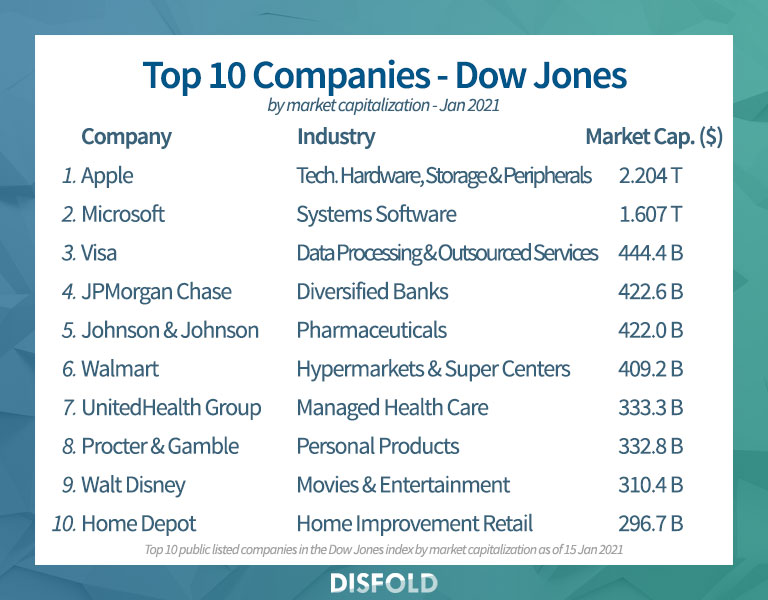
The companies within the Dow are not just any 30 corporations; they are often household names, global behemoths with significant market share and influence. Companies like Apple, Microsoft, Johnson & Johnson, Walmart, and Coca-Cola are staples of the index, representing technology, healthcare, retail, and consumer goods, among others. Their collective performance is often seen as a leading indicator of the broader market’s health. When the Dow rises, it generally suggests optimism in these major industrial and service sectors, potentially signaling a healthy economic outlook. Conversely, a decline can indicate concerns among investors regarding these key economic drivers.
The Evolving Composition
While the number 30 is fixed, the specific companies comprising the index are not. The Dow is a living entity, designed to adapt to the changing economic landscape. Companies are added and removed periodically to ensure the index remains relevant and reflective of the current industrial leaders and economic structure. This dynamic nature is crucial for its continued utility as a market indicator.
The Dynamic Nature of Dow Components
The selection and removal of companies from the Dow are not based on rigid formulas but rather on the subjective judgment of a committee, guided by a set of principles designed to maintain the index’s integrity and relevance.
Criteria for Inclusion and Exclusion

There’s no published rulebook for how companies are chosen for the Dow. Instead, the Averages Committee, which oversees the index, considers several factors:
- Reputation and Growth: Companies should have an excellent reputation, demonstrate sustained growth, and be of interest to a large number of investors.
- Sector Representation: The committee aims for a reasonable representation of major sectors of the U.S. economy to avoid over-concentration in any single industry.
- Size and Influence: Generally, candidates are large, well-established companies that are leaders in their respective industries and have a broad investor base.
- Public Ownership: A company must be publicly traded on a major U.S. exchange.
Companies are typically removed when they undergo significant structural changes (like bankruptcy, acquisition, or a shift in core business that makes them less representative) or when their market influence wanes, making way for new, more dynamic leaders.
Notable Additions and Removals
History is replete with examples of companies joining and leaving the Dow. General Electric, one of the original components, was a continuous member for over 100 years before being removed in 2018, symbolizing a shift away from traditional manufacturing giants. More recently, Salesforce.com, Amgen, and Honeywell were added in 2020, replacing Exxon Mobil, Pfizer, and Raytheon Technologies, reflecting the growing dominance of technology and healthcare in the economy. Such changes underscore the committee’s efforts to keep the Dow a modern and pertinent indicator, even if its methodology is historic.
Implications of Changes for Investors
Changes in the Dow’s composition can have several implications. For companies added, it often signals a boost in prestige, visibility, and potentially increased investment, particularly from index funds that track the Dow. For companies removed, it can be seen as a demotion, potentially leading to some selling pressure from institutional investors who must rebalance their portfolios to mirror the index. For investors broadly, these changes offer insights into the evolving landscape of American business and the industries that are gaining or losing prominence.
The Dow’s Role in Investing and Finance
Despite criticisms regarding its price-weighted methodology and limited number of components, the Dow Jones Industrial Average maintains a central role in financial discourse and investment strategies.
A Barometer of the US Economy
For many, the Dow is the quickest and easiest way to gauge the mood of the market. Its daily fluctuations are front-page news and the lead story on financial broadcasts. While it only represents 30 companies, these firms are so large and influential that their collective performance is often considered a strong indicator of the broader economic environment and investor confidence. A sustained bull run in the Dow can suggest robust corporate earnings, economic growth, and a positive outlook, while a prolonged downturn might signal recessionary fears or other economic headwinds.
Investing in the Dow: ETFs and Index Funds
Directly investing in all 30 Dow components can be cumbersome for individual investors. However, there are numerous exchange-traded funds (ETFs) and index funds designed to replicate the performance of the DJIA. These funds offer investors a convenient and diversified way to gain exposure to the companies in the Dow without having to purchase each stock individually. Examples include the SPDR Dow Jones Industrial Average ETF (DIA), which trades on the NYSE Arca and holds all 30 Dow components, mirroring the index’s performance. Investing in such instruments allows individuals to participate in the growth of these blue-chip companies with relatively low costs and minimal effort.
Criticisms and Alternatives
The Dow’s primary criticisms revolve around its price-weighted nature and its limited scope. The argument is that 30 companies, even if they are large, cannot fully represent the vast and complex U.S. economy, especially in an era dominated by market capitalization. Critics also point out that the price-weighted methodology can distort its true representativeness, as a small company with a high share price can impact the index more than a massive company with a lower share price.
For these reasons, many professional investors and analysts often prefer broader, market-capitalization-weighted indexes like the S&P 500. The S&P 500 includes 500 of the largest U.S. publicly traded companies, offering a much more comprehensive view of the market’s performance and sectors. It’s often considered a more accurate reflection of the overall health of the American stock market. Other alternatives include the Nasdaq Composite, which is heavily weighted towards technology stocks, and the Russell 2000, which tracks small-cap companies.
Beyond the Number: The Broader Economic Narrative
While the precise number of companies in the Dow is 30, its significance extends far beyond this simple count. It encapsulates a rich history, a continuous effort to adapt, and an enduring role in the financial consciousness.
Sector Diversification within the Dow
Despite its limited number of components, the Averages Committee strives for meaningful sector diversification within the Dow. The goal is to ensure that the index isn’t overly reliant on any single industry, providing a more balanced reflection of the broader economy. While historically rooted in “industrial” companies, today’s Dow includes a wide array of sectors, from technology (Apple, Microsoft, IBM), healthcare (Johnson & Johnson, UnitedHealth Group), consumer discretionary (Home Depot, Nike), financials (JPMorgan Chase, Goldman Sachs), and industrials (Caterpillar, Boeing), among others. This mix helps the index capture the performance of various economic engines.
The Dow as a Conversation Starter
Regardless of its methodological debates, the Dow remains an indispensable part of financial vernacular. It’s the index most often quoted in daily news reports, on financial shows, and in casual conversations about the stock market. Its long history and consistent presence have ingrained it into the collective financial consciousness, making it a powerful conversation starter and a relatable benchmark for millions. For many, “the market” is synonymous with “the Dow.”
Long-Term Perspective and Future Relevance
The Dow has survived numerous economic cycles, market crashes, and technological revolutions. Its ability to adapt by rotating its components ensures its continued relevance. While the financial world has become increasingly sophisticated with a multitude of indexes and analytical tools, the Dow Jones Industrial Average retains its unique place. It serves as both a historical relic and a dynamic indicator, offering a focused lens through which to view the performance of America’s leading corporate titans. For investors and observers, understanding that there are precisely 30 companies in the Dow, and appreciating the rationale behind that number, provides a foundational insight into one of the most enduring symbols of global capitalism.
aViewFromTheCave is a participant in the Amazon Services LLC Associates Program, an affiliate advertising program designed to provide a means for sites to earn advertising fees by advertising and linking to Amazon.com. Amazon, the Amazon logo, AmazonSupply, and the AmazonSupply logo are trademarks of Amazon.com, Inc. or its affiliates. As an Amazon Associate we earn affiliate commissions from qualifying purchases.