
In the intricate world of financial markets, investors constantly seek tools that can help them navigate various economic landscapes, from soaring bull markets to turbulent downturns. Among the myriad investment vehicles available, Exchange Traded Funds (ETFs) have gained immense popularity for their flexibility, diversification, and accessibility. However, not all ETFs are created equal, and some are designed for very specific, often short-term, strategic purposes. One such instrument that frequently sparks curiosity and warrants a thorough understanding is SQQQ.
SQQQ, or the ProShares UltraPro Short QQQ, is far from a typical “set it and forget it” investment. It represents a highly specialized financial product, engineered to deliver amplified returns when a particular segment of the market declines. Its unique design, leveraging and inverse capabilities, positions it as a powerful, albeit complex, tool primarily favored by experienced traders and sophisticated investors looking to hedge portfolios or capitalize on bearish market sentiment. Understanding SQQQ requires delving into the mechanics of leveraged and inverse ETFs, appreciating the specific market it tracks, and most importantly, recognizing the inherent risks associated with its dynamic structure. For those who grasp its intricacies, SQQQ can be a valuable component of a tactical investment strategy; for the uninitiated, it holds the potential for significant capital erosion. This article aims to demystify SQQQ, providing a comprehensive overview of its function, operational mechanisms, strategic applications, and the critical risks that every potential investor must consider.

Understanding SQQQ: An Introduction to Inverse Leveraged ETFs
To fully grasp the essence of SQQQ, it’s crucial to break down its full name and understand the fundamental concepts behind inverse and leveraged ETFs. These are not passive investment vehicles; they are actively managed to achieve very specific, often short-term, performance objectives.
Defining SQQQ: The ProShares UltraPro Short QQQ
SQQQ is the ticker symbol for the ProShares UltraPro Short QQQ ETF. As an Exchange Traded Fund, it trades on stock exchanges just like individual stocks, offering investors the ability to buy and sell shares throughout the trading day. What sets SQQQ apart is its design. It is an “inverse” and “leveraged” ETF. Inverse means it aims to deliver returns that move in the opposite direction of its underlying index. Leveraged means it seeks to amplify those returns, typically by a fixed multiple. In SQQQ’s case, it seeks to achieve three times the inverse (3x) daily performance of its benchmark index. This makes it a powerful instrument for those with a strong conviction about a market downturn, but also significantly increases its risk profile.
The NASDAQ-100: SQQQ’s Benchmark Index
Every ETF tracks an underlying asset or index, and for SQQQ, that benchmark is the NASDAQ-100 Index. The NASDAQ-100 is a modified capitalization-weighted index composed of 100 of the largest domestic and international non-financial companies listed on the Nasdaq Stock Market. It includes some of the world’s most innovative and influential companies, particularly in the technology and growth sectors, such as Apple, Microsoft, Amazon, Google (Alphabet), and Tesla. Due to its heavy concentration in technology stocks, the NASDAQ-100 is often seen as a barometer for the broader tech sector and growth stocks. Therefore, when you invest in SQQQ, you are essentially making a bet on the performance of these 100 companies, specifically anticipating their collective decline.
The Core Concept: Inverse and Leveraged Exposure
The “inverse” aspect of SQQQ means that if the NASDAQ-100 Index declines by 1% on a given day, SQQQ aims to increase by a certain percentage. Conversely, if the NASDAQ-100 rises by 1%, SQQQ aims to decrease. The “leveraged” aspect magnifies this effect. SQQQ seeks to provide three times the inverse daily performance. So, if the NASDAQ-100 drops by 1% in a day, SQQQ is designed to rise by approximately 3%. If the NASDAQ-100 climbs by 1%, SQQQ is designed to fall by approximately 3%. This mechanism is achieved through the use of various financial derivatives, such as futures contracts, options, and swap agreements, rather than direct investment in the underlying index components.
How SQQQ Operates: Mechanics and Performance Dynamics
Understanding the daily operational mechanics of SQQQ is paramount, as its performance over periods longer than a single day can deviate significantly from simply three times the inverse of the NASDAQ-100’s cumulative return. This is due to a phenomenon known as “compounding” or “volatility decay.”
Daily Rebalancing: The Foundation of Leveraged ETFs
A critical feature of SQQQ and all leveraged ETFs is their daily rebalancing. ProShares, the fund provider, designs SQQQ to achieve its stated objective (3x inverse daily return) on a daily basis. This means that at the end of each trading day, the fund’s holdings are adjusted to ensure it maintains the desired leverage for the next trading day. This rebalancing act, while necessary to maintain the leverage ratio, is the primary reason why SQQQ’s performance over weeks, months, or years will likely diverge from -3x the NASDAQ-100’s cumulative return over the same period. The daily compounding of returns can lead to significant tracking errors, especially in volatile markets that exhibit a lot of up-and-down movement without a clear trend.
Short Exposure: Profiting from Market Declines
SQQQ achieves its “short” exposure by utilizing derivatives that essentially bet against the rise of the NASDAQ-100. This involves entering into agreements where the fund profits if the index declines. For instance, futures contracts on the NASDAQ-100 allow the fund to lock in a price today for a future sale, anticipating that the actual market price will be lower. When the index falls, the value of these short positions increases, generating returns for SQQQ. This mechanism allows investors to gain exposure to a bearish market view without directly shorting individual stocks or the entire index themselves, which can be more complex and capital-intensive.
Amplifying Returns (and Risks): The “UltraPro” Factor
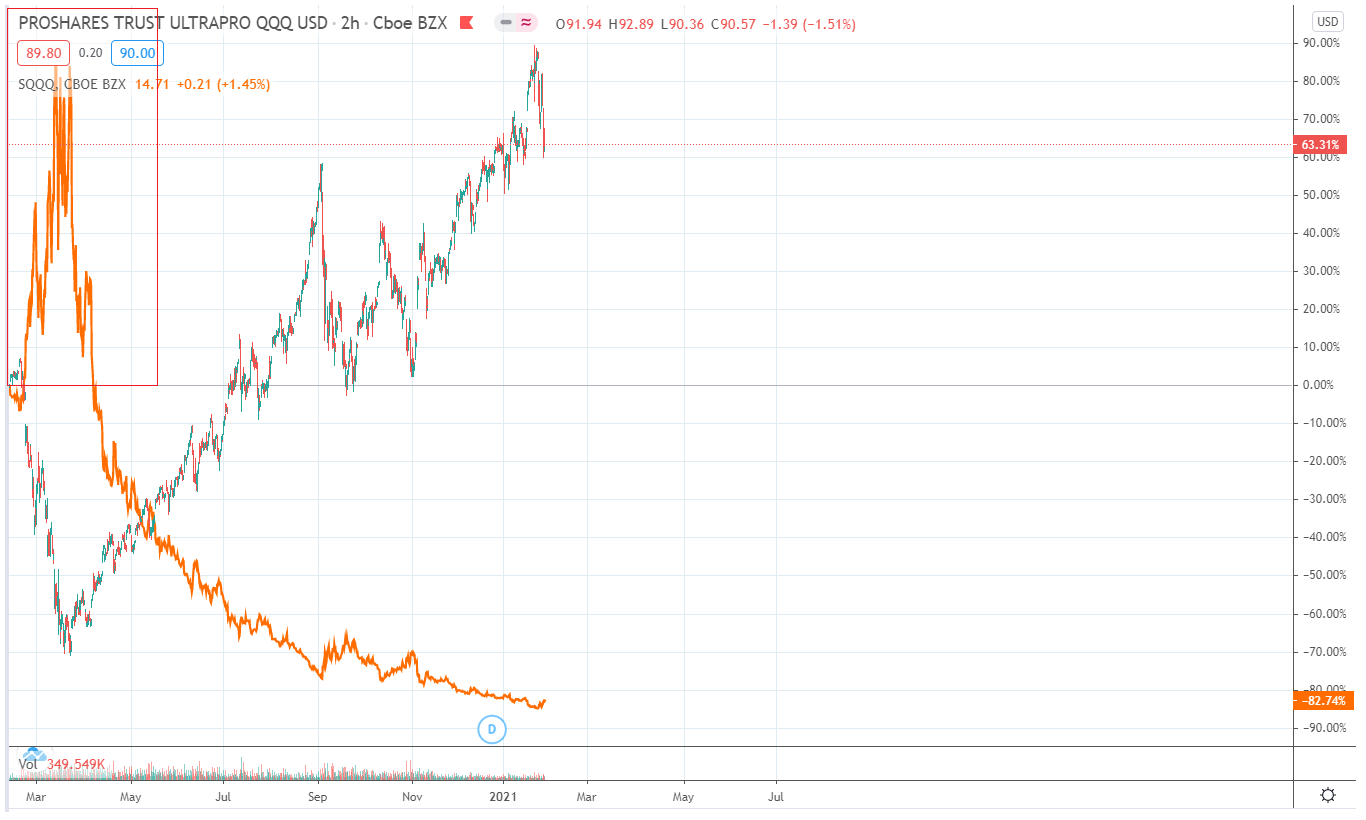
The “UltraPro” designation in SQQQ signifies its 3x leverage. This magnification is a double-edged sword. While it offers the potential for significantly higher returns during periods of market decline, it also dramatically amplifies losses when the NASDAQ-100 rises. A modest 5% gain in the NASDAQ-100 could translate into a 15% loss for SQQQ in a single day, not accounting for compounding effects. Over time, particularly in choppy or upward-trending markets, the effects of leverage and daily rebalancing can lead to a phenomenon known as “volatility decay,” where the fund loses value even if the underlying index eventually returns to its starting point. This makes SQQQ highly sensitive to market movements and volatility, requiring constant monitoring and a clear understanding of its short-term nature.
Strategic Uses of SQQQ in an Investment Portfolio
Despite its complexities and risks, SQQQ serves specific strategic purposes for certain types of investors. It is primarily a tactical instrument, not a core long-term holding. Its utility shines in scenarios where an investor anticipates or wishes to protect against a significant market downturn.
Hedging Against Bearish Markets
One of the primary uses of SQQQ is as a hedging tool. If an investor holds a substantial portfolio of growth stocks or other assets heavily correlated with the NASDAQ-100, and they foresee a potential market correction or bear market, they might buy shares of SQQQ. The goal here isn’t necessarily to make a large profit from SQQQ itself, but to offset potential losses in their long-term holdings. If the market indeed drops, the gains from SQQQ can help cushion the blow to the overall portfolio. This strategy allows investors to maintain their long-term positions without liquidating them, providing temporary protection during uncertain periods.

Short-Term Speculation on Market Downturns
For active traders with a strong conviction that the NASDAQ-100 is poised for a significant short-term decline, SQQQ offers a direct way to profit from that prediction. Given its 3x leverage, even a small percentage drop in the NASDAQ-100 can result in substantial gains for SQQQ investors in a single day. This makes it an attractive instrument for high-frequency traders or those engaging in swing trading strategies. However, this speculative use requires keen market timing, robust risk management, and the ability to react quickly to market changes, as the leverage works against the investor just as powerfully if the market moves unexpectedly.
Portfolio Diversification with Caution
While traditionally, diversification involves spreading investments across different asset classes, sectors, or geographies, SQQQ offers a different kind of “diversification” – diversification against market downturns. For a heavily growth-oriented portfolio, having a small, strategically timed allocation to an inverse ETF like SQQQ can act as an anti-cyclical component. It’s crucial, however, that this “diversification” is approached with extreme caution, understanding its short-term nature and its potential for rapid value depreciation if market conditions do not align with the investment’s premise. It should never be seen as a substitute for traditional, broad-market diversification.
The Inherent Risks and Complexities of SQQQ
Investing in SQQQ is inherently risky and is not suitable for all investors. Its complex structure and daily rebalancing mechanism introduce unique challenges that can lead to significant capital losses, even for experienced market participants. A thorough understanding of these risks is non-negotiable before considering an investment in SQQQ.
Volatility Decay: A Long-Term Detriment
The most significant risk associated with SQQQ is volatility decay, also known as path dependency or compounding risk. Because SQQQ resets its leverage daily, its performance over periods longer than one day will almost certainly not be simply -3x the cumulative return of the NASDAQ-100. In volatile, sideways markets, where the index experiences frequent up and down movements without a clear trend, the daily compounding effect causes the fund to lose value over time. For example, if the NASDAQ-100 drops 10% on day one and rises 10% on day two (ending up slightly lower than it started), SQQQ would likely show a loss, despite the initial index decline. This phenomenon makes SQQQ unsuitable for long-term holding.
Compounding Effects in Leveraged ETFs
The compounding effect is a critical concept. Imagine a scenario where the NASDAQ-100 goes down 1% on Monday, up 1% on Tuesday, down 1% on Wednesday, and so on. Even if the net change in the NASDAQ-100 over a week is zero or negligible, SQQQ could experience significant losses. This is because the base on which the 3x daily return is calculated changes every day. A 3% gain on a smaller base after a loss will not fully recover a 3% loss on a larger base. This mathematical reality means that in choppy markets, SQQQ will almost inevitably bleed value over time, regardless of whether the NASDAQ-100 ends up higher or lower than its starting point over a multi-day period.
Not for Buy-and-Hold Investors
Due to volatility decay and the compounding effects, SQQQ is explicitly designed for short-term trading strategies, typically held for no longer than a single trading day. It is not an investment to be bought and held for weeks, months, or years. Investors who attempt to use SQQQ as a long-term bearish bet will almost certainly experience substantial losses, even if their long-term market prediction eventually proves correct. The fund’s performance mechanism works against longer holding periods in all but the most consistent, prolonged, and extreme downward trends in the underlying index.
Understanding Tracking Error
While SQQQ aims to provide 3x the inverse daily return of the NASDAQ-100, perfect tracking is rarely achieved. Various factors can lead to tracking error, including transaction costs, market liquidity, the timing of rebalancing, and the performance of the derivatives used. While often small on a daily basis, these tracking errors can accumulate, further contributing to the divergence of SQQQ’s performance from its theoretical target over extended periods. Investors should be aware that even within a single day, the precise -3x correlation may not always hold perfectly.
Investor Profile and Responsible Use
Given its inherent complexity and high-risk profile, SQQQ is certainly not for every investor. It requires a specific understanding, a particular temperament, and robust risk management strategies.
Who is SQQQ For?
SQQQ is best suited for sophisticated investors and active traders who:
- Possess extensive knowledge of market mechanics, particularly derivatives and leveraged products.
- Have a deep understanding of the NASDAQ-100 Index and its constituent companies.
- Are able to monitor market movements actively and react quickly to changing conditions.
- Have clear, short-term market outlooks and specific hedging or speculative strategies.
- Are comfortable with high levels of risk and the potential for significant, rapid losses.
- Have established risk management protocols, including stop-loss orders.
It is generally not recommended for novice investors, those seeking long-term growth, or individuals with a low-risk tolerance.
Due Diligence and Continuous Monitoring
Before considering an investment in SQQQ, investors must conduct thorough due diligence. This includes reviewing the fund’s prospectus, understanding its investment objective, and comprehending the risks outlined by the fund provider. Furthermore, continuous monitoring of both the NASDAQ-100 and SQQQ’s performance is absolutely essential. Market conditions can change rapidly, and what might be a profitable position one moment could turn into a significant loss the next. Relying on gut feelings or outdated information can be financially disastrous.
The Importance of Professional Financial Advice
Given the specialized nature and significant risks associated with SQQQ, seeking advice from a qualified financial advisor is highly recommended. A professional can help assess an investor’s risk tolerance, financial goals, and overall portfolio to determine if such a complex instrument aligns with their broader investment strategy. They can also provide insights into proper position sizing, risk management techniques, and alternative strategies that might achieve similar objectives with potentially lower risk.
Conclusion: Navigating the Nuances of SQQQ
SQQQ stands as a powerful testament to the innovation within financial markets, offering investors a direct, leveraged inverse exposure to the NASDAQ-100 Index. While it presents an appealing proposition for those looking to capitalize on bearish market trends or to hedge existing positions, its intricate design necessitates a profound understanding of its mechanics. The daily rebalancing, compounding effects, and the phenomenon of volatility decay mean that SQQQ is unequivocally a short-term trading instrument, profoundly unsuitable for long-term buy-and-hold strategies. For the experienced, risk-aware investor employing tactical strategies, SQQQ can be a valuable tool. For all others, its allure of amplified returns is overshadowed by the very real potential for substantial and rapid capital erosion. As with any sophisticated financial product, education, diligence, and professional guidance are not just advisable, but absolutely critical for navigating the nuances of SQQQ effectively.
aViewFromTheCave is a participant in the Amazon Services LLC Associates Program, an affiliate advertising program designed to provide a means for sites to earn advertising fees by advertising and linking to Amazon.com. Amazon, the Amazon logo, AmazonSupply, and the AmazonSupply logo are trademarks of Amazon.com, Inc. or its affiliates. As an Amazon Associate we earn affiliate commissions from qualifying purchases.