
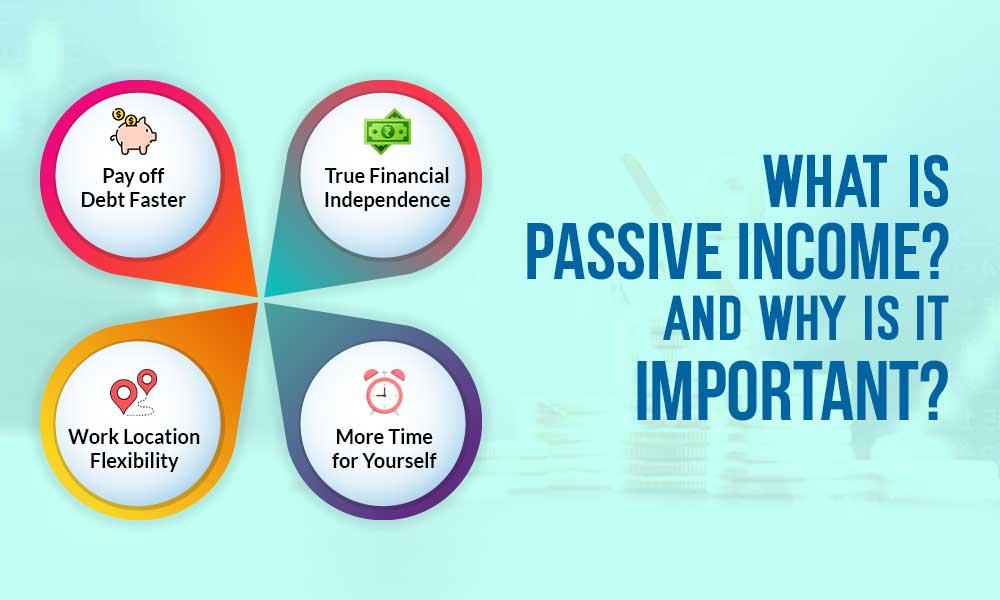
In the traditional economic model, most individuals are taught to trade their time for money. This is the essence of active income—a salary, hourly wages, or commissions earned through direct labor. However, the limitation of this model is inherent: time is a finite resource. To transcend the ceiling of a traditional career and achieve true financial independence, one must understand the mechanics of passive income.
Passive income is often misunderstood as “money for nothing.” In reality, it is a financial strategy where an individual front-loads effort, capital, or both to create an asset that continues to generate revenue with minimal ongoing maintenance. Whether it is through dividend stocks, real estate, or digital intellectual property, passive income serves as the foundation for long-term wealth preservation and lifestyle freedom.

The Mechanics of Passive Income vs. Active Income
To effectively build wealth, one must first distinguish between the various ways money is earned. The primary difference between active and passive income lies in the correlation between time spent and dollars earned.
Defining Active Income: The “Time for Money” Trap
Active income includes wages, tips, salaries, and commissions. In this scenario, if you stop working, the cash flow stops. While active income is the most common starting point for wealth building, it is inherently unscalable. You only have 24 hours in a day, and a portion of that must be dedicated to rest. Consequently, your earning potential is capped by your physical and mental capacity to perform tasks.
The Philosophy of Scalability
Passive income breaks the linear relationship between time and earnings. By investing capital into an asset (like a rental property) or investing time into a creation (like an e-book), you create a system that works independently of your presence. Scalability occurs when the revenue generated by these systems exceeds the cost of maintenance and the initial investment. This shift in mindset—from being an operator to being an owner—is the first step toward financial literacy.
Tax Implications and the IRS Perspective
From a financial and legal standpoint, the Internal Revenue Service (IRS) often categorizes income into three buckets: active, passive, and portfolio. Passive income typically refers to earnings derived from a rental property, limited partnership, or other enterprise in which a person is not materially involved. Understanding these classifications is crucial for tax planning, as passive losses can often be used to offset passive gains, providing a strategic advantage in wealth management.
High-Yield Investment Vehicles (Paper Assets)
For those who have more capital than time, paper assets offer the most direct route to passive income. These vehicles allow you to leverage the growth and productivity of established companies and markets.
Dividend-Paying Stocks and ETFs
One of the oldest and most reliable forms of passive income is dividend investing. When you purchase shares of profitable companies, many choose to distribute a portion of those profits back to shareholders. By reinvesting these dividends, investors benefit from compound interest—what Albert Einstein famously called the “eighth wonder of the world.” Exchange-Traded Funds (ETFs) that focus on “Dividend Aristocrats” (companies that have increased their dividends for 25 consecutive years) provide a diversified, lower-risk entry point for this strategy.
Real Estate Investment Trusts (REITs)
If you want exposure to the real estate market without the headaches of being a landlord, REITs are a powerful tool. A REIT is a company that owns, operates, or finances income-producing real estate. By law, REITs must distribute at least 90% of their taxable income to shareholders as dividends. This allows individual investors to earn a share of the income produced through commercial real estate—such as apartment complexes, malls, and office buildings—without ever having to fix a leaky faucet or chase down a rent check.
Peer-to-Peer (P2P) Lending and Private Debt
The democratization of finance has led to the rise of P2P lending platforms. Here, you act as the bank, lending your capital to individuals or small businesses in exchange for interest payments. While this carries higher risk than a traditional savings account or government bond, the returns are often significantly higher. By diversifying your loans across hundreds of different borrowers, you can mitigate the risk of default while maintaining a steady monthly cash flow.
Leveraging Digital Assets for Recurring Revenue

In the digital age, “sweat equity” can be converted into permanent financial assets. Creating digital products requires a significant upfront investment of time, but once the product is launched, the marginal cost of selling to an additional customer is near zero.
Content Monetization: Blogs, YouTube, and Newsletters
Content creation is a marathon that leads to a passive sprint. By building an audience around a specific niche, creators can monetize through advertising revenue, sponsorships, and subscriptions. A well-researched article or an evergreen video can continue to attract views and generate ad revenue years after it was originally published. The key here is “evergreen” content—information that remains relevant and valuable to readers regardless of current trends.
Affiliate Marketing and Lead Generation
Affiliate marketing involves promoting a third-party product or service and earning a commission on every sale made through your unique referral link. This is a pure “Money” niche strategy because it requires no inventory, no customer service, and no product development. Successful affiliate marketers focus on building trust with an audience and providing honest recommendations, turning their platforms into automated recommendation engines that generate income 24/7.
Digital Products and Automated Course Sales
If you possess a specialized skill—whether it is financial modeling, graphic design, or project management—you can package that knowledge into a digital course or e-book. Platforms like Teachable or Gumroad handle the transaction and delivery automatically. Unlike a consultant who gets paid for a one-hour session, a course creator gets paid every time a student clicks “buy,” regardless of what the creator is doing at that moment.
Tangible Assets and Cash-Flowing Businesses
Beyond the digital realm and the stock market, physical assets remain a cornerstone of passive income. These methods often require more management but offer significant tax benefits and inflation protection.
Traditional Real Estate Rentals
Residential and commercial real estate remain the gold standard for passive income. The goal is to acquire property where the monthly rental income exceeds the mortgage, taxes, insurance, and maintenance costs. The surplus is your “cash flow.” Over time, as the mortgage is paid down and the property appreciates in value, your net worth increases while your monthly income remains steady or grows with inflation.
Storage Units and Automated Vending
Unconventional real estate, such as self-storage facilities, often yields higher margins than residential housing. Storage units require minimal maintenance and have low overhead. Similarly, automated businesses like vending machines or car washes can be “passivized” by hiring a management company or a part-time technician to handle the physical labor, leaving the owner to simply collect the profits and monitor the financial performance.
Licensing Intellectual Property and Royalties
If you are an inventor, author, or musician, royalties are your path to passive income. By licensing your intellectual property to a company, you receive a percentage of every sale. For example, a photographer can upload their portfolio to stock photo websites; every time a business downloads an image for a marketing campaign, the photographer receives a royalty. This turns a single moment of creativity into a perpetual income stream.
Designing Your Passive Income Roadmap
Building a passive income portfolio is not a “get rich quick” scheme; it is a disciplined financial exercise. Success requires a strategic approach to resource allocation and risk management.
Assessing Your Resources: Time vs. Capital
The first step is identifying your starting point. If you have a high-paying job but little free time, your path to passive income should focus on capital-heavy investments like dividend stocks, REITs, and managed real estate. If you have more time than money, you should focus on building digital assets or a side business that can eventually be automated. Trying to follow a strategy that doesn’t align with your available resources is a recipe for burnout.
The Importance of Diversification
No income stream is 100% “safe.” Markets crash, rental properties sit vacant, and digital algorithms change. To protect your financial future, you must diversify. A robust passive income portfolio might include a mix of index funds for long-term growth, rental properties for monthly cash flow, and a digital asset for high-margin “bonus” income. Diversification ensures that if one stream dries up, your lifestyle is not compromised.
Maintenance and Monitoring: The “Active” Part of Passive Income
It is a myth that passive income requires zero work. Every asset requires some level of oversight. You must monitor your stock portfolio’s performance, check in with your property manager, and occasionally update your digital content to keep it relevant. However, the difference is that you are working on your income streams rather than in them. You are the CEO of your own private economy, making high-level decisions rather than performing repetitive tasks.
In conclusion, passive income is the ultimate tool for achieving financial sovereignty. It allows you to move away from a life dictated by a 40-hour work week and toward a life where your time is your own. By understanding the mechanics of cash flow, leveraging both paper and digital assets, and consistently reinvesting your earnings, you can build a scalable financial engine that supports you and your family for decades to come. The journey to passive income begins with a single investment—not just of money, but of the mindset that your time is far too valuable to be sold forever.
aViewFromTheCave is a participant in the Amazon Services LLC Associates Program, an affiliate advertising program designed to provide a means for sites to earn advertising fees by advertising and linking to Amazon.com. Amazon, the Amazon logo, AmazonSupply, and the AmazonSupply logo are trademarks of Amazon.com, Inc. or its affiliates. As an Amazon Associate we earn affiliate commissions from qualifying purchases.