
In the modern financial landscape, the days of mailing paper checks and crossing your fingers for a timely delivery are rapidly fading into obsolescence. For the savvy taxpayer, digital literacy is no longer just a luxury—it is a fundamental component of effective personal finance management. Paying your IRS taxes online is not merely a matter of convenience; it is a strategic move that enhances security, provides an immediate audit trail, and allows for more precise cash flow management.
Whether you are a W-2 employee settling a year-end balance, a freelancer managing quarterly estimated payments, or a business owner overseeing corporate liabilities, understanding the nuances of the IRS’s digital payment ecosystem is essential. This guide explores the diverse platforms available, the financial strategies behind choosing specific payment methods, and the step-by-step processes required to ensure your obligations are met with professional precision.
The Evolution of Tax Payments: Why Going Digital is the Gold Standard
The transition from physical mail to digital portals represents a significant leap in financial security and efficiency. In the realm of personal finance, “time is money,” and the time saved by utilizing online systems can be redirected toward more productive financial planning.
Speed and Efficiency in Financial Planning
When you pay via mail, there is a “float” period where your funds are in limbo. This uncertainty can complicate your monthly budgeting and interest-accrual strategies. Online payments, conversely, offer near-instantaneous processing. By using digital tools, you can schedule payments for the exact date they are due—often up to 365 days in advance. This level of control allows you to keep your capital in high-yield savings accounts or short-term investments for as long as possible, maximizing your interest earnings before the transition to the Treasury.
Enhanced Security and the Paper Trail
Security is a paramount concern in any financial transaction involving sensitive data like Social Security numbers or bank account details. The IRS’s online portals utilize high-level encryption that far surpasses the security of a standard envelope moving through the postal system. Furthermore, digital payments provide an immediate electronic confirmation number. In the event of a dispute or a clerical error by the IRS, having a time-stamped, digital receipt is an invaluable asset for your financial records. It eliminates the “he-said, she-said” dynamic and provides concrete proof of compliance.
Exploring Your Online Payment Options: Choosing the Right Tool for Your Wallet
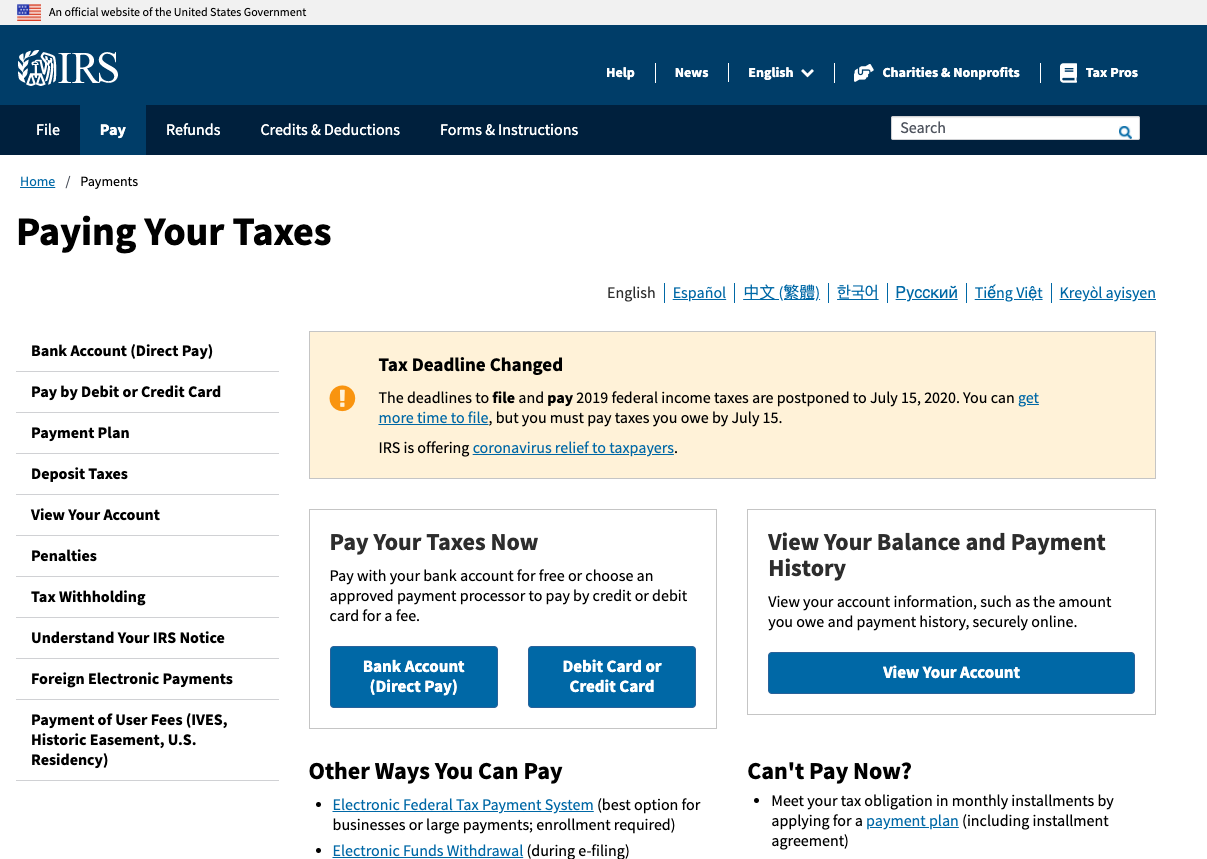
The IRS offers several distinct pathways for online payments, each catering to different financial needs and profiles. Selecting the right one depends on your liquidity, your desire for rewards, and your status as an individual or a business entity.
IRS Direct Pay: The No-Fee Solution for Individuals
For the majority of individual taxpayers, IRS Direct Pay is the most efficient and cost-effective method. This service allows you to pay directly from your checking or savings account without any processing fees. It is particularly useful for 1040-series tax returns, estimated taxes, and installment agreements. From a personal finance perspective, Direct Pay is the “cleanest” transaction, as it moves money directly from your assets to your liabilities without involving third-party intermediaries or accruing additional costs.
Debit and Credit Card Payments: Balancing Convenience and Cost
The IRS does not process card payments directly; instead, it utilizes third-party payment processors. While this method offers the convenience of using existing lines of credit, it comes with a caveat: processing fees. These fees typically range from a flat rate for debit cards to a percentage (usually between 1.82% and 1.98%) for credit cards.
From a strategic standpoint, paying by credit card only makes sense if the rewards, points, or cash-back bonuses you earn outweigh the processing fee, or if you are using the payment to meet a “minimum spend” requirement for a high-value sign-up bonus. However, one must be cautious; carrying a balance on a tax payment can lead to high-interest debt, which quickly erodes the benefits of any rewards earned.
EFTPS: The Professional Choice for Business Owners and High-Net-Worth Individuals
The Electronic Federal Tax Payment System (EFTPS) is a free service provided by the U.S. Department of the Treasury. While it requires a more rigorous registration process—including the mailing of a physical PIN—it is the gold standard for businesses and individuals with complex tax requirements. EFTPS allows for detailed reporting, history tracking for up to 16 months, and the ability to schedule multiple payments in advance. For those managing a diverse portfolio or a payroll, EFTPS provides the granular control necessary for professional-grade financial management.

Step-by-Step Implementation: Navigating the Digital IRS Portals
Executing a digital tax payment requires attention to detail. A single typo in a bank account number or a misselected tax year can result in significant administrative headaches.
Gathering Your Documentation Before You Start
Before logging onto any IRS portal, you must have your financial documentation organized. This includes your Social Security Number (SSN) or Individual Taxpayer Identification Number (ITIN), your filing status, and your most recent tax return for identity verification purposes. If you are paying for a specific tax year, ensure you have the correct form number (e.g., Form 1040 for individual income tax). In the world of finance, accuracy is the first line of defense against penalties and interest.
Executing the Transaction: A Walkthrough of the Direct Pay System
When using Direct Pay, the process is divided into five stages:
- Reason for Payment: You must specify why you are paying (e.g., “Balance Due,” “Estimated Tax,” or “Extension”).
- Verify Identity: You will enter information from a prior year’s tax return to prove you are who you say you are.
- Enter Payment Information: Here, you provide your routing and account numbers and the amount you wish to pay.
- Review and Sign: A final check of the data to ensure accuracy.
- Confirmation: Printing or saving the digital receipt for your records.
This structured approach ensures that the funds are applied to the correct tax liability, preventing the IRS from mischaracterizing your payment as a “credit” for a different year.
Integrating Tax Payments into Your Broader Financial Strategy
Taxation should not be viewed as an isolated event at the end of the year. Instead, it should be integrated into your holistic financial strategy to avoid liquidity crises and optimize wealth building.
Managing Cash Flow for Quarterly Estimated Payments
For those who are self-employed or have significant investment income, quarterly estimated payments are a reality. Rather than viewing these as a burden, treat them as a “pay-as-you-go” system that prevents a massive cash outflow in April. By using online scheduling tools, you can automate these payments based on your projected earnings. This disciplined approach ensures that you are never caught off guard by a large tax bill, allowing you to maintain a more stable and predictable investment strategy throughout the year.
Leveraging Rewards Programs via Credit Card Payments
As mentioned earlier, using a credit card to pay taxes can be a sophisticated financial maneuver. If you have a credit card that offers 2% cash back and the IRS processor charges a 1.85% fee, you are effectively “earning” 0.15% on your tax payment. While this may seem nominal, on a $10,000 tax bill, that is a free $15. More importantly, using a large tax payment to trigger a “Spend $4,000 in 3 months” sign-up bonus for a premium travel card can result in hundreds, or even thousands, of dollars in travel value. This is a classic example of “financial hacking” where you turn a mandatory liability into a wealth-generating asset.
Avoiding Common Pitfalls and Ensuring Compliance
Even with the best tools, errors can occur. Professional financial management requires a proactive approach to troubleshooting and record-keeping.
Verification and Confirmation: Protecting Your Financial History
The most common mistake taxpayers make is failing to save their confirmation numbers. In the digital world, your confirmation number is your “receipt.” You should save these as PDFs and store them alongside your digital tax returns. Additionally, check your bank statement 48 to 72 hours after making a payment to ensure the funds were successfully debited. If a payment is rejected due to a typo in the account number, the IRS may charge a “dishonored check” penalty, even if the transaction was digital.

What to Do if You Encounter Payment Hurdles
If you find yourself unable to pay the full amount due through an online portal, do not ignore the obligation. The IRS offers online “Payment Plans” or “Installment Agreements” that can be set up directly through their website. Taking the initiative to set up an agreement demonstrates financial responsibility and can often reduce the penalties that would otherwise accrue. From a personal finance perspective, it is always better to negotiate a structured payment plan than to face the aggressive collection efforts of the federal government.
By mastering the various online payment methods and integrating them into a broader financial plan, you transform tax season from a period of stress into a streamlined, professional operation. The digital tools provided by the IRS, when used correctly, offer the transparency and control necessary to manage your wealth with confidence and precision.
aViewFromTheCave is a participant in the Amazon Services LLC Associates Program, an affiliate advertising program designed to provide a means for sites to earn advertising fees by advertising and linking to Amazon.com. Amazon, the Amazon logo, AmazonSupply, and the AmazonSupply logo are trademarks of Amazon.com, Inc. or its affiliates. As an Amazon Associate we earn affiliate commissions from qualifying purchases.