
Navigating the landscape of student loan repayment can feel like wandering through a complex financial labyrinth. For many graduates, the transition from the “grace period” to active repayment is marked by a fundamental question: Where, exactly, am I supposed to send my money? Unlike a standard utility bill or a local mortgage, student loans are often managed by third-party entities known as loan servicers, and these assignments can change over the life of the loan.
Understanding where to pay your student loans is not just a matter of logistics; it is a critical component of personal finance management. Identifying your servicer, choosing the right platform, and selecting the most efficient repayment strategy can save you thousands of dollars in interest and protect your credit score. This guide provides a deep dive into the mechanisms of student loan repayment, the platforms available to you, and the strategic decisions that lead to financial freedom.

Identifying Your Student Loan Servicer
The “where” of student loan repayment depends entirely on the type of debt you hold. Generally, student loans fall into two primary categories: Federal and Private. Because the U.S. government does not directly handle the day-to-day billing for the millions of loans it issues, it contracts this work out to private companies.
Federal Student Loans: Navigating StudentAid.gov
If you have federal loans—such as Direct Subsidized, Unsubsidized, or PLUS loans—your central hub for information is StudentAid.gov. This is the official portal of the U.S. Department of Education’s Office of Federal Student Aid. While you do not usually make payments directly on this site, it serves as the master directory for your debt.
To find your specific “where,” you must log in using your FSA ID. Once logged in, your dashboard will list your “Loan Servicer.” Common federal servicers include Mohela, Nelnet, EdFinancial, and Maximus Federal Services (Aidvantage). Once you identify your servicer, you must create an account on their specific website. This servicer website is the actual portal where you will link your bank account, view your statements, and execute payments. It is important to note that the government periodically shifts loan portfolios between servicers; therefore, checking StudentAid.gov annually is a best practice to ensure your “where” hasn’t moved.
Private Student Loans: Working with Commercial Lenders
Private student loans are issued by banks, credit unions, or specialized online lenders like SoFi, Sallie Mae, or Discover. For these loans, the “where” is the lender’s proprietary online portal. Unlike federal loans, there is no centralized government database for private debt.
If you are unsure who your private lender is, the most effective way to find out is by pulling your credit report from the three major bureaus (Equifax, Experian, and TransUnion) via AnnualCreditReport.com. Your credit report will list every financial institution to which you owe money. Once identified, you will make payments directly through the lender’s website or mobile app. Private lenders often offer more streamlined digital experiences, but they lack the flexible repayment protections inherent in federal programs.
Modern Platforms and Tools for Seamless Repayment
Once you have identified your servicer, the next step is determining the most efficient method to facilitate your payments. In the modern financial ecosystem, “where” you pay can also involve third-party tools designed to optimize your cash flow and ensure you never miss a due date.
Direct Debit and Automation Strategies
Almost every student loan servicer offers an Electronic Funds Transfer (EFT) or “Auto-Pay” option. From a personal finance perspective, this is the gold standard for repayment. Most federal servicers and many private lenders provide a 0.25% interest rate reduction as an incentive for enrolling in auto-pay.
While a quarter of a percent might seem negligible, on a $50,000 balance over a ten-year term, it can result in significant savings. Furthermore, automating the “where” of your payment eliminates the risk of late fees and the potential for credit score damage. When setting up automation, ensure your “payment date” aligns with your cash flow—ideally a few days after your primary paycheck hits your account.
Third-Party Debt Management Apps
While you must ultimately send your money to the servicer, many borrowers use financial aggregators to manage the process. Apps like Empower (formerly Personal Capital), YNAB (You Need A Budget), and various “round-up” apps like ChangEd allow you to view your student loans alongside your checking and savings accounts.
These platforms act as an overlay, helping you visualize how much of your net worth is tied up in debt. Specifically, “round-up” apps link to your debit card and round up every purchase to the nearest dollar, sending the spare change as an extra payment to your student loan servicer. This “micropayment” strategy can shave months off your repayment timeline by attacking the principal balance more frequently than the standard monthly cycle.
Strategies for Optimizing Your Repayment Journey

Knowing where to pay is only half the battle; knowing how much to pay and under what terms is where true financial strategy comes into play. The U.S. federal system offers a variety of plans that can change your monthly obligation based on your economic circumstances.
Understanding Income-Driven Repayment (IDR) Plans
For federal loan borrowers, the “standard” 10-year repayment plan is not always the most viable. If your debt-to-income ratio is high, you may choose to pay via an Income-Driven Repayment (IDR) plan, such as the SAVE (Saving on a Valuable Education) plan, IBR (Income-Based Repayment), or ICR (Income-Contingent Repayment).
These plans adjust your monthly payment to a percentage of your discretionary income (often 5% to 10%). In some cases, if your income is low enough, your “payment” could be $0 per month while still counting as a qualifying payment toward eventual loan forgiveness. Choosing an IDR plan changes the “how” of your payment, often extending the term to 20 or 25 years, after which the remaining balance is forgiven. However, it is vital to monitor interest accrual, as lower payments may not cover the monthly interest, potentially leading to a growing balance unless you are on a plan like SAVE that subsidizes unpaid interest.
The Role of Forgiveness Programs (PSLF and Beyond)
Where you work can dictate where and how you pay your loans. The Public Service Loan Forgiveness (PSLF) program is a massive financial boon for those working in government or non-profit sectors. After making 120 qualifying payments (10 years) while working for a qualifying employer, the remainder of your federal student debt is forgiven tax-free.
To participate, you must ensure your loans are in the Direct Loan program and that you are enrolled in an IDR plan. Historically, all PSLF accounts were moved to a specific servicer (previously FedLoan, currently Mohela). If you are pursuing forgiveness, the “where” of your payment is strictly dictated by the Department of Education to ensure proper tracking of your qualifying payments.
Managing Refinancing and Consolidation
For many borrowers, the best place to pay student loans isn’t where they started. As your credit score improves and your income increases, you may find that the interest rates on your current loans are higher than what the current market offers.
When to Move Your Loans to a New Platform
Refinancing involves taking out a new loan with a private lender to pay off your existing loans. This effectively changes “where” you pay. The primary motivation for refinancing is to secure a lower interest rate, which reduces the total cost of the debt.
However, this is a strategic move that should be approached with caution. If you refinance federal loans into a private loan, you permanently lose access to federal protections, such as IDR plans, PSLF, and administrative forbearances. Refinancing is generally best suited for borrowers with high-interest private loans or federal borrowers with high incomes and stable jobs who do not need government protections and simply want to vanish their debt as cheaply as possible.
The Pros and Cons of Private Consolidation
Consolidation is often confused with refinancing. Federal Loan Consolidation allows you to combine multiple federal loans into one single loan with a weighted-average interest rate. This doesn’t necessarily save you money on interest, but it simplifies the “where” by giving you one single monthly payment and one servicer.
Private consolidation (refinancing) is different; it targets a lower rate. When deciding where to pay, consider if the simplicity of a single payment outweighs the benefits of keeping loans separate (which allows for the “Debt Snowball” or “Debt Avalanche” methods, where you target specific high-interest individual loans).
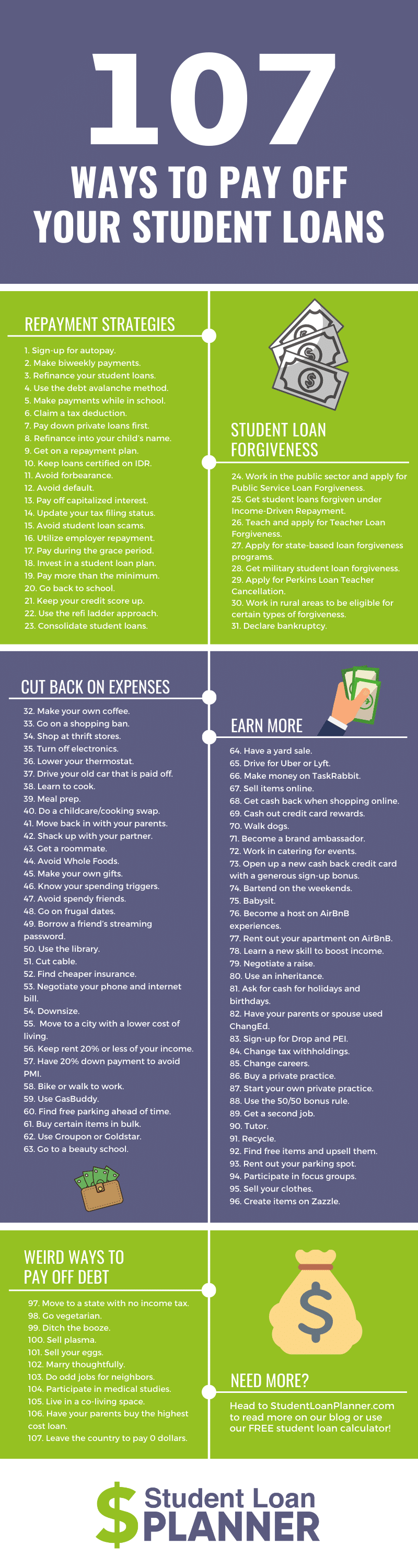
Avoiding Common Pitfalls in the Repayment Process
The journey of paying off student loans is long, and there are several financial traps that can hinder your progress. Being aware of these ensures that your money actually goes toward reducing your debt rather than unnecessary costs.
First, be wary of “debt relief” scams. You should never have to pay a third-party company to enroll you in a federal repayment plan or to “consolidate” your loans. All these actions can be done for free on StudentAid.gov or through your official servicer.
Second, understand “interest capitalization.” This occurs when unpaid interest is added to your principal balance, causing you to pay interest on your interest. This often happens after a period of deferment or forbearance. To avoid this, try to pay at least the interest portion of your loan even during periods when a payment isn’t strictly required.
Finally, keep your contact information updated with your servicer. Many borrowers run into trouble because they miss an email notification about a servicer change or a change in their monthly payment amount. By staying engaged with your “where”—the digital portal of your servicer—you maintain control over your financial destiny.
In conclusion, managing student loans is a marathon, not a sprint. By identifying your servicer, utilizing automation and fintech tools, and choosing the repayment plan that aligns with your long-term financial goals, you can navigate this debt efficiently. Whether you are aiming for forgiveness through public service or aggressively refinancing to save on interest, the key is to remain proactive and informed. Your student loans are a significant part of your financial portfolio, and treating them with the same rigor as an investment account will lead to a faster path to debt-free living.
aViewFromTheCave is a participant in the Amazon Services LLC Associates Program, an affiliate advertising program designed to provide a means for sites to earn advertising fees by advertising and linking to Amazon.com. Amazon, the Amazon logo, AmazonSupply, and the AmazonSupply logo are trademarks of Amazon.com, Inc. or its affiliates. As an Amazon Associate we earn affiliate commissions from qualifying purchases.