
In the vast and often complex world of financial markets, understanding the various indices is paramount for investors, economists, and anyone tracking global economic health. Among the most prominent of these benchmarks is the Nasdaq Composite Index. Far more than just a collection of numbers, the Nasdaq Composite represents a dynamic snapshot of innovation, growth, and technological advancement, predominantly reflecting the performance of companies listed on the Nasdaq Stock Market. For many, it serves as a crucial barometer for the tech sector and emerging industries, offering deep insights into the investment landscape. This article will delve into the intricacies of the Nasdaq Composite, exploring its origins, composition, significance for investors, and its historical journey through various market cycles, all within the exclusive context of finance and investing.

The Nasdaq Exchange: A Hub for Innovation
To truly grasp the essence of the Nasdaq Composite, one must first understand the exchange it represents: the Nasdaq Stock Market. Born out of a vision to modernize securities trading, Nasdaq quickly distinguished itself from its older, more traditional counterparts.
Genesis and Digital Revolution
The Nasdaq Stock Market officially launched on February 8, 1971, as the world’s first electronic stock market. At a time when stock trading was dominated by physical trading floors, shouting, and handwritten tickets, Nasdaq introduced a revolutionary computerized system. This innovation not only dramatically increased the speed and efficiency of transactions but also democratized access to market data. It eliminated the need for a physical trading floor, allowing brokers and dealers to conduct trades from anywhere, directly challenging the established norms of exchanges like the New York Stock Exchange (NYSE). This digital pioneering spirit laid the groundwork for future advancements in financial technology and cemented Nasdaq’s reputation as a forward-thinking market.
Market Structure: Understanding its Electronic, Dealer-Based System
Unlike the auction-based system of many traditional exchanges, Nasdaq operates on a “dealer market” or “negotiated” system. In this model, multiple market makers—broker-dealers who stand ready to buy and sell specific stocks—compete with each other by quoting bid (buy) and ask (sell) prices. This competition is designed to ensure fair prices and high liquidity. Investors buying or selling shares on Nasdaq are essentially transacting with one of these market makers rather than with another investor in an auction. This structure promotes deep liquidity and continuous trading, which has historically been attractive to companies seeking an efficient market for their shares. The electronic nature and dealer system are foundational to Nasdaq’s operational efficiency and its ability to handle high volumes of trades.
The Tech Magnet: Why Nasdaq Became Synonymous with Growth Companies
From its inception, Nasdaq’s innovative, electronic nature resonated strongly with companies that were themselves pushing the boundaries of technology and growth. Without the stringent historical requirements or physical floor presence of older exchanges, Nasdaq offered a more accessible and often more cost-effective listing venue for fledgling tech firms, biotech companies, and other high-growth industries. Giants like Microsoft, Apple, Intel, and Google (now Alphabet) chose to list on Nasdaq, solidifying its image as the premier marketplace for innovative, future-focused enterprises. This concentration of technology and growth stocks ultimately shaped the character of the Nasdaq Composite Index, making it a critical indicator for these dynamic sectors of the economy.
Decoding the Nasdaq Composite Index
The Nasdaq Composite is more than just a list of companies; it is a meticulously constructed index designed to reflect the overall performance of the Nasdaq Stock Market. Understanding its components and methodology is key to appreciating its financial significance.
Composition and Weighting: What Stocks are Included and How They Influence the Index
The Nasdaq Composite Index comprises virtually all common equities listed on the Nasdaq Stock Market that are not American Depository Receipts (ADRs), exchange-traded funds (ETFs), or other derivatives. This broad inclusion makes it one of the most comprehensive indices in the world, encompassing over 3,000 companies. Crucially, the Nasdaq Composite is a market-capitalization-weighted index. This means that companies with larger market values (share price multiplied by the number of outstanding shares) have a greater impact on the index’s overall performance than smaller companies. For instance, if a tech behemoth like Apple, with its massive market capitalization, sees a significant price movement, it will exert a more substantial influence on the Composite’s direction than a small, emerging biotech firm, even if both experience the same percentage change in their stock price. This weighting methodology ensures that the index accurately reflects the aggregate wealth being created or destroyed by the largest, most influential companies on the exchange.
Beyond Tech: A Diverse Range of Sectors, Though Tech-Heavy
While Nasdaq is undeniably synonymous with technology, the Composite Index actually includes companies from a wide array of sectors. Beyond information technology, it encompasses firms in biotechnology, telecommunications, retail, finance, industrials, and more. However, due to its historical appeal and listing criteria, the technology sector consistently holds the largest weighting within the index. This concentration means that while the Composite offers a broad view of the Nasdaq market, its movements are often heavily influenced by trends and sentiment within the tech industry. Investors interested in sectors beyond technology still find the Composite relevant, as many innovative companies across various industries choose Nasdaq for their public listing.
A Benchmark for Growth: Its Role in Gauging Market Sentiment for Innovative Firms
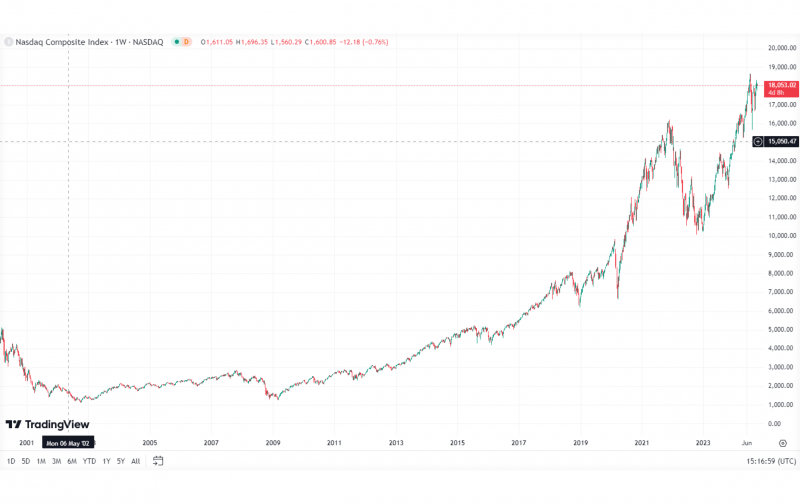
The Nasdaq Composite serves as a critical benchmark for assessing the health and investor sentiment surrounding growth-oriented companies and the broader innovation economy. Because many of its constituents are companies that prioritize research and development, have high growth potential, and often operate with disruptive business models, the Composite can act as a leading indicator for economic shifts driven by technological progress. Its performance is often analyzed to gauge investor appetite for risk and growth assets. When the Nasdaq Composite is performing strongly, it often signals investor confidence in future earnings potential and technological advancements. Conversely, periods of underperformance can reflect caution or a shift away from high-growth stocks towards more value-oriented investments.
Investing in the Nasdaq Composite: Opportunities and Considerations
For investors, the Nasdaq Composite offers a unique set of opportunities and challenges. Its distinct composition and market behavior necessitate a nuanced approach to investment strategy and risk management.
Understanding Volatility: Why its Tech-Focus Can Lead to Larger Swings
One of the defining characteristics of the Nasdaq Composite is its propensity for volatility. The index’s heavy concentration in technology and growth stocks, which often trade at higher valuations based on future earnings potential rather than current profits, can lead to more pronounced price swings. Growth stocks are typically more sensitive to changes in interest rates, economic outlooks, and investor sentiment. During periods of economic uncertainty or rising interest rates, investors may de-risk by shifting away from growth stocks, leading to sharper declines in the Composite. Conversely, during periods of optimism and economic expansion, these same stocks can experience rapid appreciation. Investors considering exposure to the Nasdaq Composite must be prepared for this inherent volatility and understand that higher potential returns often come hand-in-hand with higher risk.
Diversification within the Composite: The Breadth of Companies It Covers
Despite its tech-heavy nature, the sheer number of companies (over 3,000) included in the Nasdaq Composite provides a significant degree of diversification within the index itself. While large-cap tech companies dominate its performance, the index still captures a wide spectrum of market capitalizations, industries, and business models. For example, while Apple and Microsoft are major components, the index also includes numerous mid-cap and small-cap companies across biotech, clean energy, e-commerce, and software. This internal diversification helps mitigate some of the single-stock risk inherent in investing, as underperformance in one company or sub-sector might be offset by gains in another. However, it does not fully diversify against systemic risks affecting the broader growth or tech sectors.
Investment Vehicles: ETFs, Mutual Funds, and Their Role
Directly investing in all 3,000+ companies of the Nasdaq Composite is impractical for most individual investors. Fortunately, several investment vehicles allow investors to gain exposure to the index. The most common are Exchange-Traded Funds (ETFs) and mutual funds that track the Nasdaq Composite or indices highly correlated with it, such as the Nasdaq 100 (which tracks the 100 largest non-financial companies on Nasdaq). These funds offer a cost-effective and convenient way to achieve broad market exposure to the Nasdaq-listed universe. By investing in such funds, individuals can benefit from the collective performance of the Composite without having to research and purchase individual stocks. Other options include investing in actively managed funds that focus on growth stocks or specific tech sub-sectors, though these typically come with higher fees and may or may not outperform the passive index.
Historical Performance and Market Insights
The Nasdaq Composite’s journey through market history is a compelling narrative of innovation, speculation, resilience, and growth. Its performance often mirrors critical periods of economic transformation and investor sentiment.
Key Milestones: Highs, Lows, and Significant Market Events
The Nasdaq Composite has witnessed extraordinary highs and devastating lows. One of its most memorable periods was the late 1990s, culminating in the “dot-com bubble.” Fueled by irrational exuberance and speculative investments in internet companies, the index surged to unprecedented levels, only to crash dramatically starting in March 2000. This period served as a stark reminder of the dangers of market speculation. Following the bust, the Composite spent years recovering, eventually surpassing its dot-com era peak much later. More recently, the 2010s saw a sustained bull run, driven by the resurgence of established tech giants and the rise of new digital innovators, significantly boosting the index. Events like the 2008 financial crisis, the COVID-19 pandemic, and subsequent economic recovery also left their mark, demonstrating the index’s sensitivity to global economic and geopolitical events. Each milestone underscores the dynamic nature of growth investing.
Correlation with Economic Cycles: How it Reacts to Broader Economic Shifts
The Nasdaq Composite often exhibits a strong correlation with broader economic cycles, albeit with its own unique characteristics. During periods of economic expansion, particularly when accompanied by low interest rates and strong corporate earnings, the Composite tends to thrive. Growth companies, which are highly dependent on future consumer spending and business investment, benefit immensely from a healthy economy. Conversely, economic downturns, rising interest rates (which make future earnings less valuable in present terms), or geopolitical instability can weigh heavily on the index. The prospect of reduced consumer spending or higher borrowing costs for businesses can dampen expectations for growth, leading to declines. Analyzing the Composite’s performance often provides valuable insights into the market’s collective assessment of current and future economic conditions, especially concerning the innovation-driven sectors.

Future Outlook and Innovation: Its Continued Relevance in a Rapidly Evolving Economy
Looking ahead, the Nasdaq Composite is poised to remain a pivotal index in the global financial landscape. Its inherent focus on technology and growth companies positions it at the forefront of economic evolution. Industries like artificial intelligence, biotechnology, renewable energy, and advanced computing are continually disrupting traditional sectors and creating new investment opportunities. As long as innovation drives economic progress, the Nasdaq Composite will likely continue to attract companies pushing these boundaries. Its relevance for investors lies in its ability to capture the dynamism of these cutting-edge industries, providing a benchmark for performance in an economy increasingly shaped by digital transformation and technological advancement. While volatility will undoubtedly remain a factor, the index’s long-term trajectory is closely tied to the enduring human pursuit of innovation.
In conclusion, the Nasdaq Composite Index is far more than a simple market average; it is a powerful financial instrument that reflects the pulse of innovation and growth. Its history is intertwined with the digital revolution, and its composition continues to make it a vital gauge for the performance of technology and other future-oriented companies. For investors navigating the complexities of the modern economy, understanding the Nasdaq Composite – its structure, its drivers, its opportunities, and its risks – is indispensable for making informed financial decisions and strategically positioning portfolios for long-term growth.
aViewFromTheCave is a participant in the Amazon Services LLC Associates Program, an affiliate advertising program designed to provide a means for sites to earn advertising fees by advertising and linking to Amazon.com. Amazon, the Amazon logo, AmazonSupply, and the AmazonSupply logo are trademarks of Amazon.com, Inc. or its affiliates. As an Amazon Associate we earn affiliate commissions from qualifying purchases.