
For decades, the question “Where is the headquarters of Amazon?” had a simple, singular answer: Seattle, Washington. However, as Amazon evolved from a niche online bookseller into a global titan of cloud computing, artificial intelligence, and digital logistics, the concept of a “headquarters” transformed. Today, Amazon’s physical presence is a sophisticated map of technological nerve centers, headlined by its original urban campus in Seattle and its secondary headquarters (HQ2) in Arlington, Virginia.
This expansion is not merely a real estate play; it is a strategic alignment of physical space with technological ambition. From the biophilic architecture of the Seattle Spheres to the cloud-optimized infrastructure of National Landing, Amazon’s headquarters serve as the physical manifestation of its software-first philosophy.

The Heart of Innovation: Seattle and the “Day 1” Digital Philosophy
The primary headquarters of Amazon is located in the South Lake Union neighborhood of Seattle. This sprawling urban campus is more than just a collection of office buildings; it is the birthplace of the Kindle, Alexa, and the foundational algorithms that power the world’s largest e-commerce engine. At its core, the Seattle headquarters embodies the “Day 1” mentality—a tech-centric philosophy that encourages constant iteration and a refusal to succumb to corporate inertia.
The Spheres: A Biophilic Approach to High-Tech Workspaces
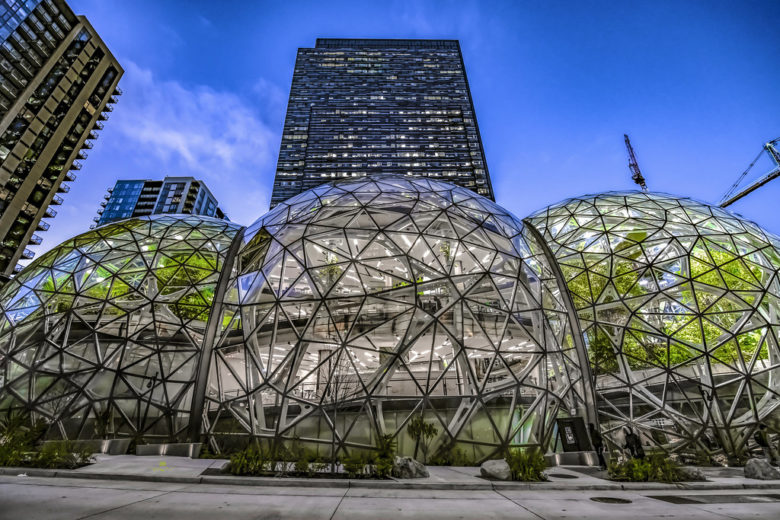
The most iconic feature of Amazon’s Seattle headquarters is “The Spheres.” While they appear to be futuristic greenhouses, they are actually high-tech workspaces designed to foster creative software engineering and hardware design. The logic behind The Spheres is rooted in environmental psychology: by housing over 40,000 plants from 30 countries, Amazon provides an ecosystem that reduces stress and stimulates the cognitive functions necessary for complex coding and algorithmic troubleshooting.
From a technological standpoint, The Spheres are a marvel of climate-control engineering. They utilize a sophisticated Building Management System (BMS) that regulates temperature, humidity, and airflow to mimic a high-altitude cloud forest during the day and a cooler, drier environment at night. This integration of nature and data-driven climate control reflects Amazon’s commitment to using technology to enhance human productivity.
Integrating AI and Robotics into Corporate Infrastructure
The Seattle campus serves as a testing ground for Amazon’s most advanced retail technologies. Beneath the office towers where software developers work on AWS (Amazon Web Services) architecture, the ground floors often feature “Amazon Go” stores. These locations utilize Just Walk Out technology, which relies on a sophisticated fusion of computer vision, deep learning algorithms, and sensor fusion.
By embedding these tech-heavy retail environments directly into their headquarters, Amazon creates a feedback loop. Engineers working on the 20th floor can walk downstairs to test the real-world application of the computer vision models they just updated. This proximity between the developer and the end-user application is what keeps Amazon’s AI development cycle significantly shorter than that of its competitors.
HQ2 and the Expansion of Cloud Sovereignty in Arlington
In 2018, Amazon announced a search for a second headquarters, a move that culminated in the selection of Arlington, Virginia. Known as HQ2, this campus at National Landing is strategically positioned to serve as the technological bridge between the private tech sector and the federal government’s burgeoning digital needs.
National Landing: A Strategic Hub for AWS and Cybersecurity
The selection of Arlington was no accident. Its proximity to Washington, D.C., makes it the ideal headquarters for Amazon Web Services’ public sector division. AWS is the backbone of the modern internet, providing the infrastructure for millions of apps and government agencies. By establishing a primary headquarters near the Pentagon and various federal data centers, Amazon has solidified its role as the premier provider of secure cloud computing.
The Arlington HQ is specifically designed to house thousands of cybersecurity experts and cloud architects. These teams are responsible for developing the next generation of encryption protocols and edge computing solutions. The architecture of HQ2 emphasizes “connectivity,” not just in terms of foot traffic, but in high-speed data transfer capabilities that allow for seamless synchronization with Amazon’s massive data center clusters located in Northern Virginia (often referred to as “Data Center Alley”).
Sustainable Engineering: Powering the Modern Tech Campus
Amazon has committed to the Climate Pledge, and the Arlington headquarters is the technological flagship of this promise. HQ2 is designed to run on 100% renewable energy. This is achieved through a combination of off-site solar farms and on-site electrification systems that eliminate the need for fossil fuels for heating and cooling.

The buildings utilize “smart glass” technology, which automatically tints based on the sun’s position to reduce energy consumption from air conditioning. Furthermore, the construction of “The Helix”—the centerpiece of the Arlington campus—incorporates advanced materials science to minimize the carbon footprint of the structure itself. This focus on green technology proves that for Amazon, the headquarters is a laboratory for sustainable urban development.
The Distributed Headquarters: Global Tech Hubs and the Future of Remote Synergy
While Seattle and Arlington are the two official headquarters, Amazon operates under a “decentralized” tech model. The company recognizes that the next breakthrough in AI or software development may not come from a single zip code. This has led to the rise of “Tech Hubs” that function as mini-headquarters, each specializing in a specific niche of the Amazon ecosystem.
Satellite Innovation Centers: From Berlin to Bangalore
Amazon’s global footprint includes significant technical headquarters in cities like Berlin, Bangalore, and Tel Aviv. The Berlin hub, for instance, is a center of excellence for machine learning and computer vision. Developers there focus on perfecting the localized versions of Alexa and optimizing the logistics software used across the European continent.
In Bangalore, the focus shifts to the foundational software that powers the Amazon marketplace and the mobile app ecosystem. These hubs are connected to the Seattle and Arlington headquarters through a proprietary, ultra-secure internal network that allows for real-time collaborative coding. This distributed model ensures that Amazon can tap into global talent pools without being restricted by the geographic limitations of a single headquarters.
Digital Security and the Decentralized Corporate Network
Managing a headquarters that is spread across continents requires a monumental investment in digital security. Amazon utilizes a Zero Trust Architecture for its internal corporate network. Whether an employee is logging in from the Seattle Spheres or a tech hub in Tokyo, their access is governed by dynamic identity verification and device health checks.
This technological layer effectively makes the “headquarters” a virtual concept as much as a physical one. The software tools used for project management, such as internal versions of AWS Chime and specialized DevOps pipelines, ensure that the “culture of innovation” remains consistent regardless of the physical office’s location.
The Impact of Amazon’s Technical Infrastructure on Urban Ecosystems
The presence of an Amazon headquarters fundamentally alters the technological landscape of its host city. When Amazon moves into a region, it brings with it a “tech halo” effect, attracting startups, venture capital, and specialized talent.
Smart City Integration and Data-Driven Urbanism
In both Seattle and Arlington, Amazon has collaborated with local governments to integrate its tech stack into urban planning. This includes the use of data analytics to optimize public transit routes for thousands of employees and the implementation of smart lighting and waste management systems within the campus vicinity.
Amazon’s headquarters act as a “living lab” for smart city technologies. By analyzing the movement patterns and resource consumption of its workforce, Amazon can provide valuable data to urban planners on how to create more efficient, tech-enabled city centers. This data-driven approach to urbanism is a key component of how Amazon views its physical footprint: not just as a place to work, but as an integrated node in a larger digital and physical network.
Future-Proofing Software Development through Hyper-Local Talent Pools
Finally, the location of Amazon’s headquarters is a strategic move to secure the future of its software development pipeline. By placing its main offices near major research universities (like the University of Washington in Seattle and Virginia Tech’s Innovation Campus in Alexandria), Amazon ensures a steady stream of talent in AI, robotics, and data science.
The company frequently hosts “hackathons” and technical workshops at its headquarters, inviting local students and developers to solve real-world problems using AWS tools. This creates a symbiotic relationship where the headquarters becomes an educational hub, fostering the next generation of tech leaders who will eventually maintain and expand Amazon’s digital empire.
In conclusion, “where is the headquarters of Amazon” is a question with a multi-layered answer. It is in the glass-domed forests of Seattle; it is in the high-security cloud hubs of Arlington; and it is in the decentralized network of global tech hubs. Each location is a specialized engine of innovation, designed to ensure that Amazon remains at the forefront of the technological frontier. Through smart architecture, sustainable engineering, and a relentless focus on software-driven growth, Amazon’s headquarters are the physical blueprints for the future of the digital world.
aViewFromTheCave is a participant in the Amazon Services LLC Associates Program, an affiliate advertising program designed to provide a means for sites to earn advertising fees by advertising and linking to Amazon.com. Amazon, the Amazon logo, AmazonSupply, and the AmazonSupply logo are trademarks of Amazon.com, Inc. or its affiliates. As an Amazon Associate we earn affiliate commissions from qualifying purchases.