
Amazon.com, Inc. has evolved far beyond its humble beginnings as an online bookstore operating out of a garage in Bellevue, Washington. Today, it is a global titan with a market capitalization that frequently flirts with the $2 trillion mark. For investors, financial analysts, and business enthusiasts, understanding what companies Amazon owns is not just a matter of curiosity—it is an essential exercise in understanding modern capital allocation and corporate strategy.
Amazon’s growth strategy has been characterized by aggressive diversification. By systematically acquiring companies across retail, media, healthcare, and technology, Amazon has built an ecosystem that captures a staggering percentage of consumer spending. This article explores the vast portfolio of Amazon, examining how these acquisitions serve the company’s “flywheel” effect and what they mean for the business’s financial future.

The Financial Strategy Behind Amazon’s M&A Philosophy
To understand Amazon’s acquisitions, one must first understand its financial philosophy. Unlike many traditional firms that prioritize immediate quarterly dividends, Amazon has historically prioritized long-term cash flow and market dominance. This approach, championed by founder Jeff Bezos and continued by CEO Andy Jassy, involves reinvesting profits into high-growth sectors.
Growth Through Ecosystem Diversification
Amazon’s acquisitions are rarely random. Every purchase is designed to strengthen the “Amazon Prime” ecosystem. Whether it is a grocery chain or a movie studio, the goal is to increase the value of the Prime subscription, thereby ensuring recurring revenue and high customer retention. From a business finance perspective, this reduces the cost of customer acquisition over time and increases the lifetime value (LTV) of each user.
Vertical and Horizontal Integration
Amazon utilizes both vertical and horizontal integration to protect its margins. By acquiring logistics companies and robotics firms (vertical), it reduces its reliance on third-party shippers like UPS or FedEx. By acquiring competitors or adjacent service providers in the retail space (horizontal), it expands its market share and data collection capabilities. This dual-threat strategy makes Amazon one of the most formidable financial entities in the world.
The Crown Jewels: Major Acquisitions That Defined an Era
Over the past two decades, Amazon has spent tens of billions of dollars to bring established brands under its umbrella. These “crown jewels” represent significant shifts in Amazon’s business model and have had a profound impact on its balance sheet.
Whole Foods Market: The Entry into Physical Retail
In 2017, Amazon sent shockwaves through the financial markets by acquiring Whole Foods Market for $13.7 billion. At the time, it was Amazon’s largest acquisition. From a financial standpoint, this move was about more than just selling organic kale. It provided Amazon with hundreds of high-end physical locations in wealthy demographic areas, effectively turning these stores into “last-mile” delivery hubs and data collection centers for grocery shopping habits.
Metro-Goldwyn-Mayer (MGM): The Intellectual Property Play
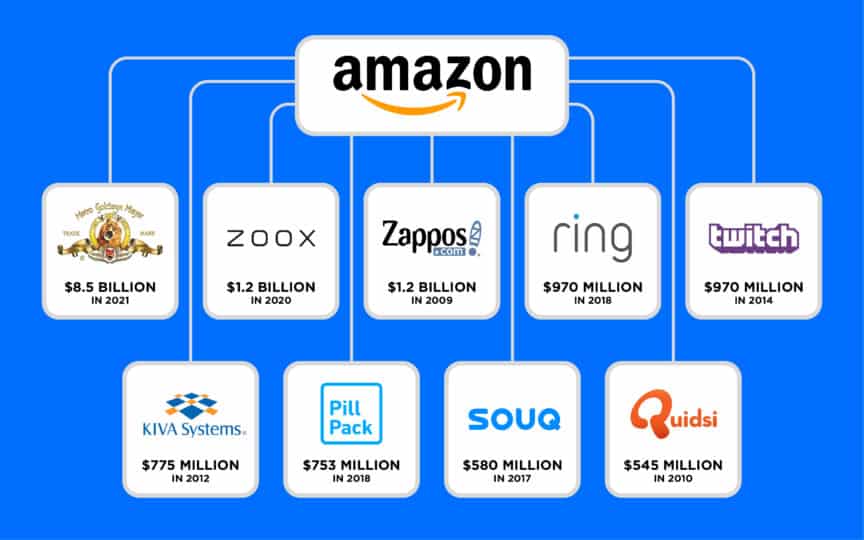
In 2022, Amazon completed its $8.5 billion acquisition of MGM Studios. This was a strategic move aimed at the “streaming wars.” By owning the rights to the James Bond franchise, Rocky, and thousands of other titles, Amazon secured a massive library of intellectual property. This reduces the long-term cost of licensing content from competitors and provides a significant draw for Prime Video, which remains a key pillar of the Prime subscription value proposition.
One Medical and PillPack: Disrupting Healthcare Finance
Amazon’s entry into healthcare represents one of its most ambitious financial frontiers. The acquisition of PillPack in 2018 for approximately $753 million laid the groundwork for Amazon Pharmacy. This was followed by the $3.9 billion acquisition of One Medical in 2023. These moves indicate a desire to capture a portion of the massive U.S. healthcare spend, moving the company into primary care and prescription delivery—sectors with high barriers to entry and massive potential for scale.
Expanding the Digital and Logistics Frontier
Beyond the headline-grabbing billion-dollar deals, Amazon has strategically acquired niche companies that have become integral to its operational efficiency and digital presence.
Zappos and Twitch: Dominating E-commerce and Media
In 2009, Amazon acquired the online shoe retailer Zappos for $1.2 billion. While Zappos continues to operate as a somewhat independent entity, its focus on customer service culture influenced Amazon’s own internal operations.
Similarly, the 2014 acquisition of Twitch for $970 million was a masterstroke in capturing the “attention economy.” Today, Twitch dominates the live-streaming market, particularly in gaming. For Amazon, Twitch is not just a platform; it is a massive advertising engine and a way to integrate Prime Gaming rewards, further locking younger demographics into the Amazon financial ecosystem.
Ring and Zoox: The Future of Smart Homes and Autonomous Transport
Amazon’s acquisition of Ring in 2018 for $1 billion allowed the company to move aggressively into the smart home security market. This serves a dual purpose: selling hardware and offering subscription-based cloud storage services for video footage.
On the logistics side, the 2020 acquisition of Zoox (estimated at $1.2 billion) signals Amazon’s interest in autonomous vehicles. While Zoox is focused on “robotaxis,” the underlying technology is invaluable for Amazon’s long-term goal of automating its delivery fleet, which would drastically reduce one of its largest operating expenses: human labor and fuel for shipping.
The Financial Impact for Investors and the Market
For those looking at Amazon through the lens of personal finance and investing, the company’s vast ownership of subsidiaries creates a unique risk-reward profile. Amazon is no longer just a “tech stock”; it is a diversified holding company that resembles a modern-day Berkshire Hathaway, but with a focus on technology and logistics rather than insurance and energy.
How Acquisitions Drive Shareholder Value
Amazon’s acquisitions contribute to shareholder value primarily through “synergy.” When Amazon buys a company like Kiva Systems (now Amazon Robotics), it isn’t just buying a robotics firm; it is buying a way to make its hundreds of fulfillment centers more profitable. By reducing the time it takes to pick and pack an order, Amazon increases its operating margin, which eventually flows down to the bottom line and boosts the stock price.
Risk Factors: Antitrust and Overextension
From a business finance perspective, Amazon’s aggressive expansion is not without risk. The company faces increasing scrutiny from the Federal Trade Commission (FTC) and European regulators regarding antitrust concerns. There is a “regulatory risk” that Amazon may be forced to divest certain companies or be blocked from future acquisitions (as seen with the attempted purchase of iRobot). Furthermore, integrating diverse businesses like healthcare and filmmaking requires massive capital expenditure (CapEx), which can weigh on short-term profitability if the expected synergies do not materialize.
Minority Stakes: The Rivian Investment
It is also worth noting that Amazon often exerts influence through minority stakes. Its significant investment in the electric vehicle manufacturer Rivian is a prime example. While Amazon does not “own” Rivian, it holds a large enough stake to influence the company’s production—specifically the creation of custom electric delivery vans. This is a strategic financial move that aligns with Amazon’s “Climate Pledge” while potentially offering a massive windfall if Rivian’s valuation grows.
Conclusion: The Integrated Future of the Amazon Empire
Amazon’s portfolio is a testament to the power of reinvesting capital into scalable, data-driven businesses. By owning companies across the spectrum of human necessity—food, health, entertainment, and logistics—Amazon has made itself nearly indispensable to the modern consumer.
For the investor, Amazon represents a play on the total economy. While the core e-commerce business remains the face of the company, the “hidden” companies in its portfolio—AWS (which was built internally), Whole Foods, MGM, and Zoox—are the engines that will drive its next decade of growth. As Amazon continues to identify and acquire undervalued assets or strategic technologies, its role as a global financial powerhouse only becomes more entrenched. Understanding what Amazon owns is the first step in understanding the future of global commerce and the strategic deployment of corporate wealth.
aViewFromTheCave is a participant in the Amazon Services LLC Associates Program, an affiliate advertising program designed to provide a means for sites to earn advertising fees by advertising and linking to Amazon.com. Amazon, the Amazon logo, AmazonSupply, and the AmazonSupply logo are trademarks of Amazon.com, Inc. or its affiliates. As an Amazon Associate we earn affiliate commissions from qualifying purchases.