
Apple Inc. (AAPL) has long been considered the gold standard of the equity markets—a “fortress” stock that investors flock to for stability, consistent growth, and massive capital returns. However, recent market cycles have seen the tech giant face uncharacteristic volatility. When the world’s most valuable company sees its share price stumble, it sends ripples through the S&P 500 and the Nasdaq-100. To understand why Apple stock is down, one must look beyond the hardware and dive into the complex financial ecosystem of interest rates, geopolitical revenue risks, and the shifting expectations of institutional investors.
Macroeconomic Pressures and the High-Interest Rate Environment
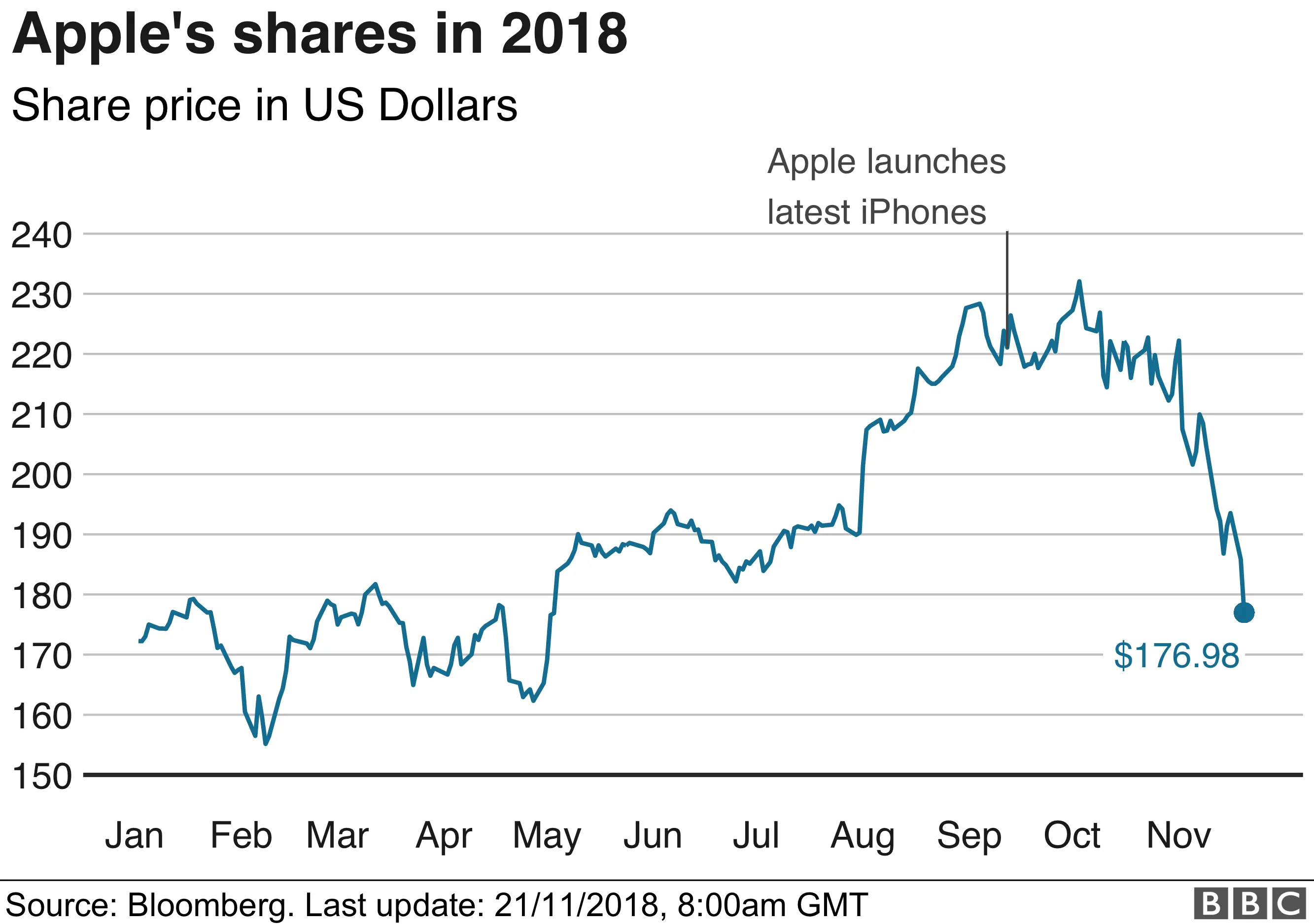
The most significant factor weighing on Apple’s stock price is not necessarily internal to the company, but rather the broader macroeconomic climate. For over a decade, Apple thrived in a low-interest-rate environment that fueled aggressive growth and allowed for cheap debt to fund massive share buyback programs. As the Federal Reserve shifted toward a “higher-for-longer” interest rate policy to combat inflation, the fundamental math of stock valuation changed.
The Impact of Discounted Cash Flow (DCF) Adjustments
From an analytical perspective, a stock’s value is the present value of its future cash flows. When interest rates rise, the “discount rate” used in these financial models also rises. For a company like Apple, which generates tens of billions in future cash, a higher discount rate significantly lowers the present value of those future earnings. Investors have recalibrated Apple’s Price-to-Earnings (P/E) multiple, leading to a “multiple compression” where the stock price drops even if earnings remain relatively stable.
The Shift from Growth to Value
Historically, Apple straddled the line between a high-growth tech stock and a steady value play. In a high-interest-rate environment, capital often rotates out of high-valuation tech companies and into “risk-free” assets like U.S. Treasuries, which now offer competitive yields. When an investor can get a 5% yield on a government bond, the 1% dividend yield of Apple becomes less attractive, leading to a sell-off in favor of safer or higher-yielding income streams.
Revenue Stagnation and the China Challenge
While Apple’s Services division continues to grow, the company still relies heavily on hardware sales—specifically the iPhone—for the bulk of its revenue. Recent quarterly reports have highlighted a concerning trend: stagnant or declining hardware sales in key geographic segments.
The Lengthening Smartphone Upgrade Cycle
The consumer electronics market has reached a point of high maturity. The leap in technology from one iPhone model to the next is no longer as transformative as it was a decade ago. Consequently, consumers are holding onto their devices for longer periods—often four to five years instead of two. This lengthening of the upgrade cycle acts as a persistent drag on Apple’s top-line revenue growth. For investors, “flat” growth is often viewed as a signal to sell, as the market prizes companies that can demonstrate consistent quarter-over-quarter expansion.
Geopolitical Headwinds and Domestic Competition in China
Greater China represents roughly 18% to 20% of Apple’s total revenue. In recent years, this critical market has become a source of anxiety for shareholders. The resurgence of domestic competitors like Huawei, coupled with reports of government restrictions on the use of foreign technology in official capacities, has dented Apple’s market share. Furthermore, Chinese consumer sentiment has shifted toward domestic brands amidst broader geopolitical tensions. A slowdown in China doesn’t just hurt sales; it threatens the “growth story” that justifies Apple’s premium valuation.
Regulatory Scrutiny and Legal Risks to the Services Moat
For years, the “Services” segment—encompassing the App Store, iCloud, and Apple Pay—has been the darling of Apple’s financial statements. It offers significantly higher margins than hardware and provides recurring revenue. However, this high-margin moat is currently under siege by regulators globally, creating a cloud of legal uncertainty that investors loathe.
The EU Digital Markets Act and App Store Commissions
The European Union’s Digital Markets Act (DMA) has forced Apple to open its ecosystem to third-party app stores and alternative payment methods. This directly threatens the 15% to 30% “Apple Tax” that the company collects on digital transactions. If other jurisdictions follow the EU’s lead, Apple could see a substantial erosion of its most profitable business unit. Analysts are currently attempting to price in this “regulatory haircut,” which has contributed to the downward pressure on the stock.
US Department of Justice Antitrust Litigation
In the United States, the Department of Justice (DOJ) has filed a landmark antitrust lawsuit against Apple, alleging that the company maintains an illegal monopoly in the smartphone market by “locking in” users and suppressing competition. While legal battles of this magnitude can take years to resolve, the potential outcomes—ranging from massive fines to a forced restructuring of the business model—represent a systemic risk. Investors typically sell first and ask questions later when faced with existential legal threats to a company’s core strategy.
The “AI Gap” and Shifting Market Sentiment
In the current fiscal year, the dominant narrative in the financial markets has been the Artificial Intelligence (AI) revolution. Companies like Nvidia and Microsoft have seen their valuations soar as they position themselves at the forefront of generative AI. Apple, conversely, was perceived as being late to the party.
Investor Impatience with “Apple Intelligence”
The market operates on expectations. While Apple eventually announced its “Apple Intelligence” suite, the delay in its rollout compared to competitors created a perception that Apple was lagging in the next great technological frontier. This “innovation lag” caused a rotation of capital, as institutional investors moved funds out of Apple and into semiconductor stocks or cloud service providers that were showing immediate, AI-driven revenue gains.
Comparative Valuation vs. Big Tech Peers
When institutional fund managers look at their portfolios, they compare Apple’s growth metrics against other “Magnificent Seven” companies. If Microsoft or Amazon is growing revenue at 15% while Apple is growing at 2%, the capital will naturally flow toward the higher-growth options. The recent dip in Apple’s stock reflects this rebalancing, as the market demands more proof that Apple can monetize AI as effectively as its peers.
Conclusion: Volatility in a Mature Giant
The decline in Apple’s stock price is rarely the result of a single catastrophic event, but rather a “perfect storm” of financial and fundamental factors. High interest rates have compressed its valuation, geopolitical tensions have hampered its largest growth market, and regulatory bodies are chipping away at its most profitable margins.
However, it is essential to note that Apple remains a cash-generating machine with over $160 billion in cash and equivalents on its balance sheet. For the long-term investor, the current downward trend represents a period of “valuation normalization.” The market is currently grappling with how to price a company that is transitioning from a high-growth hardware innovator into a mature, services-oriented utility. Until Apple can prove it can reignite iPhone demand through AI or successfully navigate the regulatory minefield without sacrificing its margins, the stock is likely to face continued scrutiny from the financial community.
aViewFromTheCave is a participant in the Amazon Services LLC Associates Program, an affiliate advertising program designed to provide a means for sites to earn advertising fees by advertising and linking to Amazon.com. Amazon, the Amazon logo, AmazonSupply, and the AmazonSupply logo are trademarks of Amazon.com, Inc. or its affiliates. As an Amazon Associate we earn affiliate commissions from qualifying purchases.