
American Express, commonly known as Amex, is one of the most recognizable names in the global financial landscape. To the average consumer, Amex represents a premium credit card provider, a symbol of travel perks, and a gateway to high-end concierge services. However, from a financial and investment perspective, the question of “who owns Amex” reveals a complex web of institutional power, legendary investment strategies, and the mechanics of a publicly traded powerhouse.
Unlike a private family business or a company owned by a single tech mogul, American Express is a public entity. Its ownership is distributed among thousands of shareholders, ranging from individual retail investors to some of the largest asset management firms in the world. Understanding this ownership structure is essential for anyone interested in personal finance, institutional investing, or the stability of the American banking sector.

The Institutional Titans: Who Really Controls the Shares?
As a publicly traded company listed on the New York Stock Exchange (NYSE) under the ticker symbol AXP, American Express does not have a single “owner.” Instead, it is governed by a Board of Directors and owned by its shareholders. When we look at the data, the vast majority of Amex shares—approximately 85% to 90%—are held by institutional investors.
The Berkshire Hathaway Dominance
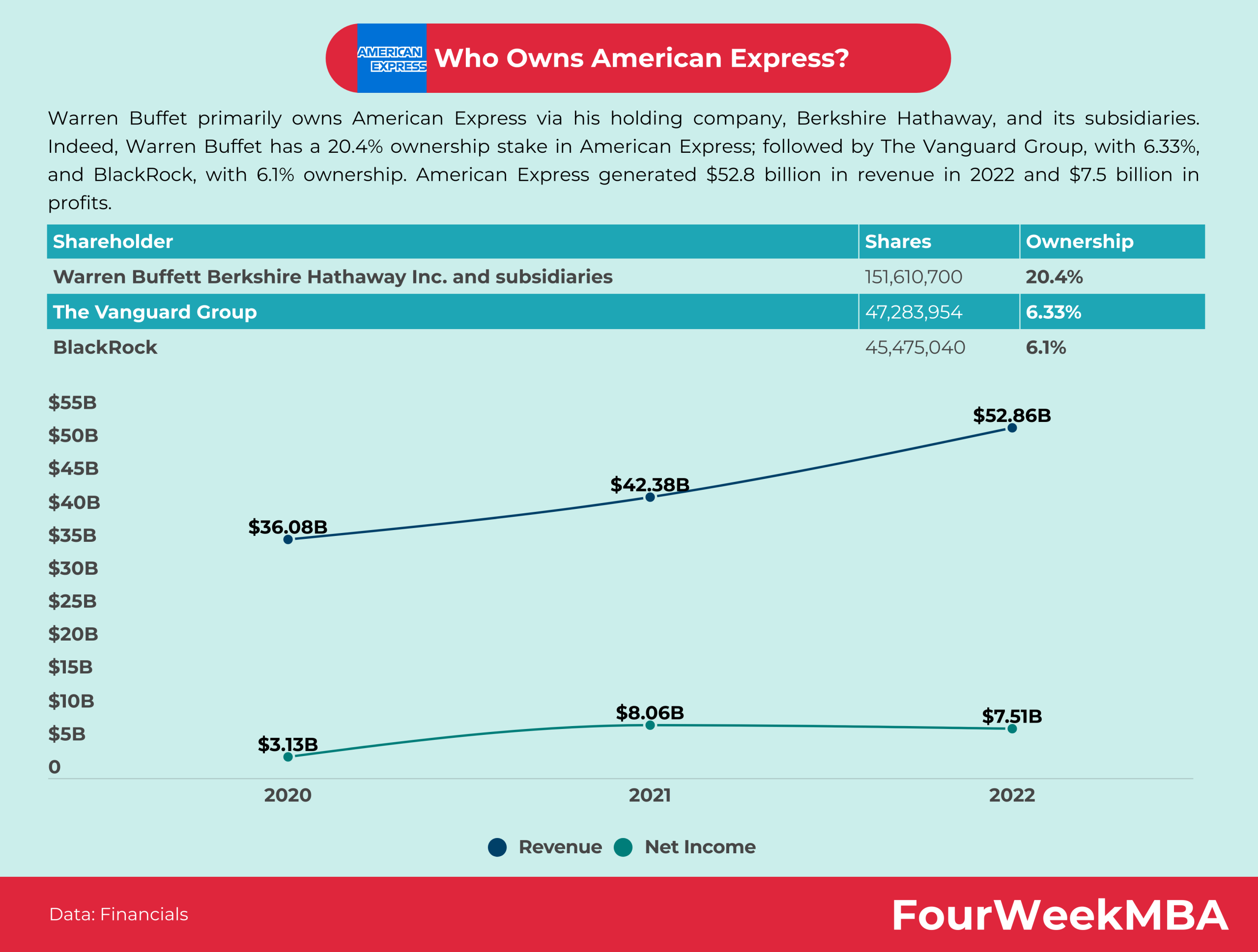
You cannot discuss the ownership of American Express without mentioning Warren Buffett. Through his conglomerate, Berkshire Hathaway, Buffett has been a staunch supporter and the largest shareholder of Amex for decades. Currently, Berkshire Hathaway owns roughly 21% of the company.
Buffett’s ownership is significant not just because of the volume of shares, but because of what it represents in the world of value investing. He famously refers to Amex’s “moat”—the brand loyalty and closed-loop network that makes it difficult for competitors to replicate. For Berkshire, Amex is a “forever” stock that provides massive dividends and long-term capital appreciation, anchoring the company’s financial services portfolio.
The Role of Asset Management Giants: Vanguard and BlackRock
Following Berkshire Hathaway, the list of owners is dominated by the “Big Three” of the indexing world: The Vanguard Group and BlackRock. These firms own approximately 6% and 5% of the company, respectively.
It is important to note that Vanguard and BlackRock do not “own” Amex in the traditional sense of making daily operational decisions. Instead, they hold these shares on behalf of millions of individual investors who own target-date funds, S&P 500 index funds, and ETFs. Because Amex is a core component of the Dow Jones Industrial Average and the S&P 500, any investor with a standard retirement account likely owns a small piece of American Express.
State Street and Other Institutional Players
State Street Corporation also holds a significant stake, typically around 3% to 4%. Other major players include Geode Capital Management and various pension funds. These institutional owners provide the liquidity and stability that Amex needs to maintain its market capitalization, which often exceeds $150 billion. The high level of institutional ownership suggests that the “smart money” views Amex as a reliable, long-term cornerstone of the financial sector.
The Corporate Structure: Public Listing and Governance
American Express is incorporated in New York and operates as a bank holding company. This status means it is subject to rigorous federal oversight, which influences how ownership and capital are managed.
Publicly Traded Status (NYSE: AXP)
Since its initial public offering, Amex has been a staple of the American stock market. Its inclusion in the Dow Jones Industrial Average—a price-weighted index of 30 prominent companies—places it in an elite category of “Blue Chip” stocks. Being a public company means that any individual with a brokerage account can become a part-owner of Amex. This democratization of ownership is a hallmark of the modern financial system, allowing retail investors to benefit from the company’s growth alongside billionaires like Buffett.
Executive Leadership and Insider Ownership
While the institutions own the bulk of the equity, the direction of the company is set by its executive leadership. The current Chairman and CEO, Stephen Squeri, and other high-ranking officers hold a portion of the company’s stock.
Insider ownership at Amex is relatively low compared to tech startups where founders might retain 10-20% of the shares. At Amex, insider ownership is usually well below 1%. This is typical for century-old financial institutions. However, the compensation packages for these executives are often tied to stock performance, ensuring that their interests are aligned with the shareholders who own the company.
The Influence of the Board of Directors
The Board of Directors acts as the representative for the shareholders. They are responsible for overseeing the CEO and making high-level decisions regarding dividends, mergers, and acquisitions. The board members themselves often hold shares, adding another layer to the ownership narrative. Their primary fiduciary duty is to ensure that the “owners”—whether it’s Berkshire Hathaway or a teacher with a 401(k)—see a return on their investment.
Why Ownership Structure Matters to the Individual Investor
For someone focused on personal finance or stock market investing, knowing who owns Amex is more than just trivia; it is a vital indicator of the company’s financial health and risk profile.
Dividend Stability and Capital Returns
When a company is 20% owned by Warren Buffett, it is under constant pressure to maintain a healthy dividend policy and share buyback program. Buffett values “capital returned to shareholders.” For the retail investor, this means Amex is often seen as a “total return” stock—one that provides both a steady quarterly check and the potential for the stock price to rise. The ownership concentration among long-term institutional holders creates a floor for the stock, as these giants are unlikely to engage in panic selling.
The “Closed-Loop” Economic Advantage
Amex’s ownership of its own payment network is a unique financial trait. Unlike Visa or Mastercard, which are primarily technology rails for banks, Amex is both the card issuer and the network. This “closed-loop” system means they keep a larger slice of every transaction. From a “Money” perspective, this makes the ownership of AXP shares more lucrative because the company captures more value per customer than its competitors. Investors own a piece of a bank, a network, and a service provider all in one.
Resilience During Economic Downturns
The ownership profile of Amex also speaks to its resilience. Because the majority of its owners are large institutions with long-term horizons, the stock tends to be less volatile than speculative tech stocks. Furthermore, Amex’s focus on high-net-worth individuals—who are less likely to default on debt during a recession—makes it a preferred “defensive” play within the financial sector. Owners of Amex are essentially betting on the continued spending power of the global affluent class.
The Evolution of Ownership: From Freight to Finance
To understand who owns Amex today, one must look at how the company’s value proposition has shifted over its 170-year history. Ownership has evolved alongside its business model.
The Early Days of Express Mail
Founded in 1850, American Express started as a freight forwarding company (a competitor to the U.S. Postal Service). At that time, ownership was concentrated among a few wealthy businessmen, including Henry Wells and William G. Fargo. It was a private venture focused on the physical movement of goods and money.
The Pivot to Financial Services
The introduction of the Travelers Cheque in 1891 and the first Amex credit card in 1958 shifted the company’s valuation from “logistics” to “finance.” As it moved into the financial sector, it required more capital, leading to its current structure as a widely-held public company. The shift in ownership from private partners to the public market allowed Amex to scale globally and become the financial behemoth it is today.

Conclusion: A Multi-Layered Ownership Model
So, who owns Amex? In short: the public, the giants, and the Oracle of Omaha.
While Warren Buffett’s Berkshire Hathaway remains the most influential single owner, the true “owners” of American Express are millions of global citizens. Whether you own the stock directly in your portfolio, indirectly through a mutual fund, or simply contribute to a pension fund that holds AXP, you are a part of the Amex ecosystem.
This diversified ownership structure ensures that American Express remains a stable, transparent, and highly regulated entity. For the investor, this means a lower risk profile compared to concentrated private ownership. For the consumer, it ensures that the company must remain profitable and innovative to satisfy the demands of its institutional heavyweights. In the world of money, Amex stands as a prime example of how institutional backing and public trust can turn a 19th-century delivery service into a 21st-century pillar of global finance.
aViewFromTheCave is a participant in the Amazon Services LLC Associates Program, an affiliate advertising program designed to provide a means for sites to earn advertising fees by advertising and linking to Amazon.com. Amazon, the Amazon logo, AmazonSupply, and the AmazonSupply logo are trademarks of Amazon.com, Inc. or its affiliates. As an Amazon Associate we earn affiliate commissions from qualifying purchases.