
Setting financial goals is the bridge between your current economic reality and your future aspirations. Without a structured plan, money remains a source of stress rather than a tool for empowerment. In the world of personal finance, goal setting is not a one-time event but a dynamic process that requires precision, psychological discipline, and a deep understanding of market mechanics.
The objective of this guide is to move beyond vague desires—such as “wanting to be rich”—and into the realm of actionable financial engineering. By categorizing your objectives and aligning them with your cash flow, you can build a roadmap that survives economic volatility and personal life changes.

1. The Framework of Effective Goal Setting
To set a financial goal that actually yields results, you must move beyond the conceptual. Professional financial planners often utilize the SMART framework, but within the “Money” niche, we must apply this specifically to capital allocation and risk management.
Defining Your Time Horizons
Financial goals are generally divided into three distinct categories based on their proximity.
- Short-term goals (0–2 years): These include building an emergency fund, saving for a wedding, or planning a major purchase. These funds should typically remain in liquid, low-risk accounts like High-Yield Savings Accounts (HYSA).
- Medium-term goals (2–10 years): These might include a down payment for a home or funding a graduate degree. Here, a balance of liquidity and moderate growth is essential.
- Long-term goals (10+ years): This is almost exclusively the domain of retirement planning and wealth transfer. These goals allow for higher risk tolerance and the utilization of compound interest through equity markets.
The Psychology of Specificity
Vague goals like “saving more money” often fail because they lack a “stop” or “start” point. A financial goal must be measurable. Instead of “saving for a house,” a robust goal is “saving $60,000 for a 20% down payment on a $300,000 home by December 2027.” This level of specificity allows you to reverse-engineer the monthly savings requirement, making the goal a line item in your budget rather than a wish.
Alignment with Personal Values
Financial goals do not exist in a vacuum. They must reflect your personal values. If you value security, your goals might lean heavily toward debt elimination and a larger-than-average emergency fund. If you value freedom and mobility, your goals might focus on building passive income streams through dividend investing or real estate. Alignment ensures you remain motivated during the “boring middle” of the wealth-building process.
2. Conducting a Financial Audit: Establishing Your Baseline
You cannot chart a course to a destination if you do not know your current coordinates. Before setting new goals, you must perform a comprehensive audit of your current financial standing. This involves an objective look at your net worth and your cash flow.
Calculating Your Net Worth
Your net worth is the ultimate scorecard in personal finance. It is calculated by subtracting your total liabilities (what you owe) from your total assets (what you own).
- Assets: Cash, bank accounts, retirement accounts (401k, IRA), brokerage accounts, real estate equity, and personal property of significant value.
- Liabilities: Student loans, credit card debt, mortgages, auto loans, and any other outstanding balances.
Tracking your net worth quarterly provides a macro-view of your progress that monthly budgeting sometimes obscures.
Analyzing Cash Flow and Burn Rate
Setting a goal to save $2,000 a month is impossible if your net income is $4,000 and your expenses are $3,800. A financial audit requires a “deep dive” into at least three months of bank statements to identify your burn rate. This helps you identify “leaks”—unnecessary subscriptions, excessive dining out, or “lifestyle creep”—that can be redirected toward your financial goals.
Identifying Your Risk Profile
Every financial goal carries a different risk requirement. An audit of your current portfolio and your psychological reaction to market dips will determine how you set your goals. If the thought of a 10% market correction keeps you up at night, your goals for wealth accumulation must be balanced with more conservative asset allocations, even if it means a longer timeline to reach your target.
3. Prioritizing Financial Objectives for Maximum Impact
One of the most common mistakes in personal finance is trying to hit too many targets at once. This dilutes your capital and slows your progress. Success requires a hierarchy of needs.
The Foundation: The Emergency Fund
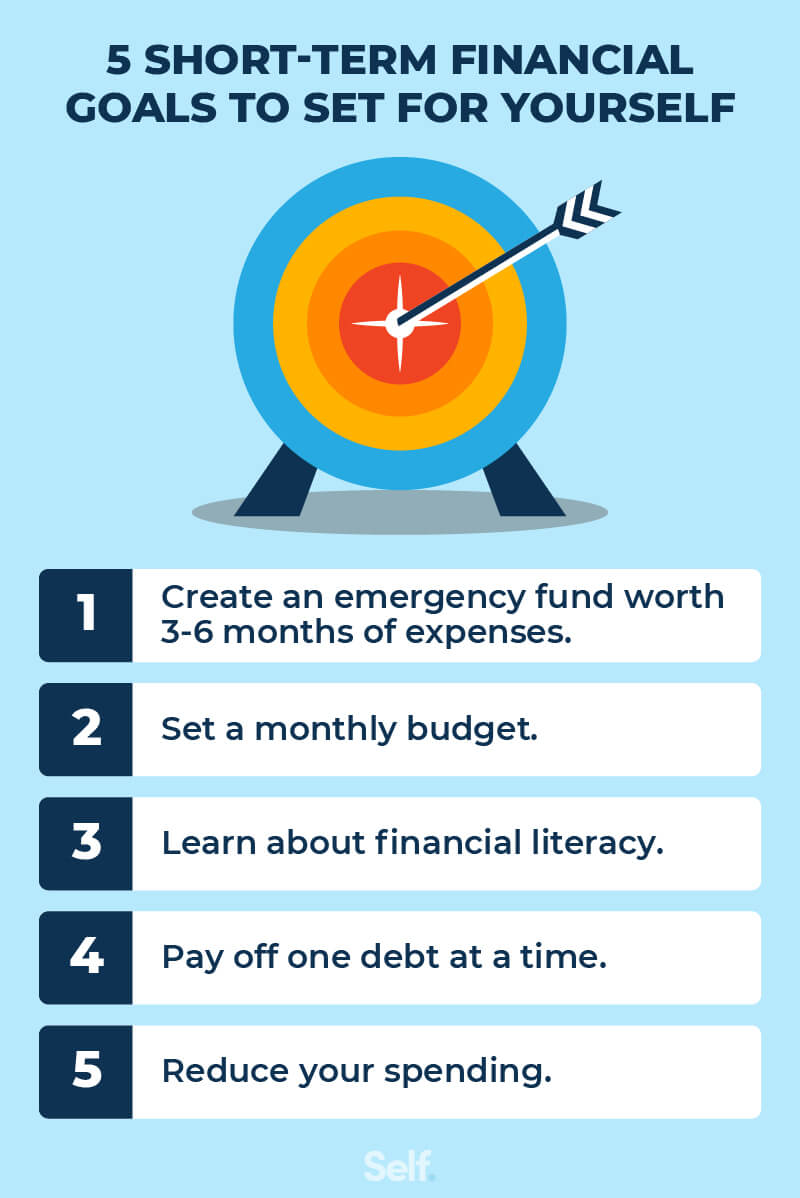
Before investing a single dollar in the stock market or saving for a luxury item, you must establish an emergency fund. The standard recommendation is three to six months of essential living expenses. This acts as “financial insurance,” ensuring that a job loss or medical emergency doesn’t force you to liquidate long-term investments or take on high-interest debt.
Tackling High-Interest Debt
In the hierarchy of money, high-interest debt (typically credit cards with 15-25% APR) is a financial emergency. No investment will consistently return 20% annually; therefore, paying down high-interest debt is the equivalent of a guaranteed 20% return on your money. Whether you use the “Debt Snowball” (paying smallest balances first for psychological wins) or the “Debt Avalanche” (paying highest interest first for mathematical efficiency), this must be a primary goal.
Harnessing the Power of Compounding
Once the foundation is secure, the focus shifts to wealth accumulation. This involves maximizing tax-advantaged accounts. If your employer offers a 401(k) match, your first investment goal should be to contribute enough to capture the full match—this is effectively a 100% return on your investment. Following this, goals should focus on Roth IRAs or Health Savings Accounts (HSAs), which offer significant tax benefits that accelerate the compounding process over decades.
4. Systems and Implementation Strategies
Setting a goal is the “what,” but the system is the “how.” High-achievers in the financial world rely on systems that remove human error and emotional decision-making from the equation.
The 50/30/20 Budgeting Rule
A popular and effective system for goal implementation is the 50/30/20 rule. This allocates 50% of your income to “Needs” (housing, groceries, utilities), 30% to “Wants” (entertainment, hobbies), and 20% strictly to “Financial Goals” (debt repayment and savings). If your goals are aggressive—such as early retirement—you may need to invert these numbers, but the structure provides a clear boundary for spending.
Automation: The “Set It and Forget It” Philosophy
The greatest enemy of financial goals is “friction.” If you have to manually move money into a savings account every month, you are less likely to do it. Automation is the solution. Set up automatic transfers from your payroll or checking account to your high-yield savings and brokerage accounts the day after you get paid. When the money is moved before you have a chance to spend it, you are “paying yourself first.”
Sinking Funds for Irregular Expenses
To prevent your monthly budget from being derailed by predictable but irregular expenses (like car registration, annual insurance premiums, or holiday shopping), use sinking funds. This involves taking the annual cost of an expense, dividing it by 12, and saving that amount monthly in a dedicated sub-account. This ensures that when the “surprise” bill arrives, the money is already there, leaving your primary financial goals untouched.
5. Monitoring, Reviewing, and Adjusting for Life Stages
Financial goal setting is not a “set it and forget it” endeavor in the long term. Life is non-linear, and your financial plan must be agile enough to adapt to changing circumstances.
The Quarterly Review Process
Schedule a “Money Date” with yourself or your partner every three months. During this time, review your progress toward your H1 and H2 goals. Are you ahead of schedule? If so, should you increase your targets or redirect the surplus to a different goal? If you are behind, identify the friction points. Was it an unexpected expense, or has your lifestyle expanded beyond your means?
Navigating Life Transitions
Major life events—marriage, the birth of a child, a career change, or receiving an inheritance—require a total recalibration of your financial goals. For instance, the birth of a child might shift your priority from aggressive debt repayment to establishing a 529 College Savings Plan. Similarly, a significant salary increase should not automatically lead to a bigger house; instead, it should be used to shorten the timeline of your existing long-term goals.

The Role of Inflation and Market Conditions
Your goals must account for the eroding power of inflation. A retirement goal of $1 million set twenty years ago does not have the same purchasing power today. It is essential to adjust your “final number” based on an average inflation rate of 2-3%. Furthermore, while you cannot control the market, you can control your reaction to it. During market downturns, your goal shouldn’t necessarily change, but your strategy might shift to “tax-loss harvesting” or increasing contributions to buy assets at a discount.
In conclusion, setting financial goals is an exercise in intentionality. It requires an honest assessment of your current state, a disciplined prioritization of your needs, and the implementation of robust systems. By treating your personal finances with the same level of professional rigor as a business enterprise, you transform money from a source of anxiety into a powerful engine for a life of choice and security.
aViewFromTheCave is a participant in the Amazon Services LLC Associates Program, an affiliate advertising program designed to provide a means for sites to earn advertising fees by advertising and linking to Amazon.com. Amazon, the Amazon logo, AmazonSupply, and the AmazonSupply logo are trademarks of Amazon.com, Inc. or its affiliates. As an Amazon Associate we earn affiliate commissions from qualifying purchases.