
Navigating tax season is a perennial challenge for most Americans, representing one of the most significant financial tasks of the fiscal year. As one of the largest tax preparation firms in the world, H&R Block is often the first name that comes to mind when taxpayers seek professional assistance or robust software. However, because tax situations vary wildly—from the simple W-2 employee to the complex crypto-investor or small business owner—the question of “how much does H&R Block charge?” does not have a single, static answer.

In the realm of personal finance, understanding the cost-to-benefit ratio of tax preparation is essential. Whether you choose their digital DIY tools or a face-to-face consultation with a tax professional, the fees are structured around the complexity of your financial life. This guide breaks down the current pricing models, hidden costs, and the financial logic behind choosing the right H&R Block service for your needs.
The Evolution of Tax Preparation Costs: DIY Software vs. Professional Assistance
Before diving into specific dollar amounts, it is important to understand the two primary “money paths” H&R Block offers. The company has successfully bridged the gap between traditional retail accounting and modern fintech software, creating a tiered pricing structure that targets different financial demographics.
The Budget-Conscious Digital Path
For those who are financially savvy and have relatively straightforward income streams, H&R Block’s online software is the most cost-effective route. This path follows a “Software as a Service” (SaaS) model where you pay a flat fee based on the forms required. The primary financial advantage here is predictability; you generally know the cost upfront before you begin inputting data.
The Full-Service Professional Path
Conversely, the in-person or “Virtual Pro” services are priced based on the expertise required and the volume of forms generated. In the financial world, this is a “fee-for-service” model. While more expensive, the value proposition lies in risk mitigation and the potential for identifying deductions that an automated system might overlook. For high-net-worth individuals or business owners, the higher upfront cost is often viewed as an investment in financial security.
Breaking Down H&R Block’s DIY Online Tax Filing Tiers
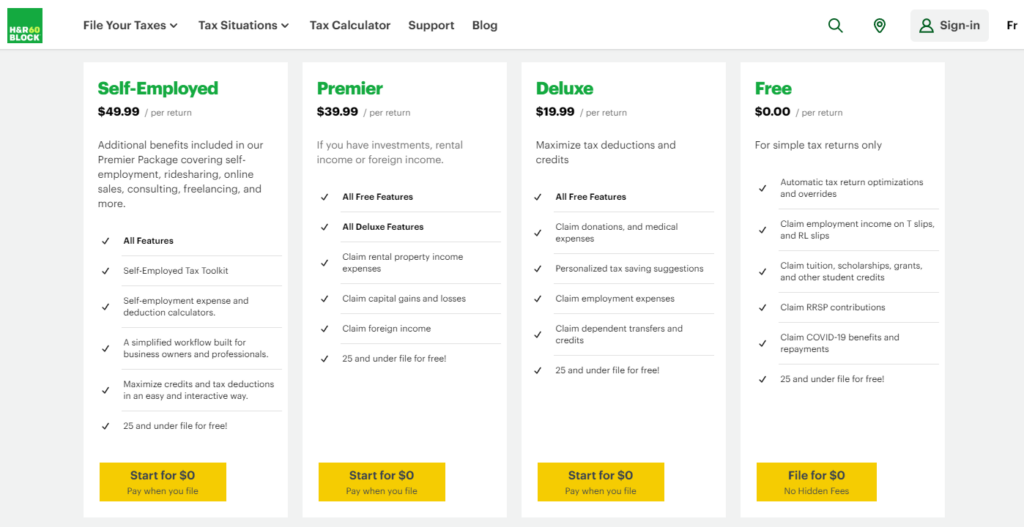
H&R Block’s digital platform is divided into four main categories. It is vital to select the tier that matches your financial complexity to avoid paying for features you don’t need or being forced into an upgrade mid-process.
1. Free Online
The “Free” version is designed for very simple financial profiles—primarily those with W-2 income, interest income (1099-INT), and those claiming the standard deduction.
- Cost: $0 for Federal (State filing may also be $0 for simple returns, though this is subject to seasonal promotions).
- Best For: Students, entry-level employees, and renters with no significant investments.
2. Deluxe
The Deluxe tier is the most popular for middle-class taxpayers. It is designed to handle more complex “Money” moves, such as homeownership and health savings accounts (HSAs).
- Cost: Usually starts around $35–$55 (plus state fees).
- Best For: Homeowners who want to itemize deductions, those with significant charitable donations, and individuals with childcare expenses.
3. Premium
As your investment portfolio grows, so does the cost of preparation. The Premium tier is built for the “Investor” persona.
- Cost: Usually starts around $65–$85 (plus state fees).
- Best For: Individuals selling stocks, bonds, or cryptocurrency, and those with rental property income (Schedule E). This tier provides the specialized calculators needed to determine capital gains and losses accurately.
4. Self-Employed
With the rise of the “Side Hustle” economy, this tier has become increasingly relevant. It handles business expenses, depreciation of assets, and complex 1099-NEC or 1099-K forms.
- Cost: Usually starts around $85–$115 (plus state fees).
- Best For: Freelancers, Uber/Lyft drivers, small business owners, and independent contractors looking to maximize their business tax write-offs.
The Cost of In-Person Professional Tax Preparation

When you walk into an H&R Block retail office, the pricing moves away from flat software fees and into a more complex calculation based on your specific financial documents. H&R Block generally uses a “starting at” price point for professional services, which typically begins around $85 to $100, but the final bill often lands much higher.
Variable Pricing Factors
The final price of a professional filing is dictated by the number of forms (Schedules) required. For instance, filing a Schedule C for a business or a Schedule D for investment gains will add incremental costs to the base fee. In the personal finance community, this is often called “menu pricing.” You are essentially paying for the professional’s time and the liability the firm assumes by signing off on your return.
The “Tax Pro Review” Hybrid Option
For those who want the lower cost of the software but the peace of mind of a professional, H&R Block offers a “Tax Pro Review” add-on. For an additional fee (usually starting around $50–$90), a CPA or Enrolled Agent will review your self-prepared digital return before it is filed. This is an excellent middle-ground financial strategy for those who are confident in their data entry but want a professional “safety net” to ensure no money is left on the table.
Hidden Fees and Add-on Services: What to Watch For
In personal finance, the “sticker price” is rarely the final price. To accurately budget for H&R Block’s services, you must account for several common add-ons that can significantly inflate your total expenditure.
State Filing Fees
While H&R Block often advertises its federal filing price, state returns almost always carry an additional charge. For most digital tiers, filing a state return costs approximately $37 to $45 per state. If you lived or worked in multiple states during the year, these costs can accumulate quickly, potentially doubling your total bill.
Refund Transfer and “Pay-from-Refund” Fees
H&R Block offers the convenience of deducting your preparation fees directly from your tax refund. While this sounds like a great way to manage cash flow, it is a financial trap for the unwary. This service—often called a “Refund Transfer”—usually carries a fee of $39 or more. From a wealth-building perspective, it is almost always better to pay the fee upfront with a credit or debit card rather than losing a percentage of your refund to an administrative convenience fee.
Audit Support and Peace of Mind Extended Service
H&R Block offers a “Peace of Mind” (POM) guarantee for an additional fee (around $35–$40). This service promises that if the IRS audits you, an H&R Block representative will accompany you and help defend your return. For individuals with complex business deductions or high-risk financial profiles, this “insurance” can be a sound financial move. However, for a standard W-2 filer, it is often an unnecessary expense.
Maximizing Your Financial Return: Is H&R Block Worth the Investment?
The ultimate question in personal finance is not just “how much does it cost?” but “what is the value?” Deciding whether H&R Block’s fees are justified depends on the complexity of your financial life and your personal “value of time.”
The Cost of Error vs. the Cost of Prep
If you have a complex financial portfolio involving K-1s from partnerships, foreign accounts, or complicated business structures, the $300–$500 you might spend at H&R Block is a small price to pay compared to the potential penalties and interest from an IRS error. In this context, the fee is a form of financial risk management.
Comparing the “Big Three” in Tax Prep
When looking at the market, H&R Block generally sits in the middle. It is typically more expensive than “FreeTreeTax” or “Cash App Taxes,” which offer free filing for a wider range of forms but lack the robust support network. On the other hand, H&R Block is often slightly more affordable than TurboTax, particularly in the higher-tier software versions and professional review options.
Strategic Timing
H&R Block often employs “dynamic pricing.” The fees you see in January are frequently lower than those in the week leading up to April 15th. For the financially disciplined, filing early is not just about getting a refund faster; it’s about locking in the lowest possible service rates before the “procrastination tax” (seasonal price hikes) kicks in.
In conclusion, while H&R Block can cost anywhere from $0 to $500+, the average taxpayer with a home and some investments can expect to spend between $80 and $150 for a digital filing with a state return. By understanding these tiers and avoiding unnecessary add-ons like refund transfers, you can ensure that your tax preparation is a calculated financial decision rather than a costly surprise. In the world of money management, knowledge of the fee structure is the first step toward keeping more of what you earn.
aViewFromTheCave is a participant in the Amazon Services LLC Associates Program, an affiliate advertising program designed to provide a means for sites to earn advertising fees by advertising and linking to Amazon.com. Amazon, the Amazon logo, AmazonSupply, and the AmazonSupply logo are trademarks of Amazon.com, Inc. or its affiliates. As an Amazon Associate we earn affiliate commissions from qualifying purchases.