
When we talk about “owning” a piece of the digital world, Google is often the first name that comes to mind. However, from a financial and corporate governance perspective, the answer to “who owns Google” is more complex than a single name. Since 2015, Google has operated as a subsidiary of its parent company, Alphabet Inc. For the modern investor, understanding the ownership structure of Alphabet is not just a matter of curiosity; it is a fundamental requirement for evaluating the company’s stability, voting power, and long-term financial trajectory.
Alphabet Inc. is one of the most valuable companies in the world, often fluctuating within the trillion-dollar market capitalization bracket. Its ownership is a blend of visionary founders, massive institutional asset managers, and millions of individual retail investors. To understand who truly controls this titan of industry, we must look beyond the search bar and into the ledger of shares, voting rights, and corporate equity.
Understanding Alphabet Inc.: The Corporate Umbrella and the Investing Landscape
To understand who owns Google, one must first recognize that Google, as an entity, is a wholly-owned subsidiary of Alphabet Inc. This restructuring, which took place in 2015, was designed to provide more transparency to investors regarding where money was being spent—separating the highly profitable “Google” core (Search, YouTube, Android) from the speculative “Other Bets” (Waymo, Verily, and X).
The 2015 Restructuring and Its Financial Implications
The transition to Alphabet was a strategic move to clean up the balance sheet. For investors, this meant they could see exactly how much the core advertising business was subsidizing the company’s more experimental ventures. When you buy a share of Alphabet today, you are investing in a massive conglomerate. The ownership of this conglomerate is divided among different classes of stock, which is the most critical factor in determining who “owns” the influence versus who “owns” the equity.
From Search Engine to Global Financial Powerhouse
Alphabet’s revenue streams are diverse, but they are anchored by Google Services. For a “Money” niche perspective, owning Google means owning a stake in the world’s most dominant advertising platform. The ownership structure reflects this dominance, with a concentrated group of insiders holding the keys to the kingdom while the public provides the vast majority of the capital.
The Power Dynamics of Share Classes: A, B, and C
One of the most unique aspects of Alphabet’s ownership is its tri-class share structure. For the average person looking at a brokerage app, seeing two different tickers—GOOGL and GOOG—can be confusing. This structure was intentionally designed to ensure that the founders could maintain control even as the company grew and required more external capital.
Class A Shares (GOOGL): The Standard Investor’s Choice
Class A shares are the most common way for individual and institutional investors to own a piece of the company. These shares carry one vote per share. If you are a retail investor holding Alphabet in your portfolio, you likely own Class A shares. While they provide a voice in shareholder meetings, the sheer volume of these shares held by the public means that any single individual’s vote is a drop in the ocean.
Class B Shares: The Secret to Insider Control
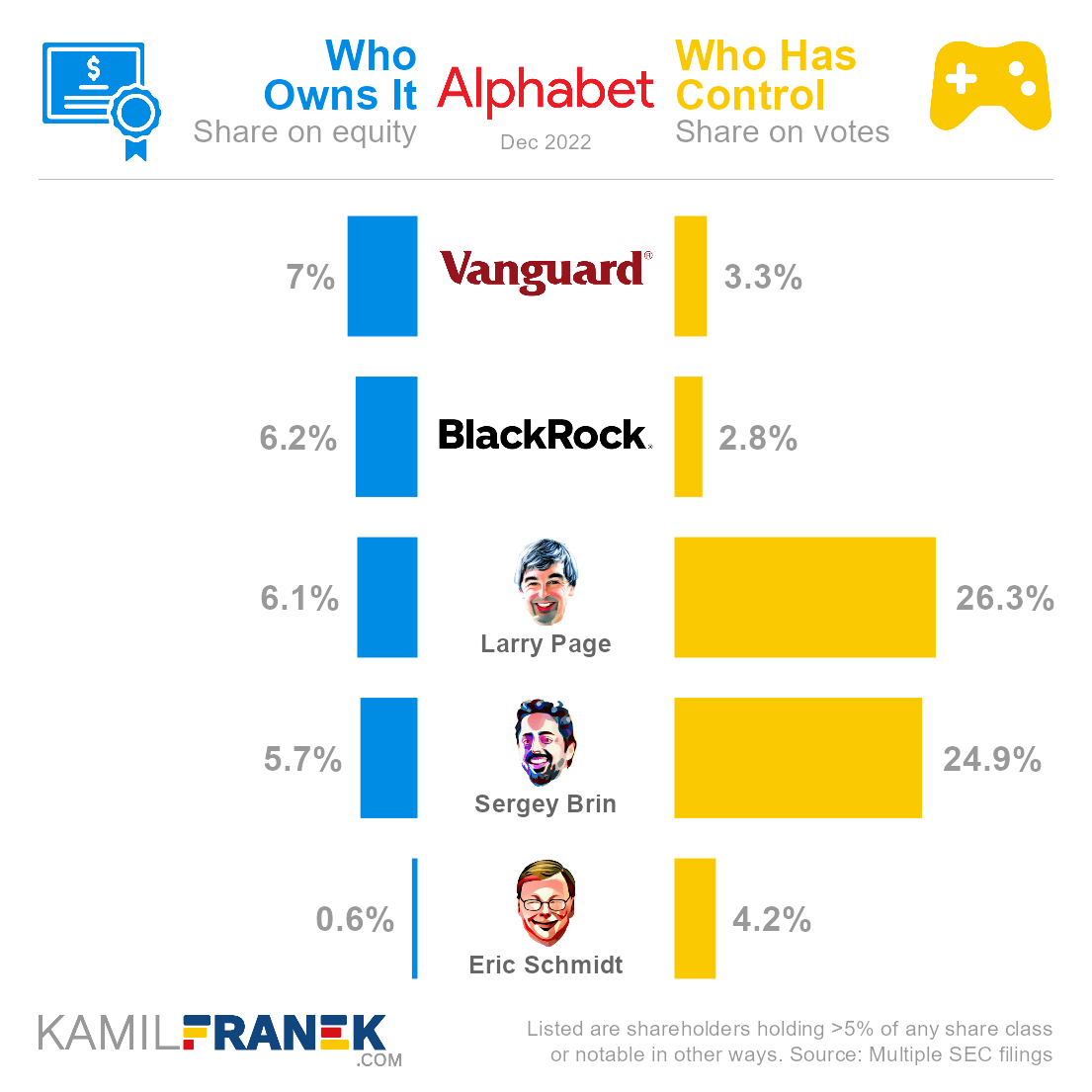
This is where the “actual” ownership of Google’s direction lies. Class B shares are not traded on public exchanges. They are held exclusively by insiders, primarily the founders, Larry Page and Sergey Brin. The defining characteristic of Class B shares is that they carry ten votes per share. This super-voting power ensures that even if the founders own a minority of the total equity, they retain a majority of the voting power. In the world of business finance, this is known as a “controlled company” structure, shielding the leadership from hostile takeovers or activist investors who might prioritize short-term profits over long-term innovation.
Class C Shares (GOOG): Equity Without the Voice
Alphabet also offers Class C shares, which trade under the ticker GOOG. These shares have zero voting rights. They were originally created as a way for the company to issue stock for employee compensation and acquisitions without further diluting the voting power of the founders. From a financial standpoint, Class C shares generally trade at a slight discount or parity with Class A, but they represent pure economic interest without any say in corporate governance.
The Major Institutional Shareholders: The Passive Giants
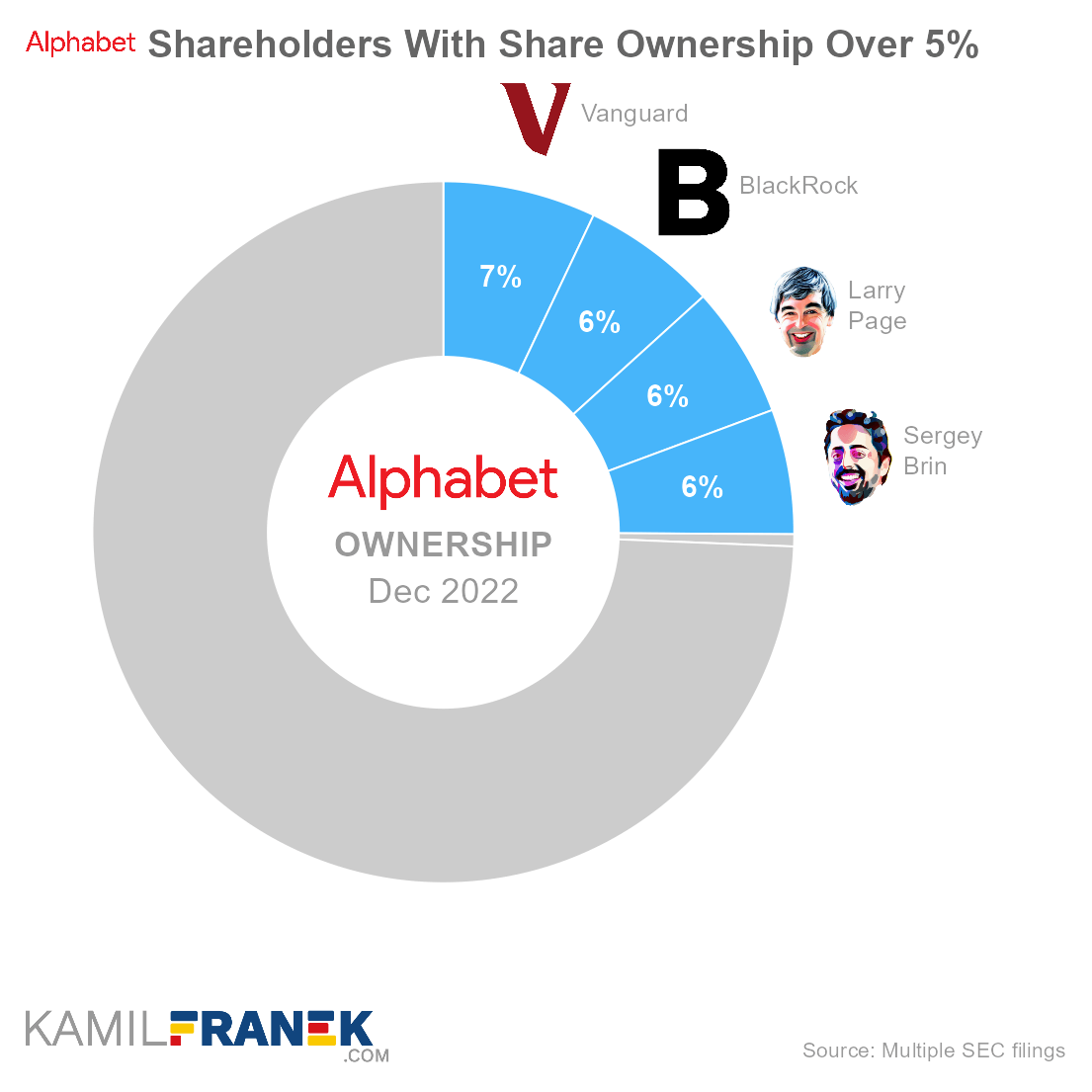
While the founders control the voting, the vast majority of Alphabet’s equity is held by institutional investors. These are the mutual funds, pension funds, and asset management firms that manage the retirements and savings of millions of people worldwide.
Vanguard and BlackRock: The Market’s Heavyweights
The Vanguard Group and BlackRock are consistently the two largest institutional owners of Alphabet Inc. As of recent filings, Vanguard typically holds between 7% and 8% of the company, while BlackRock follows closely with approximately 6%. These firms don’t necessarily “buy” Google because they have a specific opinion on the latest AI update; rather, they buy it because Google is a massive component of the S&P 500 and other major indices.
When you invest in a “Total Stock Market Index Fund” or an “S&P 500 ETF,” you are indirectly becoming a part-owner of Google. These institutional giants provide market stability, but because they are largely passive investors, they rarely challenge the status quo established by the company’s board.
The Role of State Street and Fidelity
Following the “Big Two” are firms like State Street Global Advisors and Fidelity. These institutions hold significant blocks of shares (often 3-4% each). For the personal finance enthusiast, it is important to realize that through these intermediaries, a significant portion of Google is actually owned by the “public” via 401(k) plans and IRAs. However, the fiduciary duty of these firms is to maximize returns, not necessarily to steer the company’s daily operations.
The Human Element: Founders and Key Executives
Despite the trillions of dollars managed by institutions, the face of Google’s ownership remains its founders. Larry Page and Sergey Brin may have stepped down from their day-to-day executive roles, but their financial shadow over Alphabet is enormous.
Larry Page and Sergey Brin’s Multi-billion Dollar Legacy
Between them, Page and Brin own roughly 11% to 12% of the total equity of Alphabet. However, because of their Class B holdings, they control over 51% of the total voting power. This means that, for all intents and purposes, they are the ultimate owners of the company’s destiny. From an investment perspective, this creates a unique “founder-led” risk/reward profile. Investors are essentially betting on the founders’ original vision and their choice of successors.
Sundar Pichai’s Role as a Significant Individual Shareholder
As the CEO of both Google and Alphabet, Sundar Pichai holds a significant amount of stock, largely granted through performance-based equity awards. While his ownership percentage is nowhere near that of the founders, he is one of the largest individual “non-founder” shareholders. For those analyzing the business finance aspect of the company, Pichai’s compensation and stock vesting schedules are key indicators of the company’s confidence in its current leadership.
Investing in Alphabet: What Ownership Means for Your Wallet
For the retail investor or someone looking to build a side hustle in equity trading, “owning” Google is often seen as a cornerstone of a healthy portfolio. But what are the financial metrics that matter to an owner?
Valuation and Performance Metrics
Alphabet is often analyzed through its Price-to-Earnings (P/E) ratio and its free cash flow. As an owner, you are interested in how efficiently Google converts your capital into profit. Alphabet has historically maintained a strong balance sheet with massive cash reserves, which it uses for share buybacks. Share buybacks are a “Money” strategy where the company buys its own stock back from the market, effectively increasing the ownership percentage of every remaining shareholder.

The Future Outlook: AI and Market Competition
The ownership landscape of Google is currently facing its most significant challenge in decades: the rise of generative AI and increased antitrust scrutiny. As an investor, owning Google means participating in the “AI Arms Race.” The company’s ability to monetize AI through its Cloud division and Search advertisements will determine if the stock remains a “Blue Chip” essential or if it faces a decline.
In conclusion, “who owns Google” is a two-part answer. Technically, the world’s largest asset managers—Vanguard and BlackRock—own the largest chunks of the equity on behalf of global investors. However, functionally and legally, the company is owned and controlled by Larry Page and Sergey Brin through a meticulously crafted share structure. For the individual investor, owning Alphabet is a way to gain exposure to the backbone of the digital economy, provided they are comfortable with the concentrated voting power at the top. Understanding this hierarchy is the first step in making an informed decision about including this tech giant in your personal financial strategy.
aViewFromTheCave is a participant in the Amazon Services LLC Associates Program, an affiliate advertising program designed to provide a means for sites to earn advertising fees by advertising and linking to Amazon.com. Amazon, the Amazon logo, AmazonSupply, and the AmazonSupply logo are trademarks of Amazon.com, Inc. or its affiliates. As an Amazon Associate we earn affiliate commissions from qualifying purchases.