
In the realm of personal finance, few decisions carry as much weight—or as much potential for optimization—as the acquisition of a vehicle. For the majority of households, a car represents the second-largest expenditure after housing. However, unlike real estate, which historically appreciates over time, a vehicle is a depreciating asset. From a wealth-building perspective, the question of where to buy a used car is not merely a matter of logistics; it is a fundamental exercise in capital allocation and risk management.
Choosing a pre-owned vehicle over a new one is one of the most effective strategies for preserving net worth. By understanding the mechanics of depreciation, financing, and market channels, an informed buyer can secure reliable transportation while minimizing the “drain” on their long-term financial goals. This guide explores the most effective venues for purchasing used cars through the lens of financial strategy and total cost of ownership.
The Financial Logic of Pre-Owned Vehicles
To understand why the “where” matters, one must first understand the “why.” The primary driver behind the used car market is the avoidance of the steepest part of the depreciation curve. A new vehicle can lose between 15% and 25% of its value the moment it is driven off the lot, and up to 60% of its value within the first five years.
Understanding the Depreciation Curve
From a money management standpoint, buying a two-to-three-year-old vehicle allows a consumer to “outsource” the most aggressive depreciation to the original owner. By the time a car reaches its third year, the rate of value loss begins to level off. This means that if you choose to sell the vehicle in another three years, your “cost of use”—the difference between purchase price and resale price—is significantly lower than that of a new car buyer.
Opportunity Cost and Reinvesting the Savings
The financial advantage of used cars is magnified when considering opportunity cost. If the delta between a new car and a comparable used car is $15,000, and that sum is instead diverted into a diversified brokerage account or a high-yield investment vehicle, the long-term impact on a family’s balance sheet is profound. Over a 10-year horizon, at a 7% annual return, that $15,000 “savings” grows into nearly $30,000. In this context, where you buy the car becomes a tactical decision to maximize that initial capital retention.
Identifying the Best Channels for Maximum ROI
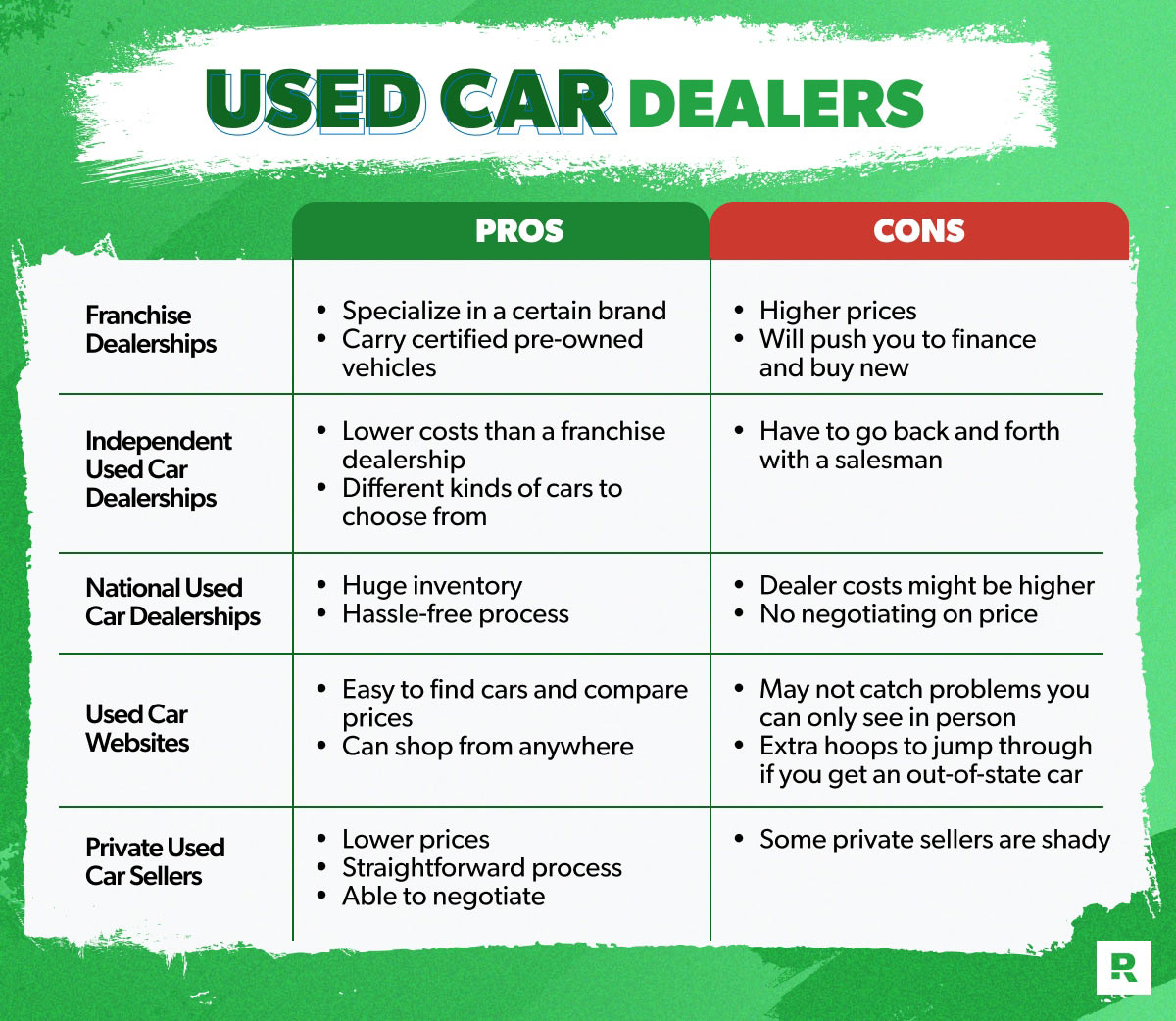
The marketplace for used vehicles is fragmented, ranging from individual private sellers to massive corporate conglomerates. Each channel offers a different balance of price, risk, and financial convenience.
Private Party Purchases: The Risk-Reward Ratio
For the purely profit-motivated buyer, the private market (found via platforms like Facebook Marketplace or Craigslist) often yields the highest ROI. In a private sale, you are eliminating the “dealer spread”—the margin a dealership adds to cover overhead, commissions, and profit.
However, the private market requires the highest level of financial due diligence. Without the protections of a dealership’s reputation or a formal warranty, the buyer assumes all risk. To mitigate this, savvy investors in the used car space budget for a Pre-Purchase Inspection (PPI) by a third-party mechanic. Spending $150 on an inspection to protect a $15,000 investment is a prudent risk-mitigation strategy that prevents “lemon” scenarios which could lead to a total loss of capital.
Certified Pre-Owned (CPO) Programs: Balancing Cost and Security
On the other end of the spectrum are Certified Pre-Owned programs offered by franchised dealerships. CPO vehicles are typically late-model cars that have undergone a rigorous inspection and come with manufacturer-backed warranties.
From a financial planning perspective, CPO vehicles represent a “middle way.” You pay a premium over a standard used car (the “CPO Tax”), but in return, you hedge against the risk of catastrophic mechanical failure. For individuals who do not have a liquid emergency fund to cover a $3,000 transmission repair, the CPO route acts as a form of insurance, smoothing out the cost of ownership over the life of the vehicle.
Direct-to-Consumer Digital Platforms
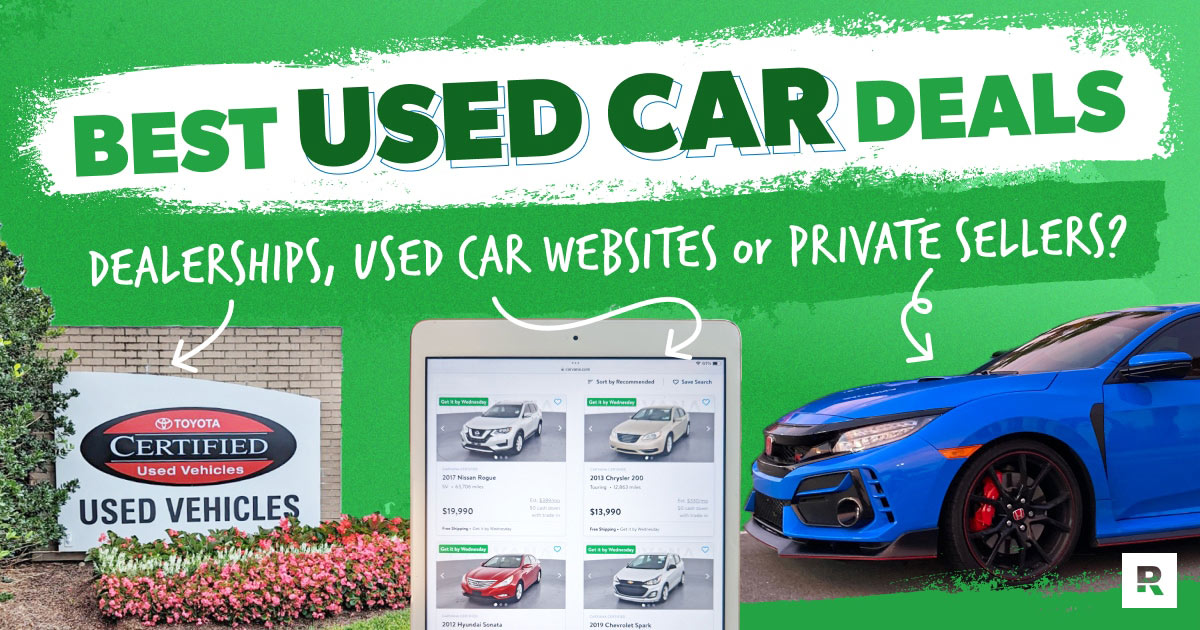
The rise of platforms like Carvana and Vroom has introduced a new variable: convenience-driven pricing. These platforms often use algorithmic pricing to offer competitive, no-haggle rates. While they may not always provide the absolute lowest price found in a private sale, they offer high transparency and often include short-term return policies. For a professional whose time is billed at a high hourly rate, the “soft cost” of spending three weekends visiting dealerships might outweigh the $500–$1,000 saved by shopping traditionally.
Evaluating the Total Cost of Ownership (TCO)
A common mistake in personal finance is focusing solely on the purchase price—the “sticker price”—rather than the Total Cost of Ownership (TCO). Where you buy your car can influence these secondary costs in significant ways.
Insurance and Maintenance Variances
The age and source of your vehicle impact your insurance premiums. Financing a used car through a traditional lender often requires “full coverage,” which can be a significant monthly line item. Conversely, if you have the liquidity to purchase a used vehicle with cash from a private seller, you have more flexibility in your insurance structure (though maintaining robust liability coverage is always a financial necessity).
Furthermore, maintenance must be factored into the purchase decision. A “cheap” luxury vehicle from an independent used car lot may appear to be a bargain, but the cost of parts and specialized labor can lead to a negative ROI over a five-year period. True financial efficiency involves selecting a vehicle with a proven track record of low maintenance costs and high parts availability.
Financing Strategies: Interest Rates vs. Loan Terms
Unless you are paying cash, the “where” of your purchase is inextricably linked to the “how.” Large dealerships often have relationships with multiple lenders, allowing them to offer competitive APRs—or sometimes inflated ones through “dealer reserve” (a markup on the interest rate).
To optimize the financial outcome, one should secure a pre-approval from a credit union before stepping onto a lot. Credit unions, being member-owned, typically offer the lowest interest rates on used vehicle loans. By comparing the credit union’s rate against the dealership’s offer, the buyer can ensure they aren’t losing hundreds or thousands of dollars in interest over the life of the loan.
Navigating the Transaction: Tax Implications and Resale Value
The final stage of the car-buying process involves the actual exchange of capital, which carries its own set of financial nuances.
Tax-Efficiency in Private Sales and Trades
Depending on your jurisdiction, trading in a vehicle at a dealership can provide a significant tax shield. In many states, you only pay sales tax on the “difference” between your trade-in value and the price of the new-to-you car. For example, if you buy a $20,000 car and trade in a $10,000 car, you only pay tax on $10,000. This 5% to 10% savings can sometimes make a dealership trade-in more financially advantageous than selling the old car privately and buying another one separately.
Maintaining Equity for Future Liquidity
The ultimate goal of a financially savvy car buyer is to maintain as much equity in the vehicle as possible. This means avoiding “gap” scenarios where you owe more on the loan than the car is worth. By choosing a vehicle with high resale value (such as certain brands known for longevity) and buying at a price point near the bottom of the depreciation curve, you ensure that the car remains a liquid asset that can be converted back into cash if your financial circumstances change.

Conclusion: The Wealth-Building Choice
In conclusion, “where to buy a used car” is a question of strategic financial alignment. For those prioritizing absolute cost savings, the private market remains the gold standard, provided it is paired with rigorous mechanical vetting. For those prioritizing risk mitigation and predictable cash flows, CPO programs and reputable dealerships offer a more conservative path.
Ultimately, the most successful buyers are those who treat a vehicle purchase not as an emotional milestone, but as a calculated business decision. By minimizing interest expenses, avoiding the initial depreciation hit, and accounting for the total cost of ownership, you transform a necessary expense into a manageable component of a robust financial plan. In the journey toward financial independence, the money saved on a used car is often the fuel that powers more productive investments elsewhere.
aViewFromTheCave is a participant in the Amazon Services LLC Associates Program, an affiliate advertising program designed to provide a means for sites to earn advertising fees by advertising and linking to Amazon.com. Amazon, the Amazon logo, AmazonSupply, and the AmazonSupply logo are trademarks of Amazon.com, Inc. or its affiliates. As an Amazon Associate we earn affiliate commissions from qualifying purchases.