
Buying a car is often the second-largest financial commitment an individual makes, trailing only the purchase of a home. For most, it is not merely a lifestyle choice but a significant capital allocation that impacts monthly cash flow, credit health, and long-term net worth. In a market characterized by fluctuating interest rates and evolving inventory levels, approaching a vehicle purchase through a strictly financial lens is essential. This guide dismantles the process of buying a car into a strategic financial framework, ensuring that your next vehicle serves your mobility needs without compromising your financial future.
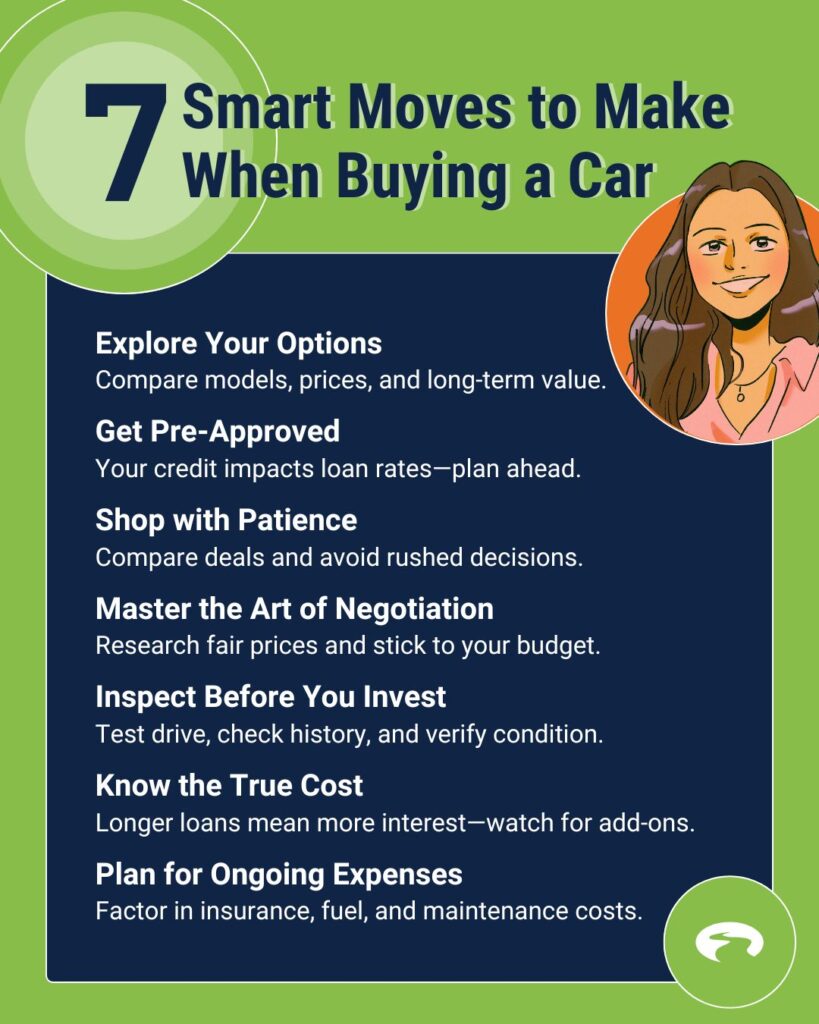
1. Establishing a Robust Financial Foundation
Before stepping onto a dealership lot or browsing online marketplaces, you must conduct a rigorous internal audit of your finances. Buying a car is an exercise in cash flow management and opportunity cost analysis.
The 20/4/10 Rule of Thumb
Financial experts often recommend the 20/4/10 rule as a benchmark for affordability. This suggests a down payment of at least 20%, a financing term of no more than four years (48 months), and total monthly vehicle expenses (including insurance and fuel) that do not exceed 10% of your gross monthly income. Adhering to this prevents “lifestyle creep” and ensures that the car remains a tool for your life rather than a burden on your wealth-building potential.
Calculating the Total Cost of Ownership (TCO)
The “sticker price” is a deceptive metric. To understand the true financial impact, you must calculate the Total Cost of Ownership. This includes recurring expenses such as insurance premiums, which vary significantly by model; fuel or electricity costs; scheduled maintenance; and, most importantly, depreciation. A car that costs $30,000 but retains 60% of its value after five years is a better financial move than a $25,000 car that retains only 30%.
The Role of Opportunity Cost
When deciding how much to spend, consider what that money could achieve if invested elsewhere. For instance, a $500 monthly car payment invested in a diversified index fund with an average 7% annual return would grow to over $35,000 in five years. Every dollar spent on a depreciating asset like a car is a dollar that isn’t working for you in the compounding market.
2. Navigating Financing and Interest Rate Environments
In the realm of personal finance, how you pay for an asset is often as important as the price you pay. Financing is a product just like the car itself, and it should be shopped for with equal diligence.
Cash vs. Financing: The Interest Rate Arbitrage
The decision to pay cash or finance depends on the interest rate environment. If a manufacturer offers a promotional 0.9% APR, it is mathematically advantageous to finance the car and keep your cash in a high-yield savings account or the stock market, where it can earn a higher return. However, if interest rates are high (e.g., 7% or more), paying cash—or providing a massive down payment—is the most effective way to “earn” a guaranteed return by avoiding interest expenses.
The Power of Pre-Approval
Walking into a dealership without financing in hand is a common financial mistake. By securing a pre-approval from a credit union or a community bank, you establish a “ceiling” for your interest rate. This turns you into a “cash buyer” in the eyes of the salesperson, allowing you to focus negotiation on the vehicle’s price rather than the monthly payment. If the dealership’s finance office wants your business, they must beat the rate you already have.
Understanding the Impact of Credit Scores
Your credit score is the primary lever in determining your loan’s Annual Percentage Rate (APR). A “prime” borrower (720+ score) might receive an interest rate several percentage points lower than a “subprime” borrower. Over a 60-month loan on a $40,000 car, the difference between a 4% and a 10% interest rate is roughly $6,500 in pure interest. If your credit is poor, it is often more financially sound to delay the purchase and repair your credit than to lock in a high-interest loan.
3. Asset Selection: New vs. Used and the Depreciation Curve
From a wealth-management perspective, cars are generally depreciating assets. The goal is to minimize the “burn rate” of your capital while fulfilling your transportation requirements.

The “Sweet Spot” of Used Vehicles
New cars typically lose 20% of their value in the first year and up to 60% over the first five years. By purchasing a vehicle that is two to three years old, you allow the first owner to absorb the steepest part of the depreciation curve. You receive a vehicle that is still modern and reliable but at a 30-40% discount from its original MSRP.
Certified Pre-Owned (CPO) as a Risk Mitigation Tool
For those wary of the maintenance risks associated with used cars, Certified Pre-Owned programs offer a middle ground. While CPO vehicles carry a premium over standard used cars, they include manufacturer-backed warranties and rigorous inspections. Financially, this functions as a form of insurance against “lemon” scenarios, protecting your emergency fund from unforeseen catastrophic repairs.
Leasing: A Cash Flow Strategy, Not an Ownership Strategy
Leasing is often criticized in personal finance circles because you do not build equity. However, for business owners who can deduct lease payments or individuals who prioritize monthly cash flow and desire a new vehicle every three years, it can be a strategic choice. The key is understanding that leasing is essentially paying for the depreciation of the vehicle during its most expensive years. Unless there is a specific tax advantage, buying and holding a vehicle for 7-10 years is almost always the superior financial move.
4. Strategic Negotiation and Protecting the Bottom Line
The negotiation phase is where many consumers lose the financial gains they made through research. Dealerships are profit-maximizing entities; your goal is to minimize that profit at your expense.
Focusing on the “Out-the-Door” Price
Salespeople often steer the conversation toward the “monthly payment.” This is a tactic used to hide the total cost of the car by extending loan terms (e.g., 72 or 84 months). Always negotiate based on the “out-the-door” (OTD) price, which includes the vehicle cost, taxes, registration, and documentation fees. Once the OTD price is settled, you can then discuss financing and trade-ins as separate transactions.
The Trade-In Trap
Your current vehicle is a liquid asset. Dealerships often offer lower trade-in values because they provide convenience. To maximize your financial return, obtain quotes from third-party buyers (like CarMax or online wholesalers) before visiting the dealer. This gives you a baseline “floor” for your asset’s value. If the dealer cannot match or exceed that value, you are better off selling the car separately.
Avoiding “Back-End” Add-ons
The finance and insurance (F&I) office is where dealerships make a significant portion of their profit. They will offer extended warranties, gap insurance, tire protection, and VIN etching. While some items like gap insurance are vital if you have low equity in the car, most of these products are significantly marked up. Often, you can purchase equivalent extended warranties or gap insurance through your own insurance provider or a third party for a fraction of the cost.
5. Long-Term Financial Management of the Asset
The financial journey doesn’t end when you drive off the lot. How you manage the asset over the next several years determines the ultimate “per-mile” cost of your purchase.
Preventive Maintenance as Capital Preservation
Treating maintenance as a non-negotiable expense is a form of insurance. A $100 oil change and inspection can prevent a $5,000 engine failure. By keeping the vehicle in peak mechanical and aesthetic condition, you ensure a higher resale value when it eventually comes time to sell, effectively lowering your total cost of ownership.
Refinancing Opportunities
If you were forced to accept a high interest rate at the time of purchase due to market conditions or a lower credit score, monitor the market. If rates drop or your credit improves, refinancing your auto loan can save you thousands in interest over the remaining life of the loan. This is a simple way to optimize your monthly cash flow without changing your lifestyle.
The “No-Payment” Phase
The most significant financial gain in car ownership occurs after the loan is paid off. Once the debt is retired, continue “paying yourself” that monthly amount into a dedicated “Next Car” sinking fund or an investment account. This breaks the cycle of perpetual debt, allowing you to buy your next vehicle with cash or a significantly larger down payment, further accelerating your path to financial independence.
In conclusion, buying a car is more than a simple transaction; it is a complex financial maneuver that requires discipline, research, and a clear-eyed view of one’s balance sheet. By focusing on the total cost of ownership, securing competitive financing, and understanding the mechanics of depreciation, you can turn a routine purchase into a masterclass in capital management. Remember: a car is a tool to get you to your destination, but your financial strategy is what determines where you’ll be when you get there.
aViewFromTheCave is a participant in the Amazon Services LLC Associates Program, an affiliate advertising program designed to provide a means for sites to earn advertising fees by advertising and linking to Amazon.com. Amazon, the Amazon logo, AmazonSupply, and the AmazonSupply logo are trademarks of Amazon.com, Inc. or its affiliates. As an Amazon Associate we earn affiliate commissions from qualifying purchases.