
In the world of mathematics, converting a fraction like 5/6 into a decimal seems like a middle-school exercise. You divide the numerator by the denominator, observe the repeating pattern, and move on. However, in the realm of technology, software engineering, and data science, the conversion of 5/6 into 0.8333… is anything but simple. It represents a fundamental challenge in how digital systems perceive, store, and process continuous real numbers using discrete binary logic.
As we dive into the technical intricacies of this specific decimal, we uncover the pillars of floating-point arithmetic, the limitations of hardware precision, and the sophisticated software solutions designed to bridge the gap between pure mathematics and digital execution.

The Mathematical Foundation: Converting 5/6 and the Challenge of Repeating Decimals
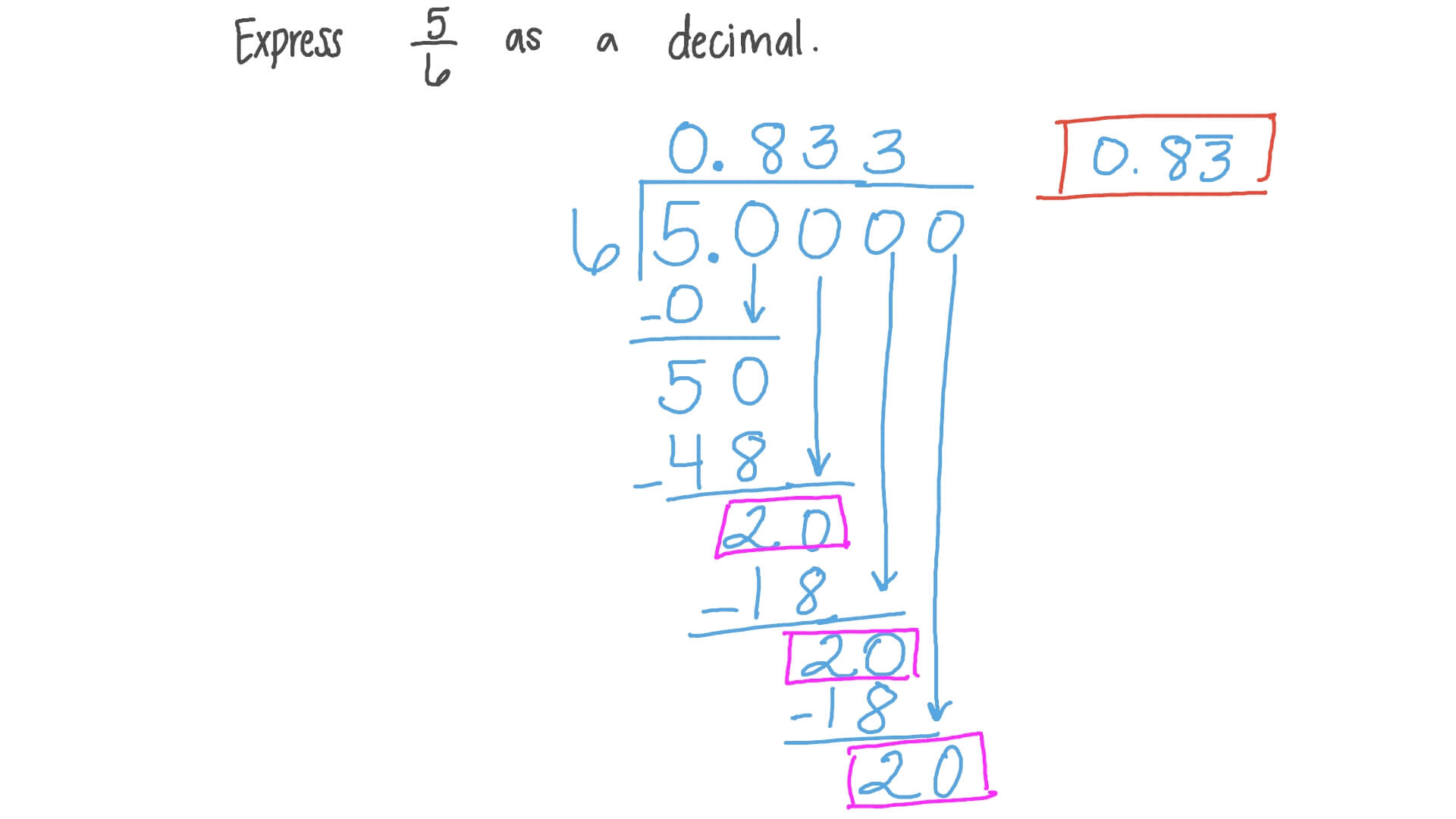
To understand the technical implications, we must first establish the mathematical reality of the fraction. 5/6 is a rational number. When we perform the division—5 divided by 6—the result is 0.833333…, where the digit 3 repeats infinitely. This is known as a “recurring” or “repeating” decimal.
The Long Division Logic
In a standard base-10 system, 6 does not divide into 5. We add a decimal point and a zero, making it 50. 6 goes into 50 eight times (48), leaving a remainder of 2. We add another zero, making it 20. 6 goes into 20 three times (18), leaving a remainder of 2. This cycle repeats forever. In mathematical notation, this is often written as 0.83̄.
The Rational vs. Irrational Distinction
It is important for developers and data scientists to distinguish between numbers like 5/6 and irrational numbers like Pi (π) or the square root of 2. While 5/6 has an infinite decimal expansion, it is predictable and rational. However, for a computer, “infinite” is a word that triggers memory overflows and processing bottlenecks. Because a computer’s memory is finite, it cannot store the true value of 0.833…; it can only store an approximation.
Precision and Floating-Point Arithmetic in Software Development
When a programmer types x = 5/6 into a script, the computer doesn’t see a fraction; it sees a request to perform an operation and store the result in a memory address. Most modern programming languages use the IEEE 754 standard for floating-point arithmetic to handle these types of calculations.
How Computers Store 0.833… in Binary
Computers do not think in base-10; they think in base-2 (binary). Just as some fractions produce repeating decimals in base-10, many more produce repeating sequences in binary. The fraction 5/6, when converted to binary, becomes an infinite sequence: 0.1101010101010....
Because a 64-bit system (the standard for most modern “double-precision” floats) only has a set number of bits to store the mantissa (the significant digits), the computer must “truncate” or “round” the number. This means that in a computer’s “mind,” 5/6 is not actually 5/6; it is a very close approximation, such as 0.83333333333333337034.
The IEEE 754 Standard and Rounding Errors
The IEEE 754 standard is the bedrock of technical computing. It defines how a number is split into a sign bit, an exponent, and a fraction (mantissa). For a value like 5/6, the standard must decide where to cut off the repeating 3s.
This leads to what developers call “floating-point error.” While the error might seem negligible—a difference in the 16th or 17th decimal place—it can compound in complex simulations, financial algorithms, or physical engine rendering. If you add 5/6 to itself a million times in a loop using standard floats, the final result will deviate slightly from the expected mathematical total of 833,333.33…
Practical Applications in Programming and AI Algorithms
Understanding how 5/6 is handled as a decimal is crucial for anyone working with data-heavy applications. From the Python developer to the AI researcher, managing this precision is a core technical competency.
Handling Fractions in Python, JavaScript, and C++
Modern languages offer different tools to deal with the 5/6 dilemma:
- Python: The
floattype handles 5/6 with standard IEEE 754 precision. However, for those needing absolute accuracy, Python’sfractionsmodule allows developers to keep the number asFraction(5, 6), avoiding the decimal conversion entirely until the final output. - JavaScript: Known for its “quirky” math, JavaScript treats all numbers as 64-bit floats. This is why
0.1 + 0.2 !== 0.3. For a developer building a calculator app, 5/6 must be handled with specialized libraries likeDecimal.jsto ensure the UI doesn’t show an ugly string of random digits at the end. - C++: Offers
float,double, andlong double. Choosing between these is a balance between memory efficiency and the required precision for the specific task at hand.
The Role of Precision in Machine Learning and Data Science
In the world of Artificial Intelligence and Neural Networks, the “weights” of a model are often decimals. When a model calculates a probability—perhaps the likelihood that a pixel represents a certain object—it might encounter values derived from ratios like 5/6.
Interestingly, in AI “Quantization” (the process of making models smaller and faster), developers often intentionally reduce the precision of these decimals. They might convert a 32-bit float version of 0.83333333 to an 8-bit integer approximation. The technical challenge here is determining how much “information” is lost when we simplify the decimal of 5/6 and whether that loss affects the model’s accuracy.
The User Interface Perspective: Formatting Decimals for Apps and UX
In software engineering, the “backend” value of a number is rarely what the “frontend” user sees. When an app displays 5/6 as a decimal, the developer must make a series of intentional design and technical choices.
Significant Figures and the 0.833 Output
A banking app, a construction calculator, and a video game would all display 5/6 differently.
- Engineering Apps: Might require 6 to 10 significant figures (0.8333333333) to ensure structural integrity in calculations.
- Consumer Apps: Usually round to two or three places (0.83 or 0.833) for readability.
The technical implementation involves using “string formatting” functions (like.toFixed(2)in JavaScript) which round the value for display while keeping the precise repeating decimal in the background memory for calculations.
Internationalization (i18n) and Localization
Even the decimal point itself is a tech variable. While 5/6 as a decimal is 0.833 in the US and UK, it is 0,833 (using a comma) in much of Europe and South America. Robust software must utilize localization libraries to ensure that the conversion of 5/6 respects the user’s regional settings. Failure to do so can break data exports (like CSV files) where commas are used as delimiters.
The Future of Computational Mathematics: Arbitrary-Precision Arithmetic
As we push the boundaries of technology—from quantum computing to high-frequency trading—the limitations of standard floating-point decimals like 0.833… are becoming more apparent. This has led to the rise of Arbitrary-Precision Arithmetic.
Solving the 0.833… Dilemma with Symbolic Math
Symbolic computation systems, like WolframAlpha or the SymPy library in Python, treat 5/6 as a symbolic object rather than a decimal approximation. In symbolic math, the computer holds the relationship “5 divided by 6” in its memory. It only converts it to a decimal at the very last possible second, or never at all, maintaining perfect mathematical purity throughout the process.
Quantum Computing and Continuous States
In the future, quantum computers may change how we represent numbers entirely. Unlike classical bits that are 0 or 1, qubits can exist in states that represent complex amplitudes. While we are still in the early stages, the way a quantum system might “calculate” a repeating decimal like 5/6 could bypass the truncation errors of binary systems, leading to a new era of hyper-precise scientific simulation.

Conclusion: Why the Decimal of 5/6 Matters in Tech
The journey from the fraction 5/6 to the decimal 0.833… is a microcosm of the challenges faced in modern technology. It highlights the eternal tension between the infinite nature of mathematics and the finite nature of digital hardware.
For the developer, understanding this conversion isn’t just about knowing the answer is 0.833; it’s about understanding memory management, the IEEE 754 standard, and the importance of choosing the right data type for the job. Whether you are building a simple mobile app or a complex AI model, the way you handle the repeating “3” in 5/6 says a lot about your approach to precision, efficiency, and software quality. In the digital age, even the smallest decimal carries the weight of the logic that powers our world.
aViewFromTheCave is a participant in the Amazon Services LLC Associates Program, an affiliate advertising program designed to provide a means for sites to earn advertising fees by advertising and linking to Amazon.com. Amazon, the Amazon logo, AmazonSupply, and the AmazonSupply logo are trademarks of Amazon.com, Inc. or its affiliates. As an Amazon Associate we earn affiliate commissions from qualifying purchases.