
In the realm of finance, numbers are the language of progress. Whether you are tracking the growth of a personal savings account, evaluating the performance of a stock portfolio, or analyzing the quarterly revenue of a scaling startup, the ability to quantify growth is essential. While absolute figures—such as a $5,000 profit—tell part of the story, they lack the context necessary for strategic decision-making. To truly understand performance, one must master the concept of percentage increase.
Percentage increase is a foundational mathematical tool used to describe the relative growth between two values over time. In financial circles, it is the primary metric for measuring Return on Investment (ROI), assessing inflation, and benchmarking business success against competitors. This guide will explore the mechanics of calculating percentage increase and demonstrate its vital application across various sectors of the financial world.
The Fundamentals of Percentage Increase in Personal Finance
At its core, calculating a percentage increase is a straightforward process, but its implications for your personal wealth are profound. It allows an investor to strip away the “noise” of large numbers and focus on the efficiency of their capital.
The Basic Formula Explained
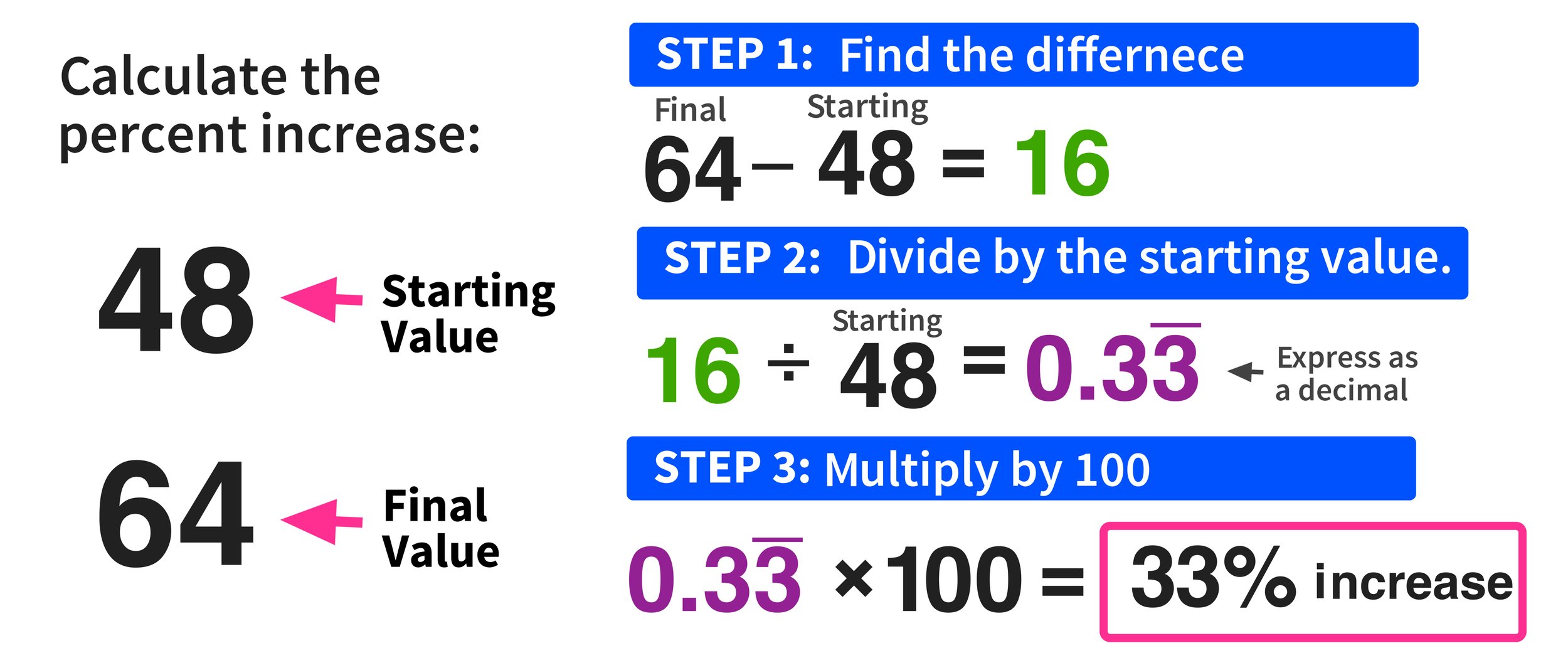
To figure out the percentage increase between two numbers, you must follow a three-step mathematical process. First, subtract the original value (the starting number) from the new value (the ending number) to find the “absolute increase.” Second, divide that absolute increase by the original value. Finally, multiply the resulting decimal by 100 to convert it into a percentage.
The formula is expressed as:
((New Value – Original Value) / Original Value) × 100 = Percentage Increase
For example, if you invested $1,000 in a mutual fund and its value grew to $1,250 over a year, the calculation would be:
- $1,250 – $1,000 = $250 (The absolute increase)
- $250 / $1,000 = 0.25
- 0.25 × 100 = 25%
Why Percentage Increase Matters More Than Absolute Numbers
In money management, absolute numbers can be deceptive. If an investor earns $500 on a $1,000 investment, they have achieved a staggering 50% increase. However, if another investor earns the same $500 on a $50,000 investment, their increase is a mere 1%. While the dollar amount is identical, the first investor’s strategy was far more effective. By focusing on percentage increase, you can compare the efficiency of different financial vehicles—such as high-yield savings accounts, real estate, or equities—regardless of the amount of capital involved.
Evaluating Investment Performance and Portfolio Growth
For the modern investor, the percentage increase is the ultimate yardstick. It provides a standardized way to measure how well assets are performing relative to their purchase price and the broader market.
Calculating Return on Investment (ROI)
ROI is perhaps the most frequent application of percentage increase in the financial world. It represents the profitability of an investment. When you calculate the percentage increase of an asset’s price, you are essentially determining your capital gains. Professional traders and casual savers alike use this to decide whether to hold an asset or liquidate it for a more promising opportunity. Understanding this calculation helps in identifying “dead money”—assets that may be increasing in value but at a percentage rate that lags behind market averages or inflation.
Year-Over-Year (YoY) Growth and Compound Annual Growth Rate (CAGR)
Long-term wealth building relies on consistent growth over extended periods. Financial analysts often look at Year-Over-Year (YoY) growth to smooth out seasonal fluctuations. For instance, comparing the value of a portfolio in December 2023 to its value in December 2022 provides a clear picture of annual progress.
However, for investments held over many years, the Compound Annual Growth Rate (CAGR) becomes the superior metric. While a simple percentage increase tells you the total growth from start to finish, CAGR tells you the mean annual growth rate required for an investment to grow from its beginning balance to its ending balance, assuming the profits were reinvested. Mastery of these percentages is what separates reactive savers from proactive wealth builders.
Business Finance: Using Percentage Increase to Scale Profitability
In a corporate or entrepreneurial setting, percentage increase serves as a diagnostic tool. It helps business owners identify which parts of their operation are scaling efficiently and which are becoming bloated.
Monitoring Revenue and Expense Trends
A healthy business is generally one where revenue increases at a faster percentage than expenses. This is known as operating leverage. If a company’s revenue increases by 20% year-over-year, but its operating expenses increase by 25%, the business is actually becoming less efficient despite making more money in absolute terms. By calculating the percentage increase for both sides of the ledger, a CFO can pinpoint where costs are spiraling out of control before they erode the company’s bottom line.
Market Share Expansion and Competitor Analysis
Percentage increase is also used to gauge a brand’s “reach” within an industry. If a company grows its customer base from 10,000 to 15,000, it has seen a 50% increase in acquisition. When compared to an industry average growth of 10%, this percentage highlights a significant competitive advantage. Businesses use these figures to justify valuations to investors and to set aggressive yet realistic targets for the following fiscal year.
Navigating Inflation and Purchasing Power
Money is not static; its value shifts based on the economic environment. Understanding percentage increase is crucial for protecting your purchasing power against the silent erosion caused by inflation.
The Impact of Consumer Price Index (CPI) Changes
Inflation is typically measured by the percentage increase in the Consumer Price Index (CPI), which tracks the average change over time in the prices paid by consumers for a basket of goods and services. If the annual inflation rate is 5%, it means the “price” of living has increased by that percentage. To maintain your standard of living, your income must see a corresponding percentage increase. If you receive a 3% raise in a year where inflation is 5%, you have effectively experienced a 2% decrease in “real” income.
Adjusting Wages and Savings for Economic Shifts
For those planning for retirement, calculating the percentage increase of living costs is vital. A retirement fund that looks substantial today may be insufficient in twenty years if it hasn’t grown at a rate that outpaces the percentage increase of healthcare, housing, and food. Savvy financial planning involves projecting these percentage increases to ensure that future withdrawals maintain the same purchasing power as today’s dollars.
Tools and Best Practices for Accurate Financial Calculations
While the manual formula is essential for understanding the logic, the modern financial landscape offers various tools to automate and refine these calculations, ensuring accuracy in complex scenarios.
Leveraging Spreadsheets and Financial Calculators
Programs like Microsoft Excel and Google Sheets are the workhorses of financial analysis. In these platforms, calculating percentage increase is simplified through formulas. For example, if your original value is in cell A1 and your new value is in cell B1, the formula =(B1-A1)/A1 (formatted as a percentage) provides an instantaneous result. Using spreadsheets allows for “what-if” modeling, where you can change the numbers to see how different percentage increases would impact your long-term financial goals.
Common Pitfalls to Avoid in Percentage Calculations
One of the most common errors in financial reporting is confusing “percentage points” with “percentage increase.” If a mortgage interest rate moves from 4% to 5%, it has increased by 1 percentage point, but the percentage increase of the interest cost is actually 25% ( (5-4)/4 = 0.25 ).
Another mistake is failing to account for the “basis” or the starting number. A 50% loss followed by a 50% gain does not bring you back to zero. If you have $100 and lose 50%, you have $50. To get back to $100, you need a 100% increase on that $50. Understanding these nuances is critical for risk management and recovering from market volatility.

Conclusion: The Strategic Value of Quantitative Literacy
Figuring out the percentage increase between two numbers is more than just a math exercise; it is a vital skill for anyone looking to navigate the complexities of the financial world. By moving beyond absolute dollar amounts and focusing on relative growth, you gain a clearer perspective on investment performance, business efficiency, and the true impact of economic shifts like inflation.
Whether you are a retail investor, a business owner, or simply someone looking to optimize a personal budget, the percentage increase formula provides a universal standard for success. In a world where financial data is abundant, the ability to distill that data into actionable percentages is what empowers individuals to make informed, strategic, and ultimately profitable decisions. Growth is the goal of any financial endeavor, and the percentage increase is the most accurate map we have to track that journey.
aViewFromTheCave is a participant in the Amazon Services LLC Associates Program, an affiliate advertising program designed to provide a means for sites to earn advertising fees by advertising and linking to Amazon.com. Amazon, the Amazon logo, AmazonSupply, and the AmazonSupply logo are trademarks of Amazon.com, Inc. or its affiliates. As an Amazon Associate we earn affiliate commissions from qualifying purchases.