
In the world of finance, percentages are the universal language. Whether you are analyzing the performance of a stock portfolio, determining the impact of inflation on your purchasing power, or simply trying to figure out how much of a tip to leave at a business lunch, the ability to calculate percentages accurately is an essential skill. While basic calculators have made the process easier, understanding the mechanics behind the numbers allows for faster mental estimates and more profound financial insights.
Navigating your personal and professional finances requires more than just knowing “how much” money you have; it requires knowing “what part” of your capital is working for you. This article serves as a comprehensive guide to mastering percentage calculations within the niche of money and finance, ensuring you can make informed decisions with confidence.

The Fundamentals of Financial Percentages
At its core, a percentage is a ratio that represents a fraction of 100. In financial terms, this ratio allows us to compare different sets of data on an even playing field. For instance, a $500 profit on a $1,000 investment is significantly more impressive than a $500 profit on a $100,000 investment. Percentages provide the context necessary to see that difference immediately.
Understanding the Basic Formula
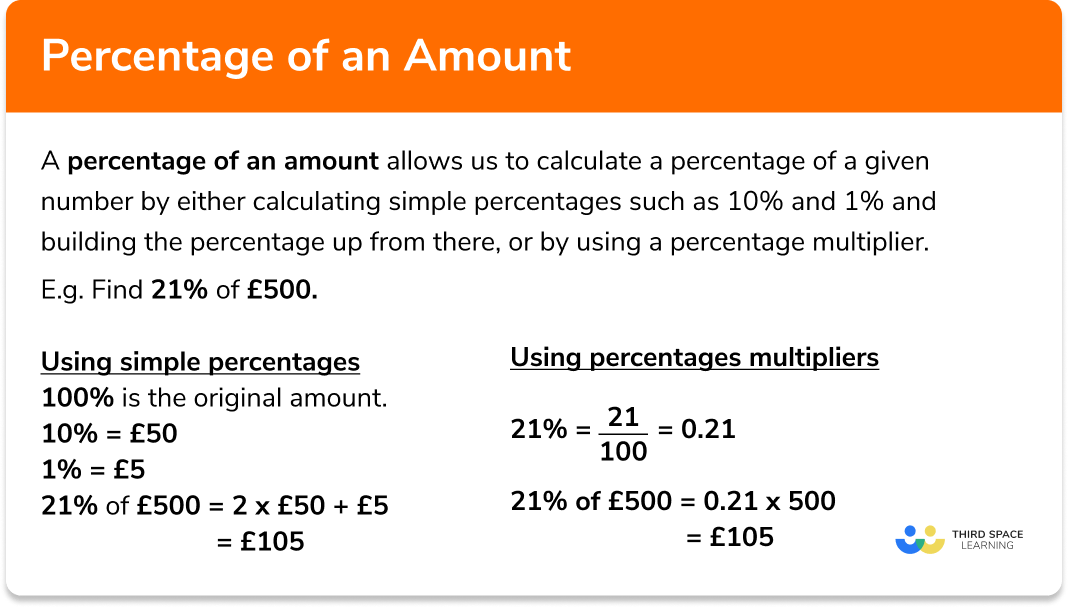
To find the percentage of a number, the most straightforward method is to multiply the “whole” by the “percentage” in its decimal form. The standard formula is:
Percentage = (Part / Whole) × 100
Alternatively, if you are trying to find a specific amount based on a known percentage, use:
Amount = Whole × (Percentage / 100)
For example, if you want to set aside 15% of a $4,500 monthly paycheck for savings, you would convert 15% to a decimal (0.15) and multiply: $4,500 × 0.15 = $675. Mastering this simple conversion—moving the decimal point two places to the left—is the quickest way to perform financial math on the fly.
The “Reverse” Percentage: Finding the Original Value
In many financial scenarios, you are given the final amount and the percentage change, but you need to find the original value. This is common when looking at prices after tax or after a market dip.
If a stock is currently worth $120 after a 20% increase, you cannot simply subtract 20% from $120 to find the original price. Instead, you must divide the current value by (1 + the percentage increase).
Calculation: $120 / 1.20 = $100.
Understanding this distinction is vital for accurate financial reporting and personal accounting. It prevents the common error of “circular math” that often leads to budget discrepancies.
Percentages in Personal Finance and Budgeting
Budgeting is essentially an exercise in percentage allocation. Financial experts often suggest that instead of focusing on fixed dollar amounts, individuals should focus on the percentage of their income dedicated to various life categories. This makes your financial plan scalable, whether you earn $30,000 or $300,000 a year.
The 50/30/20 Rule
One of the most popular financial frameworks is the 50/30/20 rule. This strategy dictates that:
- 50% of your income should go to “Needs” (housing, utilities, groceries).
- 30% of your income should go to “Wants” (entertainment, dining out, hobbies).
- 20% of your income should go to “Financial Goals” (debt repayment, savings, investments).
To implement this, you must first calculate your “Whole”—your net (after-tax) income. If your net monthly income is $6,000, calculating these buckets is a matter of simple multiplication:
- $6,000 × 0.50 = $3,000 for needs.
- $6,000 × 0.30 = $1,800 for wants.
- $6,000 × 0.20 = $1,200 for savings.
Calculating Debt-to-Income (DTI) Ratios
When you apply for a mortgage or a car loan, lenders look at your Debt-to-Income (DTI) ratio. This is the percentage of your gross monthly income that goes toward paying debts. To calculate this, you add up all your monthly debt obligations (minimum credit card payments, student loans, car loans) and divide that sum by your gross monthly income.
If your total monthly debt is $1,500 and your gross income is $5,000, your DTI is 30% ($1,500 / $5,000 = 0.30). Lenders typically look for a DTI of 36% or lower. Knowing how to calculate this percentage yourself allows you to assess your “loan-worthiness” before you ever step foot in a bank.
The Role of Percentages in Investing and Wealth Building
In the world of investing, percentages are the primary metric for success. Investors rarely talk about how many dollars they made; they talk about their “return.” This is because percentages allow for the comparison of different asset classes, such as real estate versus stocks.
ROI (Return on Investment) Calculations
Return on Investment (ROI) is the most critical percentage for any investor. It measures the efficiency of an investment or compares the efficiencies of several different investments.
The formula is:
ROI = [(Current Value – Original Value) / Original Value] × 100
Suppose you bought shares of a company for $2,000 and sold them a year later for $2,500.
($2,500 – $2,000) / $2,000 = 0.25.
Multiply by 100 to get a 25% ROI.
Understanding this percentage helps you decide whether your capital is being used effectively or if it would be better served in a different financial vehicle.
Compound Interest and Annual Percentage Yield (APY)
When saving money, the percentage that matters most is the Annual Percentage Yield (APY). Unlike a simple interest rate, the APY reflects the effect of compounding—the process where you earn interest on your interest.
If you have $10,000 in a high-yield savings account with a 4% APY compounded monthly, you aren’t just earning 4% on the $10,000 once a year. Each month, the 1/12th of that 4% is added to your balance, and the next month’s interest is calculated on that new, slightly larger “Whole.” Over long periods, even a 1% difference in interest rates can result in tens of thousands of dollars in difference due to the power of compounding percentages.
Navigating Taxes and Discounts
Real-world financial literacy often comes down to how well you can handle percentages during transactions. Taxes and discounts are the two most common ways percentages interact with our daily spending.
Sales Tax and Effective Tax Rates
Sales tax is a percentage added to the cost of goods and services. If you buy a laptop for $1,000 in a city with an 8.5% sales tax, the calculation is $1,000 × 0.085 = $85. Your total cost is $1,085.
On a broader scale, understanding your Effective Tax Rate is crucial for wealth management. Your “tax bracket” (marginal rate) only applies to the last dollar you earned. Your effective tax rate is the actual percentage of your total income that goes to the IRS.
Effective Tax Rate = (Total Tax Paid / Total Taxable Income) × 100.
Knowing this number is the first step in tax planning and determining how much you need to earn to maintain your lifestyle.
Evaluating Discounts and Sales
Retailers often use percentages to lure customers, but not all discounts are created equal. A “20% off” sale followed by an “additional 10% off the sale price” is not the same as a flat 30% discount.
If an item is $100:
- 30% off = $70.
- 20% off ($80), then 10% off that $80 ($8) = $72.
By understanding how to calculate percentages of a number in sequence, you become a more disciplined consumer, less susceptible to marketing tactics that make deals look better than they actually are.
Advanced Financial Tools and Automation
While mental math is a great asset, professional-grade financial management requires precision and automation. Whether you are managing a small business or a complex personal portfolio, using tools to handle percentage calculations can reduce human error and save time.
Using Spreadsheets for Complex Calculations
Microsoft Excel and Google Sheets are the gold standards for financial percentage calculations. They allow you to build dynamic models that update automatically.
In a spreadsheet, to find what percentage one number is of another, you would use the formula =A1/B1 and then click the “Percent Style” button. To calculate a 5% increase in a budget line item, you would use =A1*1.05. These tools are essential for “What-If” analysis—for example, “What if my expenses increase by 10%? How will that affect my 20% savings goal?”
The Importance of Precision in Business Finance
For entrepreneurs and business owners, percentages dictate the health of the company. Gross Margin Percentage (Total Revenue minus Cost of Goods Sold, divided by Total Revenue) tells you how much of every dollar of sales you keep to cover operating costs.
A 2% shift in margins might seem negligible to a layperson, but in a business with $1 million in revenue, that 2% represents $20,000 in pure profit. High-level financial management relies on the obsessive tracking of these percentage-based KPIs (Key Performance Indicators) to ensure long-term sustainability.

Conclusion
Figuring out the percentage of a number is more than just a math problem; it is a foundational skill for financial freedom. By mastering the ability to calculate ratios, returns, and allocations, you move from a passive observer of your money to an active manager of your wealth. Whether you are balancing a checkbook, negotiating a raise, or analyzing a stock market trend, the math of percentages provides the clarity needed to navigate the complexities of the modern financial world.
aViewFromTheCave is a participant in the Amazon Services LLC Associates Program, an affiliate advertising program designed to provide a means for sites to earn advertising fees by advertising and linking to Amazon.com. Amazon, the Amazon logo, AmazonSupply, and the AmazonSupply logo are trademarks of Amazon.com, Inc. or its affiliates. As an Amazon Associate we earn affiliate commissions from qualifying purchases.