
For the uninitiated, the stock market can seem like a chaotic, 24-hour whirlwind of numbers and flashing lights. However, for the seasoned investor, the market is defined by a rigid schedule—a rhythmic pulse that dictates when wealth is created, when risks are mitigated, and when the global financial gears come to a grinding halt. Understanding exactly when the stock market closes is not merely a matter of checking a clock; it is a fundamental pillar of strategic personal finance and professional trading.
The “closing bell” is one of the most iconic sounds in the financial world, signaling the end of the standard trading day. Yet, in our hyper-connected digital era, the definition of “closed” has become increasingly nuanced. This guide explores the intricate timing of global exchanges, the mechanics of extended hours, and the strategic implications of the market’s daily lifecycle.
The Global Financial Heartbeat: Standard Trading Hours and Regional Variations
The primary structure of the financial world is built around “regular trading hours.” For the majority of retail investors in the United States, the window of opportunity is narrow and specific.
The New York Stock Exchange (NYSE) and NASDAQ Standards
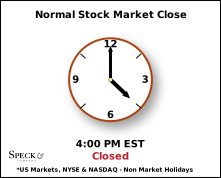
In the United States, the two largest exchanges—the NYSE and the NASDAQ—operate on a synchronized schedule. They open at 9:30 AM Eastern Time (ET) and officially close at 4:00 PM ET. This six-and-a-half-hour window is when the vast majority of trading volume occurs. These hours were originally designed to accommodate the physical presence of floor traders and the logistical needs of banking institutions. Even in an age of high-frequency algorithms, this window remains the gold standard for liquidity, meaning it is the time when it is easiest to buy or sell a stock without significantly affecting its price.
International Market Windows: London, Tokyo, and Beyond
Money never truly sleeps, but it does relocate. As the sun sets on the American markets, other global hubs are either winding down or preparing to open. The London Stock Exchange (LSE), a cornerstone of European finance, typically operates from 8:00 AM to 4:30 PM GMT. Meanwhile, in Asia, the Tokyo Stock Exchange (TSE) runs from 9:00 AM to 3:00 PM JST, famously including a “lunch break” where trading pauses entirely for an hour—a stark contrast to the continuous flow of Western markets. Understanding these international overlaps is crucial for investors dealing with multinational corporations or foreign ETFs.
Time Zone Management for Global Investors
For an investor based in California, the market “closes” at 1:00 PM local time. For someone in Dubai, it might be late in the evening. This geographical disparity creates a “24-hour news cycle” impact on a market that is only open for a fraction of that time. Successful money management requires an acute awareness of these time zones to ensure that orders are placed when liquidity is highest and spreads (the difference between buying and selling prices) are lowest.
Beyond the Closing Bell: The Mechanics of Pre-Market and After-Hours Trading
While the official closing bell rings at 4:00 PM ET, the digital infrastructure of modern finance allows for “extended-hours trading.” This period is divided into the pre-market session and the after-hours session.
The Risks and Rewards of Extended Hours
After-hours trading typically runs from 4:00 PM to 8:00 PM ET. During this time, trading is conducted through Electronic Communication Networks (ECNs) that match buyers and sellers directly without a central exchange floor. The primary “reward” here is the ability to react instantly to news—such as a major company’s quarterly earnings report or a sudden geopolitical event. However, the “risk” is substantial. Because fewer people are trading, the market is “thin,” which can lead to extreme price swings that do not necessarily reflect the stock’s value when the market reopens the following morning.
Volatility and Liquidity Outside the Main Session
In the standard 9:30 AM to 4:00 PM window, millions of shares change hands, creating a “cushion” of liquidity. Once the market closes, this cushion vanishes. A large sell order that might go unnoticed at 2:00 PM could cause a stock’s price to crater at 6:00 PM. For the average personal finance enthusiast, trading after the close is often discouraged because the “bid-ask spread” widens significantly, meaning you often pay more to buy and receive less to sell than you would during regular hours.
Who Participates in Post-Close Sessions?
Historically, after-hours trading was the playground of institutional investors, hedge funds, and high-net-worth individuals. Today, most major retail brokerages allow individual investors to participate. However, participation requires a different mindset. It is less about long-term wealth building and more about tactical positioning. If a company you own shares in announces a massive scandal at 4:05 PM, the after-hours market is your only venue to exit your position before the “gap down” occurs at the next morning’s open.
When the Doors Stay Shut: Market Holidays and Weekend Closures
Just as important as knowing when the market closes daily is knowing which days it doesn’t open at all. The stock market follows a specific calendar that often aligns with federal holidays but includes its own unique traditions.
The Standard US Exchange Holiday Calendar
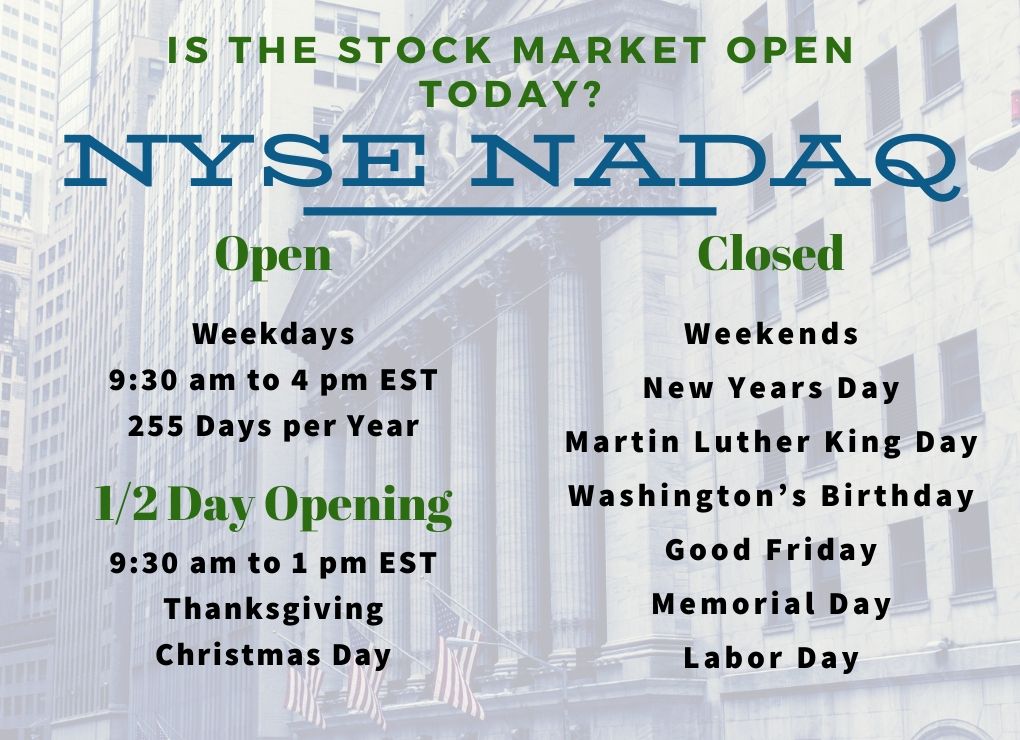
In the United States, the market is closed on Saturdays and Sundays. Additionally, there are several observed holidays where the NYSE and NASDAQ shut down entirely. These include New Year’s Day, Martin Luther King Jr. Day, Washington’s Birthday (Presidents’ Day), Good Friday, Memorial Day, Juneteenth, Independence Day, Labor Day, Thanksgiving, and Christmas. For an investor, these closures represent “blind spots” where news can accumulate without a venue for price discovery.
Early Closures: The “Half-Day” Phenomenon
There are specific days in the financial calendar where the market closes early, usually at 1:00 PM ET. The most common examples are the day after Thanksgiving (Black Friday) and Christmas Eve (if it falls on a weekday). These shortened sessions are notorious for low volume. Many professional traders take these days off, leading to “drifting” markets where prices may move on very little fundamental news.
How to Prepare Your Portfolio for Long Weekends
Long holiday weekends present a unique risk known as “weekend risk.” Significant global events—elections, natural disasters, or major policy shifts—often happen when the markets are closed. Because you cannot trade out of a position on a Sunday afternoon, you are “locked in” until Monday morning (or Tuesday, if it’s a holiday). Savvy investors often reduce their leverage or tighten their stop-loss orders on Friday afternoons to account for the uncertainty of the days when the market is closed.
Strategic Trading: How the Market Close Impacts Your Investment Decisions
The final minutes of the trading day are often the most intense. This period, known as the “closing auction,” is a sophisticated process that determines the official “closing price” of a security—a number that will be recorded in history books and used to value trillions of dollars in mutual funds.
The “Closing Auction”: Determining the Final Price
As 4:00 PM ET approaches, the exchanges run a specialized software algorithm to match as many buy and sell orders as possible at a single price point. This is called the Closing Cross. Many institutional investors, such as pension funds and index funds, prefer to execute their trades exactly at the close to ensure they receive the benchmark price. This concentration of volume makes the closing minutes a period of high efficiency but also high pressure.
Why the Last Hour of Trading is Often the Most Volatile
Known as the “Power Hour” (3:00 PM to 4:00 PM ET), the final hour of trading often sees a surge in activity. Day traders are closing out their positions to avoid “overnight risk,” while institutional managers are rebalancing portfolios. This tug-of-war between different types of market participants creates significant price movements. For a long-term investor, the “close” is often a better time to evaluate a stock’s performance than the “open,” as the closing price represents the market’s final consensus after digesting the day’s news.
Overnight Risks and News Cycles
The moment the market closes, a new phase of risk begins. Most companies deliberately wait until after 4:00 PM ET to release earnings reports or announce mergers. They do this to give investors time to read the full details without reacting impulsively in the middle of a trading session. This “overnight” period is when the most significant price “gaps” occur. If you look at a stock chart and see a price jump from $100 at Monday’s close to $110 at Tuesday’s open, that $10 gain happened while the market was technically closed.
In conclusion, knowing “when the stock market closes” is the baseline for financial literacy. However, understanding the mechanics of that closure—the transition from high-liquidity regular hours to the volatile extended sessions, and the strategic importance of the closing auction—is what separates a casual observer from a successful investor. By mastering the clock, you gain the ability to navigate volatility, exploit liquidity, and protect your capital from the uncertainties of the hours when the world’s great exchanges go dark.
aViewFromTheCave is a participant in the Amazon Services LLC Associates Program, an affiliate advertising program designed to provide a means for sites to earn advertising fees by advertising and linking to Amazon.com. Amazon, the Amazon logo, AmazonSupply, and the AmazonSupply logo are trademarks of Amazon.com, Inc. or its affiliates. As an Amazon Associate we earn affiliate commissions from qualifying purchases.