
In the world of high-stakes finance, timing is not just a factor—it is the foundation upon which successful strategies are built. For investors, day traders, and institutional managers alike, the question of “when do US markets open” is the pulse of the global economy. The United States stock market represents the largest concentration of capital in the world, and its operating hours dictate the rhythm of international trade, influence global currency valuations, and determine the window of opportunity for millions of portfolios.
Understanding the schedule of the U.S. markets requires more than just knowing the time the opening bell rings. It involves a deep dive into the nuances of pre-market sessions, after-hours trading, holiday schedules, and the strategic implications of trading at different points throughout the day. Whether you are a retail investor managing a retirement account or a seasoned trader looking for liquidity, mastering the market clock is essential for navigating the complexities of modern finance.
The Foundation: Standard Trading Hours for Major US Exchanges
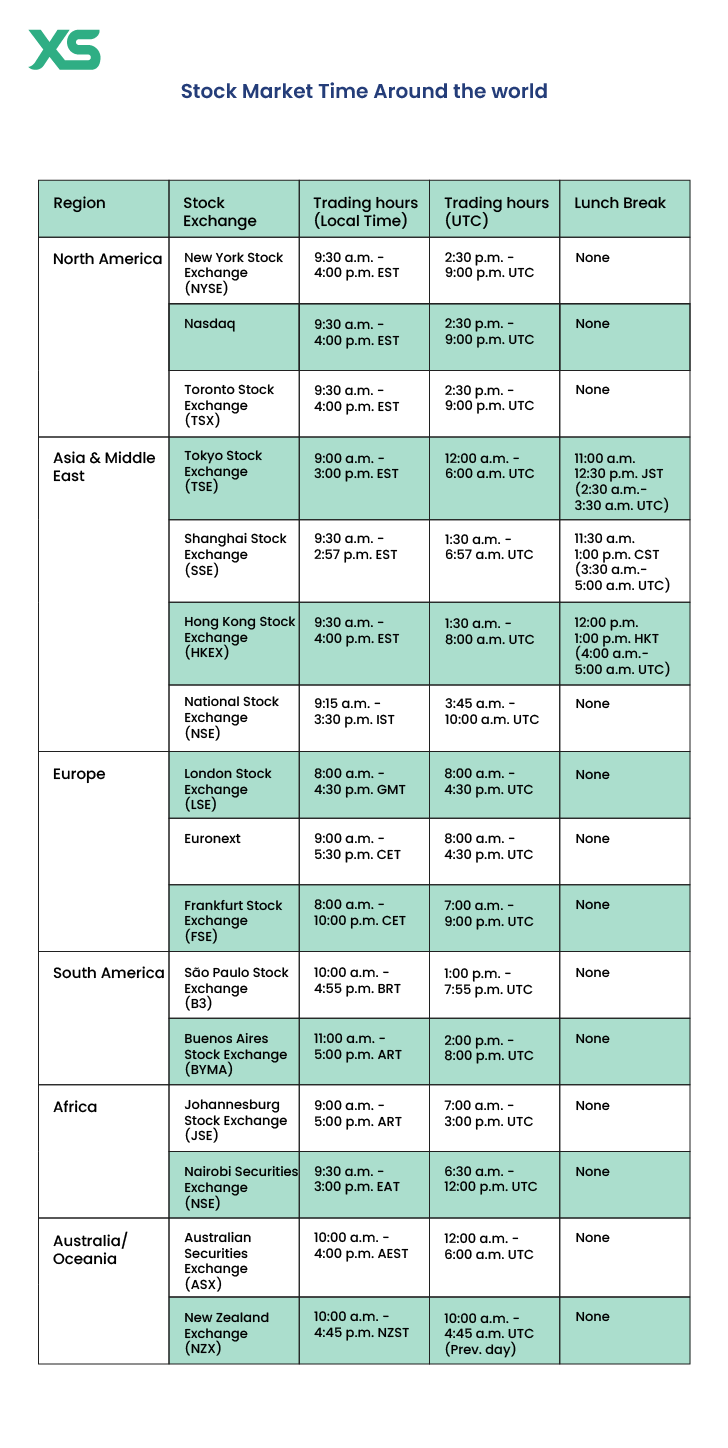
The core of the American financial system revolves around its two primary exchanges: the New York Stock Exchange (NYSE) and the NASDAQ. While they operate with different historical backgrounds and listing requirements, they share a synchronized schedule designed to maximize liquidity and provide a stable environment for price discovery.
The Opening Bell: 9:30 AM ET
The official start of the US trading day occurs at 9:30 AM Eastern Time (ET). This is the moment when the “Opening Cross” occurs on the NASDAQ and the “Opening Auction” takes place on the NYSE. During these first few minutes, the market processes a massive influx of orders that have accumulated overnight, leading to high volatility and significant price movements. For many institutional investors, the opening bell is the most critical time of day, as it sets the tone for the session’s momentum.
The Closing Bell: 4:00 PM ET
The trading day concludes at 4:00 PM ET. Similar to the opening, the final minutes of the day—often referred to as the “Closing Auction”—see a surge in volume as mutual funds and ETFs rebalance their holdings to match their benchmarks. The closing price is of paramount importance as it serves as the official record for daily gains or losses and is used to calculate the Net Asset Value (NAV) of thousands of investment funds worldwide.
Time Zone Considerations for Global Investors
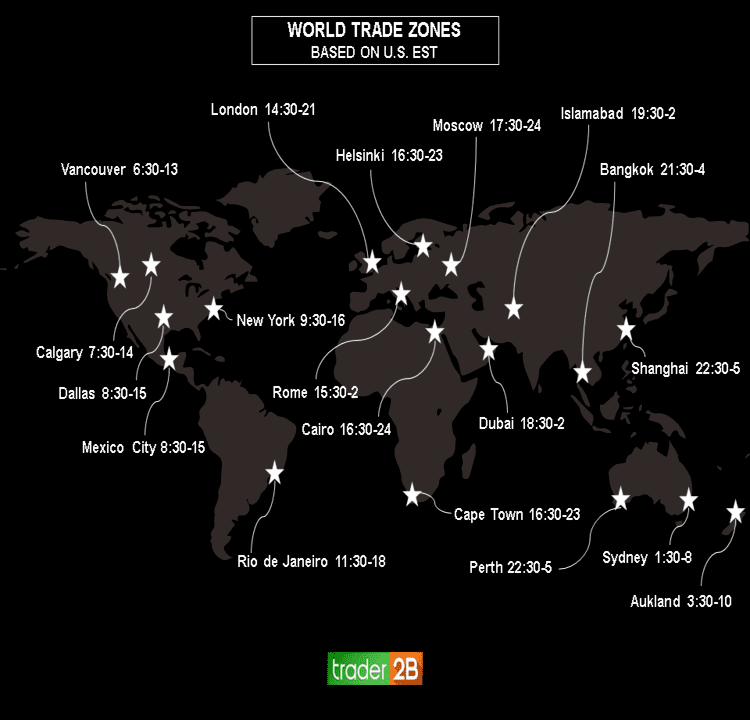
While the markets operate on Eastern Time, the global nature of finance means participants are logging in from London, Tokyo, and San Francisco. It is vital for international investors to account for Daylight Savings Time changes, which may occur at different times in the U.S. compared to Europe or Asia. For a trader in London, the US market opens at 2:30 PM GMT; for a trader in Hong Kong, it opens late in the evening. Keeping a synchronized global clock is the first step in avoiding costly execution errors.
The Extended Sessions: Pre-Market and After-Hours Trading
In the digital age, the concept of a “closed” market is somewhat of a misnomer. While the floor of the NYSE might be quiet, electronic communication networks (ECNs) allow for trading long before the opening bell and well after the closing bell. These extended sessions offer opportunities but come with heightened risks that every money-manager must understand.
The Mechanics of Pre-Market Trading
Pre-market trading in the US typically begins as early as 4:00 AM ET and runs until the official open at 9:30 AM ET. However, the bulk of the volume usually appears after 8:00 AM ET. Pre-market sessions are often used by traders to react to overnight news, such as international economic data, geopolitical shifts, or early-morning corporate earnings releases. Because fewer participants are active, price movements can be exaggerated, providing a “preview” of how the stock might perform during regular hours.
Navigating After-Hours Sessions
After-hours trading begins immediately at 4:00 PM ET and can last until 8:00 PM ET. This session is primarily driven by corporate earnings reports, which are almost always released after the market closes to prevent extreme volatility during the regular session. If a major tech giant misses its revenue targets at 4:15 PM, the after-hours market allows investors to exit positions or hedge their bets immediately rather than waiting for the next morning.
Risks: Liquidity and Volatility
The most significant danger of extended-hours trading is the lack of liquidity. During the regular session, thousands of market makers ensure that buy and sell orders are matched efficiently with narrow “bid-ask spreads.” In the pre-market and after-hours, the spread—the difference between the highest price a buyer will pay and the lowest price a seller will accept—can widen significantly. This means an investor might end up buying at a much higher price or selling at a much lower price than intended. Furthermore, many brokerage firms require the use of “limit orders” during these times to protect clients from sudden, irrational price swings.
Strategic Trading Windows: When Is the Best Time to Trade?
Experienced investors know that not all hours of the trading day are created equal. The market exhibits different “personalities” at different times, and aligning your strategy with these windows can significantly impact your returns.
The Morning Volatility Window (9:30 AM – 10:30 AM)
The first hour of trading is often the most volatile. This is when “amateur” retail orders meet institutional “smart money.” It is a period characterized by high volume and rapid price discovery. Momentum traders thrive in this window, looking for stocks that are breaking out of their overnight ranges. However, for conservative long-term investors, this is often a time to wait and watch, as prices can be erratic before settling into a trend.
The Mid-Day Lull (12:00 PM – 2:00 PM)
As the lunch hour hits New York, trading volume typically thins out. Institutional traders often step away, and the market enters a period of consolidation. During this time, price movements are often “noise” rather than meaningful shifts in value. It is generally considered a poor time to execute large trades, as the lack of volume can lead to slippage. However, for those looking to enter a position with minimal interference, the stability of the mid-day period can be an advantage.
The “Power Hour” (3:00 PM – 4:00 PM)
The final hour of the trading day is known as the “Power Hour.” Volatility and volume surge again as traders close out intraday positions and institutional managers move large blocks of stock to prepare for the close. This period often sees the “true” direction of the day revealed. If a market has been trending upward all day and finishes strong in the Power Hour, it is often seen as a bullish signal for the following day.
Beyond Equities: Bond Markets and Futures
While the stock market has rigid hours, other financial instruments operate on different schedules, often providing leading indicators for what the equity markets will do when they open.
The 24-Hour Futures Cycle
US Stock Futures (such as the S&P 500 E-minis) trade almost 24 hours a day, five days a week. They open on Sunday evening at 6:00 PM ET and trade continuously until Friday afternoon. Because futures track the expected value of the market, they are the best tool for seeing how global events—like a bank failure in Europe or a stimulus announcement in China—will affect the US opening. If “the futures are red,” it means the market is expected to open lower than the previous day’s close.
The Bond Market Schedule
The US Treasury market is the backbone of global interest rates. While it generally follows a schedule similar to the NYSE (8:00 AM to 5:00 PM ET), it is governed by SIFMA (Securities Industry and Financial Markets Association). The bond market often closes early or remains shut on certain holidays when the stock market stays open (such as Columbus Day or Veterans Day). Monitoring the bond market is crucial for equity investors because rising yields often put downward pressure on stock valuations.
Market Holidays and Scheduled Breaks
Success in finance requires planning, and that includes knowing when the doors are locked. The US markets follow a specific holiday schedule where trading is either completely halted or shortened.
Federal Holidays and Closures
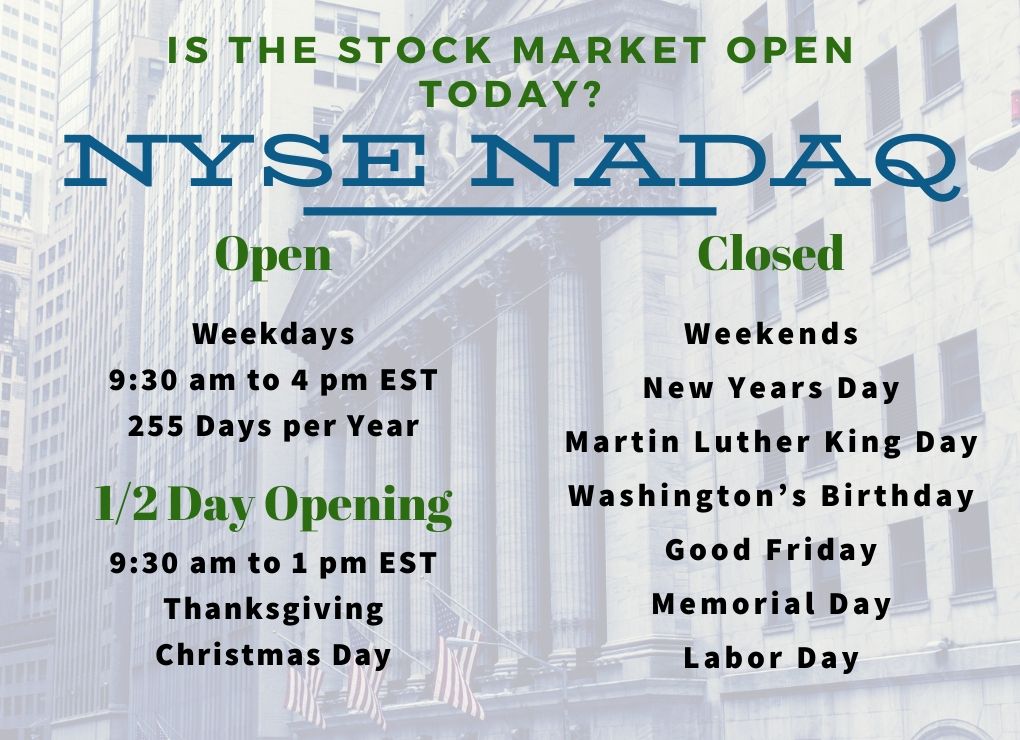
The NYSE and NASDAQ close for several major US holidays, including:
- New Year’s Day
- Martin Luther King Jr. Day
- Presidents’ Day
- Good Friday (a religious holiday where the market closes, though the government remains open)
- Memorial Day
- Juneteenth National Independence Day
- Independence Day (July 4th)
- Labor Day
- Thanksgiving Day
- Christmas Day
Early Closures and Half-Days
There are specific days when the market closes early, typically at 1:00 PM ET. These usually occur on the day after Thanksgiving (Black Friday) and sometimes on Christmas Eve or July 3rd, depending on what day of the week the holiday falls. Trading volume on these days is notoriously thin, and professional traders often refer to these as “skeleton crew” days. While the markets are open, the lack of participation means that even small trades can move prices disproportionately.
Conclusion: Integrating Timing into Your Financial Strategy
The question “when do US markets open” is the gateway to a much deeper understanding of financial mechanics. For the modern investor, the market is no longer a simple 9-to-5 operation. It is a continuous, global ecosystem that breathes through various sessions, from the quiet pre-dawn hours of electronic trading to the frenetic energy of the Power Hour.
To manage money effectively, one must respect these cycles. Whether you are seeking the high-octane volatility of the 9:30 AM open or the calculated stability of the mid-day session, your success depends on your ability to synchronize your actions with the market’s clock. By mastering the schedule of the US exchanges, understanding the nuances of extended trading, and planning for holiday closures, you position yourself to trade with confidence and precision in the world’s most influential financial arena.
aViewFromTheCave is a participant in the Amazon Services LLC Associates Program, an affiliate advertising program designed to provide a means for sites to earn advertising fees by advertising and linking to Amazon.com. Amazon, the Amazon logo, AmazonSupply, and the AmazonSupply logo are trademarks of Amazon.com, Inc. or its affiliates. As an Amazon Associate we earn affiliate commissions from qualifying purchases.