
The sight of a $29 cross-country flight often triggers a mixture of disbelief and skepticism. In an era where inflation has driven the cost of living to historic highs, Spirit Airlines remains a persistent outlier, offering fares that seem to defy the laws of aviation economics. However, Spirit’s pricing is not the result of charity or luck; it is a masterclass in the “Ultra-Low-Cost Carrier” (ULCC) business model.
To understand why Spirit flights are so cheap, one must look past the yellow livery and into the company’s rigorous financial architecture. By unbundling services, maximizing asset utilization, and maintaining a fanatical focus on unit costs, Spirit has engineered a business finance strategy that prioritizes volume and efficiency over traditional luxury.
The Unit Cost Advantage: Operating with Surgical Precision
The foundation of Spirit’s low-cost leadership lies in its Cost per Available Seat Mile (CASM). In the airline industry, CASM is the gold standard for measuring efficiency—it represents how much it costs the company to fly one seat one mile. Spirit consistently maintains one of the lowest CASMs in the global aviation industry through several strategic financial decisions.
Single-Fleet Type Strategy
One of the most significant cost-saving measures in Spirit’s portfolio is its commitment to a single aircraft family: the Airbus A320. From a financial perspective, this is a stroke of genius. By operating only one type of aircraft, Spirit drastically reduces its capital expenditures and operational overhead.
Maintenance crews only need to be trained on one set of engines and airframes, which reduces labor training costs. Furthermore, the airline doesn’t need to stock a diverse inventory of spare parts, which minimizes tied-up capital in warehouses. Pilots and flight attendants also hold a single type of certification, allowing for seamless scheduling and higher crew productivity. This uniformity ensures that a mechanical issue with one plane doesn’t require a specialized replacement, keeping the schedule fluid and costs predictable.
High-Density Seating and Revenue Per Square Foot
In real estate, profitability is often measured by revenue per square foot. Spirit applies this same financial logic to its cabins. By utilizing “slimline” seats that do not recline and removing heavy amenities like seatback entertainment screens and Wi-Fi hardware, Spirit can fit significantly more passengers onto each aircraft than “legacy” carriers like Delta or United.
While this reduces legroom, it fundamentally changes the break-even math of a flight. If a competitor fits 150 people on a plane and Spirit fits 182, Spirit can charge significantly less per person while still generating the same total revenue for the flight. This high-density configuration allows the airline to spread the fixed costs of fuel, landing fees, and pilot salaries across a larger pool of paying customers.
Ancillary Revenue: The “Unbundled” Profit Engine
The most misunderstood aspect of Spirit’s financial model is the “Bare Fare.” To the consumer, it looks like a cheap ticket. To the business analyst, it is the entry point into a sophisticated retail ecosystem known as ancillary revenue.
Redefining the Base Fare
Spirit views the seat itself as a “loss leader” or a low-margin product designed to capture the customer. The real profit margins are found in the “unbundled” extras. By stripping away everything from the base price—including carry-on bags, seat assignments, and even water—Spirit lowers the barrier to entry. This ensures their flights appear at the top of search results on travel meta-search engines, which rank primarily by price.
From a financial management perspective, this unbundling allows Spirit to tax specific behaviors rather than charging every passenger for services they might not use. A passenger traveling with only a small personal item essentially receives a “discount” for their lack of baggage, while a passenger with three suitcases subsidizes the low base fare of others.
The Psychology of Optional Add-ons
Ancillary revenue is remarkably resilient and often carries higher margins than the flight itself. In recent fiscal years, Spirit’s non-ticket revenue has often accounted for nearly half of its total operating revenue. This includes fees for “Big Front Seats,” early boarding, and onboard snacks.
Because these fees are processed digitally and require minimal physical overhead, they represent a highly efficient cash flow stream. This diversified income model protects the airline’s bottom line during periods of high fuel prices, as the margins on a $50 bag fee remain constant even if the cost of jet fuel spikes.
Operational Efficiency and Asset Utilization
Time is money in any business, but in aviation, a plane only generates revenue when it is in the air. Spirit’s financial success is deeply tied to its ability to keep its “metal” moving.
High Aircraft Utilization Rates
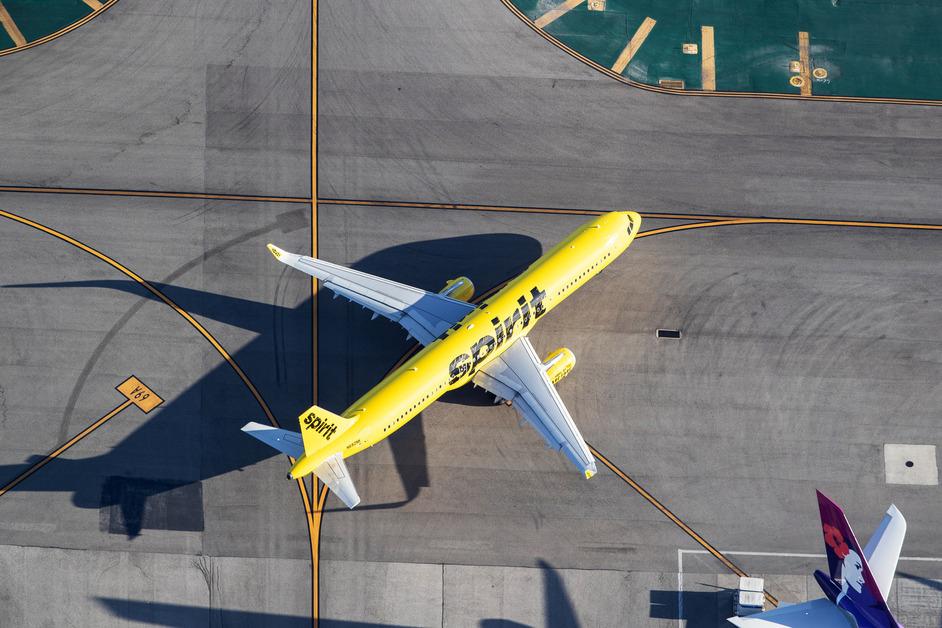
Spirit’s planes spend more hours per day in the air than almost any other airline. While legacy carriers often leave planes at gates overnight or during mid-day lulls to accommodate business traveler schedules, Spirit optimizes its schedule for maximum utilization.
By flying more frequently—often at less desirable times like late at night (red-eyes) or very early in the morning—Spirit spreads the massive fixed costs of owning or leasing an aircraft over more flight hours. This reduces the “fixed cost per flight,” allowing for lower ticket prices while maintaining profitability.
Point-to-Point vs. Hub-and-Spoke
Most major airlines operate on a “hub-and-spoke” model, where passengers are funneled from small cities into a central hub (like Atlanta or Chicago) before being sent to their final destination. This model is expensive; it requires massive ground operations at hubs, complex baggage transfer systems, and long “turn times” where planes sit idle waiting for connecting passengers.
Spirit utilizes a “point-to-point” model. They fly directly between high-demand cities, often utilizing secondary airports where landing fees are lower. This minimizes the time a plane spends on the ground. A Spirit plane can often “turn” (land, deplane, clean, board, and take off) in under 45 minutes. This speed allows them to squeeze an extra flight or two into every day compared to a traditional airline.
Strategic Financial Positioning and Growth
Beyond the day-to-day operations, Spirit’s long-term financial strategy involves aggressive cost-containment regarding its debt and capital investments.
Fleet Age and Fuel Efficiency
Spirit operates one of the youngest fleets in the United States. While buying new planes requires significant capital expenditure (CapEx), it is a calculated financial move to lower operating expenses (OpEx). New planes are significantly more fuel-efficient than older models. Given that fuel is typically an airline’s largest or second-largest expense, a 15% improvement in fuel burn across a fleet of 200+ aircraft translates to hundreds of millions of dollars in annual savings.
Furthermore, younger planes require less frequent and less intensive maintenance, reducing the “AOG” (Aircraft on Ground) time that drains revenue. The financial trade-off—high upfront investment for drastically lower recurring costs—is a cornerstone of Spirit’s low-fare capability.
Navigating Economic Volatility
The ULCC model is uniquely positioned to handle economic downturns. During a recession, corporate travel budgets are slashed, and leisure travelers become hyper-sensitive to price. While premium airlines struggle to fill their expensive business-class cabins, Spirit often sees a surge in “trade-down” customers—travelers who previously flew legacy carriers but are now forced to prioritize the bottom line.
This creates a “sticky” customer base. Once a flyer realizes they can get from Point A to Point B for a fraction of the cost, the value proposition of the legacy carrier becomes harder to justify for short-haul flights. Spirit’s ability to remain the “low-price leader” acts as a competitive moat, making it difficult for new entrants to undercut them without matching their extreme operational efficiencies.
Conclusion: The Bottom Line on Cheap Fares
The “cheapness” of a Spirit flight is not an indicator of a struggling business; rather, it is the visible result of a highly disciplined financial machine. By stripping the aviation experience down to its bare essentials, Spirit has created a product that perfectly serves the price-sensitive segment of the market.
Through the strategic use of a unified fleet, the aggressive pursuit of ancillary revenue, and a point-to-point operational model that maximizes aircraft utilization, Spirit has redefined the economics of flight. They have proven that in the modern economy, transparency in pricing—letting the customer pay only for what they value—is a powerful tool for driving volume and maintaining a competitive edge in one of the world’s most difficult industries. Spirit flights are cheap because the company has systematically removed every cent of “waste” from the process of moving a human being through the sky.
aViewFromTheCave is a participant in the Amazon Services LLC Associates Program, an affiliate advertising program designed to provide a means for sites to earn advertising fees by advertising and linking to Amazon.com. Amazon, the Amazon logo, AmazonSupply, and the AmazonSupply logo are trademarks of Amazon.com, Inc. or its affiliates. As an Amazon Associate we earn affiliate commissions from qualifying purchases.