
The meteoric rise of Super Micro Computer, Inc. (SMCI) has been one of the most compelling narratives in the modern financial markets. As a primary beneficiary of the generative AI boom, the company’s stock price mirrored the exponential demand for high-performance server solutions. However, the old adage “what goes up must come down” has resonated painfully with investors recently. When a high-flyer like SMCI experiences a significant pullback, it isn’t usually due to a single factor, but rather a convergence of valuation concerns, internal governance issues, and shifting macroeconomic tides.

For investors looking to understand why SMCI is down today, it is essential to look past the ticker symbol and examine the underlying financial mechanics that drive institutional and retail selling pressure.
Market Dynamics and the Erosion of the AI Premium
One of the primary reasons for SMCI’s recent downward trajectory is the cooling of the “AI euphoria” that dominated the early parts of the year. Stocks tied to the artificial intelligence infrastructure trade—including Nvidia, AMD, and Super Micro—reached valuations that priced in years of perfect execution. When reality begins to collide with these lofty expectations, even minor setbacks can lead to massive sell-offs.
The Phenomenon of Profit-Taking and Valuation Correction
For much of the past eighteen months, SMCI was the darling of momentum traders. When a stock rises by hundreds of percentage points in a short window, it becomes highly susceptible to profit-taking. Institutional investors, such as hedge funds and mutual funds, often have mandates to rebalance their portfolios when a single position becomes too large. As these large players lock in gains, the increased supply of shares on the market creates downward pressure. Furthermore, from a fundamental valuation perspective, SMCI’s Price-to-Earnings (P/E) ratio had expanded significantly. As the market begins to question whether the company can maintain its historic growth rates, the multiple begins to “compress,” leading to a lower share price even if earnings remain stable.
Sector Rotation and the Shift to Value
Financial markets operate in cycles. For a long period, capital flowed aggressively into growth and technology sectors. Recently, we have seen a “rotation” where investors move money out of high-priced tech stocks and into defensive sectors like utilities, consumer staples, or value-oriented industrial stocks. This shift is often driven by the perception that the tech trade has become “crowded.” When everyone is already “long” on SMCI, there are few buyers left to push the price higher, making the path of least resistance go downward.
Fundamental Headwinds: Margin Compression and Internal Governance
While market sentiment plays a role, the hard numbers and corporate conduct are equally influential. Investors pay a premium for growth, but they also pay for transparency and reliability. Recent developments at SMCI have cast a shadow over both.
The Crisis of Declining Gross Margins
One of the most significant red flags in recent earnings reports has been the compression of gross margins. Super Micro is in a hyper-competitive race to provide the liquid-cooled racks and server architectures required for AI data centers. To capture market share from competitors like Dell and Hewlett Packard Enterprise (HPE), SMCI has had to price aggressively. In the world of investing, rising revenue is good, but if it comes at the expense of profitability, it concerns the “smart money.” When SMCI reported that its margins were thinning, it signaled to investors that the company might lack the “moat” or pricing power necessary to maintain long-term dominance.

Governance Concerns and Financial Reporting Delays
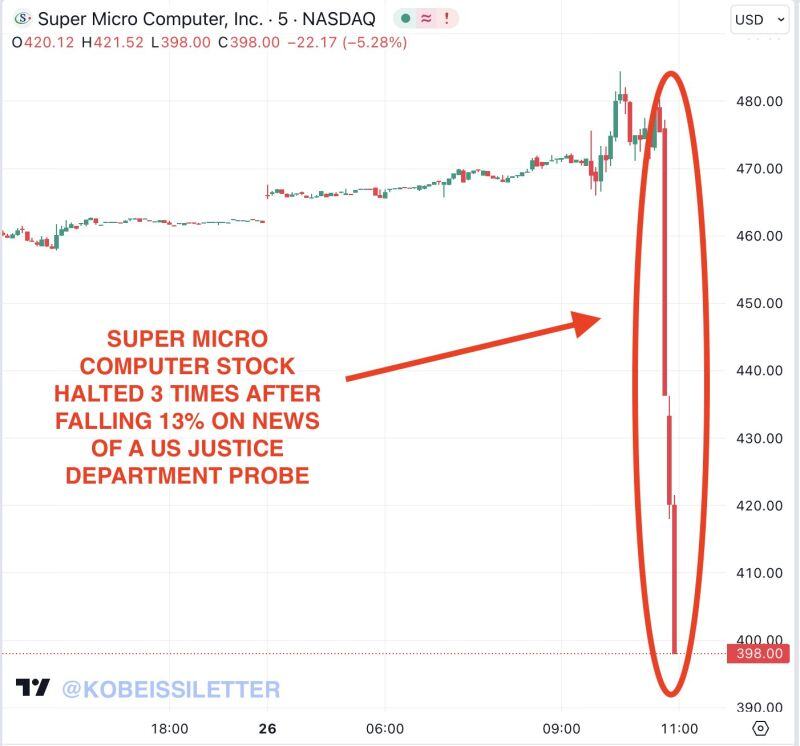
The financial community values stability above all else. SMCI has recently faced scrutiny regarding its internal accounting controls. The delay in filing its annual 10-K report acted as a massive catalyst for the current downturn. In the investing world, a delay in financial filings is often viewed as a “smoke implies fire” scenario. This was compounded by the release of a high-profile short-seller report from Hindenburg Research, which alleged accounting “red flags,” undisclosed related-party transactions, and sanctions evasion. Whether these allegations are fully proven or not, they introduce “headline risk,” causing institutional investors to sell first and ask questions later to protect their capital.
Macroeconomic Pressures and the Cost of Capital
SMCI does not trade in a vacuum. Its performance is heavily influenced by the broader economic environment, particularly interest rates and global liquidity.
Interest Rates and Growth Stock Valuations
As a growth stock, SMCI’s value is largely derived from its projected future cash flows. When interest rates are high, the “discount rate” applied to those future earnings also increases. Mathematically, this makes those future dollars worth less in today’s terms. Whenever the Federal Reserve signals that interest rates might remain “higher for longer” to combat inflation, growth stocks like SMCI typically face a de-rating. The cost of borrowing also impacts SMCI’s customers—big tech companies and data center providers—who may scale back their capital expenditures if financing becomes too expensive.
Supply Chain Fragility and Geopolitical Risks
Investing in hardware companies involves navigating complex global supply chains. SMCI relies heavily on components from manufacturers like Nvidia and various suppliers in Asia. Any disruption in the semiconductor supply chain or escalating trade tensions between the U.S. and China can impact SMCI’s ability to fulfill orders. If investors sense that delivery timelines are slipping or that export controls will limit SMCI’s total addressable market (TAM), they will quickly recalibrate their price targets downward.
Strategic Outlook: Navigating the Volatility
For the individual investor, seeing a position in SMCI decline can be jarring. However, understanding the “why” allows for a more calculated response rather than an emotional one. The stock is currently caught in a tug-of-war between its massive long-term potential in the AI space and short-term operational and reputational hurdles.
The Long-Term Bull Case vs. Short-Term Risks
The bullish argument remains that AI infrastructure is still in its early innings. Data centers need the specific high-density, liquid-cooled solutions that SMCI specializes in. If the company can clear the air regarding its accounting practices and stabilize its margins, it may find a floor. Conversely, the bear case warns that SMCI is becoming a “commodity” hardware seller in a race to the bottom, and that its previous stock price was a bubble driven by hype rather than sustainable earnings.
Risk Management and Portfolio Diversification
The current dip in SMCI serves as a masterclass in the importance of risk management. For those invested in high-volatility tech stocks, diversification is the only “free lunch” in finance. Relying on a single winner in a fast-moving sector exposes an investor to idiosyncratic risks—like the 10-K delay mentioned earlier. Professional traders often use “stop-loss” orders or hedge their positions with options to mitigate the damage when a stock breaks its trend.
In conclusion, SMCI is down today because the market is re-evaluating the company’s worth in the face of thinning profit margins, serious governance questions, and a broader cooling of the AI investment frenzy. While the technology the company produces is vital to the future of computing, the financial markets demand clarity and fiscal discipline. Until Super Micro Computer, Inc. can provide definitive answers to the concerns raised by auditors and analysts, the stock is likely to remain under pressure, serving as a reminder that in the world of money, growth without transparency is a risky proposition.
aViewFromTheCave is a participant in the Amazon Services LLC Associates Program, an affiliate advertising program designed to provide a means for sites to earn advertising fees by advertising and linking to Amazon.com. Amazon, the Amazon logo, AmazonSupply, and the AmazonSupply logo are trademarks of Amazon.com, Inc. or its affiliates. As an Amazon Associate we earn affiliate commissions from qualifying purchases.