
For over a century, the Dow Jones Industrial Average (DJIA) has served as the primary pulse of the American stock market. When news anchors report that “the market is up today,” they are often referring specifically to the movements of this historic index. However, for many novice and even intermediate investors, the underlying structure of the index remains a bit of a mystery. The fundamental question—how many companies are in the Dow?—has a deceptively simple answer: 30.
While the number 30 is fixed, the companies that fill those slots are not. This article provides an exhaustive exploration of why there are 30 companies, how they are selected, and what this specific number tells us about the health of the global economy.

Understanding the Dow Jones Industrial Average (DJIA)
The Dow Jones Industrial Average is the second-oldest stock market index in the United States, trailing only the Dow Jones Transportation Average. Created by Charles Dow and Edward Jones in 1896, it was designed to provide a snapshot of the industrial health of the U.S. economy.
Historical Context: From 12 to 30
When the index first debuted on May 26, 1896, it did not contain 30 companies. Initially, it consisted of just 12 industrial firms, most of which were involved in commodities like sugar, tobacco, oil, and rubber. At that time, General Electric was one of the original members—a spot it held for over a century until its removal in 2018.
As the American economy expanded and diversified, the index needed to grow to remain relevant. In 1916, the index expanded to 20 stocks. Finally, in 1928, it was increased to 30 companies. It has remained at this count for nearly a century, despite the U.S. economy growing exponentially in complexity and size.
Why the Number 30 Matters
In the world of modern statistics, a sample size of 30 is often considered the threshold for “statistical significance.” While 30 companies out of thousands of publicly traded firms may seem small, these 30 are “Blue-Chip” stocks—massive, stable, and highly influential corporations. Because these companies represent such a large portion of the total market capitalization and economic output of the U.S., their collective performance is a reliable proxy for the broader economy.
The Selection Process: How Companies Join the Dow
Unlike the S&P 500, which uses a strictly quantitative formula based on market capitalization, the Dow Jones Industrial Average is a “curated” index. This means that a company cannot simply grow its way into the Dow; it must be selected.
The Role of the Selection Committee
The responsibility for choosing which 30 companies represent the American economy falls to a committee at S&P Dow Jones Indices. This committee consists of the Managing Editor of the Wall Street Journal and several other financial experts. There are no rigid rules for inclusion, but there are strong guidelines. The committee looks for companies with an excellent reputation, demonstrated sustained growth, and interest to a large number of investors.
Criteria for “Blue-Chip” Status
To be one of the 30, a company must be incorporated and headquartered in the United States. It must also generate a significant portion of its revenue from domestic economic activity. The committee avoids “speculative” stocks, preferring firms that have survived multiple market cycles and maintain a leadership position in their respective industries. When a company is removed, it is usually because it has lost its status as a market leader or because its industry is no longer as representative of the total economy as it once was.
Price-Weighting vs. Market Cap Weighting
Perhaps the most unique aspect of the 30 companies in the Dow is how they are weighted. Most indices (like the S&P 500 or Nasdaq) are market-cap weighted, meaning bigger companies have more influence. The Dow, however, is price-weighted.
In a price-weighted index, the stock price per share determines its influence. A company with a $200 stock price will have twice the impact on the index as a company with a $100 stock price, regardless of how many billions of dollars the company is actually worth. This methodology is often criticized by modern economists, but it is maintained to ensure continuity with historical data.
Analyzing the Current 30: A Snapshot of the American Economy

The 30 companies in the Dow today look nothing like the original 12. While the name still includes the word “Industrial,” the index now encompasses everything from cloud computing to healthcare and consumer retail.
Key Sectors Represented
Today’s Dow is a balanced portfolio of the modern economy. It includes:
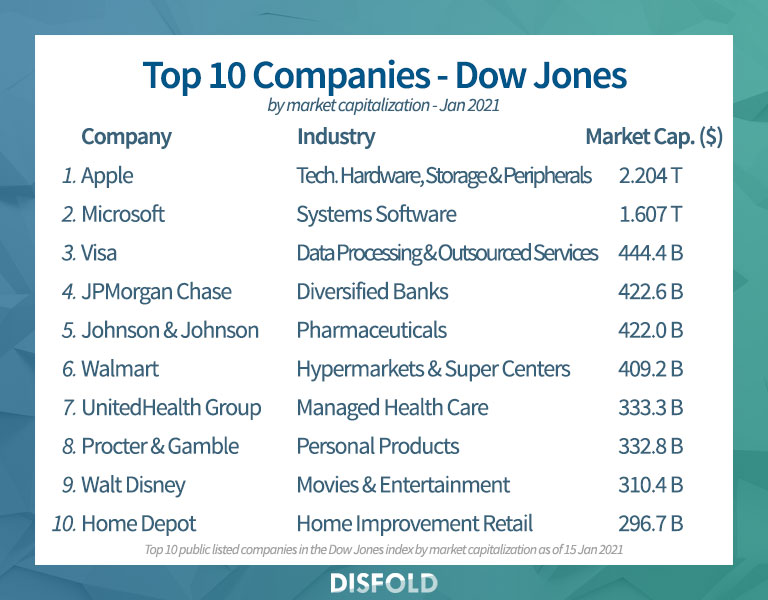
- Information Technology: Giants like Microsoft and Apple represent the digital backbone of the world.
- Healthcare: Companies like UnitedHealth Group and Amgen highlight the importance of medical services and biotechnology.
- Financials: Goldman Sachs and JPMorgan Chase represent the banking sector.
- Consumer Staples and Discretionary: Walmart, Coca-Cola, and McDonald’s reflect the spending habits of the average citizen.
By maintaining 30 companies across these diverse sectors, the Dow provides a “all-weather” look at how business-friendly the current economic environment is.
Recent Changes and Rebalancing
The list of 30 is not static. When a company’s relevance fades, the committee swaps it out. A notable example occurred in 2020 when Salesforce replaced ExxonMobil. This was a symbolic shift, signaling that software and cloud services had become more vital to the U.S. economy than traditional oil and gas. Similarly, Amazon was added to the Dow in early 2024, replacing Walgreens Boots Alliance, reflecting the dominance of e-commerce over traditional retail pharmacies.
The Dow as an Investment Tool
For the individual investor, the “30 companies” of the Dow represent more than just a news headline; they represent a specific philosophy of investing known as “Blue-Chip” investing.
Tracking the Dow via ETFs and Index Funds
Because there are only 30 companies, it is relatively easy for investment firms to create products that track the index perfectly. The most famous of these is the SPDR Dow Jones Industrial Average ETF Trust (Ticker: DIA), often referred to as “Diamonds.” By purchasing shares of this ETF, an investor is effectively buying a fractional share of all 30 companies in the index. This provides instant diversification across the leaders of every major U.S. industry.
Comparing the Dow to the S&P 500 and Nasdaq
While the Dow is the most famous index, it is often compared to the S&P 500 (which tracks 500 companies) and the Nasdaq (which is tech-heavy).
- The Dow (30 stocks): Best for tracking established, dividend-paying “value” stocks.
- The S&P 500: Best for a broad-market view of the 500 largest U.S. firms.
- The Nasdaq: Best for tracking growth and innovation in technology.
Because the Dow only has 30 companies, it tends to be less volatile than the Nasdaq but may offer lower growth potential during “bull markets” compared to the tech-heavy indices. However, during market downturns, the Dow’s 30 blue-chips often prove more resilient.
The Future of the Dow in a Modern Market
As we move further into the 21st century, some critics argue that a 30-company index is an antiquated way to measure a multi-trillion dollar global economy. However, the Dow remains as relevant as ever for several reasons.
Is 30 Companies Enough for Today?
The primary criticism of the Dow is its small sample size. Critics argue that 30 stocks cannot possibly represent the nuances of thousands of public companies. However, the Dow’s 30 components are so large that they are “systemically important.” When Microsoft or JPMorgan Chase moves, the entire market feels the ripple. The 30 companies act as the “generals” of the market; where they lead, the “soldiers” (smaller stocks) eventually follow.
Digital Transformation and Future Inclusions
The Dow will continue to evolve. As AI, renewable energy, and space exploration become larger sectors of the economy, we can expect the 30 companies to change accordingly. The index has survived the transition from the steam engine to the internet, and it will likely survive the transition to an AI-driven economy.
The “30” in the Dow is a number of prestige. For a corporation, being named one of the 30 components of the Dow Jones Industrial Average is the ultimate validation of corporate success. It signifies that the company is no longer just a business, but a fundamental pillar of the American financial system.
In conclusion, while the number 30 is a constant, the entities within that number represent the ever-changing face of capitalism. Whether you are a day trader or a long-term retirement investor, understanding the 30 companies of the Dow is essential for navigating the complex waters of the financial world.
aViewFromTheCave is a participant in the Amazon Services LLC Associates Program, an affiliate advertising program designed to provide a means for sites to earn advertising fees by advertising and linking to Amazon.com. Amazon, the Amazon logo, AmazonSupply, and the AmazonSupply logo are trademarks of Amazon.com, Inc. or its affiliates. As an Amazon Associate we earn affiliate commissions from qualifying purchases.