
In the world of finance, few terms carry as much weight, prestige, and influence as the “S&P 500.” Whether you are a seasoned portfolio manager, a casual retail investor, or someone simply tuning into the nightly business news, you have likely heard this acronym cited as the definitive barometer for the health of the American economy. But for many, the name remains a cryptic piece of financial jargon.
What does S&P 500 stand for, how did it come to exist, and why is it the cornerstone of millions of retirement accounts worldwide? To understand the S&P 500 is to understand the history of the modern stock market and the evolution of passive investing.

The Origin Story: Standard, Poor’s, and the Birth of an Icon
To understand what the S&P 500 stands for, we must look back at the history of financial reporting in the United States. The name “S&P” is a shorthand for Standard & Poor’s, a financial services company that resulted from a merger of two historical entities.
The Legacy of Henry Varnum Poor
The “Poor” in S&P refers to Henry Varnum Poor, a financial analyst who, in 1860, published History of Railroads and Canals in the United States. In an era when the stock market was the “Wild West,” Poor sought to provide investors with reliable, transparent data about the companies they were funding. His motto, “the investor’s right to know,” became the bedrock of financial analysis. His firm, H.V. and H.W. Poor Co., specialized in providing detailed insights into the burgeoning railroad industry, which was the high-tech sector of the 19th century.
The Merger with Standard Statistics
In 1906, the Standard Statistics Bureau was formed, focusing on providing financial information on companies outside of the railroad industry. In 1941, these two giants of financial data merged to form Standard & Poor’s Corp. The goal was simple: to create a centralized, authoritative source of information that would help investors navigate the complexities of the public markets.
The Evolution of the 500
While Standard & Poor’s began tracking stocks as early as 1923, the modern S&P 500 index as we know it today was officially launched on March 4, 1957. Before this, indices were often small and failed to capture the true breadth of the economy. By selecting 500 of the largest and most influential companies in the United States, S&P created a “market-cap-weighted” index that provided a much more accurate reflection of the equity market’s overall performance than the older, price-weighted Dow Jones Industrial Average.
Understanding the Mechanics: How the S&P 500 is Built
The S&P 500 is not merely a list of the 500 largest companies in America. It is a carefully curated index maintained by the S&P Dow Jones Indices. Understanding the mechanics of how companies are selected and how the index is calculated is essential for any serious investor.
Eligibility Requirements for Inclusion
A company does not automatically join the S&P 500 just by becoming large. To be included, a company must meet strict eligibility criteria. First, it must be a U.S. company with a market capitalization of at least $15.8 billion (this threshold is adjusted periodically). Second, the company must be highly liquid, meaning its shares are easily traded. Third, it must have a public float of at least 10% of its shares. Finally, and perhaps most importantly, the company must demonstrate financial viability, defined as having positive earnings over the most recent quarter and the sum of the previous four quarters.
The Float-Adjusted Market Cap Weighting Method
Unlike the Dow Jones, which is weighted by share price, the S&P 500 uses a float-adjusted market capitalization weighting. This means that companies with the highest total market value (share price multiplied by the number of outstanding shares) have the greatest impact on the index’s performance. The “float-adjusted” part means that only shares available to the public are counted, excluding shares held by insiders or government agencies. This ensures that the index reflects the actual tradable value of the market.
Rebalancing and the Selection Committee
The S&P 500 is a living entity. It is rebalanced quarterly to ensure it remains representative of the current economy. A secretive committee at S&P Dow Jones Indices meets regularly to decide which companies should be added or removed. When a company falls into financial distress or its market cap shrinks significantly, it is replaced by a rising star. This “survival of the fittest” mechanism is one reason why the S&P 500 has historically been a robust engine for long-term wealth creation.
The Economic Significance: More Than Just a Number
For the global financial community, the S&P 500 is the ultimate benchmark. It represents approximately 80% of the total value of the U.S. stock market. When people ask, “How did the market do today?” they are almost always looking at the percentage change of the S&P 500.
A Barometer for the U.S. Economy
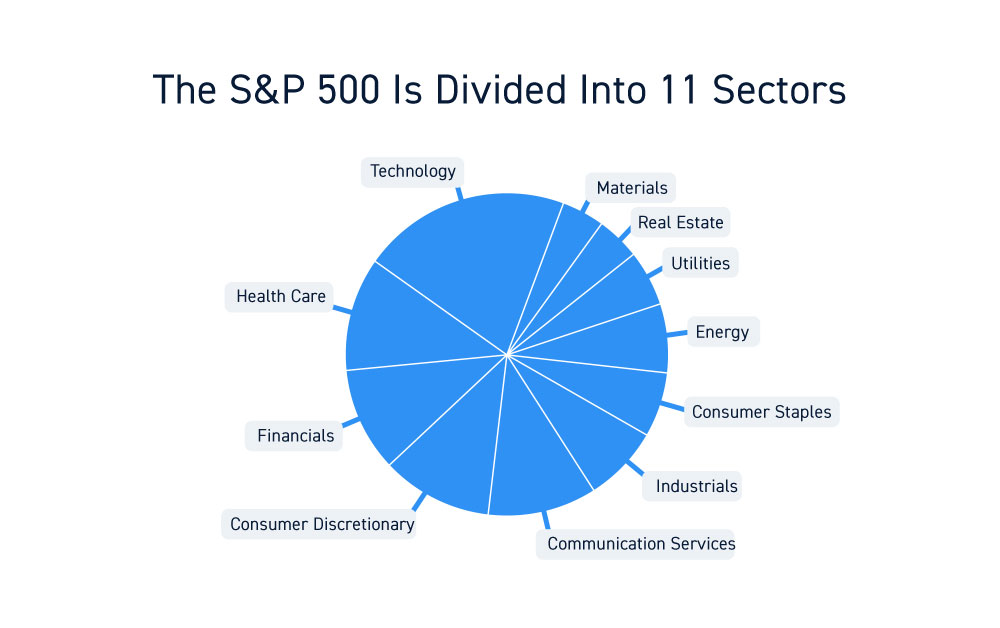
Because the index covers 500 companies across 11 major sectors—including Information Technology, Healthcare, Financials, and Consumer Discretionary—it serves as a proxy for the health of the American corporate landscape. When the S&P 500 is trending upward, it generally indicates investor confidence, corporate profitability, and economic growth. Conversely, a sustained decline, or a “bear market,” often signals an impending recession or systemic economic stress.
Risk Diversification Across 11 Sectors
One of the primary reasons investors flock to the S&P 500 is the inherent diversification it provides. By owning a piece of the index, an investor is not betting on a single company or even a single industry. If the tech sector takes a hit, gains in energy or healthcare might offset the losses. This cross-sector exposure is a fundamental principle of “Money” management, reducing the “idiosyncratic risk” associated with individual stocks.
Historical Performance and Long-term Growth
Historically, the S&P 500 has delivered an average annual return of roughly 10% (before inflation) over long periods. While there are years of significant volatility and loss, the index has a proven track record of recovering and reaching new highs. For individuals practicing long-term personal finance strategies, such as “buy and hold,” the S&P 500 has been the most reliable tool for compounding wealth over decades.
Strategies for Success: Investing in the S&P 500
Knowing what the S&P 500 stands for is the first step; the second is knowing how to use it to achieve your financial goals. You cannot “buy” the S&P 500 directly because it is an index (a mathematical list), but you can invest in funds that track it.
Index Funds vs. ETFs
The most common way to invest in the S&P 500 is through Mutual Funds or Exchange-Traded Funds (ETFs).
- Index Funds: These are managed by firms like Vanguard or Fidelity. They are designed to mirror the performance of the S&P 500 by holding all 500 stocks in the same proportions.
- ETFs: Such as the SPDR S&P 500 ETF Trust (SPY) or the Vanguard S&P 500 ETF (VOO), these trade on an exchange like a regular stock. They are highly liquid and typically have very low expense ratios, making them a favorite for both retail and institutional investors.
The Role of the S&P 500 in a Retirement Portfolio
For many, the S&P 500 is the “core” of their retirement strategy. Whether through a 401(k) or an IRA, consistent contributions into an S&P 500 tracker allow an investor to capture the growth of the American economy. Warren Buffett, one of the most successful investors in history, has famously advocated for the average person to simply invest in a low-cost S&P 500 index fund rather than trying to pick individual stocks.
Understanding the Limitations and Risks
While the S&P 500 is a powerful tool, it is not without risks. It is a “heavy-top” index, meaning the largest companies (like Apple, Microsoft, and Amazon) have a disproportionate influence on its movement. If the “Magnificent Seven” tech stocks struggle, the entire index can drop, even if the other 493 stocks are doing well. Additionally, the S&P 500 is strictly a U.S. index; investors should consider adding international and small-cap exposure to create a truly diversified global portfolio.

Conclusion: The Foundation of Financial Literacy
The S&P 500 stands for more than just “Standard & Poor’s 500.” It stands for a legacy of transparency, a rigorous methodology for measuring value, and the collective might of the American corporate engine. By understanding that it is a market-cap-weighted index designed to represent the broad economy, investors can move away from the noise of daily market fluctuations and focus on long-term wealth building.
Whether you are looking to hedge against inflation, save for retirement, or simply understand the news, the S&P 500 is the most important “Money” metric to master. It remains the gold standard of benchmarks, proving that over the long haul, betting on the collective success of the world’s most innovative companies is one of the smartest financial moves a person can make.
aViewFromTheCave is a participant in the Amazon Services LLC Associates Program, an affiliate advertising program designed to provide a means for sites to earn advertising fees by advertising and linking to Amazon.com. Amazon, the Amazon logo, AmazonSupply, and the AmazonSupply logo are trademarks of Amazon.com, Inc. or its affiliates. As an Amazon Associate we earn affiliate commissions from qualifying purchases.